BUIDL Loops $18.9M Through Morpho, 0.6% Of $3.1B Live
Key Points
- BlackRock’s BUIDL fund holds $3.1 billion in assets under management but only $18.9 million of that capital is actively cycling through DeFi protocols.
- Tokenized assets sit at roughly 10% DeFi-active utilization today, leaving the wrapper, lending, and yield-split layers room to grow as access gates expand.
- DeFi wallets on Ethereum can access BUIDL yield indirectly through OUSG, USDtb, or syrupUSDC and post any of them as collateral on Morpho without KYC.
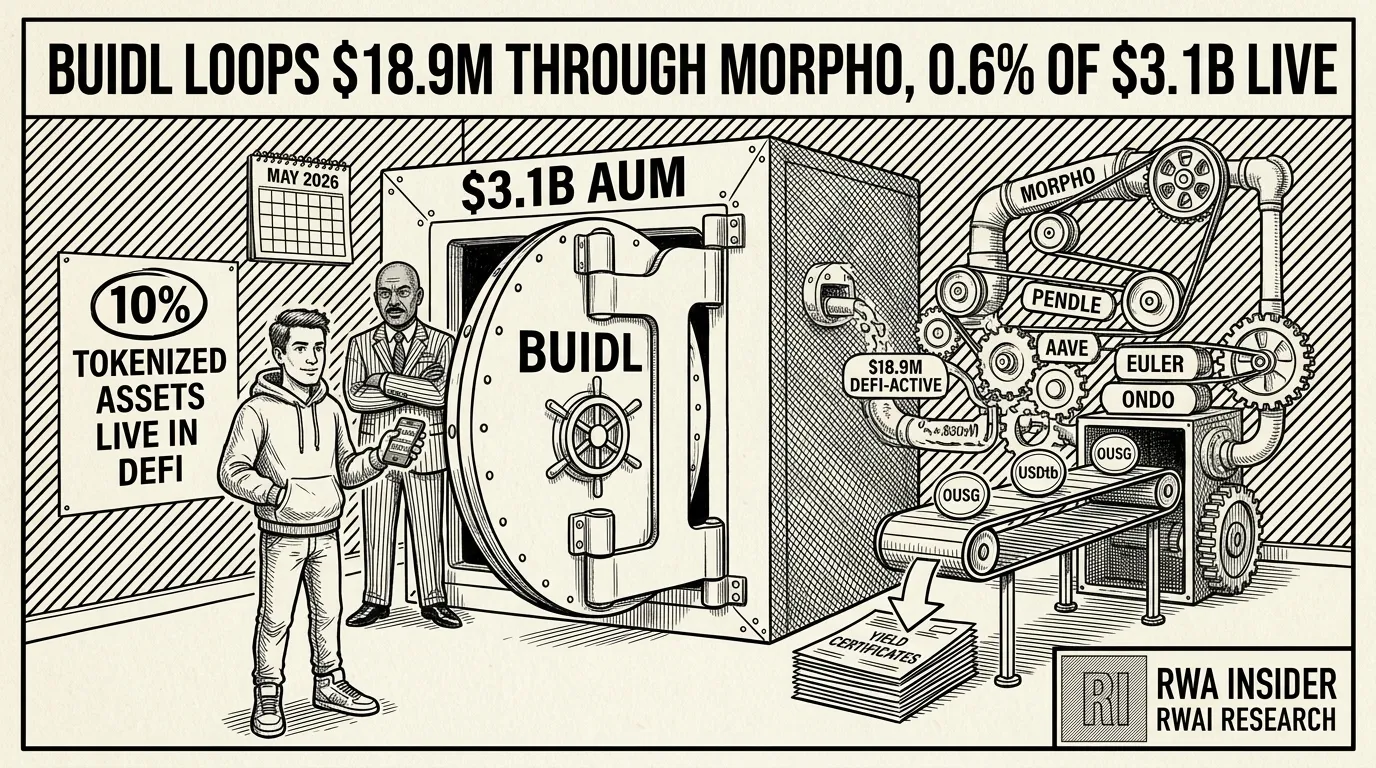
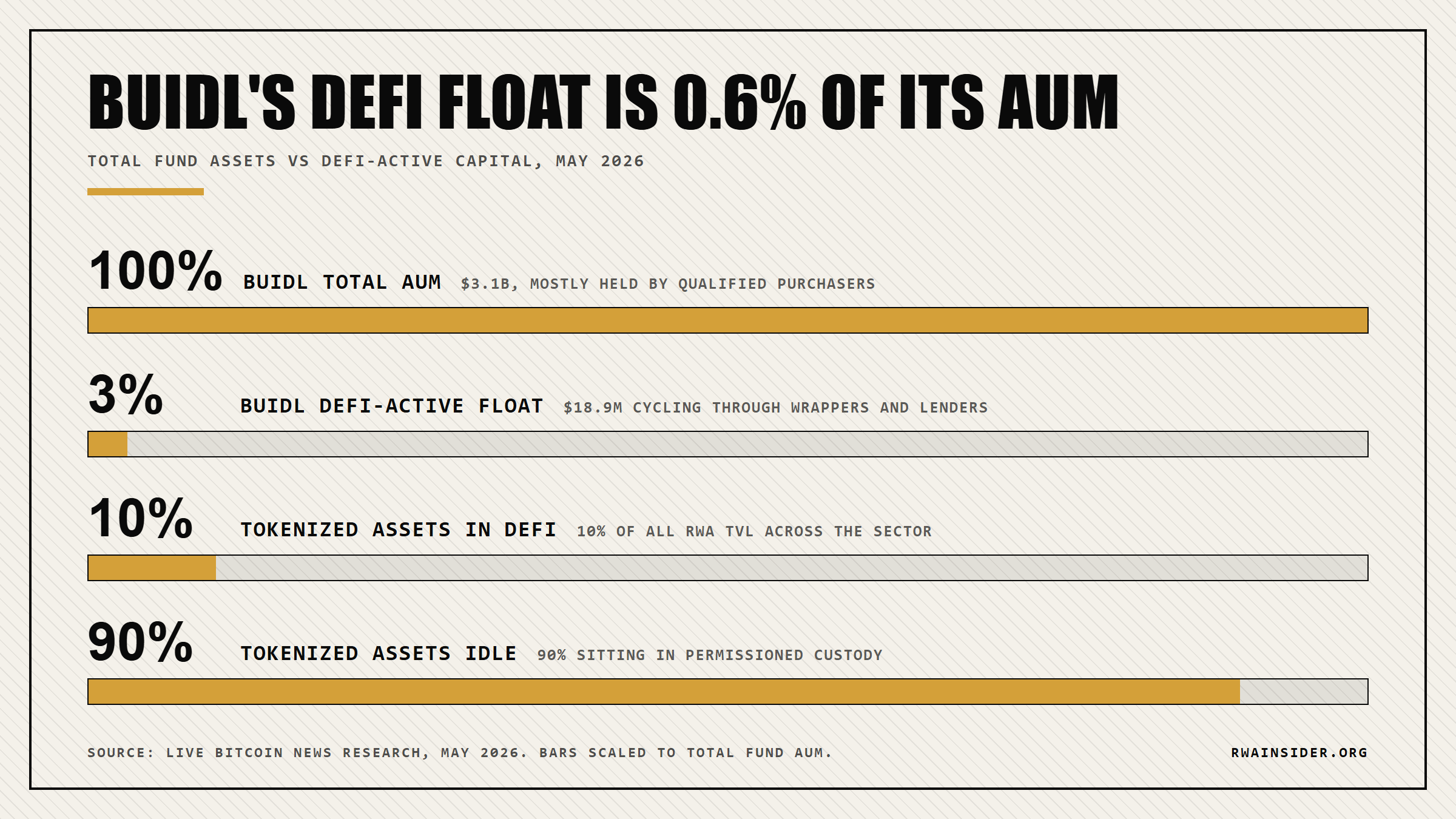
BlackRock’s BUIDL fund holds $3.1 billion in assets under management, but only $18.9 million of that capital is actively cycling through DeFi protocols. The remaining 99.4% sits in permissioned wallets, earning Treasury yield without ever touching on-chain markets. Crypto analyst Kaff called the emerging architecture “DeFi rebuilding the repo market” in a May 26 post on X. For a wallet holder, the gap between BUIDL’s AUM and its DeFi-active float is the entire RWA loops thesis: a $3.1 billion pool of yield-bearing collateral that has barely started compounding through composable infrastructure.
BUIDL Holds $3.1B But Only $18.9M Loops Live On-Chain
BUIDL is the largest tokenized US Treasury fund on-chain. The product has distributed more than $100 million in cumulative dividends since launch, and its derivatives reach further than the base fund itself.
USDtb, Ethena’s reserve-backed dollar, holds BUIDL as its primary reserve asset. OUSG, Ondo Finance’s wrapped Treasury token, uses BUIDL underneath to generate yield for holders.
The same fund also clears as collateral on Binance triparty, Deribit, and Crypto.com simultaneously.
The gap is enforced by permissioning. BUIDL’s direct on-chain transfers require KYC, so the $18.9 million that is actually loop-active sits inside protocols that wrapped or referenced BUIDL after onboarding through the official issuance channel.
The Loop: BUIDL Mints, Pendle Splits, Morpho Lends
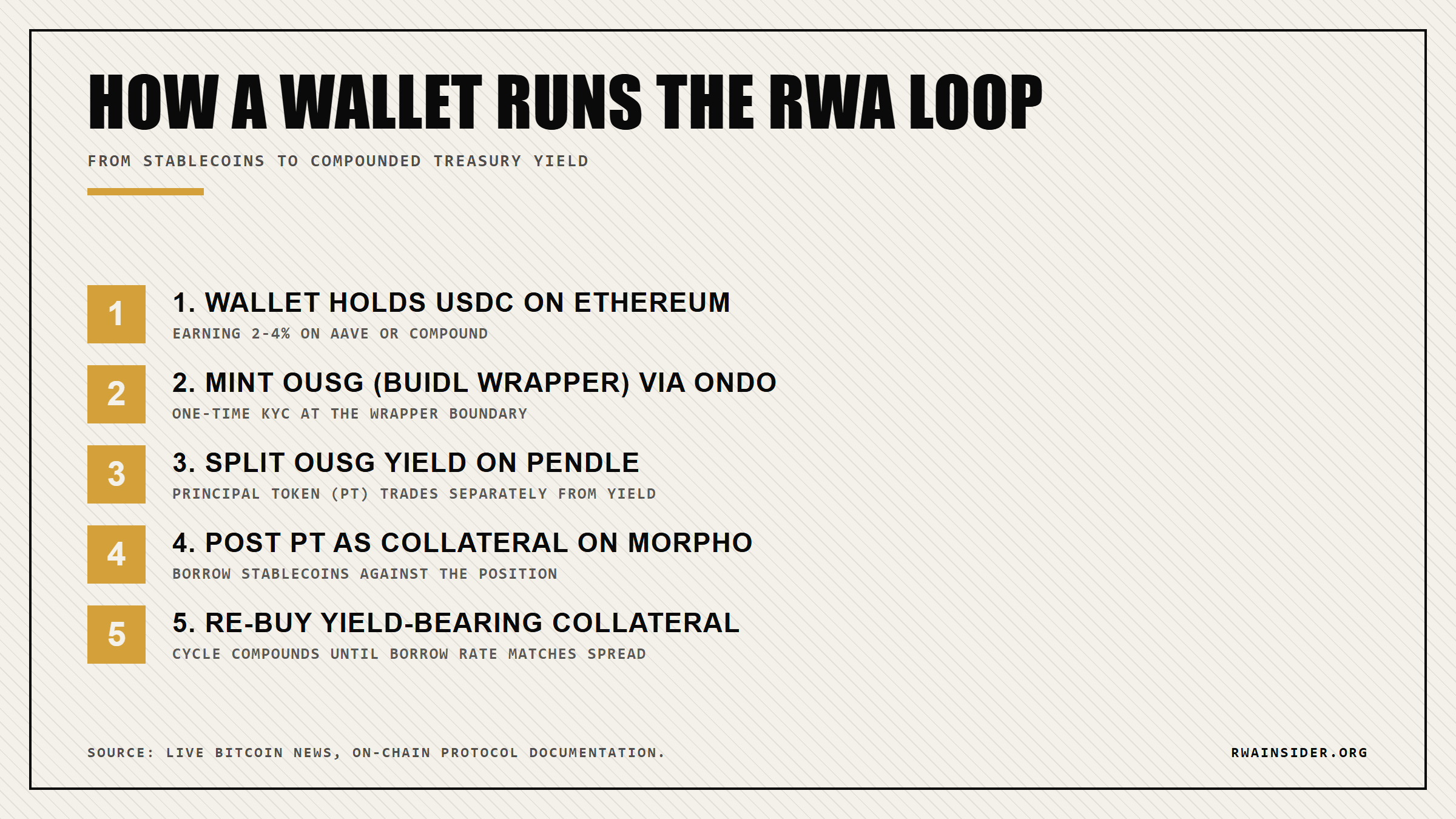
The mechanic is direct. A holder mints a yield-bearing RWA, such as BUIDL through an authorized wrapper.
The position routes to Pendle, which splits the asset into a principal token (PT) and a yield token (YT) that trade separately.
The PT is then posted as collateral on Morpho, Euler, or Aave. The borrower draws stablecoins against it, then buys more yield-bearing collateral, and the cycle compounds until borrowing costs match the spread.
Only 10% of all tokenized assets are deployed in DeFi today, per the source data. That figure is the headroom for the entire stack.
For a DeFi user, the story matters less as institutional adoption than as a permissionless yield stack that wraps Treasury exposure into composable collateral. Wallets on Ethereum can hold OUSG, USDtb, or syrupUSDC and post any of them as collateral on Morpho without ever touching BUIDL directly.
The principal-and-yield split on Pendle then lets a user lock a fixed rate on the principal while trading the variable yield component separately, the same way an interest rate swap would work in traditional fixed income. Tracking that mechanic across wrappers is what our DeFi-native RWA coverage on RWA Insider is built around.
Ondo, Centrifuge, Maple Wire $1.5B+ Into The Stack
Centrifuge crossed $1.5 billion in TVL after JAAA and JTRSY pulled institutional credit capital onto its private credit rails.
Maple Finance routes syrupUSDC into Morpho, Pendle, Kamino, and Revolut, putting verified institutional borrower demand directly into retail-accessible wallets.
Ondo Finance positions its tokenized Wall Street products as active margin collateral on perpetual venues, while Spark, the MakerDAO-adjacent allocator, holds billions in sUSDS reserves and has routed hundreds of millions into Centrifuge products through its Tokenization Grand Prix.
Crypto analyst Kaff, posting as @Kaffchad on X, characterized the architecture as the on-chain rebuild of the traditional repo market, with BUIDL acting as the pristine collateral at the base.
RWA Insider’s earlier read on BlackRock’s multi-chain BUIDL expansion to Solana tracked the chain footprint that now underpins these loops.
Apyx and Saturn Credit are routing Strategy’s $STRC dividend yield directly on-chain, wrapping it into Pendle and looping the position through Morpho. The question for wallet holders is whether the stack stays permissionless at the wrapper layer or whether BUIDL-style KYC gates spread across the rails below.
Whether the $3.1 billion BUIDL pool ever fully sheds its permissioning gates is what decides if RWA loops scale to the next $10 billion or stay stuck inside wrapped-derivative liquidity. Until then, retail DeFi accesses Treasury yield through OUSG, USDtb, and syrupUSDC, not through BUIDL itself.
For more DeFi-native RWA coverage and yield-stack breakdowns across Morpho, Pendle, and the wrapper layer, scan the latest yield gap research on RWA Insider.
Frequently Asked Questions
What is BUIDL and how do DeFi wallets actually access its yield?
BUIDL is BlackRock’s tokenized short-duration US Treasury fund, issued through Securitize and live across multiple chains including Ethereum and Solana. Direct BUIDL holdings require KYC and institutional onboarding, so retail DeFi wallets access the underlying Treasury yield indirectly through wrappers like Ondo’s OUSG, Ethena’s USDtb stablecoin, or Maple’s syrupUSDC. Those wrapped exposures transfer freely between wallets and DeFi contracts once minted.
Why is only $18.9 million of BUIDL’s $3.1 billion live in DeFi?
Most of BUIDL’s $3.1 billion AUM is held by qualified institutional purchasers who are not actively cycling the position through DeFi protocols. The $18.9 million figure reflects the slice held inside DeFi-native wrappers and used as on-chain collateral on protocols such as Morpho. As more wrappers and derivatives launch around the fund, that DeFi-active figure is expected to climb.
How does an RWA loop on Morpho actually work step by step?
A wallet starts by minting or buying a yield-bearing RWA wrapper like OUSG, then routes it to Pendle, which splits the asset into a principal token and a yield token traded separately. The principal token is posted as collateral on Morpho, Euler, or Aave to borrow stablecoins. Those borrowed stablecoins buy more yield-bearing collateral, and the cycle compounds until borrowing costs match the spread.
Which protocols form the RWA loops stack in DeFi today?
The current stack runs across Ondo Finance and BUIDL wrappers at the asset layer, Pendle for principal-and-yield splitting, Morpho, Euler, and Aave for lending and collateral, Centrifuge for private credit at $1.5 billion in TVL, Maple Finance for institutional borrower demand via syrupUSDC, and Spark for stablecoin-collateral allocation. Ethena’s USDtb adds synthetic-dollar exposure that also functions as productive collateral inside the loop.