msUSD Depegs 71% As Accountable Ends Proof Of Reserves
Key Points
- Main Street USD lost 71% of its value in 24 hours, sliding to about $0.29 and cutting msUSD’s market cap to $30.5 million.
- Verification provider Accountable, which has checked over $1 billion in client assets, cut msUSD off after the issuer failed its standards.
- Main Street pitched msUSD as one-to-one redeemable for USDC, so any wallet holding it or msY on Morpho now carries live depeg risk.
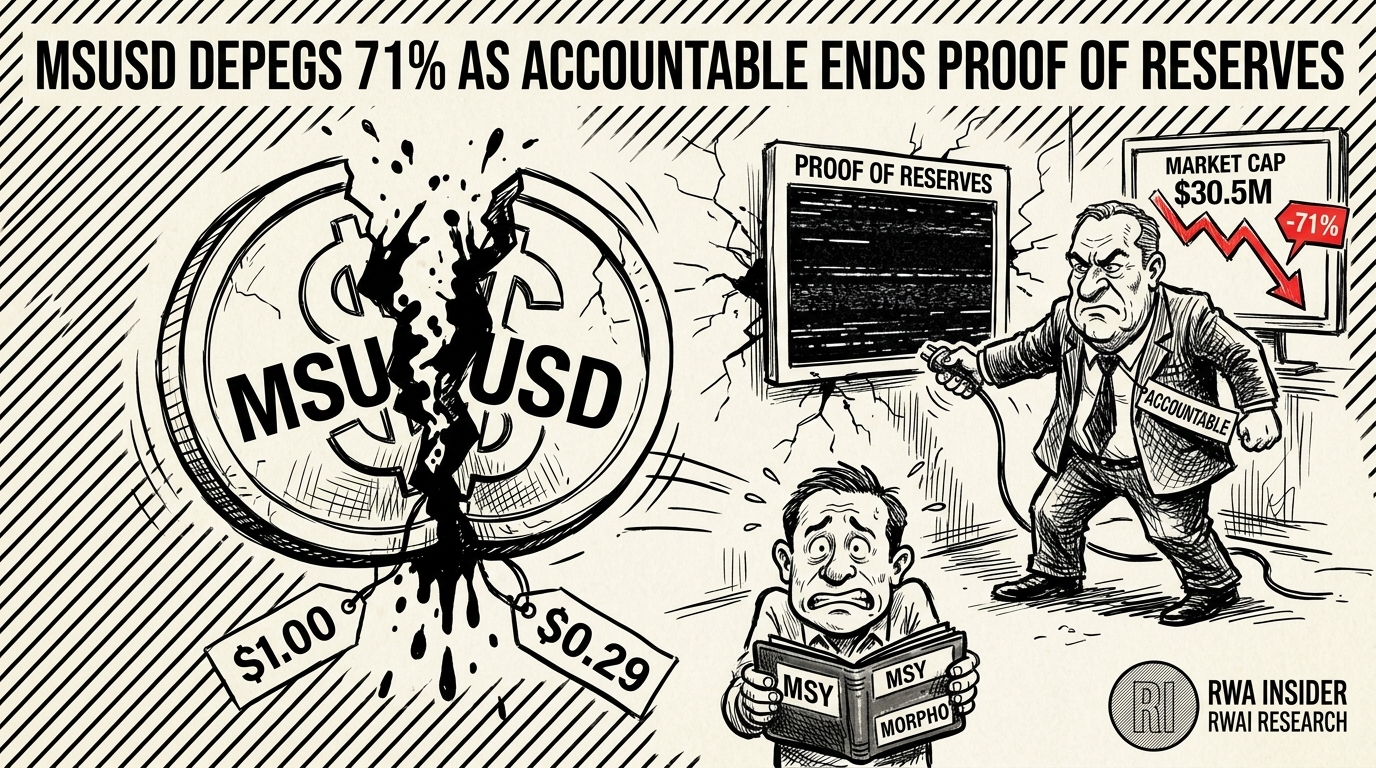
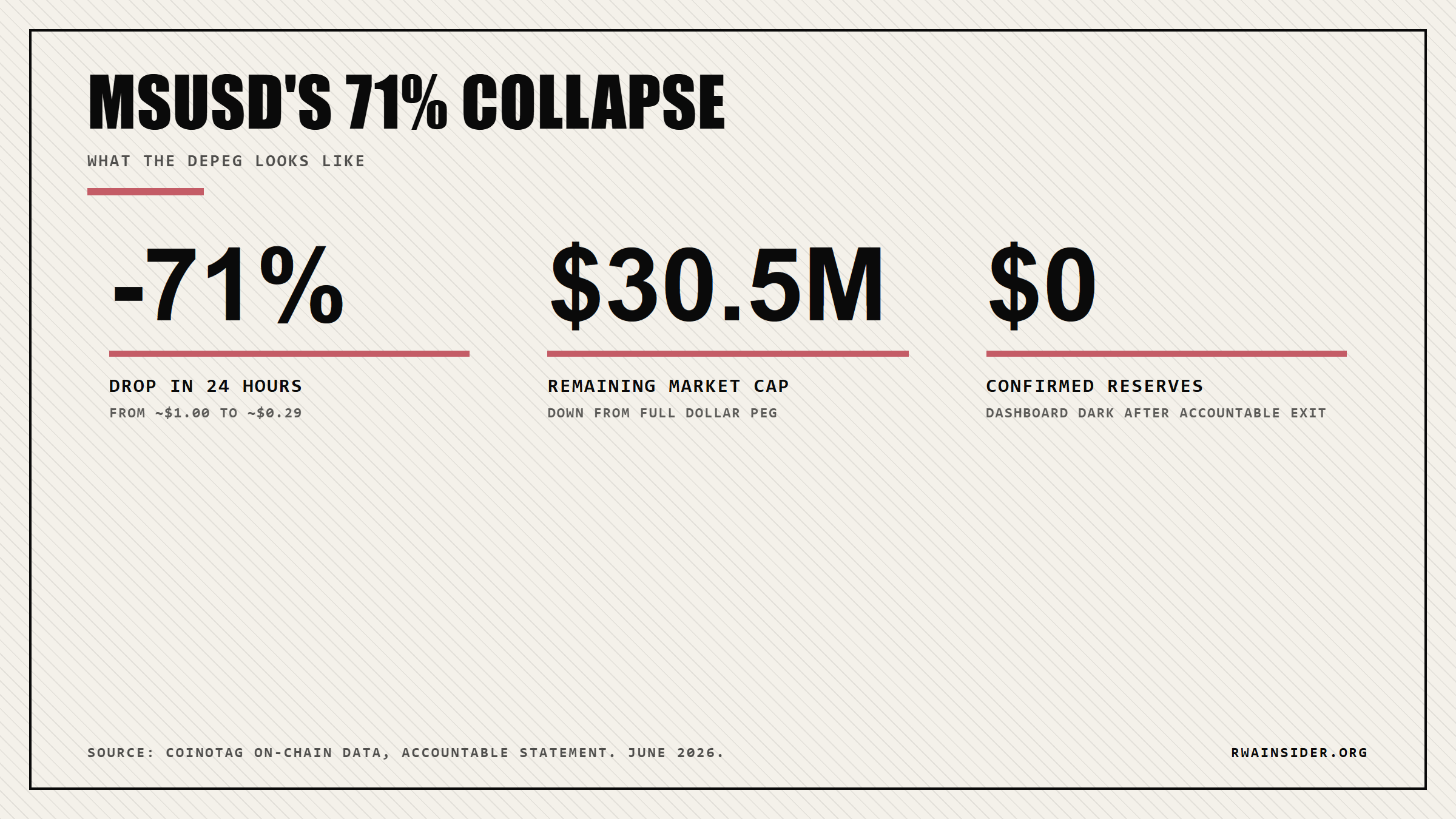
Main Street USD, a dollar-pegged stablecoin that traded near $1 for months, collapsed roughly 71% in 24 hours over the weekend and now changes hands around $0.29, cutting its market value to about $30.5 million. The trigger was its verification provider, Accountable, which abruptly ended the relationship and said Main Street “could not meet its verification standards,” switching off the public reserves dashboard. For any wallet holding msUSD or its msY yield token, the proof that collateral existed vanished the moment the attestation did.
How Accountable Cutting Its Feed Sank The msUSD Peg
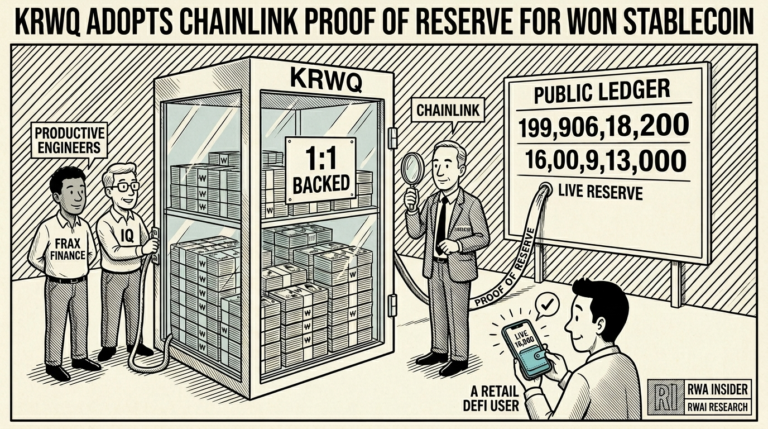
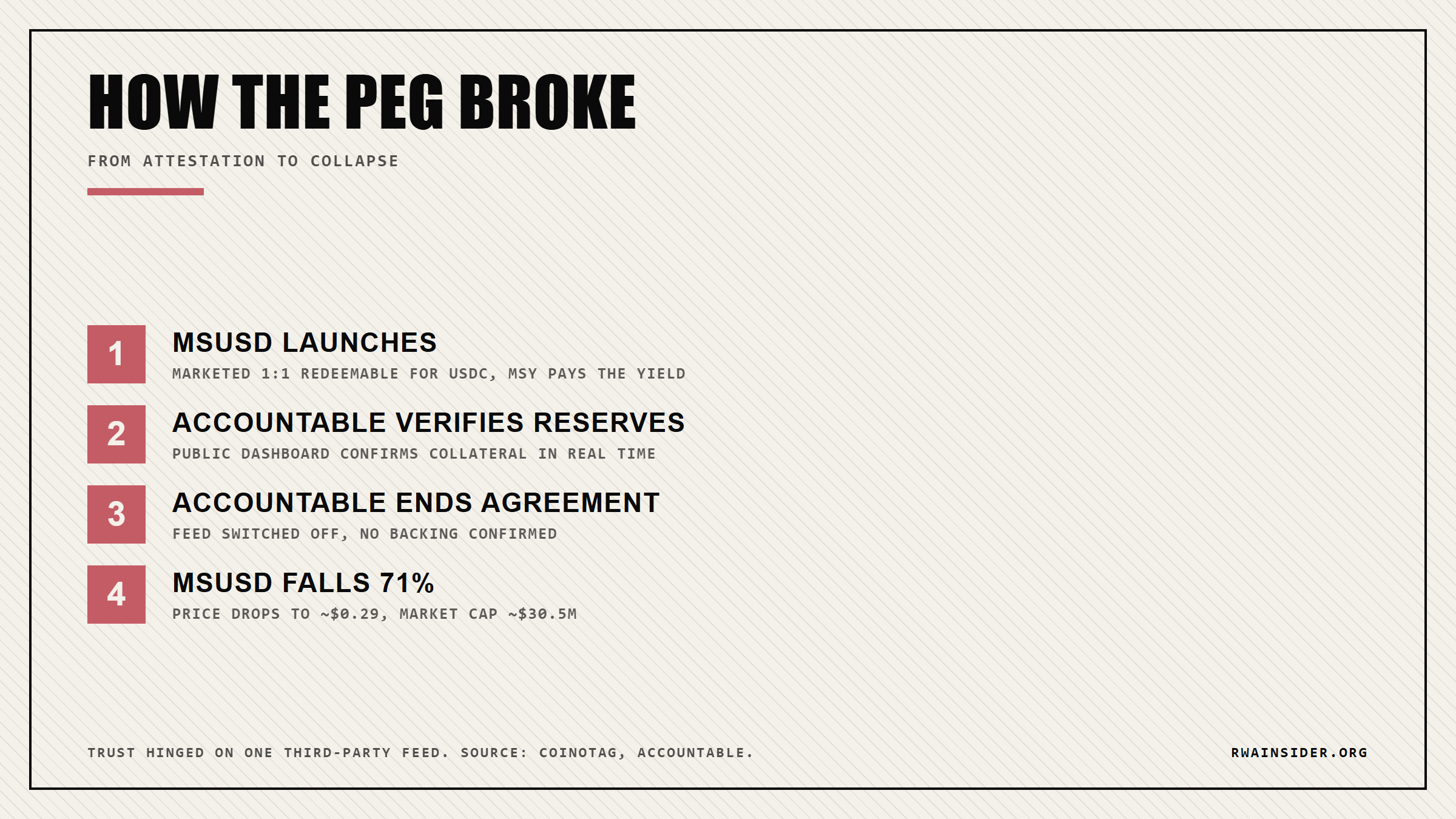
Main Street USD pitched msUSD as a dollar token always redeemable one-to-one for USDC. The pitch leaned on one feature: proof of reserves anyone could watch update in real time.
That proof came from Accountable, a firm running real-time reserve checks that says it has verified more than $1 billion in client assets, including positions held by Galaxy and Amber Group, with Pantera Capital among its backers.
On Saturday, Accountable terminated the agreement and switched off the feed. It framed the move as a standards failure on Main Street’s side and said it would apply that bar without exception.
The public dashboard that had confirmed msUSD’s collateral in real time stopped showing any backing at all.
The token had traded near $1 for months. Within 24 hours it collapsed to roughly $0.29, a 71% drop that cut its market value to about $30.5 million.
Nothing in the smart contract changed in that window. What vanished was the outside signal that the dollar peg was real, and confidence left with it.
What msY On Morpho Means For Your Wallet Now
The yield story leaned entirely on that vanished feed. Main Street promoted an msY market on Morpho, one of the largest decentralized lenders, holding billions in deposits.
Staking msUSD minted msY, a second token that earned yield from options box spreads. The team called that institutional-grade, which here means a derivatives strategy most holders could not inspect, backed by collateral they now cannot verify.
Strip away the institutional-grade label and the real question for a $1,000 wallet is whether anything still backs msY now that no dashboard confirms it.
The one-to-one USDC redemption was the whole safety net. With the attestation gone, that promise is only as good as reserves nobody can currently see.
msUSD also leaned on integrations with automated market makers and lending venues to look liquid. Those venues do not vouch for the collateral; they only quote a price, and that price is now $0.29.
DeFi users who want to compare how other stablecoins prove their reserves have a stark contrast here, since msUSD’s peg held only while a single third party kept the lights on.
GoPlus Flags The msUSD Contract As Depegs Mount In 2026
Beyond the broken feed, msUSD carries risk at the contract level. Security scanner GoPlus warns the token runs on an upgradeable proxy whose owner can disable sells, mint new tokens, or change fees at will.
Those permissions concentrate control in a few hands and magnify counterparty risk for anyone still holding. A holder cannot exit if the owner freezes sells, and fresh mints can dilute whatever value is left.
The collapse adds to a growing list of stablecoin failures this year. It echoes an earlier algorithmic dollar token that slipped its peg on thin liquidity, where holders found the exit far below par.
The pattern is consistent. Each break chips away at trust in yield-bearing dollar tokens and the attestations meant to police them, and msUSD shows an attestation is only as strong as the firm willing to stand behind it.
A credible recovery would need a new verifier, a fresh on-chain attestation, and reserves large enough to clear redemptions at par. None of that exists today.
For holders, the practical screen is whether a stablecoin’s reserves can be verified on-chain by anyone, rather than through a single provider that can walk away overnight.
Whether Main Street can find a new verifier and rebuild the dashboard will decide if msUSD ever trades at $1 again. Until an independent feed confirms real collateral, the only safe assumption is that there is none.
Ken Tanaka tracks every depeg and proof-of-reserves failure for RWA Insider, so the next attestation that quietly switches off does not catch your wallet by surprise.
Frequently Asked Questions
What is Main Street USD and how did it lose its peg?
Main Street USD, ticker msUSD, was a dollar stablecoin redeemable one-to-one for USDC, with a staking token called msY that paid yield. It lost about 71% in 24 hours to roughly $0.29 after its verification provider, Accountable, ended their agreement and the public reserves dashboard went dark.
Can I still redeem msUSD for USDC?
The one-to-one USDC redemption was the core promise, but with no live attestation confirming any collateral, holders cannot verify that backing exists. At roughly $0.29 the market is pricing redemption as unlikely, so treat any exit as selling at a deep discount on a DEX.
Why does Accountable ending its audit matter so much?
Accountable ran the real-time proof-of-reserves feed that confirmed msUSD was backed, and it says it has verified more than $1 billion in client assets. When it switched the feed off, msUSD lost its only public proof of collateral, and confidence collapsed within hours.
Is the msY yield on Morpho safe?
msY earned yield from options box spreads and traded in a market on Morpho. With the attestation gone and security scanner GoPlus flagging an upgradeable contract that can disable sells or mint new tokens, any msY position now carries live depeg and counterparty risk.