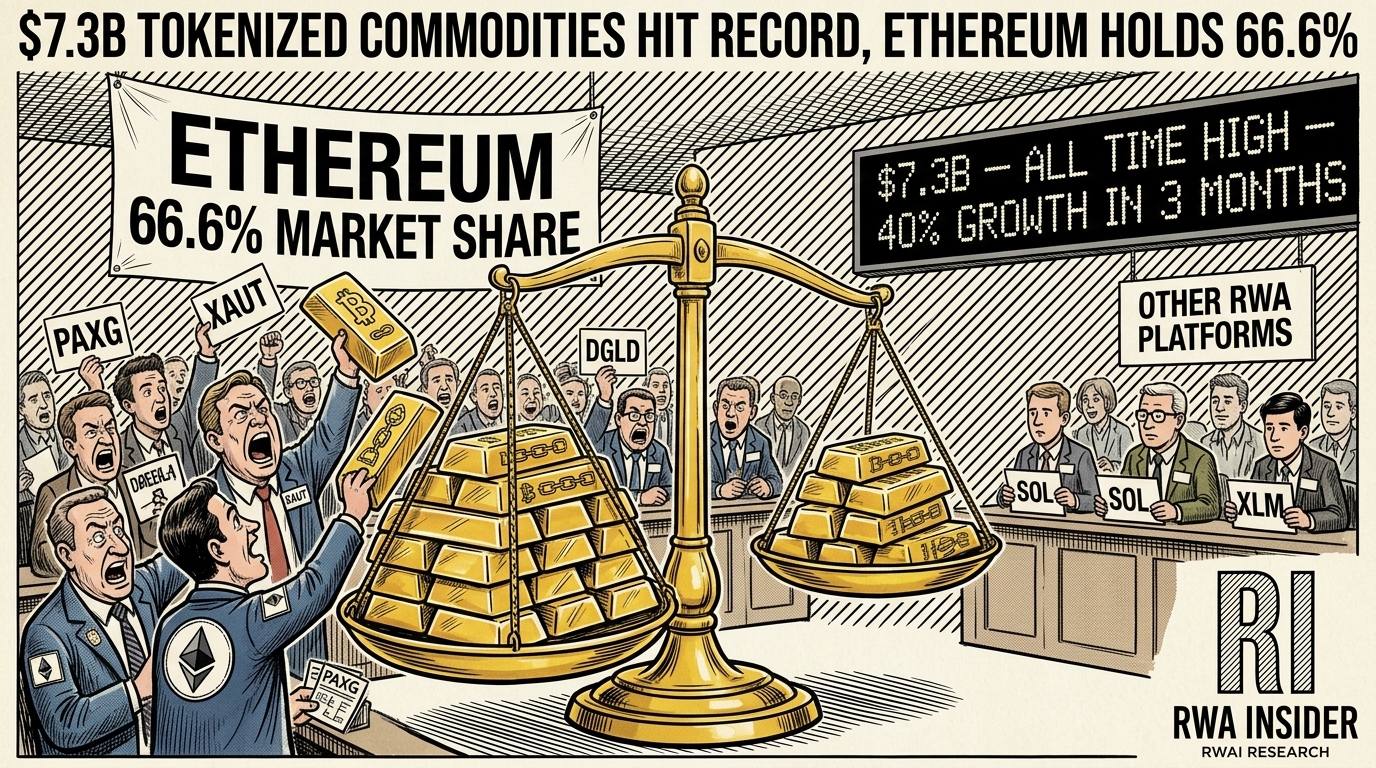
$7.3B Tokenized Commodities Hit Record, Ethereum Holds 66.6%
Key Points
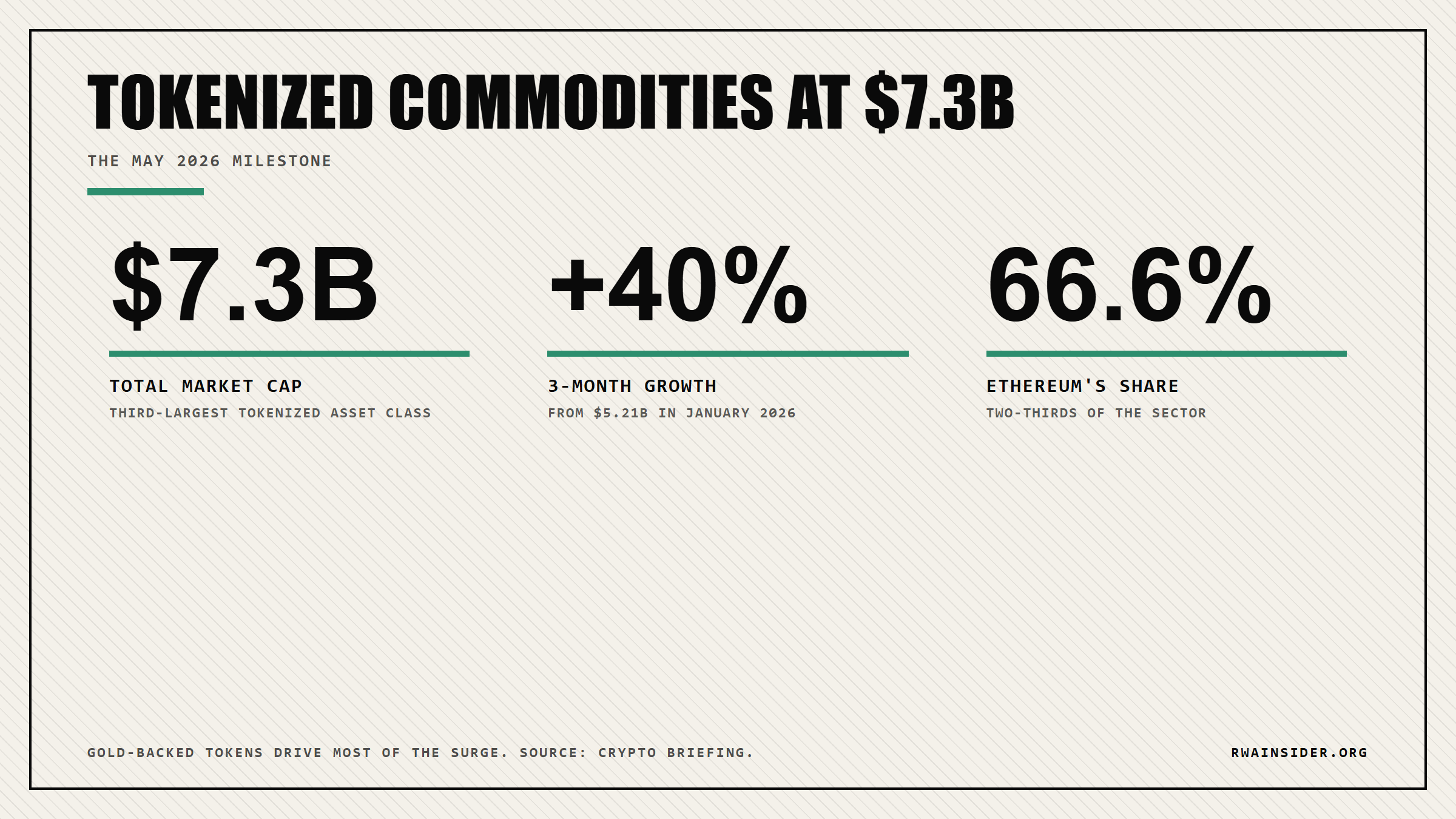
- Tokenized commodities crossed $7.3 billion in total market capitalization, the third-largest tokenized asset class behind private credit and US Treasuries.
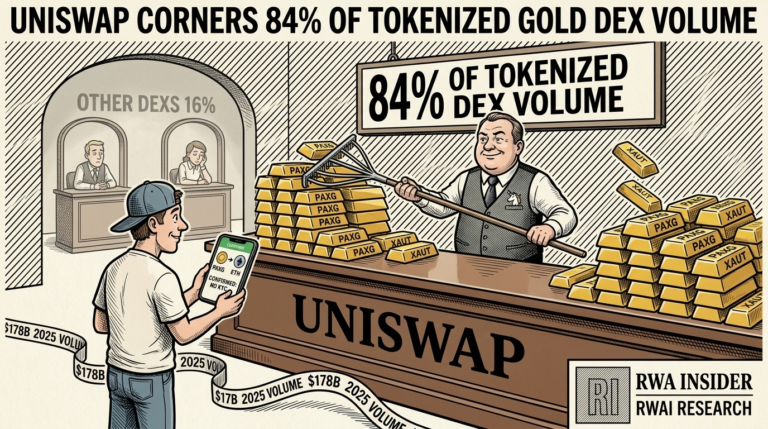
- Ethereum holds 66.6% of the tokenized commodities market, driven by gold-backed tokens that grew from $5.21 billion in January 2026 to $7.3 billion.
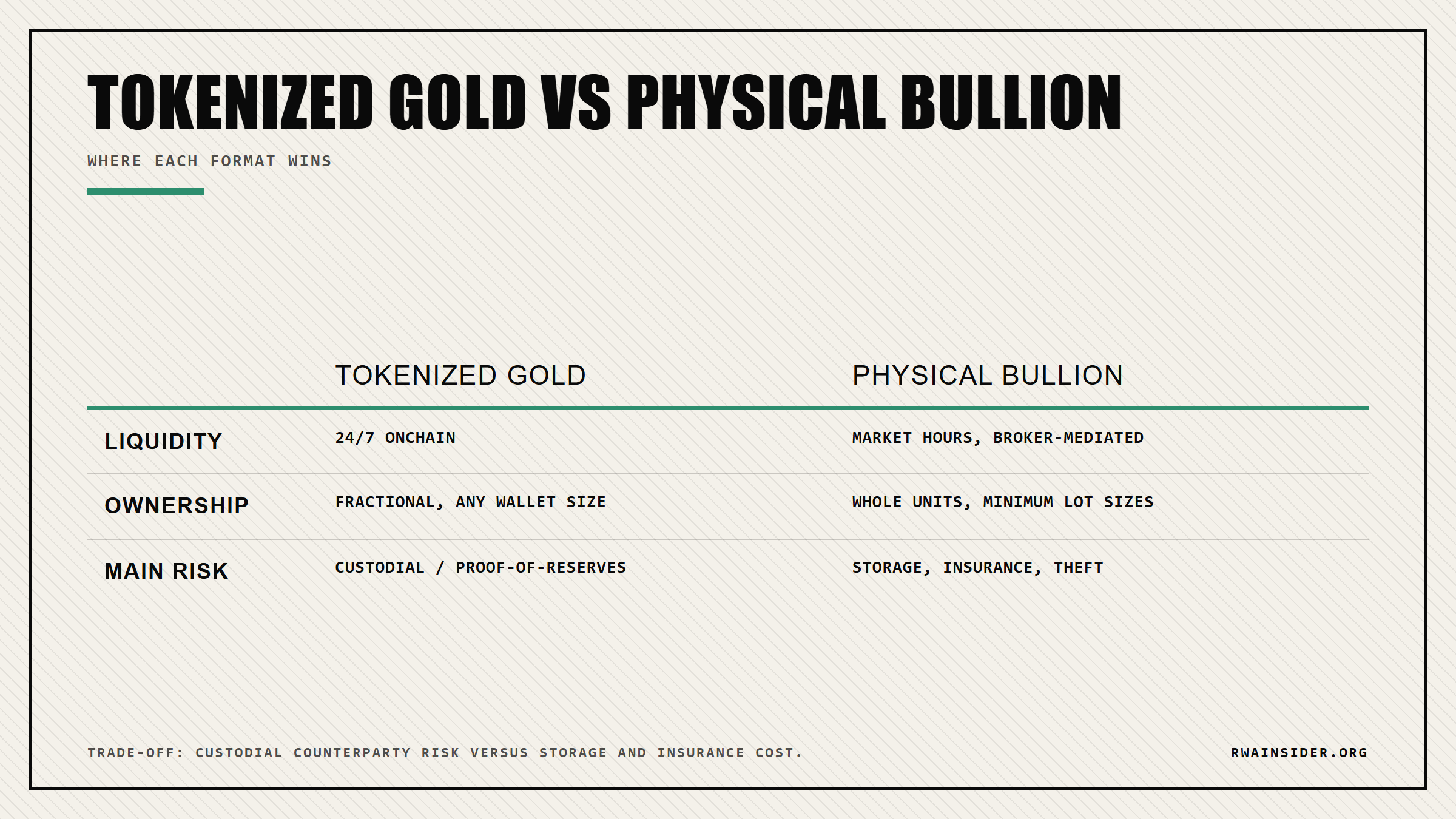
- DeFi users can buy tokenized gold onchain for 24/7 liquidity, fractional ownership, and near-instant settlement that physical gold custody cannot match.
The tokenized commodities market just crossed $7.3 billion in total market capitalization, a record that ranks the sector as the third-largest tokenized asset class behind private credit and US Treasuries. Crypto Briefing reported the milestone on May 23, 2026, attributing the growth almost entirely to gold-backed tokens running primarily on Ethereum, which now holds 66.6% of the tokenized commodities market. For a DeFi user weighing safe-haven exposure, the practical read is that tokenized gold offers what physical bullion can’t: 24/7 onchain liquidity, fractional ownership down to small wallet sizes, and near-instant settlement instead of vault paperwork or dealer markups.
Gold-Backed Tokens Drive The $7.3B Commodities Surge
Crypto Briefing called the milestone “a record that would have sounded absurd two years ago.”
The sector sat at roughly $5.21 billion in late January 2026. That is a jump of about 40% in three months.
The large majority of the $7.3 billion comes from gold-backed tokens, digital representations of physical gold that live on blockchains and trade like any other crypto asset.
Gold prices have been on a favorable run through the first quarter of 2026. Tokenized versions offer something the physical metal can’t: 24/7 liquidity, fractional ownership, and near-instant settlement.
At $7.3 billion, tokenized commodities now rank third among tokenized asset classes, behind private credit and US Treasuries on aggregate market cap.
Private credit holds the top spot, with US Treasuries second. The commodities sector’s $7.3 billion now sits third, ahead of tokenized real estate, equities, and private equity sub-sectors that have not yet scaled in the same way.
Why Ethereum Holds 66.6% Of Tokenized Commodities
Ethereum‘s two-thirds share of the tokenized commodities market is the result of years of infrastructure development, smart contract standardization, and network effects, per Crypto Briefing.
Competing chains are making inroads, and multi-chain activity is growing. But the 66.6% share suggests that for high-value tokenization, the network remains the default choice.
Strip away the chain-share takes and this is really about whether a $1k wallet can buy tokenized gold with the same custody assurances and faster transfer mechanics than holding physical bullion through a broker.
Readers can compare tokenized commodity products across issuers as the proof-of-reserves question becomes more material to allocation decisions.
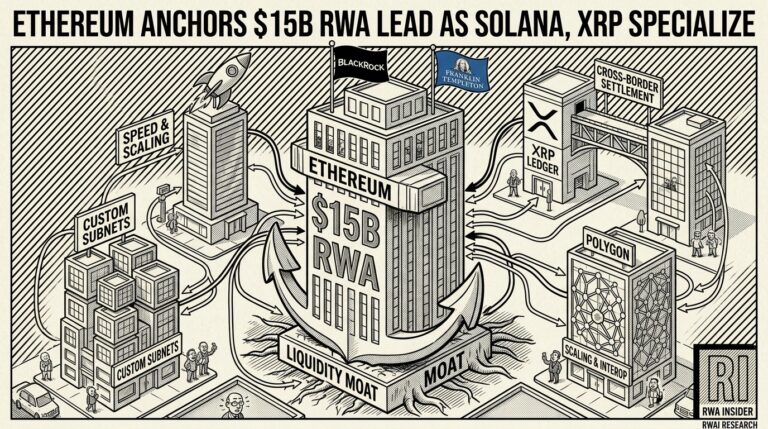
Our earlier read on Ethereum’s $15B RWA lead and the multi-chain landscape framed the institutional liquidity picture. The commodities sub-sector at $7.3 billion is one piece of that broader stack.
For commodity-focused investors, the onchain versions offer structural advantages. Fractional ownership lowers the barrier to entry.
Settlement is faster than traditional commodity markets. And the transparency of blockchain-based custody eliminates some counterparty risk that has historically plagued the precious metals market.
Proof-Of-Reserves Risk And The $7.3B Custody Question
Tokenized commodities are only as reliable as the custodians backing them, Crypto Briefing noted directly.
If the physical gold isn’t actually in the vault, the token is just a very expensive database entry.
Investors should scrutinize proof-of-reserves mechanisms and the regulatory frameworks governing issuers before allocating meaningful capital.
This is the central risk question for the $7.3 billion sector. Unlike tokenized US Treasuries where the underlying asset is a government-issued security, tokenized gold depends on a custodian holding physical bullion that matches the on-chain supply.
For DeFi users actively allocating, the practical move is to map each gold-backed token’s proof-of-reserves attestation cadence (monthly, quarterly, on-demand) and its custodial jurisdiction before committing meaningful size.
The forward question is whether the tokenized commodities sector keeps growing at the current 40% three-month pace, or whether macroeconomic conditions like a stronger dollar or rising rates shift the safe-haven appetite away from gold.
As long as gold maintains its first-quarter run and DeFi infrastructure improves, the on-chain version of the asset class should keep absorbing demand that physical gold custody can’t satisfy.
Whether the $7.3 billion holds depends on gold’s continued price trajectory and on whether proof-of-reserves audits keep pace with rising token supply. The next quarterly check will tell.
Track more Secondary Markets coverage from RWA Insider as tokenized commodities expand.
Frequently Asked Questions
How big is the tokenized commodities market right now?
The tokenized commodities market crossed $7.3 billion in total market capitalization as of May 2026, per Crypto Briefing. The sector now ranks third among tokenized asset classes, behind private credit and US Treasuries. Growth was about 40% in the three months from late January 2026.
Why does Ethereum hold 66.6% of tokenized commodities?
Ethereum’s dominance reflects years of infrastructure development, smart contract standardization, and network effects, per Crypto Briefing. Competing chains are making inroads, but Ethereum remains the default choice for high-value real-world asset tokenization at scale.
What are the main risks of tokenized gold?
Tokenized commodities depend entirely on the custodian holding the physical asset. If the gold isn’t actually in the vault, the token is worthless. Investors should scrutinize proof-of-reserves mechanisms, attestation cadence, and regulatory jurisdiction before allocating meaningful capital.
How is tokenized gold different from holding physical bullion?
Tokenized gold offers 24/7 onchain liquidity, fractional ownership down to small wallet sizes, and near-instant settlement that physical bullion can’t match. Physical gold requires vault custody, dealer markups on small trades, and slower settlement. The trade-off is custodial counterparty risk versus the storage-and-insurance cost of physical.