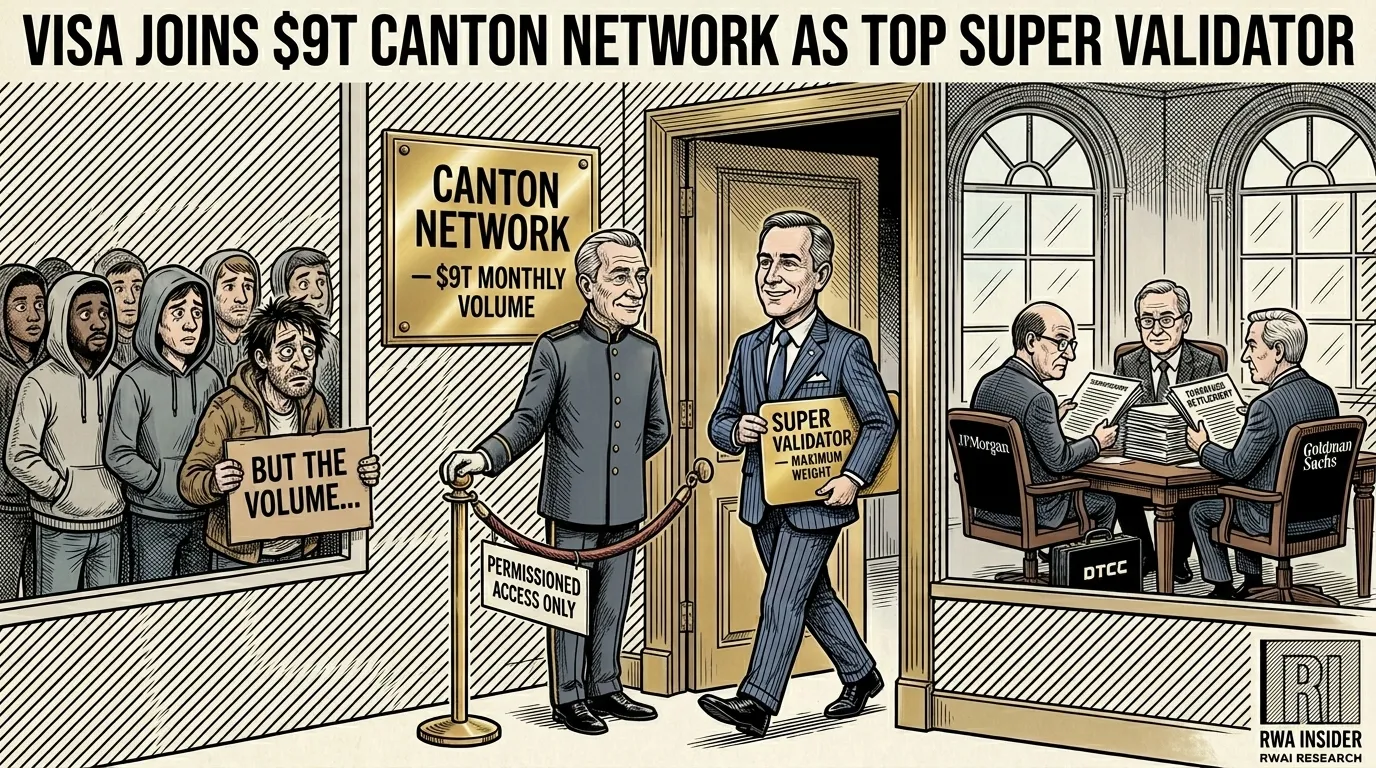
Visa Joins $9T Canton Network As Top Super Validator
Key Points
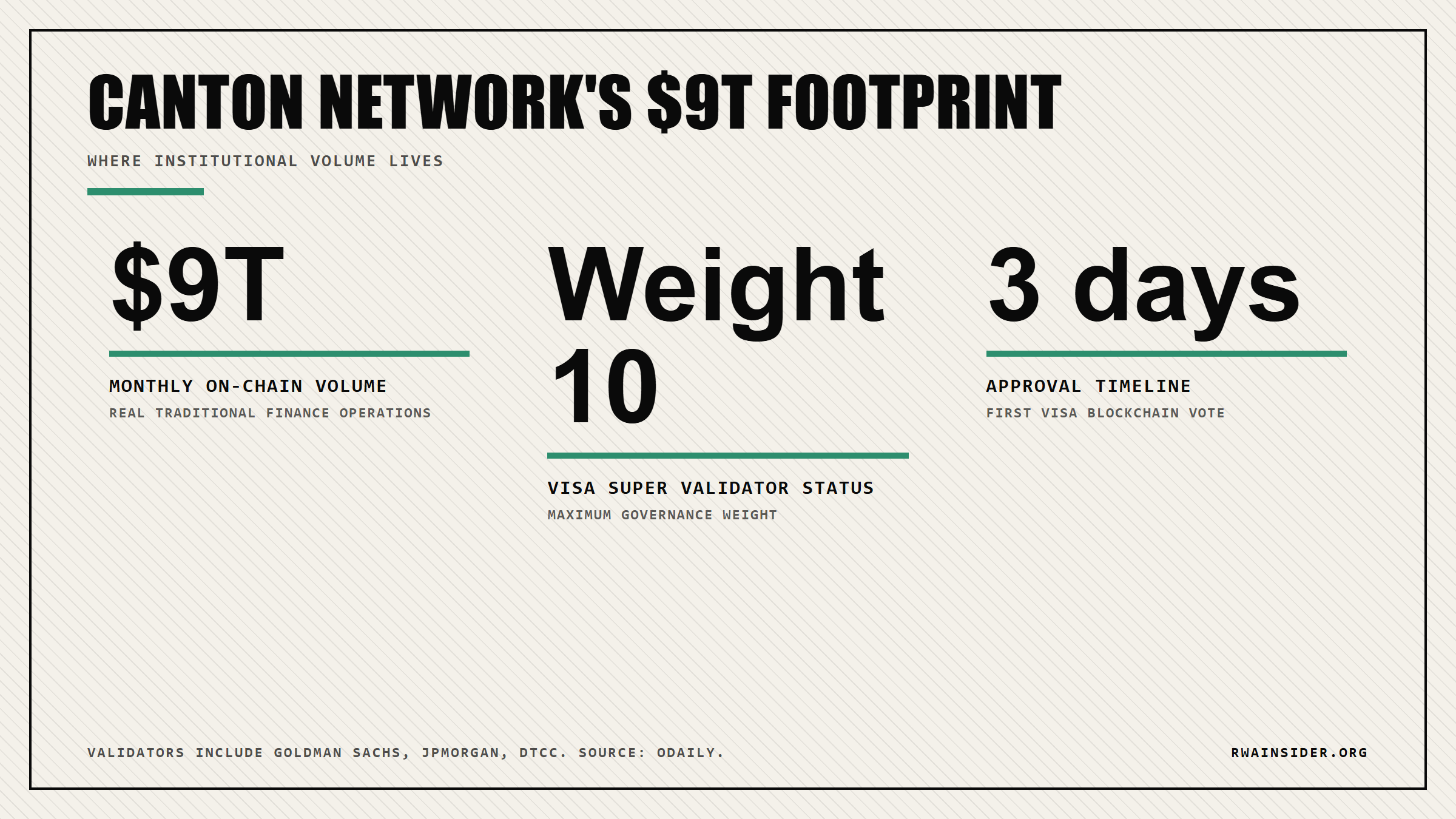
- Visa became a Super Validator on the Canton Network in March 2026, with its first blockchain governance proposal approved in three days at maximum weight.
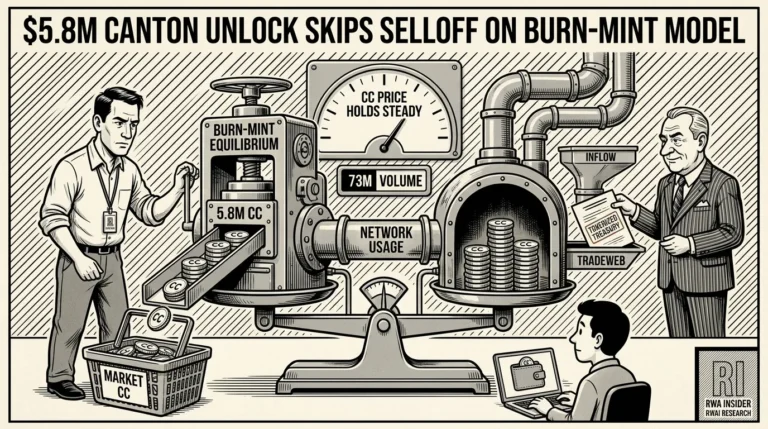
- Canton Network processes over $9 trillion per month in on-chain volume, anchored by JPMorgan’s JPM Coin, DTCC’s tokenized treasury, and Goldman Sachs validators.
- DeFi users can’t trade on Canton because it is permissioned, but the $9 trillion volume reshapes RWA settlement that DeFi protocols will bridge to.
Visa became a Super Validator on the Canton Network at maximum weight 10, with its first blockchain governance proposal approved in three days on March 20, 2026. ODaily reported the milestone, noting that Canton Network now processes over $9 trillion per month in on-chain volume, anchored by JPMorgan’s JPM Coin and DTCC’s tokenized treasury settlement. For DeFi users watching where institutional RWA infrastructure consolidates, Canton is a permissioned L1 with privacy controls at the protocol layer, which is what banks needed to put real settlement volume on-chain instead of leaving it on the experimental sidelines.
Visa’s Super Validator Status Marks Canton’s Production-Ready Phase
ODaily called the Visa vote “a shift in traditional finance’s recognition of privacy-preserving blockchain infrastructure from the experimental stage to a production-ready phase.”
The three-day approval is unusually swift for an institution like Visa. ODaily noted compliance vetting was “fully completed beforehand,” suggesting months of behind-the-scenes negotiation before the public proposal.
Visa now holds the maximum Super Validator weight (10) on a network where validators include Goldman Sachs and JPMorgan.
The Canton Network was built by Digital Asset, a Wall Street-veteran team, with a stated goal of replicating traditional finance success within a compliant framework.
The CC token used as Canton’s network utility asset has zero pre-mining, zero team allocation, and zero VC allocation, a structure designed to address institutional concerns about unfair token distribution.
Visa’s compliance team moves slowly by design; this Super Validator slot was months of behind-the-scenes work before the public vote.
How $9T Monthly Volume Reshapes On-Chain Settlement Plumbing
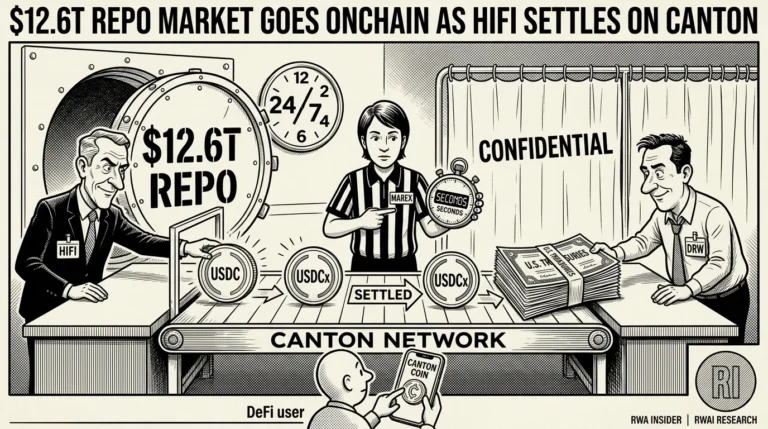
Canton Network processes over $9 trillion in on-chain volume per month, handling real traditional finance operations including tokenized repos and treasury settlement rather than artificially inflated activity.
JPMorgan’s JPM Coin and DTCC’s tokenized treasury are flagship use cases, representing actual institutional settlement flows on a permissioned L1.
The core differentiator is data visibility control at the L1 protocol layer. Only transaction participants can see the details, which addresses banks’ privacy concerns and allows regulated entities to operate without leaking position information to the public chain.
Strip away the institutional framing and this is really about whether the next decade of on-chain settlement runs on permissioned L1s like Canton or on the public chains DeFi users actually wallet into.
Readers can compare the permissioned versus permissionless RWA infrastructure split as more institutional volume migrates onchain.
Visa’s involvement specifically targets atomic settlements, where the buyer’s payment and asset delivery complete simultaneously. That eliminates time gaps and counterparty risk, and gives Canton an institutional payments anchor on top of the capital markets footprint it already had.
Why DeFi Users Should Watch Canton Even Though They Can’t Use It
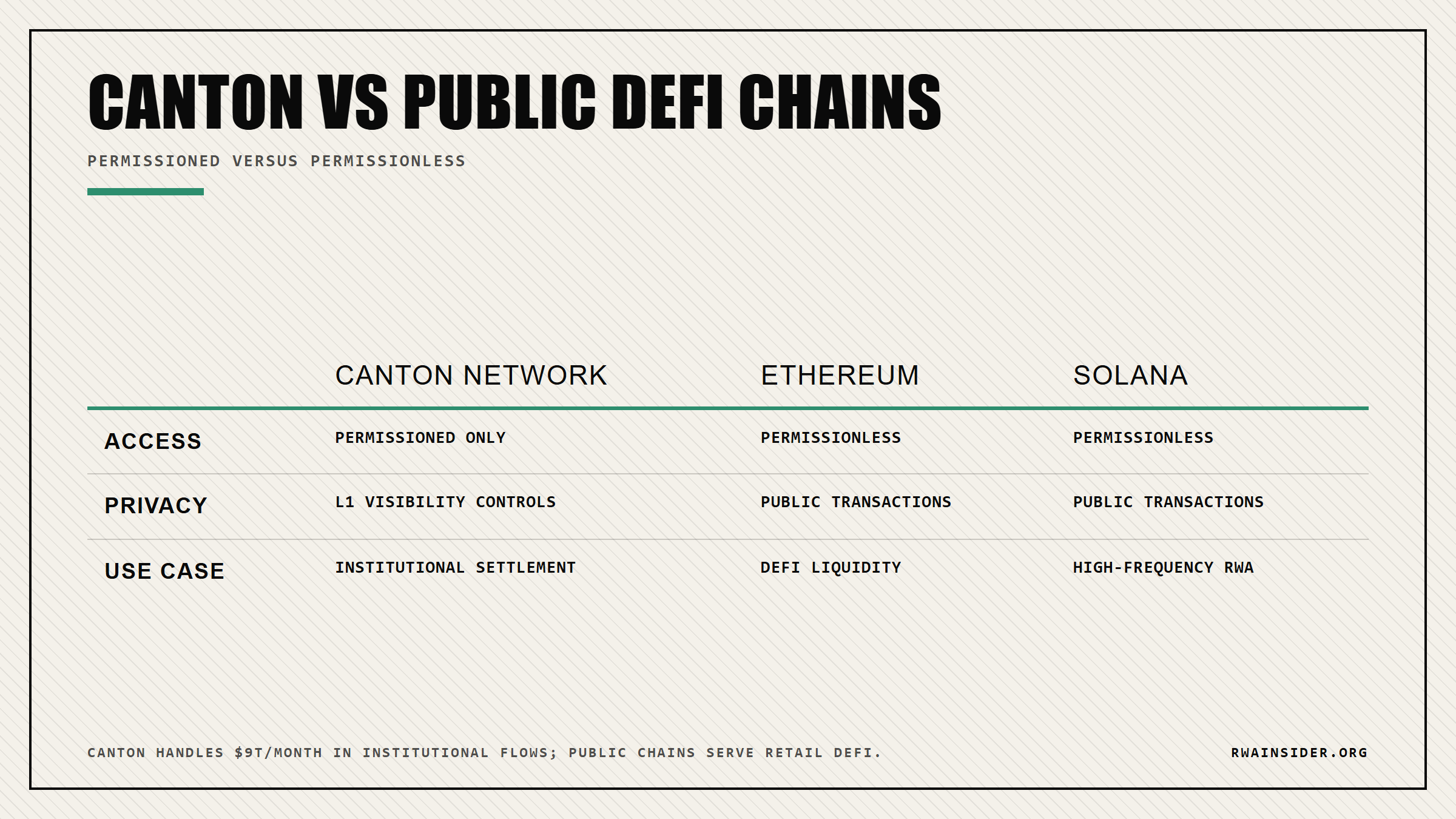
Canton is permissioned by design. A retail DeFi wallet with $1k can’t trade on Canton today, and likely never will in the way it trades on Ethereum or Solana.
But the $9 trillion in monthly volume matters because it represents capital that DeFi protocols will eventually need to interface with through bridges, wrappers, and tokenized representations.
Our earlier read on the multi-chain RWA landscape covered Canton at $313.7 billion in total RWA value, the public-side figure. The $9 trillion monthly settlement volume is a separate, larger institutional flow figure.
The CC token’s distribution design matters here. Zero pre-mining and zero VC allocation reduces the typical concerns about insider dumps that plague new institutional crypto projects.
For DeFi users watching where capital flows next, the practical question is which permissioned L1s eventually open bridges to permissionless markets and how much of the institutional volume becomes accessible through those bridges.
The forward read is that Canton’s institutional success doesn’t displace DeFi protocols. It builds a parallel rail that eventually has to interconnect for capital to circulate.
The institutional rail and the public DeFi rail are not opposed, but eventually they have to interconnect for capital to circulate freely across both.
Whether the $9 trillion stays inside Canton’s permissioned walls or eventually bridges to public DeFi markets is the question that determines how the next phase of RWA settlement plays out.
Track more Secondary Markets coverage from RWA Insider as institutional rails connect to public DeFi.
Frequently Asked Questions
What is the Canton Network and why does Visa joining matter?
Canton Network is a permissioned L1 blockchain built by Digital Asset for regulated institutional finance, with data visibility controls embedded at the protocol layer. Visa joining as a Super Validator at maximum weight (10) in March 2026 marks traditional finance’s recognition of Canton as production-ready infrastructure rather than an experiment.
How much volume does Canton Network actually process?
Canton Network processes over $9 trillion per month in on-chain volume, handling real traditional finance operations including tokenized repos and treasury settlement. JPMorgan’s JPM Coin and DTCC’s tokenized treasury are flagship use cases.
Can a retail DeFi user trade on Canton Network?
No. Canton is permissioned by design, restricted to vetted institutional participants. Retail DeFi wallets cannot directly trade on Canton or hold native Canton assets without institutional onboarding. The CC utility token may eventually trade on secondary venues, but core network activity stays inside the permissioned environment.
How is Canton different from Ethereum or Solana for RWA tokenization?
Canton is permissioned and privacy-preserving, with data visibility controls at the L1 protocol layer that hide transaction details from non-participants. Ethereum and Solana are permissionless and transparent. Banks chose Canton specifically because they need to keep position information private while still settling on a shared infrastructure.