Franklin Templeton’s BENJI Opens 24/7 Yield Rail To Asia Via DigiFT
Key Points
- Franklin Templeton’s BENJI Technology Platform now distributes tokenized US government securities to institutional investors across Asia via DigiFT, the MAS-licensed exchange.
- The launch brings 24/7 transferability and Franklin Templeton’s patent-pending intraday yield accrual to tokenized Treasury exposure in Singapore and Hong Kong.
- DeFi users should watch this as institutional infrastructure: tokenized Treasury yields typically beat Aave or Compound stablecoin yields, though access remains accredited-only for now.
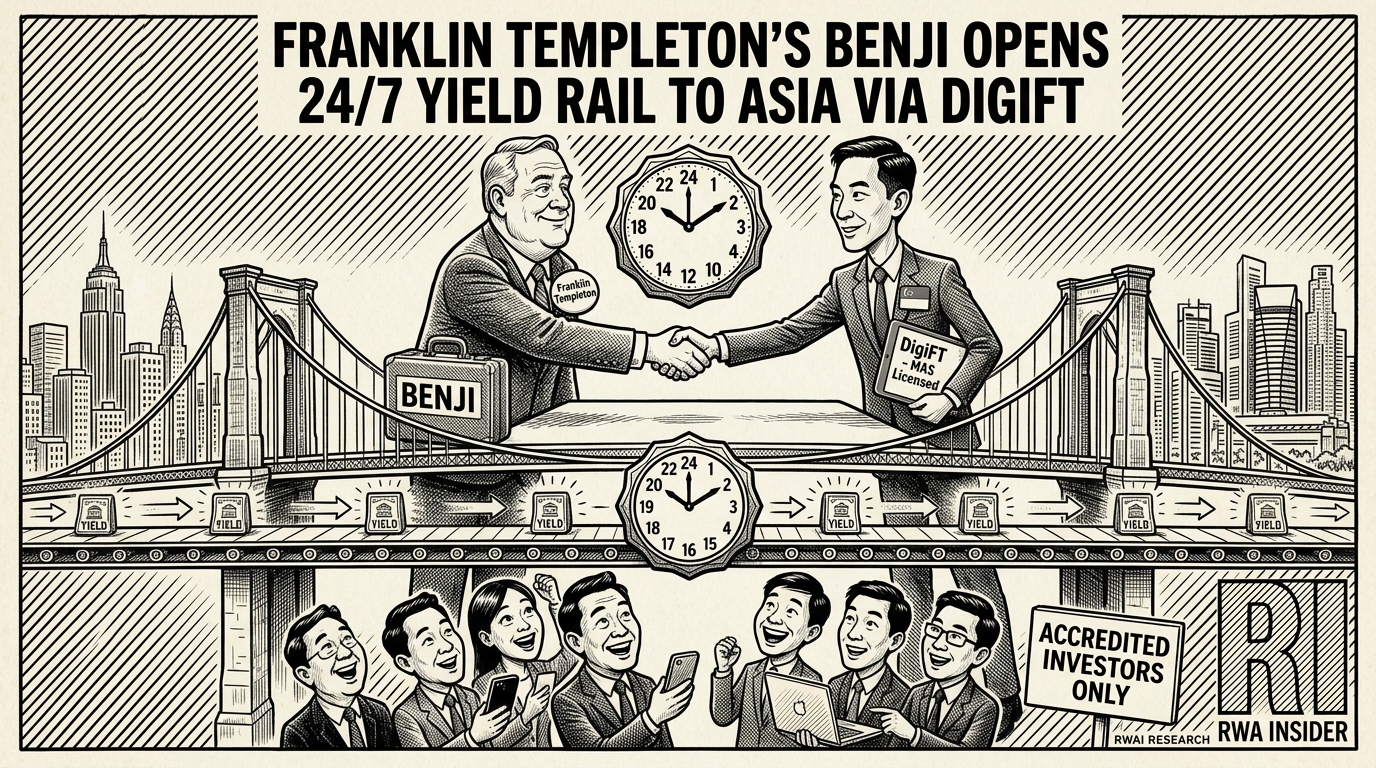
Franklin Templeton and DigiFT launched a long-term strategic partnership on May 22, 2026 to bring the BENJI Technology Platform’s tokenized US government securities to accredited investors across Asia. Markets Media reported the deal, noting DigiFT holds MAS Capital Markets Services and Recognised Market Operator licences in Singapore plus SFC Type 1 and Type 4 licences in Hong Kong. For a DeFi user watching where tokenized Treasury yield infrastructure builds next, the story matters less for who can access BENJI today and more for the 24/7 transferability and intraday yield mechanics now reaching Asia’s institutional capital.
BENJI’s Asia Launch Brings 24/7 Treasury Yield To Institutional Wallets
Henry Zhang, Founder and Group CEO of DigiFT, framed it as “institutional investors deserve access to the world’s best on-chain financial instruments, through a platform that meets the regulatory standard they require.”
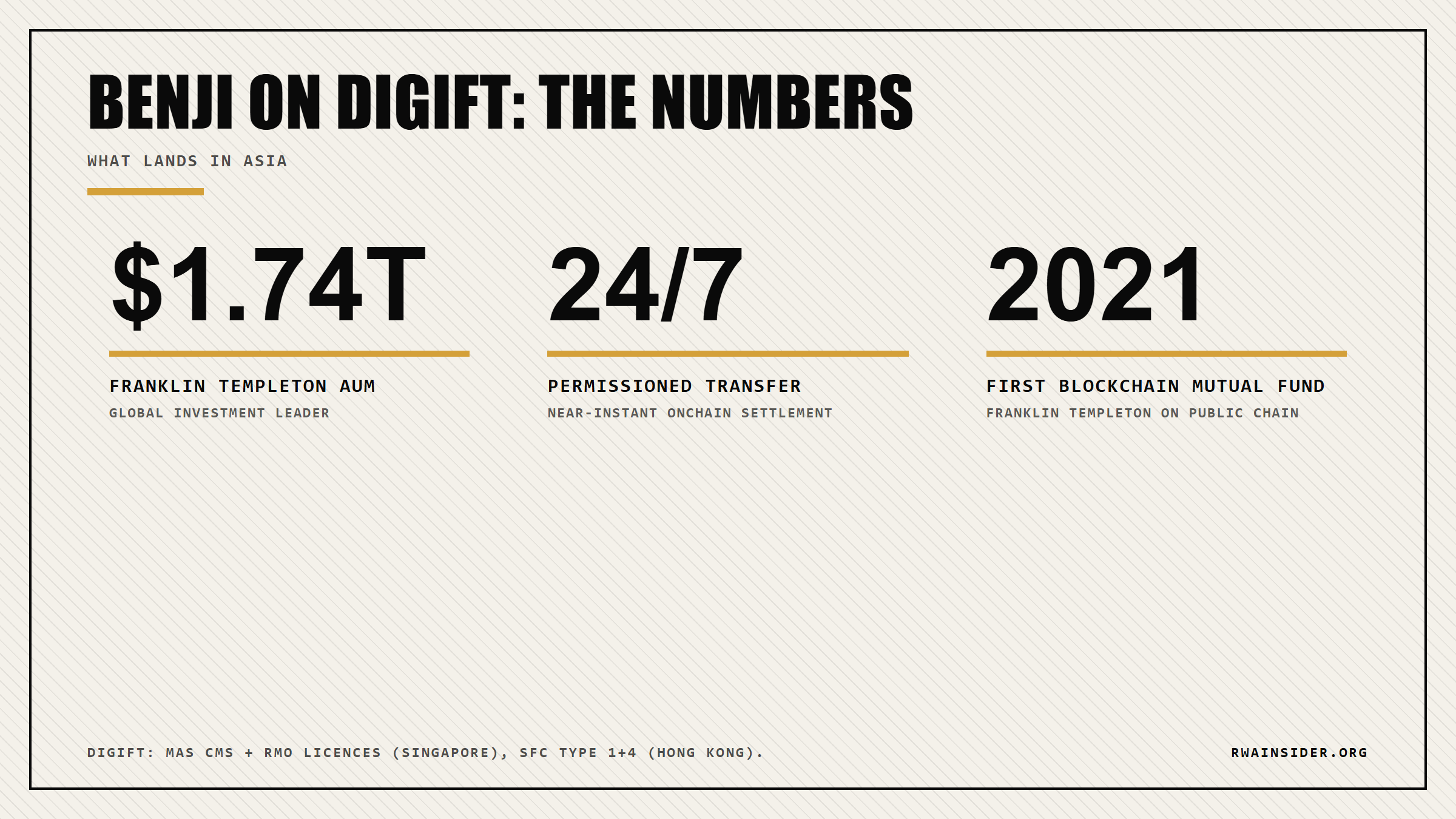
The BENJI Technology Platform supports tokenized US government securities strategies with intraday yield accrual via Franklin Templeton‘s patent-pending mechanism.
BENJI tokens transfer between permissioned wallets 24/7 with near-instant on-chain settlement, enabling treasury management, payment, and off-exchange collateral use cases for institutions.
Franklin Templeton operates with $1.74 trillion in assets under management. The firm launched the first US-registered mutual fund using public blockchain for transactions and share ownership in 2021.
BENJI is Franklin Templeton’s proprietary blockchain-enabled recordkeeping and transfer agency infrastructure, supporting tokenized investment strategies across both retail and institutional channels in the firm’s home market.
DigiFT holds Type 1 and Type 4 licences from the Securities and Futures Commission of Hong Kong, alongside its Singapore MAS licences.
How BENJI’s $18.6B Tokenized Treasury Year Compares To Aave Yields
The partnership lands at a structural inflection point.
Tokenized real-world assets on public blockchains grew from approximately $5.5 billion to $18.6 billion in 2025, with US government securities the leading institutional category per the Markets Media writeup.
That growth reflects what Markets Media called a “structural inefficiency in digital markets, where institutional capital is frequently held in non-yielding stablecoins or on-exchange balances, while traditional fund infrastructure remains constrained by defined settlement cycles.”
BENJI’s intraday yield mechanism plus 24/7 transferability is designed to close that gap.
Strip away the institutional framing and this is really about whether tokenized Treasury yield, accruing every block, can replace stablecoin balances as the default holding for capital between trades.
Readers can compare yields across tokenized Treasury products as more permissioned wallets gain access.
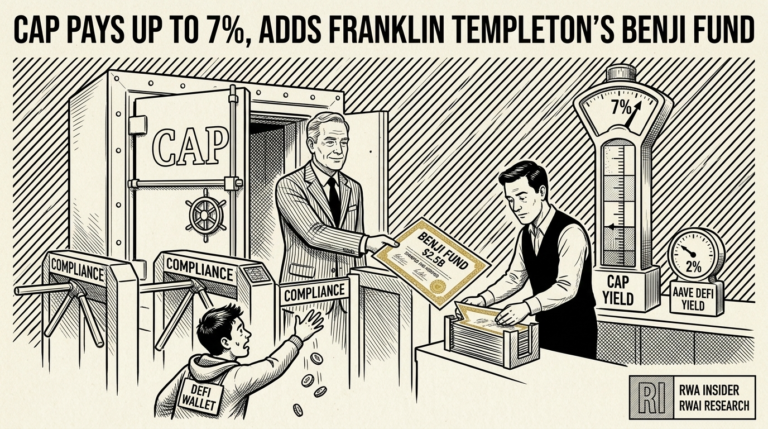
BENJI yield tracks short-duration US Treasury rates. For a DeFi user, the comparison is whether tokenized Treasury exposure beats holding cash in Aave or Compound.
Current US Treasury yields typically outpace DeFi stablecoin lending rates by a meaningful margin, though BENJI access remains accredited-only via DigiFT.
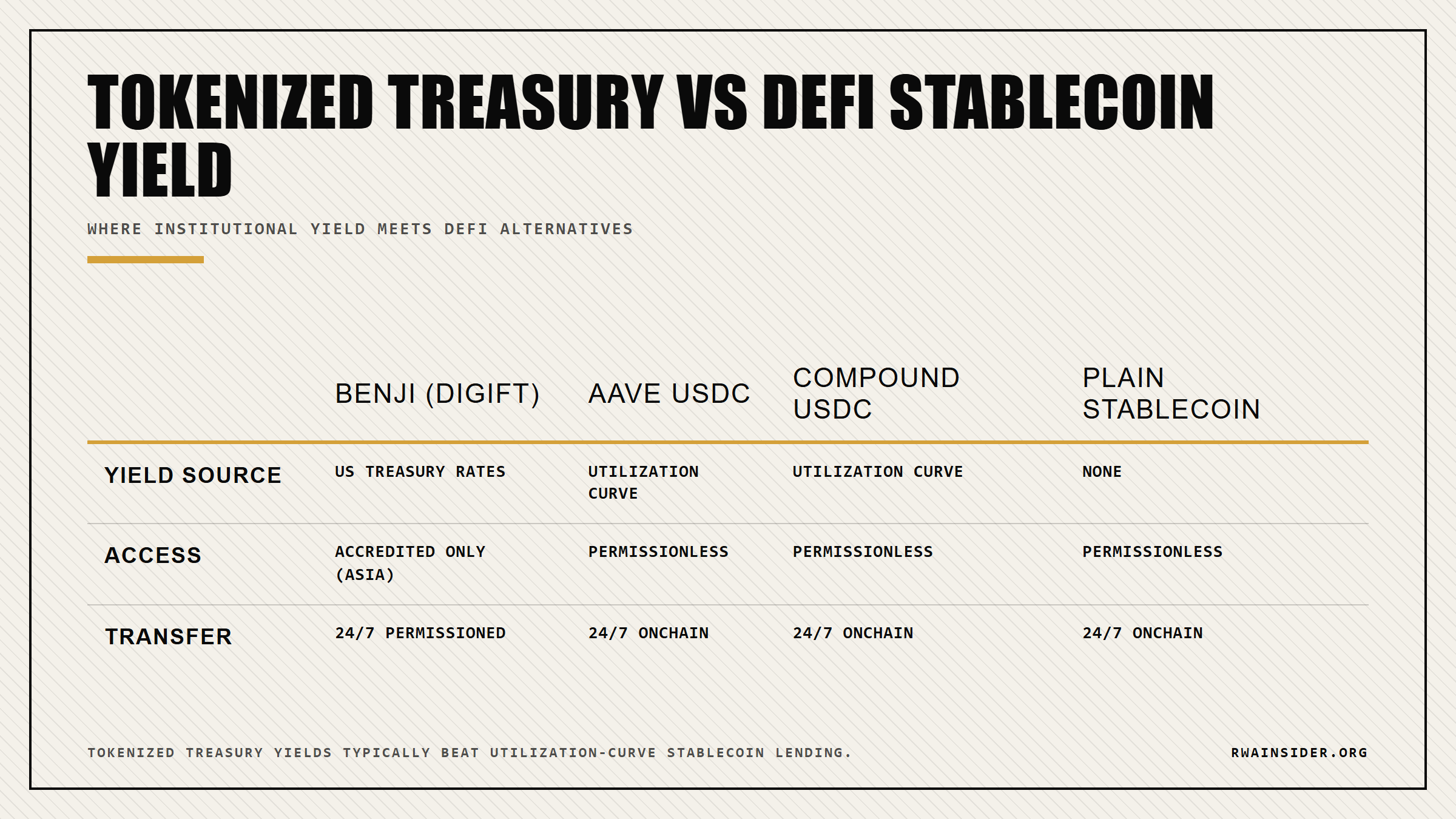
What Franklin Templeton’s Karkhanis And DigiFT Are Building Next
Chetan Karkhanis, SVP for Digital Asset Partnership Development at Franklin Templeton, called the deal “the beginning of what we expect to be an expanding and enduring collaboration.”
The partnership specifically targets institutional treasury management, payment and settlement use cases, and deployable off-exchange collateral.
For DeFi infrastructure observers, the most consequential piece is the intraday-yield plus 24/7-transfer combination. Stablecoin balances that sit idle in wallets become economically inefficient against a tokenized Treasury that accrues yield every block.
Our earlier read on the multi-chain RWA landscape mapped Franklin Templeton’s tokenized products as one of Ethereum’s institutional anchors. This Asia launch extends that anchor into a new regulated distribution zone.
The forward question for retail DeFi is when the BENJI-style intraday yield mechanism reaches permissionless wrappers, or when MAS-licensed access opens beyond accredited investors.
Until then, the story is institutional rails first and retail composability second, with the watch question being when that gap closes.
For the Yield Gap watch list, BENJI’s Asia rollout joins an expanding set of tokenized Treasury products that combine institutional yield with on-chain transferability.
Karkhanis described this as a “long-term commitment, not just our near-term distribution objectives,” which suggests DigiFT is the first of several Asia integrations rather than a one-off.
Whether the intraday-yield mechanic reaches retail wallets depends on regulatory paths in Singapore, Hong Kong, and the US. The next product launch on DigiFT will signal the pace.
Track more Yield Gap coverage from RWA Insider as tokenized Treasury infrastructure expands into new jurisdictions.
Frequently Asked Questions
What is BENJI and how does Franklin Templeton’s platform work?
BENJI is Franklin Templeton’s blockchain-enabled recordkeeping and transfer agency infrastructure for tokenized investment strategies. It launched in 2021 as the world’s first US-registered mutual fund to use public blockchain for transactions and share recordkeeping. The platform now supports tokenized US government securities with intraday yield accrual.
Can a retail DeFi user buy BENJI on DigiFT in Asia?
Not currently. DigiFT distributes BENJI to accredited and institutional investors only, under its MAS Capital Markets Services licence in Singapore and SFC Type 1 and Type 4 licences in Hong Kong. Retail access would require either a regulatory expansion or a permissionless wrapper product.
How does tokenized Treasury yield compare to Aave or Compound stablecoin yields?
Tokenized US Treasury products typically pay a yield close to short-duration government rates. In most market conditions, that beats the variable utilization-curve yields on Aave USDC or Compound stablecoin lending. The trade-off is access restrictions on most current tokenized Treasury products.
What does ’24/7 transferability’ mean for tokenized Treasury holders?
Traditional fund infrastructure operates on defined settlement cycles, typically T+1 or T+2. BENJI’s 24/7 transferability allows permissioned wallets to move tokenized Treasury exposure at any time, with near-instant on-chain settlement. That enables off-exchange collateral and constant treasury management without waiting for market-hours settlement.