
July 18 GENIUS Rules Bar Yield, DeFi Pays Up To 8%
Key Points
- Six US agencies must finalize GENIUS Act stablecoin rules by July 18, and the compliance math prices out any issuer under $200 million.
- A mid-market issuer’s compliance stack runs about $15 million a year against $7.5 million in reserve income, roughly twice its gross revenue.
- The law bans stablecoin yield, so DeFi lending on Ethereum and Solana, still paying up to 8%, becomes the only place idle dollars earn.
Six federal agencies have until July 18 to finalize the GENIUS Act rules that decide who can legally issue a stablecoin in the United States, and the cost structure they impose is one a $200 million issuer cannot survive. Mike McCluskey, CEO of stablecoin infrastructure firm tx, called it “not a one-time licensing fee” but “a recurring operational infrastructure involving segregated reserve accounts, monthly independent audits, transaction monitoring, and dedicated compliance personnel.” For your wallet, the quieter line matters more: the same law bans stablecoin yield outright, and DeFi is where that demand goes next.
The GENIUS Act Rules That Land July 18
The GENIUS Act was signed into law on July 18, 2025, and it gave six agencies exactly one year to write the rules that make it real.
Those agencies, the OCC, FDIC, NCUA, Treasury, FinCEN, and OFAC, must publish final rules by July 18, 2026, with every major comment period already closed on June 9.
The law created a third category: a compliant payment stablecoin is neither a security nor a commodity, but a federally supervised instrument with strict reserve, audit, and anti-money-laundering duties.
None of that scales down for a small operator.
A stablecoin under $200 million carries the same fixed compliance load as one holding tens of billions, and that is the design, not a side effect.
The rules that hand institutional capital a safe market also price mid-market issuers out of it.

The $200M Math And DeFi’s 8% Escape Hatch
Start with the arithmetic. At roughly 3.74% on three-month Treasury bills, a $200 million stablecoin earns about $7.5 million a year in reserve income.
A mid-market compliance stack, covering audits, legal, AML systems, and dedicated officers, costs around $15 million a year.
That issuer spends about twice its gross income on compliance before earning a cent of margin.
Scale the same bill against a $10 billion issuer’s roughly $374 million in reserve income and it drops to about 4%, and at $50 billion it falls below 1%.
Zaheer Ebtikar, chief strategy officer at Plasma, called it “not an explicit prohibition, but a compliance cost floor that is inherently regressive.”
Strip away the rulebook and this is really a yield problem: the statute bars issuers from paying holders any interest, so the dollars that want a return leave the regulated rail.
DeFi lending protocols on Ethereum and Solana already pay 5% to 8% on stablecoin deposits, outside the banking perimeter.
It is the same dynamic that let money market funds drain zero-yield bank deposits after the 1980s, and you can follow each stablecoin rule as it reshapes on-chain yield as the deadline nears.

Tether Waits, Circle Scales, DeFi Absorbs
The concentration is already visible at the top.
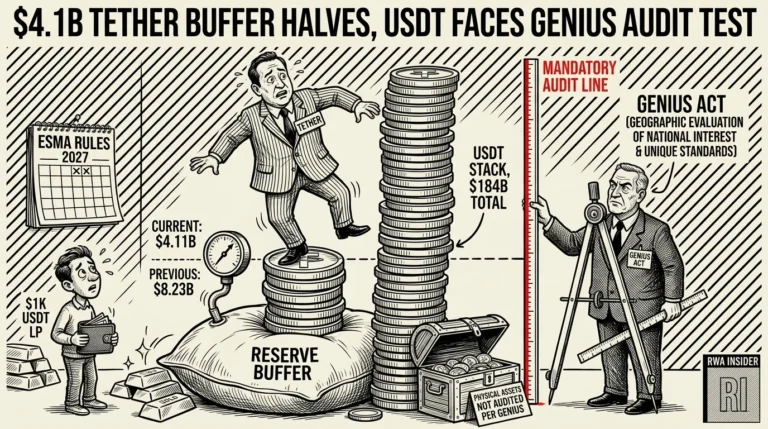
Tether‘s USDT held about $184 billion on July 3, roughly 59% of the whole stablecoin market, yet as a foreign issuer from El Salvador it still needs a Treasury reciprocity ruling that has not come.
Its answer was USAT, a US-chartered coin launched in January that sits near $141 million, a rounding error next to Circle‘s $73 billion USDC.
Circle and Coinbase can absorb the compliance cost, but smaller fintechs cannot, and Stripe and Block now face a raise-or-exit choice.
Circle strategy chief Dante Disparte argues that yield is a secondary-market job for DeFi protocols once the base coin is secured, not something issuers should pay.
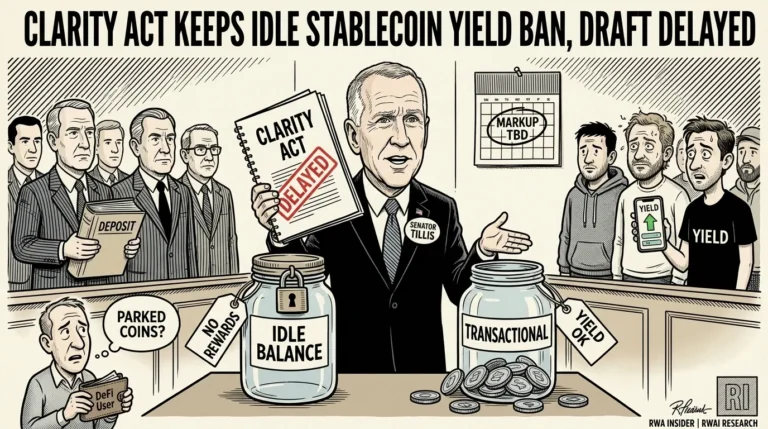
The open risk is the CLARITY Act, which advanced in the Senate in May and carries language that could restrict DeFi yield arrangements that mimic bank deposits.
Non-compliant tokens keep exchange access until July 2028, so nothing delists overnight, but the yield gap is what your portfolio has to price now.
Whether that 8% gap survives depends on how hard the CLARITY Act lands on DeFi, and the July 18 rules are only the opening move. Until an agency blinks or a bill passes, the regulated dollar pays zero and the on-chain one still pays.
If you are chasing that spread, it is worth seeing how one synthetic dollar keeps paying the yield the ban forbids before you park stablecoins anywhere.
Frequently Asked Questions
What is the July 18 GENIUS Act deadline?
July 18, 2026 is the statutory date by which six US agencies, the OCC, FDIC, NCUA, Treasury, FinCEN, and OFAC, must issue final rules for the GENIUS Act. If they meet it, the framework takes effect about 120 days later. If they miss it, the fallback date is January 18, 2027.
Can I still earn yield on stablecoins after the ban?
Not from a regulated issuer. The GENIUS Act bars stablecoin issuers from paying holders any interest, even through affiliates. The yield moves to DeFi lending protocols on Ethereum and Solana, which pay roughly 5% to 8% on stablecoin deposits but carry smart-contract and platform risk.
Is Tether’s USDT going to be banned in the US?
Not immediately. Non-compliant stablecoins keep exchange access until July 18, 2028. Tether, which runs USDT at about $184 billion, still needs a US Treasury reciprocity ruling as a foreign issuer, and it launched a compliant coin, USAT, in January 2026 as a hedge.
Why cannot small stablecoin issuers survive the new rules?
The compliance costs are fixed, not scaled to size. A stablecoin under $200 million earns about $7.5 million a year in reserve income but faces roughly $15 million in annual audit, legal, and AML costs. The bill exceeds the revenue, which pushes the market toward a few large issuers.