Ondo USDY Jumps 66% As Ethena sUSDe Sheds $2B
Key Points
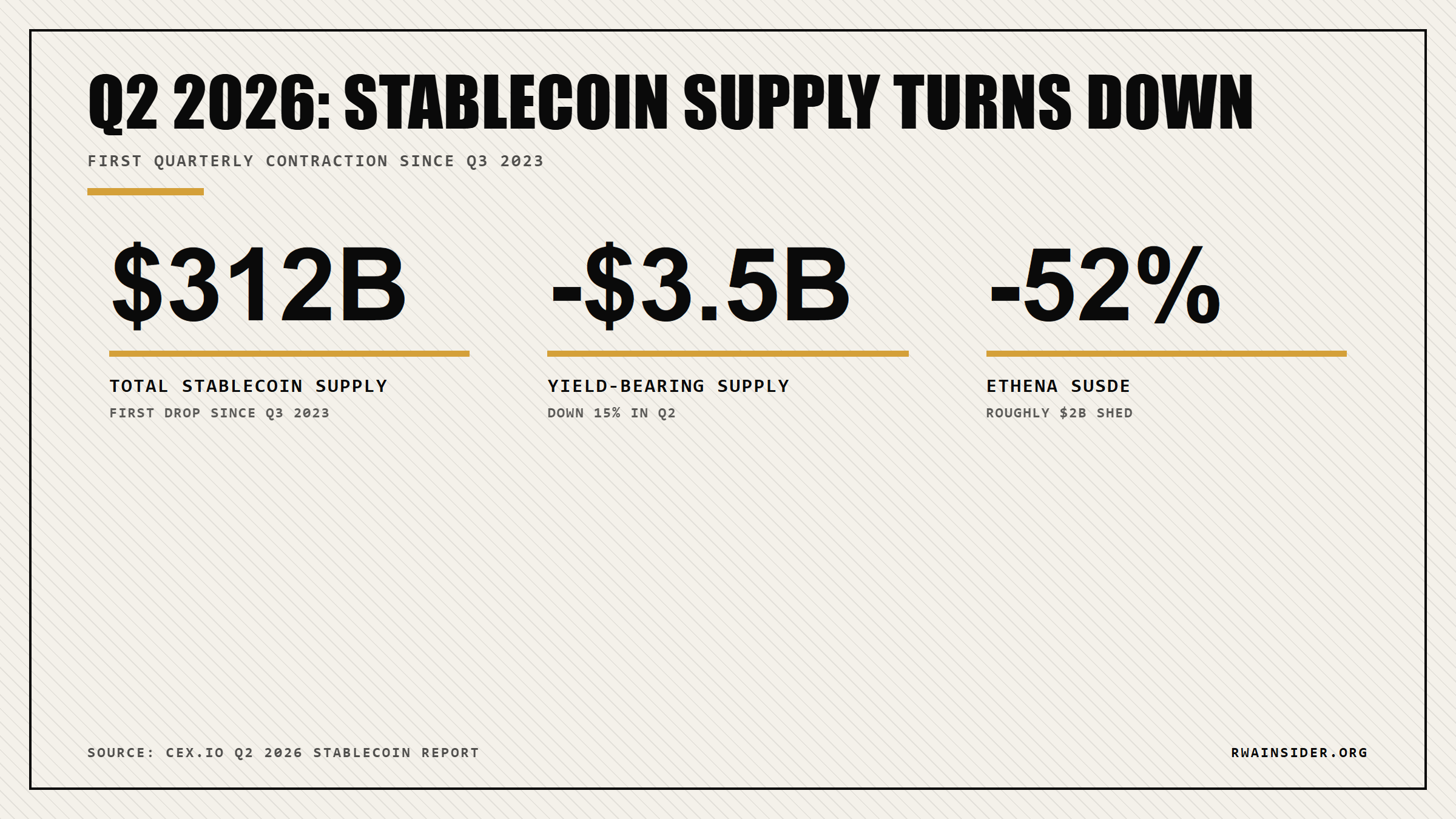
- Yield-bearing stablecoins shed more than $3.5 billion in Q2 2026, pulling the total stablecoin market to $312 billion, its first quarterly drop since 2023.
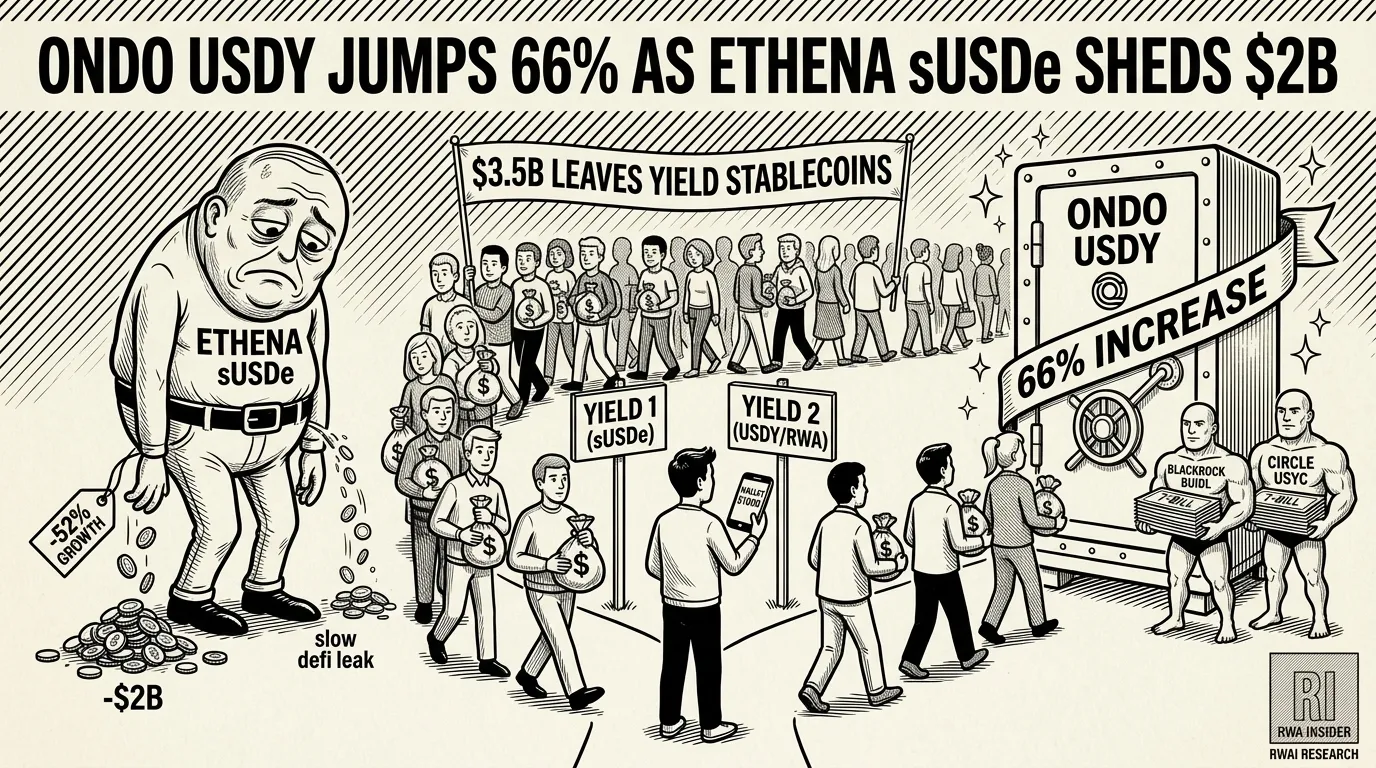
- Ethena’s sUSDe lost 52% of its supply, close to $2 billion, while Sky’s sUSDS fell 16% as demand for synthetic yield cooled.
- RWA-backed yield rose instead: Ondo’s USDY jumped 66% and Circle’s USYC gained 16%, giving a yield-seeking wallet a lower-risk, Treasury-backed lane.
Yield-bearing stablecoins lost more than $3.5 billion in supply during the second quarter of 2026, dragging the total stablecoin market down to $312 billion and into its first quarterly contraction since 2023. The figures come from CEX.IO’s Q2 2026 stablecoin report, which described the quarter as the market’s “first quarterly decline since the third quarter of 2023.” For a wallet parked in a synthetic-yield token like Ethena’s sUSDe, this is the quarter the crowd started moving. It did not move away from yield. It moved toward tokenized Treasuries.
The $3.5B Exit From Yield-Bearing Stablecoins
Yield-bearing stablecoin supply fell 15% in the second quarter, a sharp reversal after climbing every quarter since mid-2023, a run that included a 19% jump in the prior three months.
The losses landed almost entirely on DeFi-native products. Ethena‘s sUSDe lost more than half its market cap, falling 52% and shedding close to $2 billion, while Sky’s sUSDS dropped 16%.
Those two tokens drove most of the contraction between them. They are the synthetic dollars that pay a return through trading strategies, not through a vault of Treasury bills.
The majors split too. USDT supply grew by $500 million over the quarter while USDC supply fell $3.2 billion, reversing the positions the two held in the first quarter.
The wider market cooled with them. Trading volume fell 18% to $6.8 trillion, and total stablecoin transactions posted their largest absolute quarterly drop on record.
Adjusted transaction volume fell 5.5% to $4.09 trillion, breaking a ten-quarter growth streak and confirming the slowdown was activity-wide, not just a yield-token story.
Where The Money Went: Ondo USDY And BUIDL
Treasury-backed yield went the other way. Ondo Finance‘s USDY jumped more than 66% over the quarter, the strongest growth anywhere in the category.
BlackRock’s BUIDL added 2% and Circle’s USYC climbed nearly 16%, a clean rotation out of crypto-collateralized synthetic yield and into real-world asset yield.
Strip away the report and this is really about which yield a wallet trusts: the kind spun from funding rates, or the kind backed by short-term U.S. Treasuries you can verify on-chain.
The same preference showed up in the majors. USDC trading volume rose 34% to an all-time-high 12.5% share of crypto trading, while USDT volume fell 24%.
Bigger players are building for it. Lido opened institutional stablecoin vaults for USDT and USDC in March, routing corporate treasury and family-office deposits into curated lending markets.
For a $1,000 wallet, the practical on-ramp arrived this week. MetaMask opened a consumer Money Account paying up to 4% on its mUSD stablecoin, built on Monad and tied to the MetaMask Card.
You can track how tokenized-Treasury yield keeps stacking up against DeFi-native rates as the rotation runs.

Why RWA Yield Is Pulling Capital From sUSDe
The sUSDe drop is not a depeg. It is a demand story.
Synthetic yield leans on funding-rate spreads, so when those spreads compress, the reason to hold the token compresses with them.
Treasury-backed tokens do not carry that sensitivity, which is why capital rotated toward them even as the overall market shrank.
Ondo Finance, run by co-founder and chief executive Nathan Allman, built USDY on exactly that pitch: short-term Treasury yield with on-chain transparency.
When RWA Insider covered Ondo’s tokenized-Treasury premium over Aave’s USDC rate, the same logic played out a month early.
Access is still the catch. USDY and BUIDL gate many wallets behind KYC, so the cleanest permissionless route for a small holder is a consumer product like MetaMask’s mUSD account rather than the institutional funds themselves.
Watch the plumbing too. Stablecoin supply on Ethereum Layer-2 networks fell 24%, with Arbitrum shedding 45% as HyperEVM’s own supply grew 300% to $5.6 billion.
Whether this is a one-quarter wobble or the start of a durable rotation depends on funding rates and how long tokenized-Treasury yield stays ahead, and the third quarter will tell. Until synthetic yield out-earns the extra risk again, the capital is quietly voting for Treasuries.
If you hold a synthetic-yield token, the move is not to panic-sell but to check what actually backs your yield, and whether a Treasury-backed option now pays enough to make switching worth it.
Frequently Asked Questions
Why did yield-bearing stablecoins lose $3.5 billion in Q2 2026?
Demand for synthetic yield cooled after two years of growth. Ethena’s sUSDe alone shed close to $2 billion, a 52% supply drop, and Sky’s sUSDS fell 16%. The two tokens drove most of the 15% decline in yield-bearing supply that quarter.
What is the difference between Ethena’s sUSDe and Ondo’s USDY?
sUSDe is a synthetic dollar that pays yield from a funding-rate trading strategy, so its return moves with market conditions. USDY is backed by short-term U.S. Treasuries, so its yield tracks Treasury rates. In Q2 2026, USDY supply grew 66% while sUSDe fell 52%.
Can I earn RWA yield with a $1,000 wallet?
Directly holding USDY or BUIDL often requires clearing a KYC allowlist, which locks out many retail wallets. The more open route is a consumer product like MetaMask’s new Money Account, which pays up to 4% on its mUSD stablecoin built on Monad.
Is Ethena’s sUSDe still safe to hold?
The Q2 drop was a fall in supply, not a depeg, so sUSDe held its dollar value. The risk is that its yield depends on funding-rate spreads that can compress, which is why capital rotated toward Treasury-backed tokens. Check current funding rates before deciding.