$250M Ethena Allocation Lands On Solana Via Securitize CLO
Key Points
- Securitize listed its Tokenized AAA CLO Fund, STAC, on Solana, and Ethena Labs plans to allocate $250 million into the institutional credit fund.
- Tokenized real-world assets on Solana have jumped about 75% in 30 days to more than $611 million, trailing only Ethereum and zkSync Era in Securitize’s rankings.
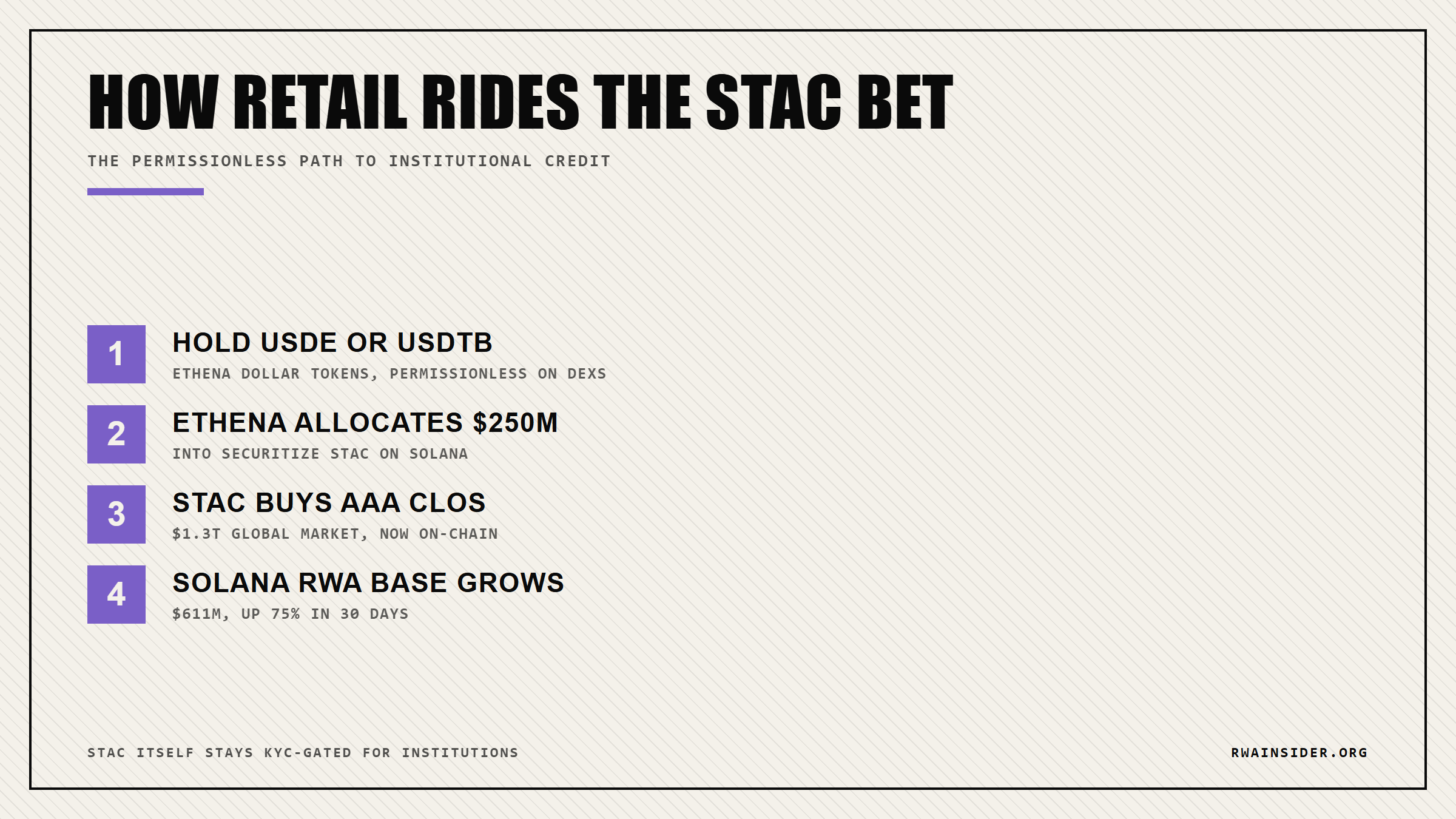
- STAC stays KYC-gated, but a $1,000 wallet can hold Ethena’s USDe or USDtb on a DEX, riding the same tokenized-credit thesis permissionlessly.
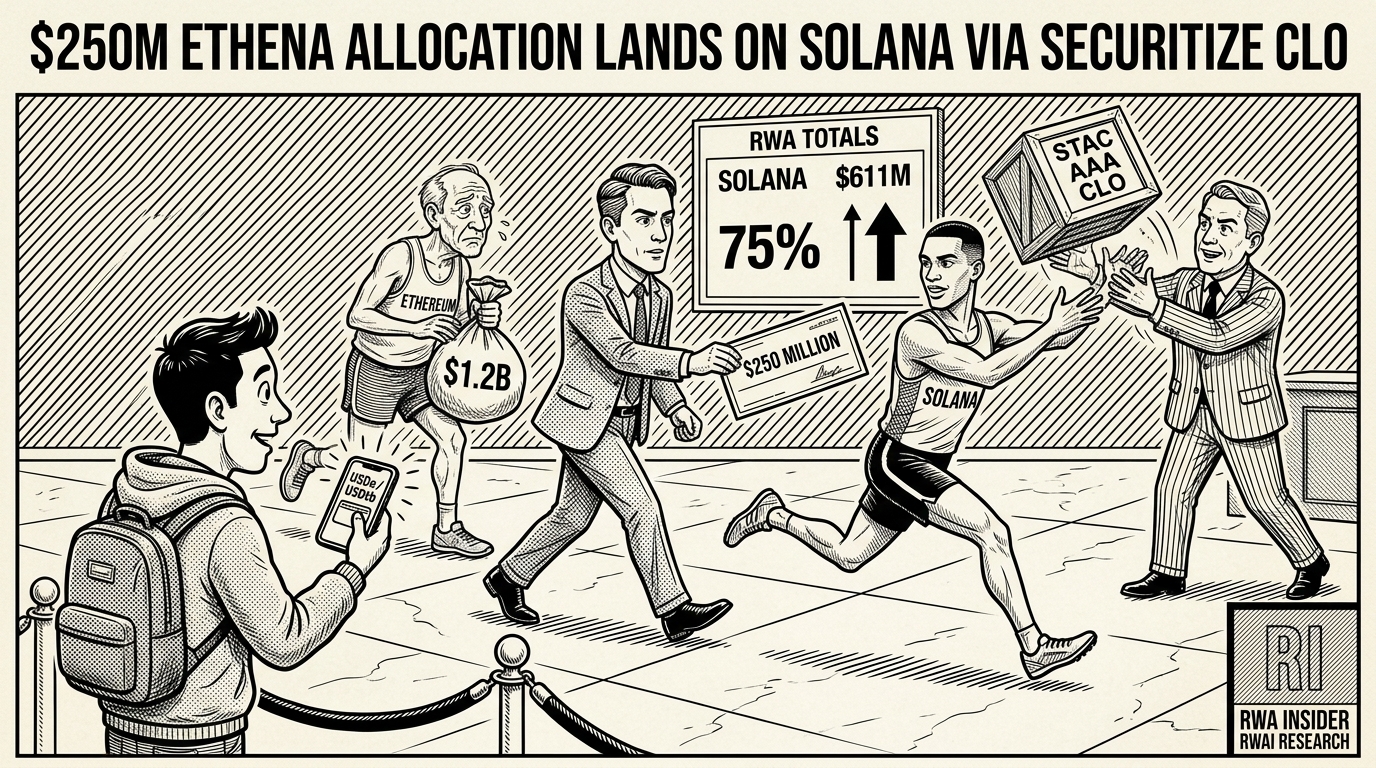
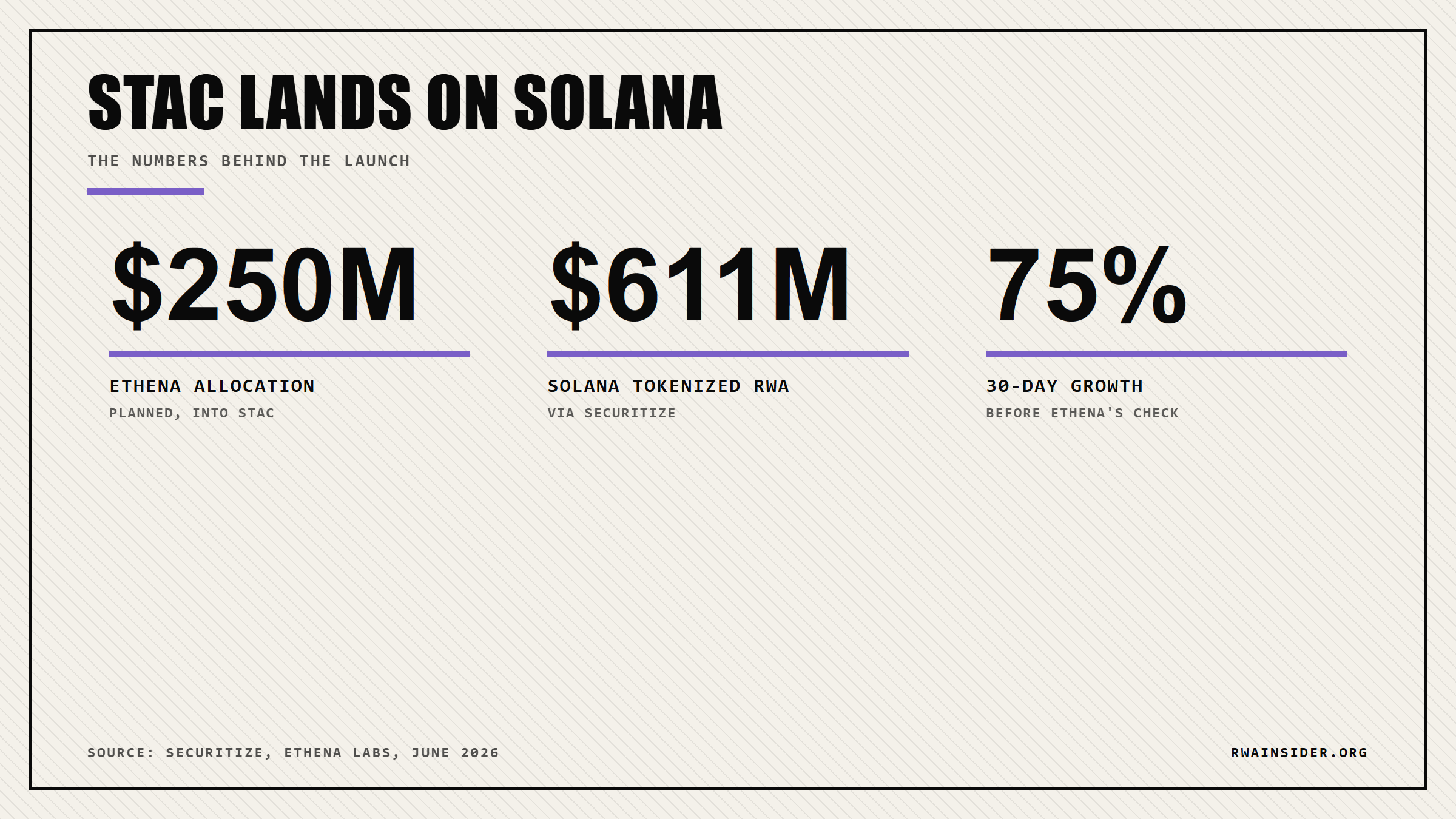
Securitize listed its Tokenized AAA CLO Fund, STAC, on Solana on June 12, and Ethena Labs plans to pour $250 million into it, one of the largest commitments to tokenized structured credit Solana has seen. “Tokenization is most powerful when it combines quality assets with the speed, efficiency and accessibility of blockchain infrastructure,” said Carlos Domingo, co-founder and CEO of Securitize. You cannot buy STAC with a $1,000 wallet, but you can hold Ethena’s USDtb today, the dollar token from the same firm now buying tokenized credit.
STAC Brings AAA CLO Credit Onto Solana
Securitize, a tokenization platform with more than $4 billion under management, made its Tokenized AAA CLO Fund live on Solana.
STAC holds only AAA-rated collateralized loan obligations, the top slice of one of the largest corners of global fixed income.
BNY runs custody and acts as sub-adviser through BNY Investments, so the plumbing behind the token is a 240-year-old bank, not a DeFi startup.
Here is the catch for any wallet: STAC is built for institutions, gated behind KYC and accreditation, and a $1,000 balance does not get you in.
What changed is the address, since the fund now settles on Solana, the same chain where Raydium, Orca, and Kamino already route retail DeFi flow.
That puts AAA structured credit one block away from the permissionless market, even if the fund token itself stays walled off for now.
Solana’s $611M RWA Stack Trails Only Ethereum
The reason Securitize picked Solana shows up in the growth curve.
Tokenized assets on Solana through the platform jumped roughly 75% in the past 30 days, and that count predates Ethena’s planned money.
Solana now carries more than $611 million in tokenized real-world assets, ranking behind only Ethereum and zkSync Era in Securitize’s tally.
Ethereum still leads with over $1.2 billion tracked through the same ecosystem, but lower fees and faster settlement keep pulling issuers toward Solana, Avalanche, and Aptos.
The prize is enormous, since global CLO issuance tops $1.3 trillion and almost none of it lives on-chain yet.
For a DeFi user, this matters less as an institutional fund launch than as proof that the chain under your wallet is winning real credit, not just stablecoin loops.
Ethena, the team behind the USDe and USDtb dollar tokens, is writing the $250 million check, and it treats tokenized RWAs as core infrastructure for those products.
You can hold USDe or USDtb in a wallet today, permissionless and tradable on a DEX, the closest retail seat to the thesis Ethena is funding.
For the wider map of how chains fight over this capital, track the protocol battles shaping tokenized credit.
Why Ethena’s $250M Bet Targets Solana
The Solana Foundation is not hiding its ambition here.
“Solana is the premier destination for institutional capital moving onchain,” said Nick Ducoff, head of institutional growth at the Solana Foundation, tying the STAC launch to a broader convergence of bank assets and on-chain markets.
Ethena founder Guy Young framed the allocation as a long bet, not a one-off.
“As onchain finance evolves, we believe tokenized real-world assets will play an increasingly important role in supporting scalable, capital-efficient financial systems,” Young said.
The $250 million would rank among the largest public allocations into a single tokenized credit product so far.
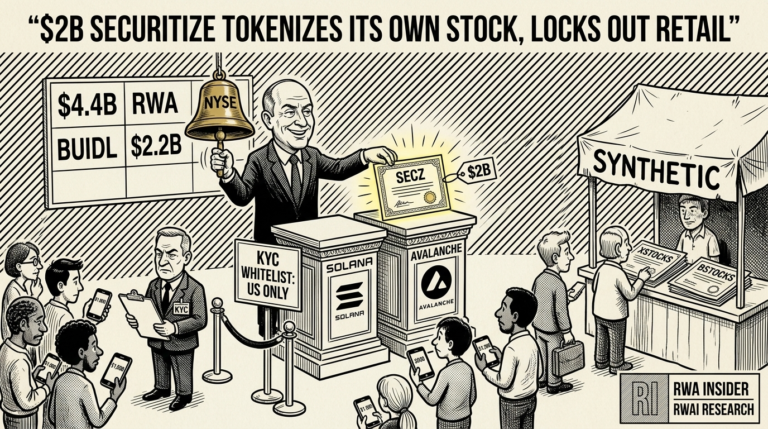
A corporate clock is ticking too, since Securitize is merging with Cantor Equity Partners II to list on the NYSE under the ticker SECZ, pending approvals.
For now the access split is clean: STAC stays KYC-gated for institutions, while the retail path runs through Ethena’s permissionless dollar tokens and Solana’s open DeFi venues.
The open question is whether any of this tokenized credit ever lands in a lending market a $1,000 wallet can actually borrow against.
Whether Solana’s credit lead holds depends on issuers following Securitize past the $611 million mark, and the next quarter of allocations will tell. Ethereum still sits on a $1.2 billion cushion, so the chain battle for tokenized credit is far from settled.
Want to see how fast Solana is closing the gap? Our breakdown of how Solana’s RWA base is scaling against its DeFi liquidity shows where the capital is actually landing.
Frequently Asked Questions
What is Securitize’s STAC fund and how does it work?
STAC is Securitize’s Tokenized AAA CLO Fund, holding only AAA-rated collateralized loan obligations sourced from primary and secondary markets. BNY acts as custodian and sub-adviser. The fund uses no leverage and targets floating-rate structured credit returns.
Can I buy STAC with a small DeFi wallet?
No. STAC is built for institutions and gated behind KYC and accreditation, so a $1,000 wallet cannot hold it directly. The closest retail route is holding Ethena’s USDe or USDtb, which trade permissionlessly on DEXs.
Why is Ethena allocating $250 million to tokenized credit?
Ethena treats tokenized real-world assets as core infrastructure for its USDe and USDtb dollar tokens. Founder Guy Young calls them increasingly important for capital-efficient on-chain finance. The $250 million is among the largest public allocations into a single tokenized credit product.
How does Solana compare to Ethereum for tokenized assets?
Solana holds more than $611 million in tokenized real-world assets through Securitize, up roughly 75% in 30 days, ranking behind only Ethereum and zkSync Era. Ethereum still leads with over $1.2 billion, but Solana’s lower fees are closing the gap.