JPMorgan Files Tokenized Treasury Fund On Ethereum, Eyes $13T
Key Points
- JPMorgan filed in May 2026 to launch a tokenized U.S. Treasury money-market fund directly on Ethereum’s public blockchain.
- JPMorgan moved its JPM Coin deposit token to Coinbase’s Base in late 2025 and projects the tokenized RWA market hitting $13 trillion by 2030.
- None of it touches a $1,000 wallet yet, but the tokenized Treasuries land on Ethereum and Base, the chains DeFi already runs on.
JPMorgan filed in May 2026 for approval to launch a tokenized U.S. Treasury money-market fund directly on Ethereum’s public blockchain, first reported by CoinDesk. It is the clearest sign yet the largest U.S. bank is building on open rails, not a closed ledger, eight years after its 2019 JPM Coin launch. As the World Economic Forum put it, tokenization “introduces a shared system of record and programmable, real-time asset transfer, reducing settlement risk.” For a DeFi wallet, the signal is the venue: the collateral banks have hoarded is moving onto the chains you already use.
JPMorgan Files A Treasury Fund On Ethereum
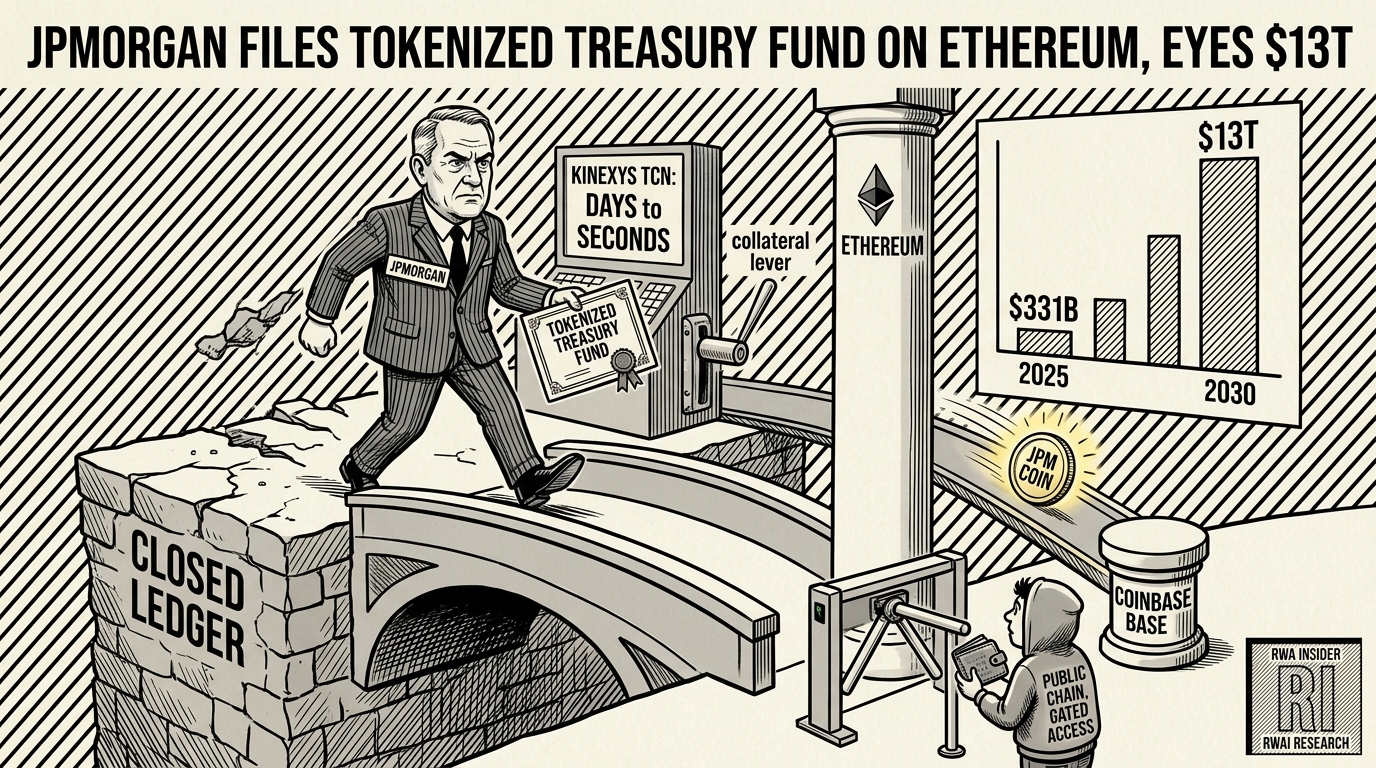
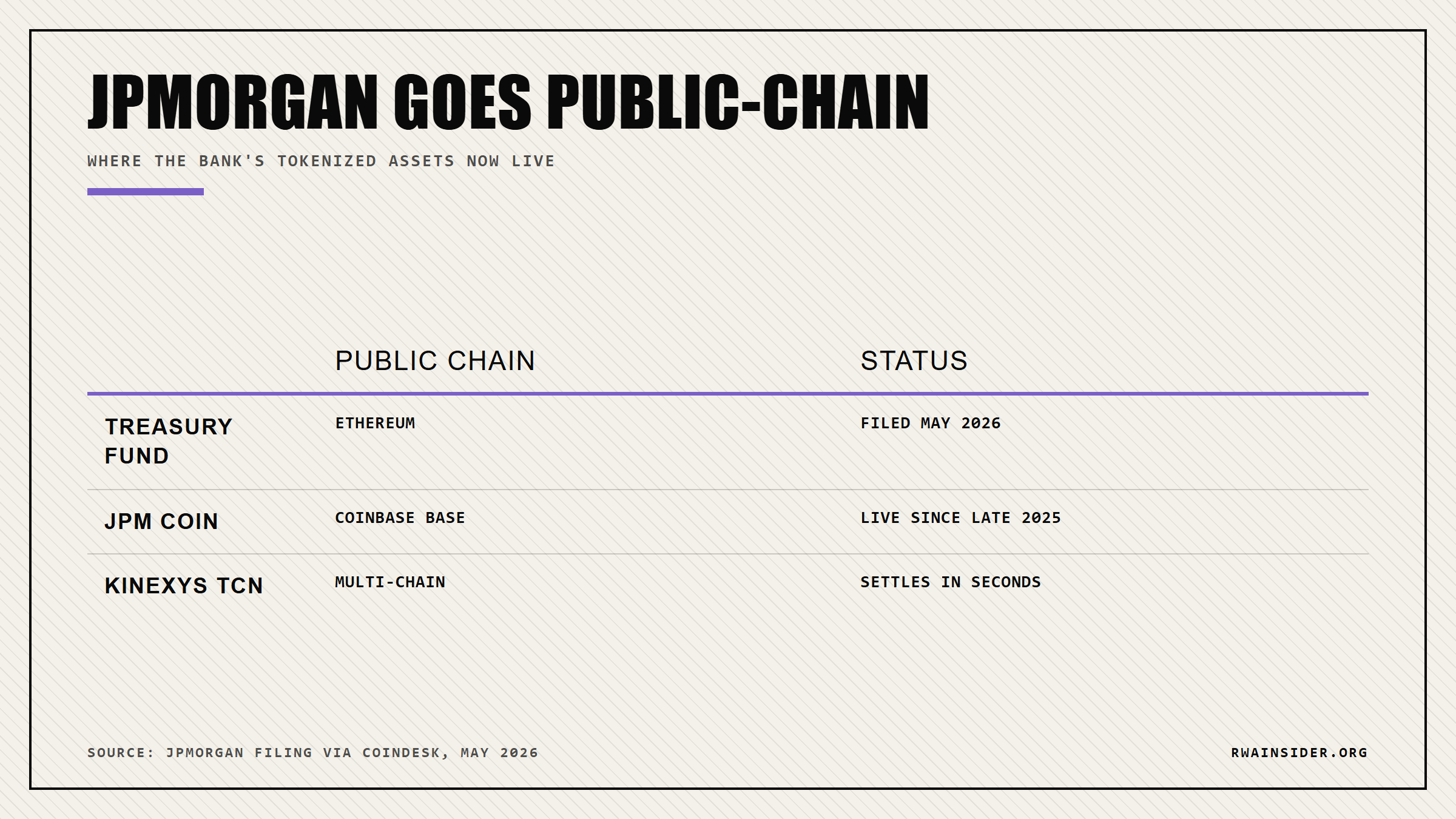
JPMorgan filed in May 2026 for regulatory approval to launch a tokenized U.S. Treasury money-market fund on Ethereum, the public blockchain.
This is not an internal pilot. The fund would settle on the same open network any wallet touches, not a private bank database.
The filing follows a louder move from late 2025, when JPMorgan shifted its JPM Coin deposit token onto Coinbase’s Base, a public Ethereum layer-2.
By choosing Base over a proprietary chain, the bank publicly backed interoperable, non-proprietary standards instead of the closed ledger it ran for years.
That choice caps eight years of build-out since JPM Coin first launched in 2019.
For an on-chain user, the catch is access. This is a regulated money-market product, so it arrives KYC-gated and aimed at institutions, not a permissionless token you can swap today.
Kinexys Turns Treasuries Into On-Chain Collateral
Behind the filing sits Kinexys, the platform JPMorgan rebranded from Onyx in November 2024.
It now runs three jobs at once: programmable payments, real-world asset tokenization, and near-real-time multi-currency settlement.
The same design lets institutional clients represent Treasury securities, equity shares, commodities, and private equity funds as on-chain tokens while staying inside compliance rules.
JPMorgan’s latest tokenized private equity fund shows the rails now carry principal-protected products, not just simple cash tokens.
The piece that matters for DeFi is the Tokenized Collateral Network. It lets participants pledge tokenized assets as collateral with no intermediate custodian, cutting settlement cycles from days to seconds.
Strip away the press release and this is really about JPMorgan laying the collateral DeFi has wanted onto the same chains your wallet already runs on.
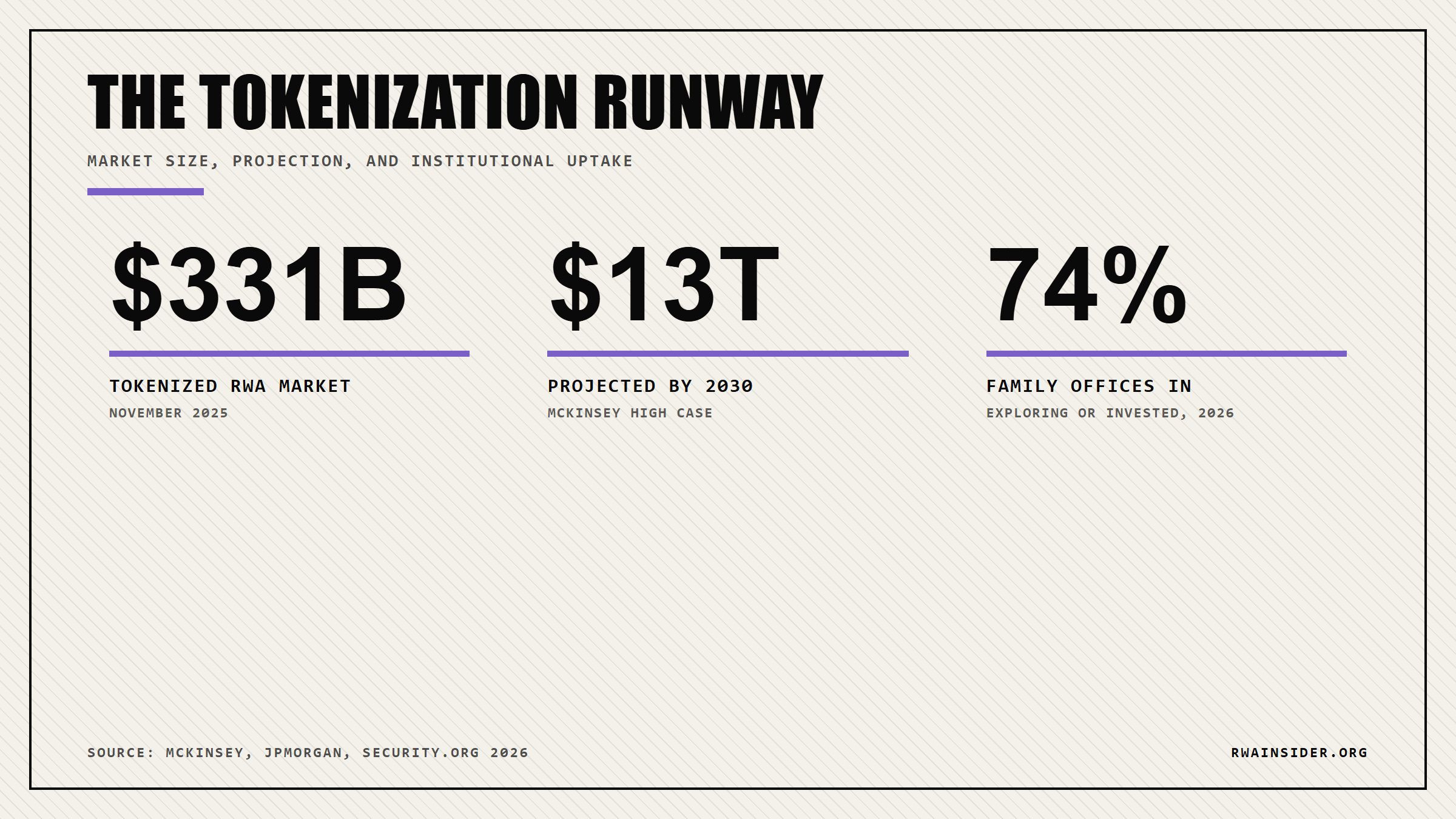
The scale behind it is large. The tokenized real-world asset market sat near $331 billion in November 2025, and JPMorgan projects it reaching as much as $13 trillion by 2030.
It is not alone on those rails. Siemens issued a 300 million euro corporate bond on a public chain in May 2026, proof the shift now reaches fixed income, not just cash deposits.
You can track which chains are winning institutional RWA flow as more of that supply lands on-chain.
The $13T Bet Still Locks Retail Wallets Out
The institutional read is bullish. Citi Institute argued in its November 2025 “Beyond Stablecoins” report that bank-issued tokens could boom as settlement moves on-chain.
McKinsey frames the runway, putting tokenized assets between $2 trillion and $13 trillion by 2030, with 74% of family offices already exploring or invested.
Regulation is clearing the path. The SEC now lets institutions file tokenized fund offerings on public blockchains, and Congress is advancing the bipartisan Digital Commodities Consumer Protection Act.
The friction is real. Cross-chain standards stay fragmented, legacy custody and clearing systems were not built for instant settlement, and a token that satisfies the SEC can still break European or Asian rules.
For a wallet holder, none of it unlocks access yet. JPMorgan’s fund checks identity at the door, and its collateral network stays inside an institutional ring fence.
What changes is location. Once tokenized Treasuries sit on Ethereum and Base, the gap between a bank’s collateral and a DeFi lending market becomes a permission setting, not a separate system.
Whether those tokenized Treasuries ever become collateral a $1,000 wallet can borrow against depends on when JPMorgan opens the gate, and the next round of filings will tell.
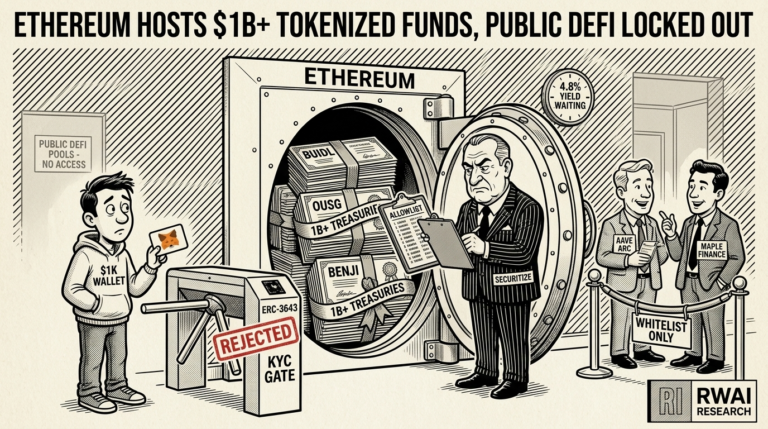
For the live version of this gap, see how Ethereum already hosts more than $1 billion in tokenized funds that public DeFi still cannot reach.
Frequently Asked Questions
What did JPMorgan file with regulators in May 2026?
JPMorgan filed for approval to launch a tokenized U.S. Treasury money-market fund on Ethereum’s public blockchain, a step CoinDesk first reported. It applies the same regulatory pathway used for spot Bitcoin ETFs to a Treasury-backed on-chain fund.
Can a retail DeFi wallet buy JPMorgan’s tokenized Treasury fund?
No. It is a regulated money-market product, so it is KYC-gated and built for institutions, not a permissionless token you can swap on a DEX. The asset lives on Ethereum, but access stays behind an identity check for now.
What is Kinexys and what does it do?
Kinexys is JPMorgan’s blockchain platform, rebranded from Onyx in November 2024. Its Tokenized Collateral Network lets institutions pledge tokenized Treasuries and equities as collateral with no intermediate custodian, cutting settlement from days to seconds.
How large could the tokenized real-world asset market get?
The market sat near $331 billion in November 2025. JPMorgan and McKinsey project it reaching $2 trillion to $13 trillion by 2030, with 74% of family offices already exploring or investing in blockchain-based assets.