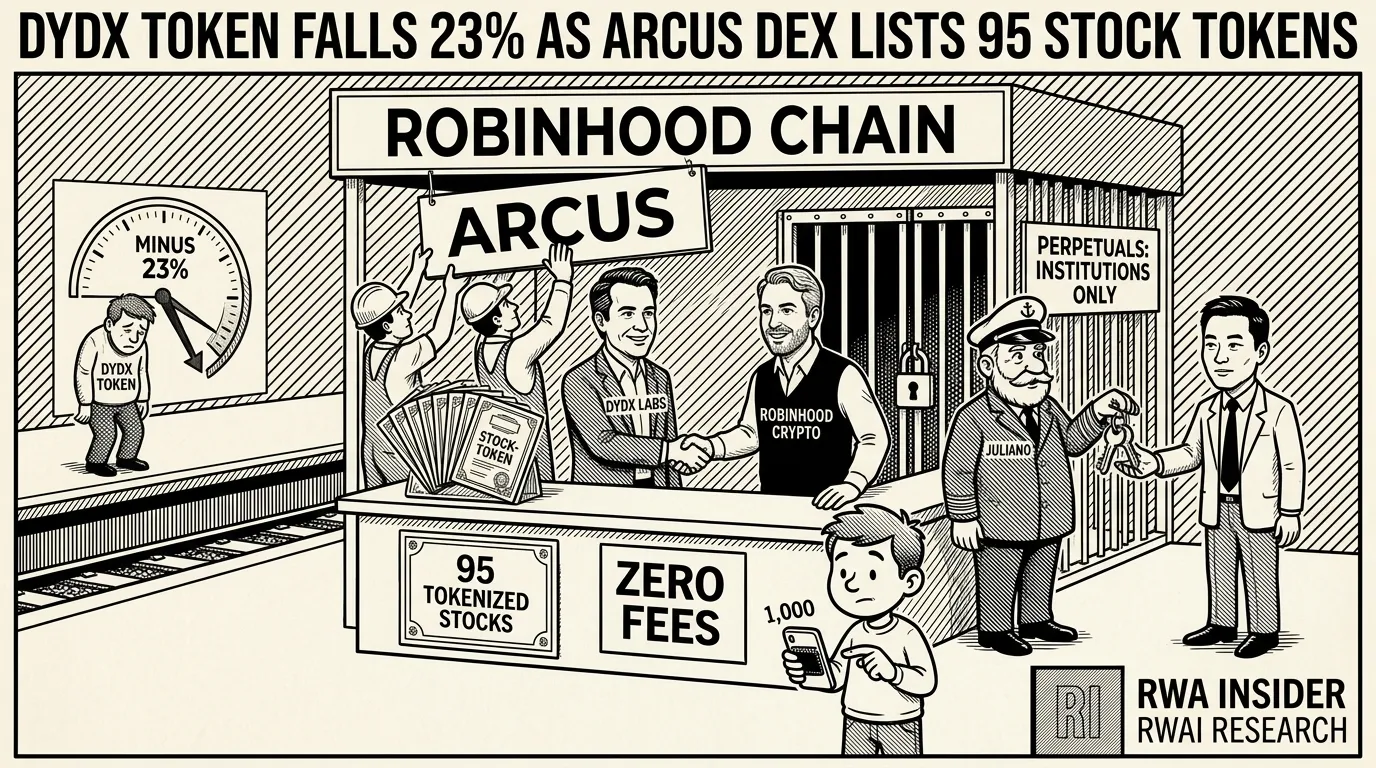
dYdX Token Falls 23% As Arcus DEX Lists 95 Stock Tokens
Key Points
- Arcus, a joint venture between dYdX Labs and Robinhood Crypto, launched a tokenized-stock and perpetuals DEX on Robinhood Chain on July 1.
- The DYDX token fell 23% within a day as founder Antonio Juliano moved to a board role and Eddie Zhang became CEO.
- Outside the US, UK and Canada, any wallet can trade 95 tokenized stocks at zero spot fees on Arcus, while perpetuals stay in institutional beta.
Arcus, a decentralized exchange for tokenized stocks and crypto perpetuals, went live on Robinhood Chain on July 1 as a joint venture between dYdX Labs and Robinhood Crypto, and the DYDX token fell about 23% within a day. Founder Antonio Juliano confirmed it as he stepped back to a board role, writing that “the best move for me, for the team, and for the dYdX community is Arcus, with Eddie at the helm.” For a wallet holder, Arcus opened zero-fee spot trading on 95 tokenized stocks outside the US, UK and Canada, while perpetuals stay locked to institutions.
dYdX And Robinhood Crypto Launch Arcus As A Separate DEX
dYdX Labs and Robinhood Crypto have launched Arcus, a new decentralized exchange for tokenized stocks and crypto perpetual futures, on Robinhood Chain.
The exchange went live on July 1 and runs as a separate entity with its own planned token, moving dYdX’s derivatives future off the dYdX chain and onto a network built for tokenized assets.
Robinhood Chain is an Ethereum Layer 2 built on Arbitrum Orbit and fully EVM-compatible, designed to host tokenized real-world assets like on-chain equities.
The leadership changed with it. Founder Antonio Juliano moved to an executive board role, and Eddie Zhang, who previously worked at dYdX, took over as chief executive and co-founder of Arcus.
For on-chain users, the launch reads less like a product update than a relocation: the team behind one of DeFi’s largest perp venues is rebuilding on a chain purpose-built for stocks.

Zero-Fee Spot On 95 Tokenized Stocks, But Perps Stay Gated
At launch, Arcus opened zero-fee spot trading on 95 tokenized stocks, available 24/7 to wallets outside the US, UK and Canada.
The perpetual futures are the catch. They sit in private beta for institutions and large-volume traders, with a public waitlist and no announced rollout date for retail.
The bigger idea is cross-margining. Arcus plans to let tokenized stock positions back perpetual futures inside one account.
That would let a trader hold tokenized Apple and a crypto perp together, without splitting capital across separate venues, the fragmented setup most derivatives users live with today.
Strip away the joint-venture language and this is really about who controls the collateral rail when a wallet wants to margin a tokenized stock against a crypto position.
For now, the open door is spot.
A $1,000 wallet outside the three excluded countries can trade tokenized stocks at no fee, and it can compare where tokenized stocks are gaining on-chain liquidity across venues.
The perps are where the real design lives, and they are exactly the part a retail wallet cannot reach yet.
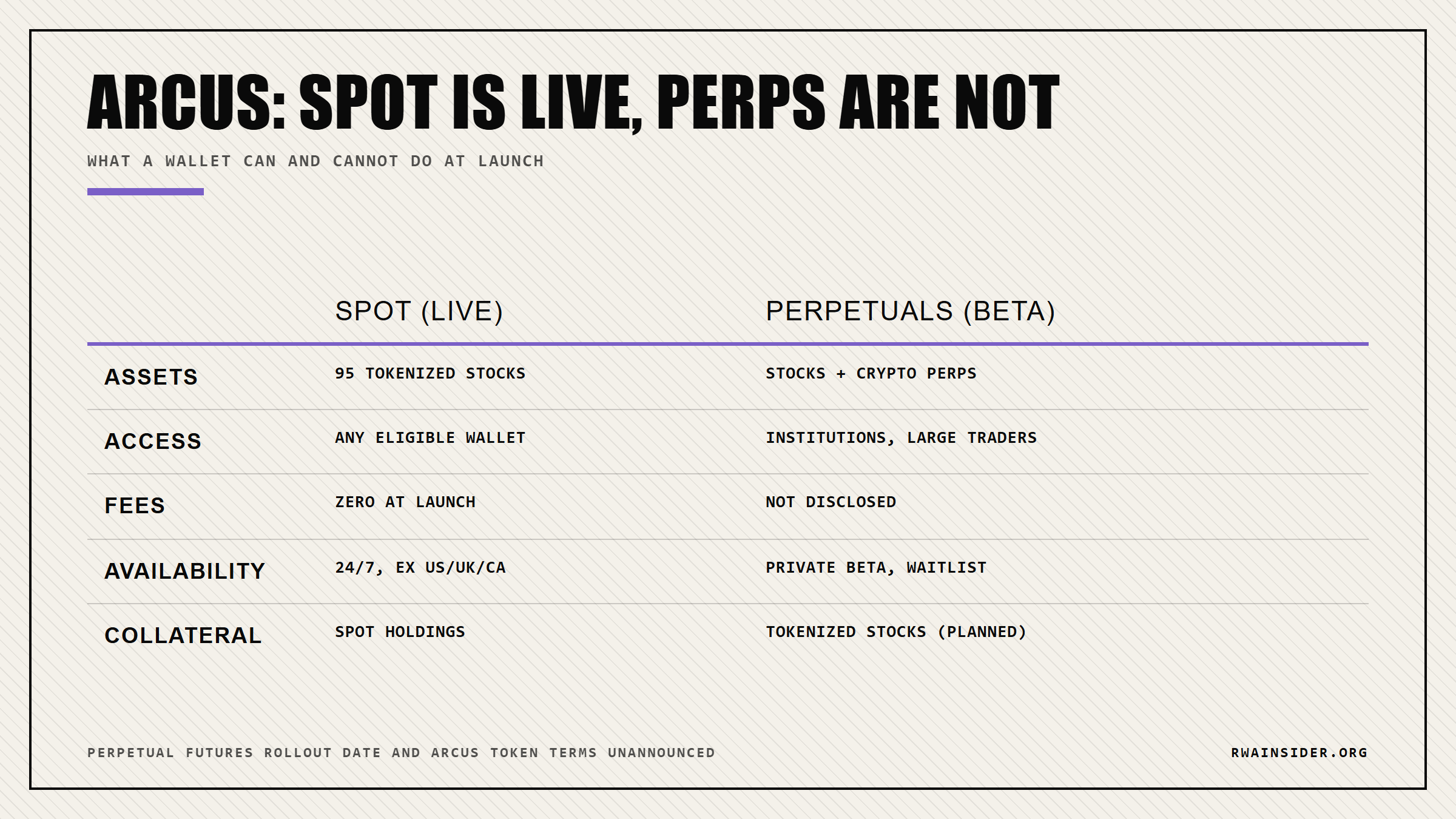
DYDX Holders Watch The Arcus Token After The 23% Drop
The 23% DYDX drop was the market pricing a spin-off it cannot yet value.
Founder Antonio Juliano framed the launch as a shift of focus from the dYdX chain toward a dedicated tokenized-asset platform, not a retreat, handing control to new chief executive Eddie Zhang.
Trading activity around Arcus surged in its first days even as DYDX sold off, a split that captures the whole trade: the product is live, the token economics are not.
The unease is the token. Arcus will issue its own Arcus Token, but as of July 2 it had published no allocation, vesting or eligibility terms, leaving DYDX holders unsure what they receive.
Arcus also lands as fresh pressure on established DeFi derivatives venues, on the same chain where Uniswap set up as the market maker for tokenized stocks days earlier.
Three milestones will decide it: when perpetuals open to retail, how the Arcus Token treats the dYdX community, and whether Robinhood Chain can pull real liquidity from rival derivatives platforms.
Whether Arcus becomes the venue where tokenized stocks and crypto perps finally share one margin account depends on when the perpetuals open to retail and how the Arcus Token treats dYdX holders. Until those terms are published, the 23% drop is the market pricing a spin-off it cannot yet weigh.
If you are deciding whether to bridge onto Robinhood Chain, trade the zero-fee spot that is actually live today and wait for the perpetual and token terms before betting on the part that is still gated.
Frequently Asked Questions
What is Arcus and how is it different from dYdX?
Arcus is a new decentralized exchange for tokenized stocks and crypto perpetuals, built as a joint venture between dYdX Labs and Robinhood Crypto on Robinhood Chain. It runs as a separate entity with its own planned token, and dYdX founder Antonio Juliano moved to a board role while Eddie Zhang became CEO.
Can I trade tokenized stocks on Arcus without a broker?
Yes, if your wallet is outside the US, UK and Canada. Arcus opened zero-fee spot trading on 95 tokenized stocks at launch, available around the clock through a wallet rather than a brokerage account. Perpetual futures remain in private beta for institutions, so check regional eligibility before bridging in.
Why did the DYDX token drop 23%?
DYDX fell about 23% in the 24 hours after Arcus launched as a separate entity with its own future token, shifting dYdX derivatives focus off the dYdX chain. As of July 2, Arcus had published no tokenomics, leaving DYDX holders unsure what the new token means for them.
When will Arcus open perpetual futures to retail traders?
No public date has been announced. Perpetual futures are in private beta for institutions and large-volume traders, with a public waitlist for everyone else. Arcus has not disclosed a rollout timeline or the allocation terms for its future token.