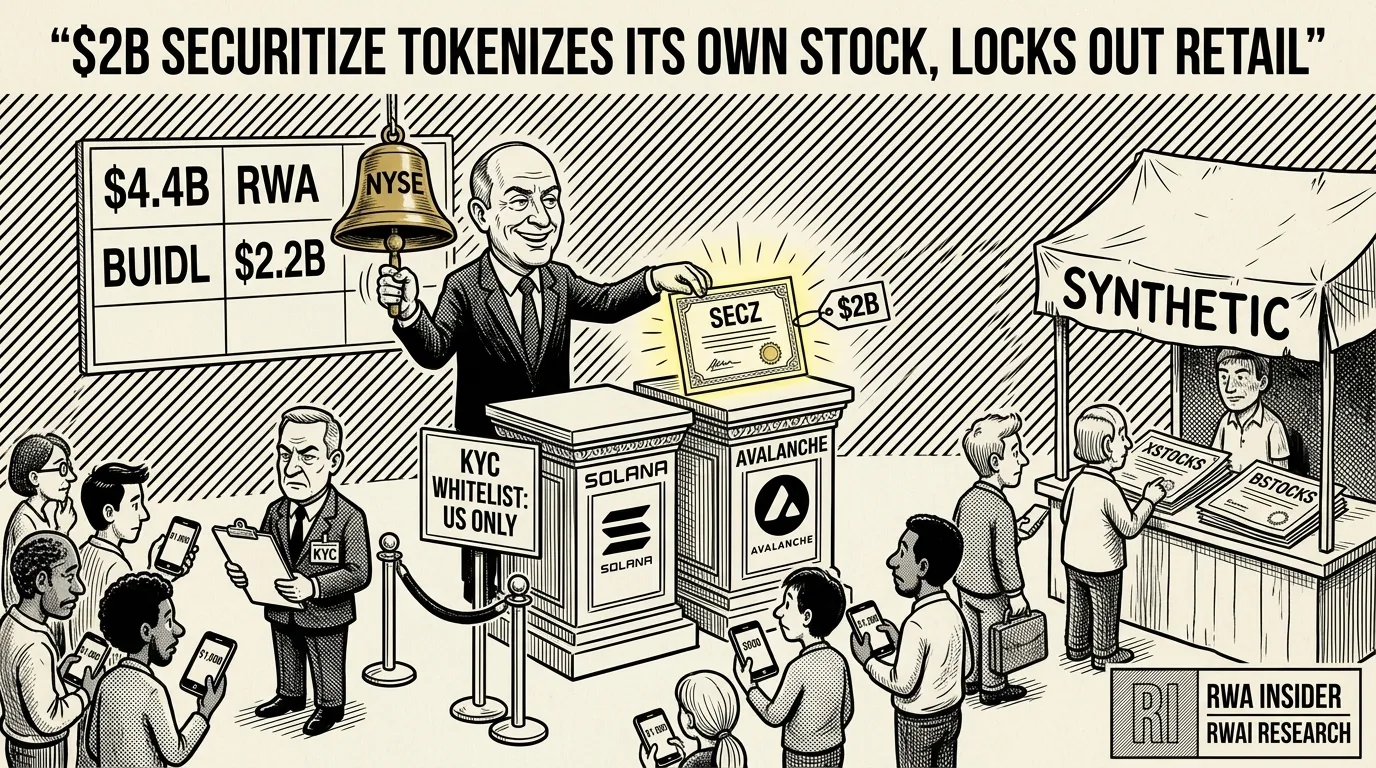
$2B Securitize Tokenizes Its Own Stock, Locks Out Retail
Key Points
- Securitize merged with a Cantor SPAC and began trading on the NYSE on July 2 under ticker SECZ, opening near a $2 billion market cap.
- SECZ became the largest tokenized stock on day one, topping $295 million on-chain, while Securitize’s total RWA issuance now passes $4.4 billion.
- SECZ is whitelisted to US investors, so a global $1,000 wallet cannot buy it on a DEX and must use synthetic tokenized stocks on Solana instead.
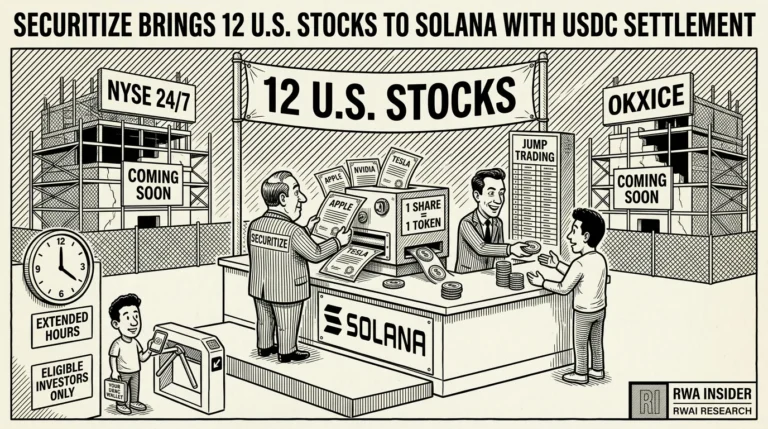
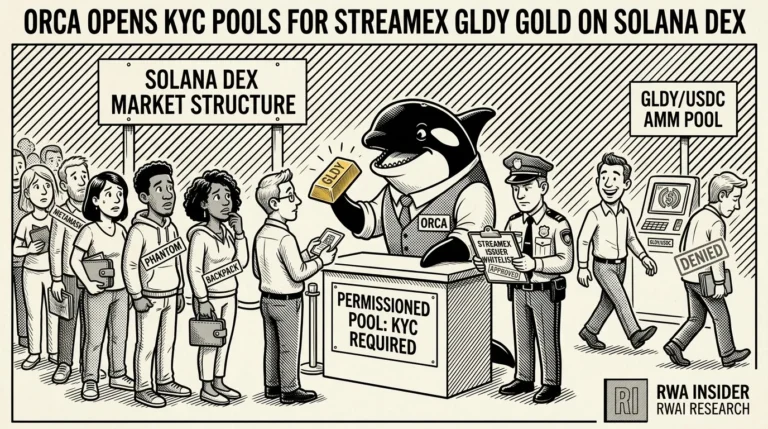
Securitize, the largest real-world asset tokenization platform, went public on the New York Stock Exchange on July 2 through a SPAC merger and tokenized its own stock the same day, opening near a $2 billion market cap under the ticker SECZ. The company posted on X that “while the traditional U.S. stock market will be closed on Friday for Independence Day, SECZ will continue trading.” For your wallet, the catch is blunt. SECZ is whitelisted to eligible U.S. investors, so the only permissionless way to trade tokenized equity stays with the synthetic versions on Solana.
Securitize Puts SECZ On Solana And Avalanche
On July 2, Securitize closed its merger with the Cantor Equity Partners II SPAC and began trading on the New York Stock Exchange under the ticker SECZ.
It is the first company to list on the NYSE and on-chain at the same time.
Securitize tokenized its common stock so eligible U.S. investors can buy SECZ directly on Solana and Avalanche through its regulated platform.
SECZ opened at $12.45, touched $13.70 intraday, and closed at $12.30, valuing the company near $2 billion.
Per RWA.xyz, SECZ became the world’s largest tokenized stock on day one, with more than $295 million in on-chain value.
The difference from rivals is ownership.
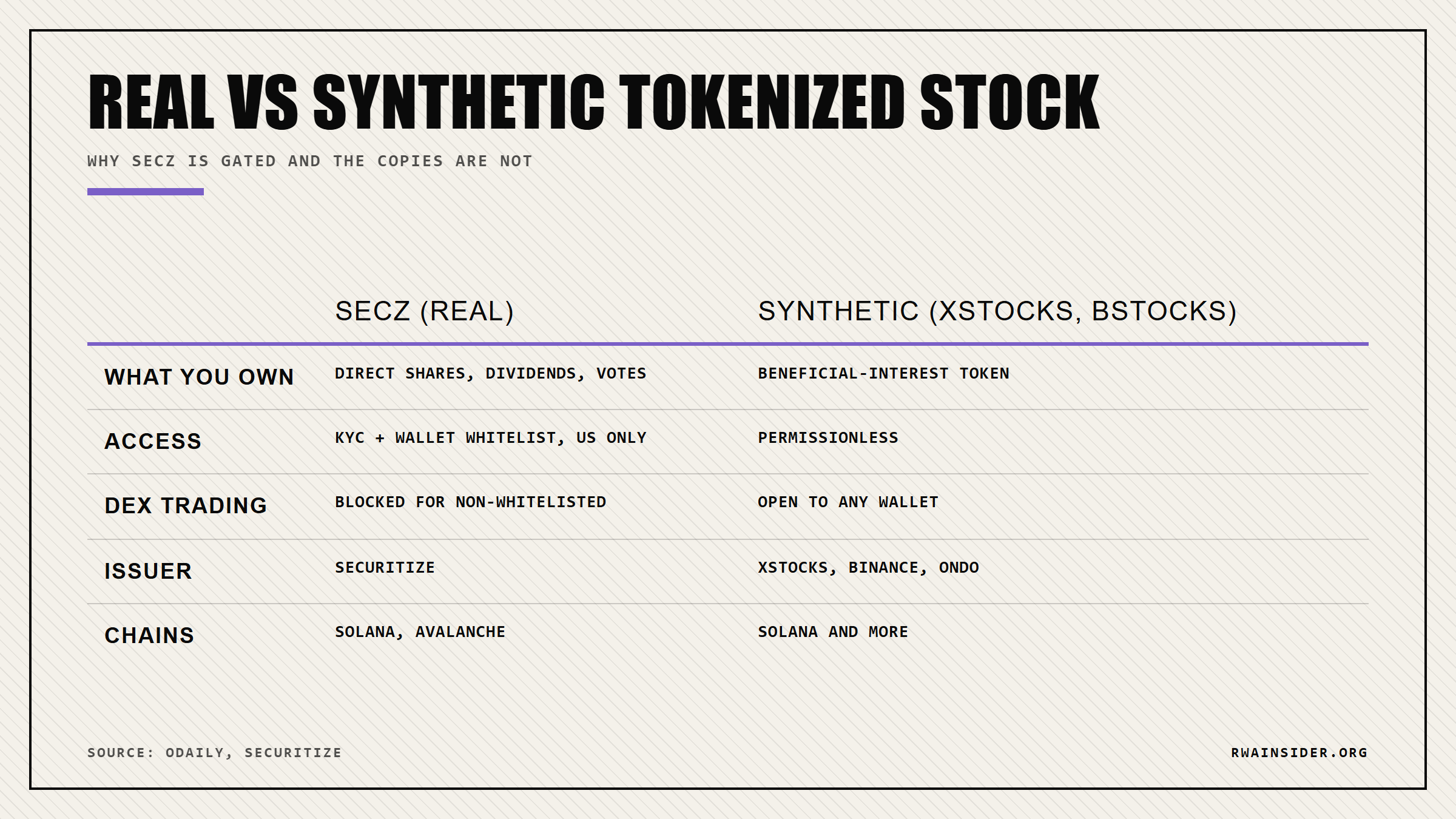
Securitize sells, in its own words, “the real thing, not a synthetic version,” so each SECZ token is direct equity with dividends and voting rights, not a certificate that only tracks the price.

Where SECZ Fits In Securitize’s $4.4B RWA Stack
Securitize is the largest issuer in real-world assets, with more than $4.4 billion in on-chain RWAs by DeFiLlama’s count, ahead of Circle, Tether, and Ondo once stablecoins are stripped out.
Its 24 tokenized products are mostly bonds, private credit, and money market funds.
The flagship is BlackRock’s BUIDL fund, now past $2.2 billion and the second-largest tokenized money market fund behind Circle’s USYC.
The business is growing into the price.
Securitize booked $55.6 million of revenue in the first nine months of 2025 and reported first-quarter 2026 revenue up 39% to a record $19.5 million.
That still leaves it richly valued.
Its price-to-sales ratio sits near 28 times against roughly 15 times for rival Figure, which holds a larger $19.4 billion in tokenized assets.
Strip away the NYSE bell and this is really about which tokenized stock your wallet can hold: the gated real thing, or the permissionless synthetic that trades on a DEX tonight.
Because SECZ is fenced off, the retail route to tokenized equity runs through those synthetic versions, and you can see how the real-versus-synthetic tokenized stock race keeps unfolding across chains.
Redfearn Says More Tokenized IPOs Are Coming
Securitize President Brett Redfearn said after the listing that the firm is already weighing tokenizing other companies’ IPOs within the next year.
Analysts are watching the model, not just the stock.
In April, investment bank Benchmark set a $16 target and pointed to Securitize’s full license stack across broker-dealer, transfer agent, and trading roles.
The tension is liquidity.
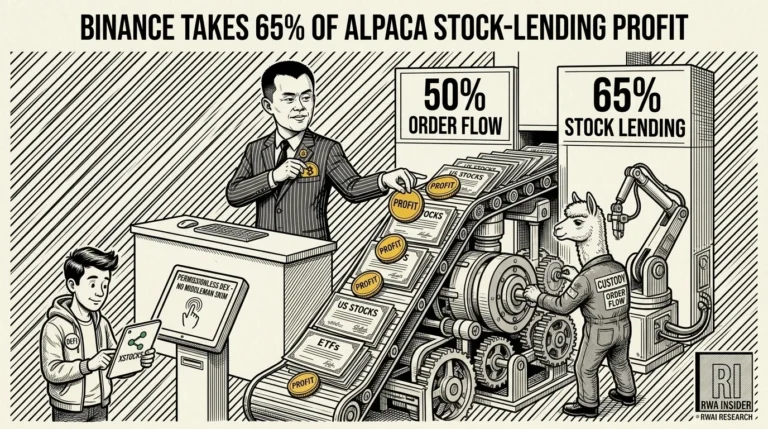
Most traders want price exposure, not shareholder rights, so cheaper synthetic tokens on xStocks, Binance’s bStocks, and Ondo may keep winning volume while SECZ sells the real thing to a whitelist.
Securitize is betting the other way.
It is wagering that when regulators eventually favor genuine on-chain ownership, the platform selling real shares wins the market it spent years licensing to build.
There is one clean edge for holders who qualify.
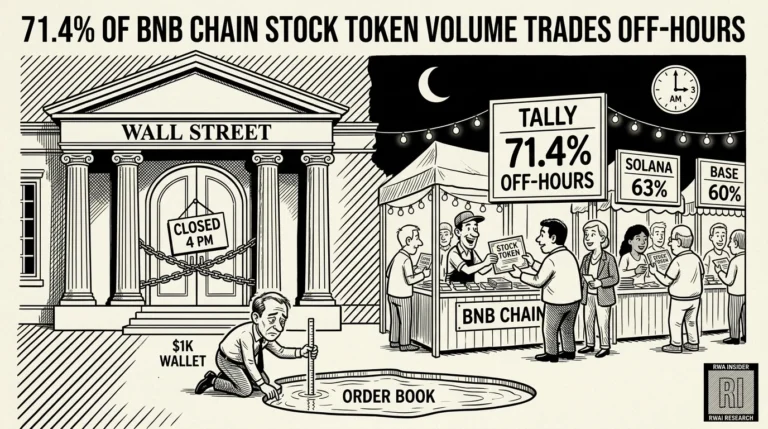
SECZ kept trading on Friday, July 3, while the NYSE sat closed for Independence Day, and that round-the-clock settlement is the part of this that actually favors on-chain.
Whether real on-chain ownership beats synthetic liquidity depends on how quickly Securitize widens the whitelist, and the next tokenized IPO will test it. Until the gate opens, your wallet trades the copy, not the original.
If you are weighing tokenized equity, it is worth seeing how Securitize’s last big move landed on Solana before you pick a side.
Frequently Asked Questions
What is SECZ and how is it different from other tokenized stocks?
SECZ is Securitize’s own common stock, tokenized on Avalanche and Solana, that gives holders direct ownership with dividends and voting rights. That sets it apart from the beneficial-interest tokens sold by xStocks or Binance, which only track a share’s price. It opened near a $2 billion market cap on July 2.
Can I buy SECZ without KYC or a US address?
No. SECZ is limited to eligible US investors through KYC checks and a wallet whitelist, so only approved addresses can trade it, even on a decentralized exchange. Investors without US residency cannot pass the check and are locked out.
How big is Securitize in real-world assets?
Securitize has issued more than $4.4 billion in on-chain real-world assets by DeFiLlama’s count, ranking first ahead of Circle, Tether, and Ondo once stablecoins are excluded. Its BlackRock BUIDL fund alone tops $2.2 billion, the second-largest tokenized money market fund.
Where can I trade tokenized stocks if SECZ is off-limits?
Permissionless tokenized stocks trade on platforms like xStocks on Solana, Binance’s bStocks, and Ondo. They give price exposure that any wallet can trade on a DEX today, but you hold a beneficial-interest token, not the underlying shares or their voting rights.