$1.3B HTX Reserves Moved To Undisclosed Custodian
Key Points
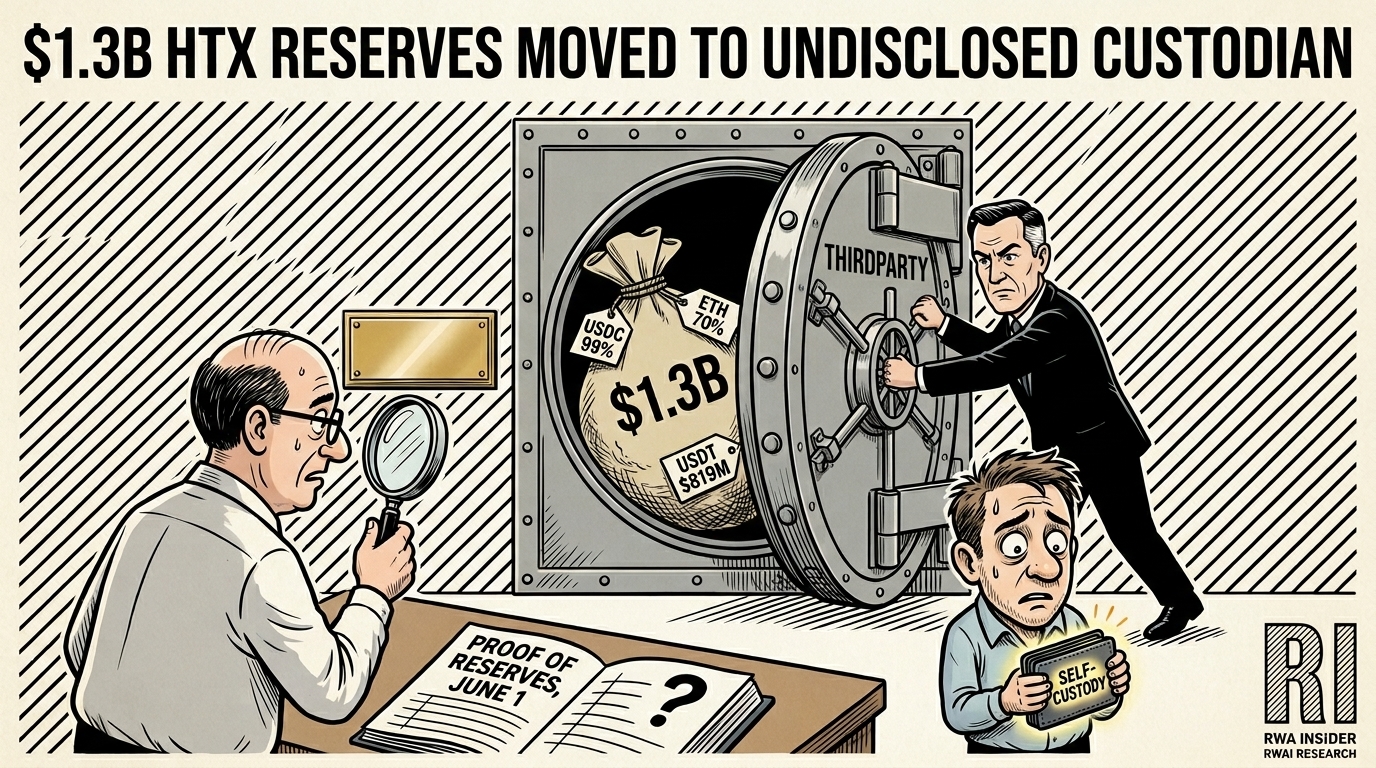
- HTX moved $1.3 billion of customer reserves, including more than 99% of its USDC, to undisclosed third-party custodians in its June 1 proof-of-reserves report.
- Roughly $819 million of USDT and 70% of all ether on HTX, some 76,515 ETH, now sit with custodians the exchange refuses to name.
- Holding native USDC or USDT in your own wallet and lending it on Aave keeps reserves verifiable on-chain, unlike HTX’s opaque custodial balances.
HTX, the crypto exchange owned by Justin Sun, moved $1.3 billion of customer reserves into a new category it labels ThirdParty, according to the proof-of-reserves report it dated June 1. “The assets in the Custodial Wallets are maintained by third-party custodians,” HTX now states on its own site, telling anyone who wants to verify the balances to contact custodians it has not named. For a trader with $1,000 on the platform, that quietly converts an on-chain balance you could once check into an IOU you cannot, the exact problem self-custody was built to remove.
Where The $1.3B Went, And Why HTX Stays Silent
HTX‘s latest proof-of-reserves, dated June 1, added a line no audit wants to see: a bucket called ThirdParty holding $1.3 billion in customer assets.
It spans bitcoin, ether, USDC, USDT, and the Usual stablecoin, each partly rerouted from wallets users could inspect into custody they cannot.
ThirdParty is not a custodian’s name. It is a placeholder for one HTX will not disclose, the opposite of what a proof-of-reserves is supposed to deliver.
When the investigative outlet Protos pressed the exchange to name those custodians, HTX gave no answer beyond a note telling users to contact the custodians directly.
On a clean proof-of-reserves you match each balance to an on-chain address yourself. Move the assets to an unnamed custodian and that check breaks, even on Ethereum and TRON, the chains DeFi runs on.
99% Of HTX’s USDC And 70% Of Its Ether Sit Off-Exchange
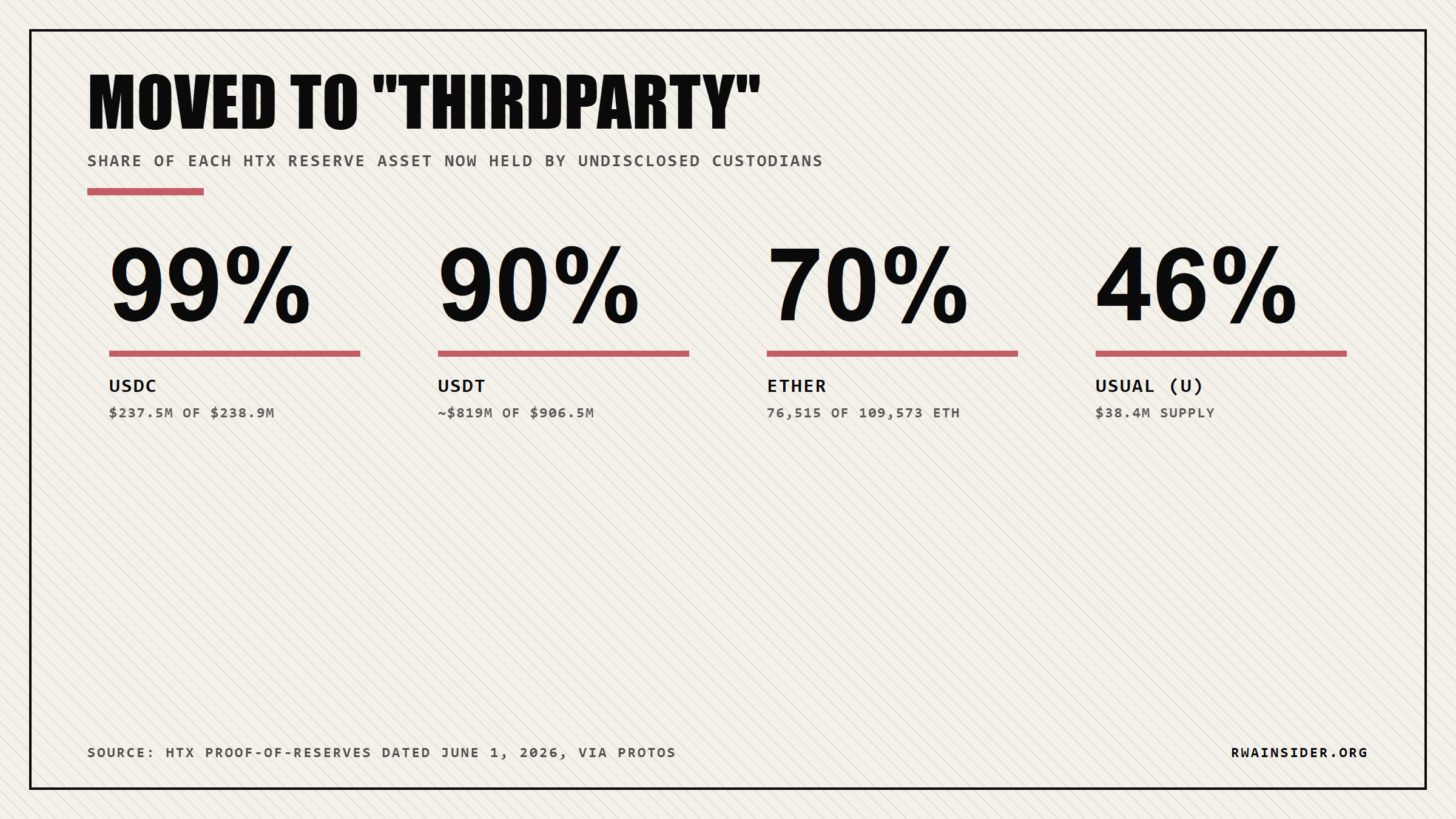
The USDC numbers are the starkest. HTX claims $238.9 million on the books, yet $237.5 million of it, more than 99%, has now moved to ThirdParty.
USDT tells the same story at scale. Of $906.5 million in reserves, only a sliver stays native on Avalanche, Ethereum, and TRON, while roughly $819 million sits with the unnamed custodian.
A further $39 million of that USDT is staked tether, once parked in US Treasuries and now lent through Aave, where the position at least stays visible on-chain.
Ether is no better. Of 109,573 ETH on HTX, just 3.7% is native, 26.5% is staked ether, and 70% has left the exchange entirely.
The Usual stablecoin follows the trend, with 46% of its $38.4 million supply pushed into the same bucket.
Strip away the custodial label and the real question is simple: does the coin HTX says it holds for you exist anywhere you can actually verify?
That gap is the entire case for self-custody, and you can weigh how on-chain reserves get verified across our risk desk before trusting any exchange dashboard.
Tokenized BTC, A Blacklist, And UK Sanctions Hit HTX
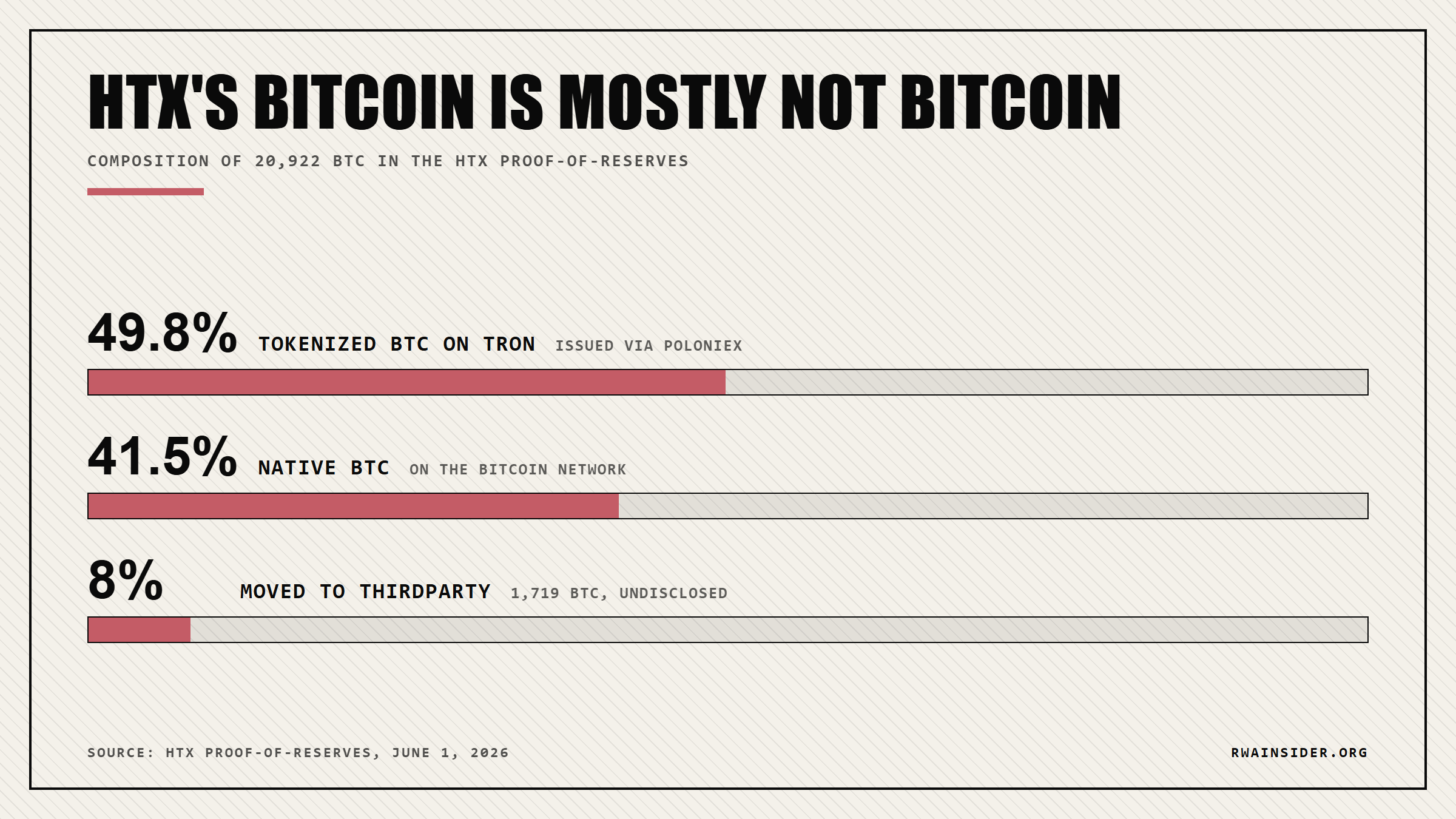
The reserve shuffle lands on an exchange already under pressure. Half of HTX’s 20,922 bitcoin are not native BTC at all, but a tokenized version minted on Sun-founded TRON through Poloniex.
Poloniex will not say where that token’s collateral sits, and its circulating supply already exceeds the bitcoin its own report discloses, the textbook setup for a backing gap.
Stack that on the missing stablecoin reserves and the picture gets harder to defend.
Outside pressure is mounting too. World Liberty Financial recently blacklisted HTX-linked addresses, and the United Kingdom sanctioned the exchange over financial services tied to Russian industry.
RWA Insider has watched this pattern before, when a multisig failure quietly pushed two euro and dollar stablecoins below their peg and thin liquidity trapped holders on the wrong side.
What HTX users can watch next is narrow but telling: whether the coming report names a single custodian, or whether the ThirdParty bucket simply grows.
Whether those reserves are whole depends entirely on custodians HTX still will not name, and the next proof-of-reserves report will either restore the addresses or confirm the hole.
If you cannot say who holds your collateral, you do not really hold it. On HTX or anywhere else, the only reserve you can fully verify is the one sitting behind keys you control.
Frequently Asked Questions
What does HTX’s ThirdParty custody label actually mean?
It is a new bucket in HTX’s June 1 proof-of-reserves holding $1.3 billion of customer assets that HTX says are kept by outside custodians. The exchange has not named those custodians, so users cannot independently verify the balances on-chain.
Can I still withdraw my USDT and USDC from HTX?
HTX has not announced any halt to withdrawals, and it describes the reserves as moved rather than lost. Still, with more than 99% of USDC and around $819 million of USDT sitting off-exchange with unnamed parties, the cautious move is to cut exposure you cannot verify.
How can I hold stablecoins without trusting an exchange’s reserves?
Hold native USDC or USDT in a self-custody wallet such as MetaMask, where the balance is yours and visible on-chain. You can then lend it on a protocol like Aave, whose collateral and rates are auditable in real time rather than reported once a month.
Why is HTX’s tokenized bitcoin a separate risk?
Almost half of HTX’s bitcoin is a tokenized version issued through Sun-owned Poloniex on TRON, not native BTC. Poloniex will not disclose where the backing sits, and the token’s circulating supply already exceeds the bitcoin its own report shows, a classic under-collateralization warning.