Ether.fi Opens 7.25% RWA Vault, $100M Flows To Plume
Key Points
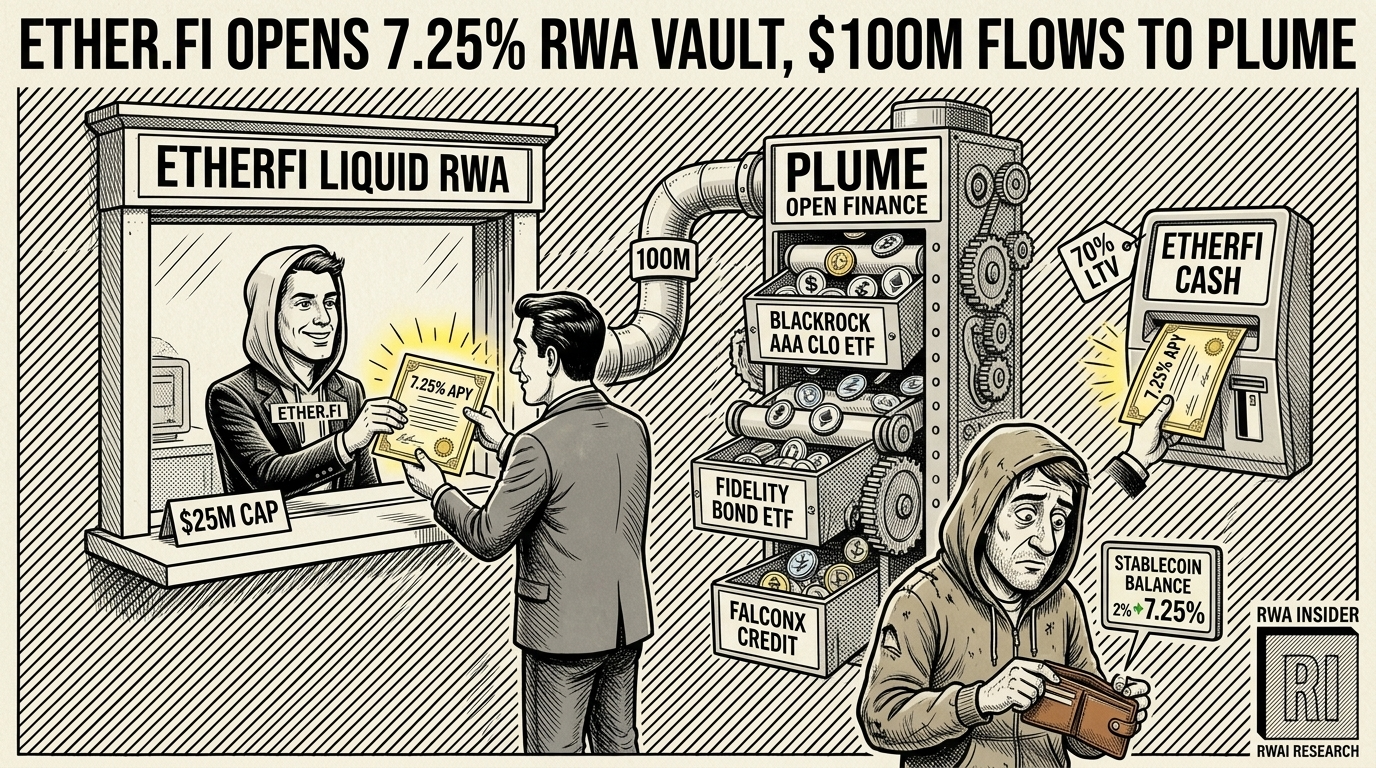
- Ether.fi is deploying $100 million into Plume to launch EtherFi Liquid RWA, a vault paying a variable 7.25% APY on stablecoins.
- The vault carries a $25 million cap and routes deposits into BlackRock’s iShares AAA CLO ETF, the Fidelity Total Bond ETF, and FalconX credit.
- Ether.fi’s $6 billion in deposits can earn 7.25% on stablecoins, then post the position as 70% loan-to-value spend collateral on Ether.fi Cash.
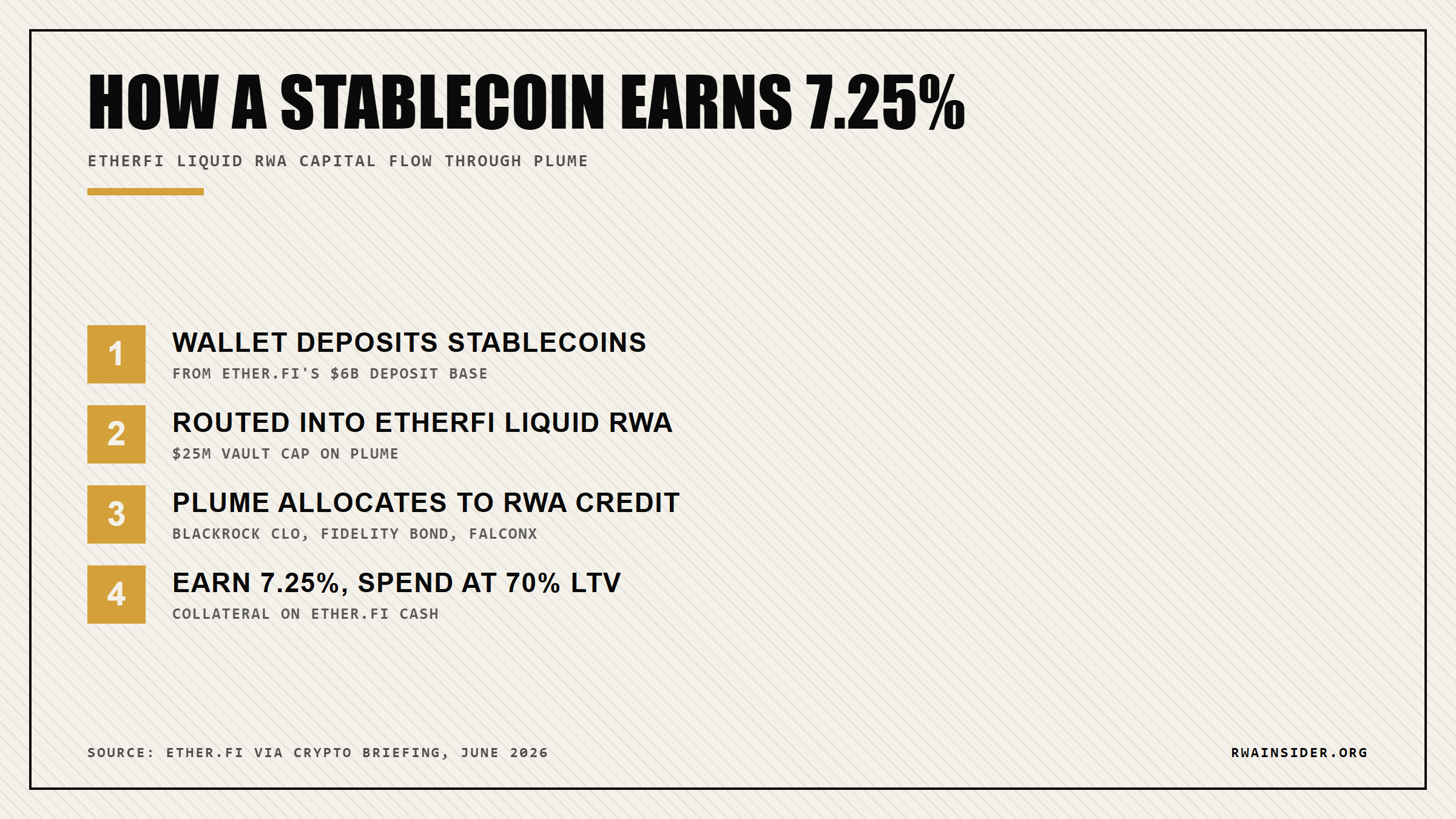
Ether.fi is deploying $100 million into Plume to launch EtherFi Liquid RWA, a new vault that pays a variable 7.25% yield on stablecoins by routing them into tokenized institutional credit and fixed income. The liquid restaking protocol, which holds more than $6 billion in customer deposits, announced the launch with Plume’s open finance platform, calling it “a new way to earn institutional-grade rewards on stables.” For a wallet already parked in Ether.fi, that is a one-tap jump from roughly 2% on idle stablecoins to a yield backed by BlackRock and Fidelity paper, with the position doubling as spend collateral.
Inside Ether.fi’s $100M Liquid RWA Vault On Plume
The product is called EtherFi Liquid RWA, and it does one thing: it turns idle stablecoins into a position that earns 7.25%.
Ether.fi is wiring $100 million into Plume to power the vault, routing deposits through Plume’s open finance platform.
Plume is a public chain built for real-world assets, and it is the rail that connects an Ether.fi balance to yield markets retail normally cannot touch.
Those markets are tokenized fixed income and institutional credit: short-term bonds, collateralized loan obligations, and private credit that used to sit behind brokerage walls.
The vault opens with a $25 million cap, so the first stablecoins in are the ones that fit.
For on-chain users the change is concrete. The same wallet that holds restaked ETH on Ether.fi can now park stables in a yield product without leaving the app.
The 7.25% Yield Gap Over Aave USDC
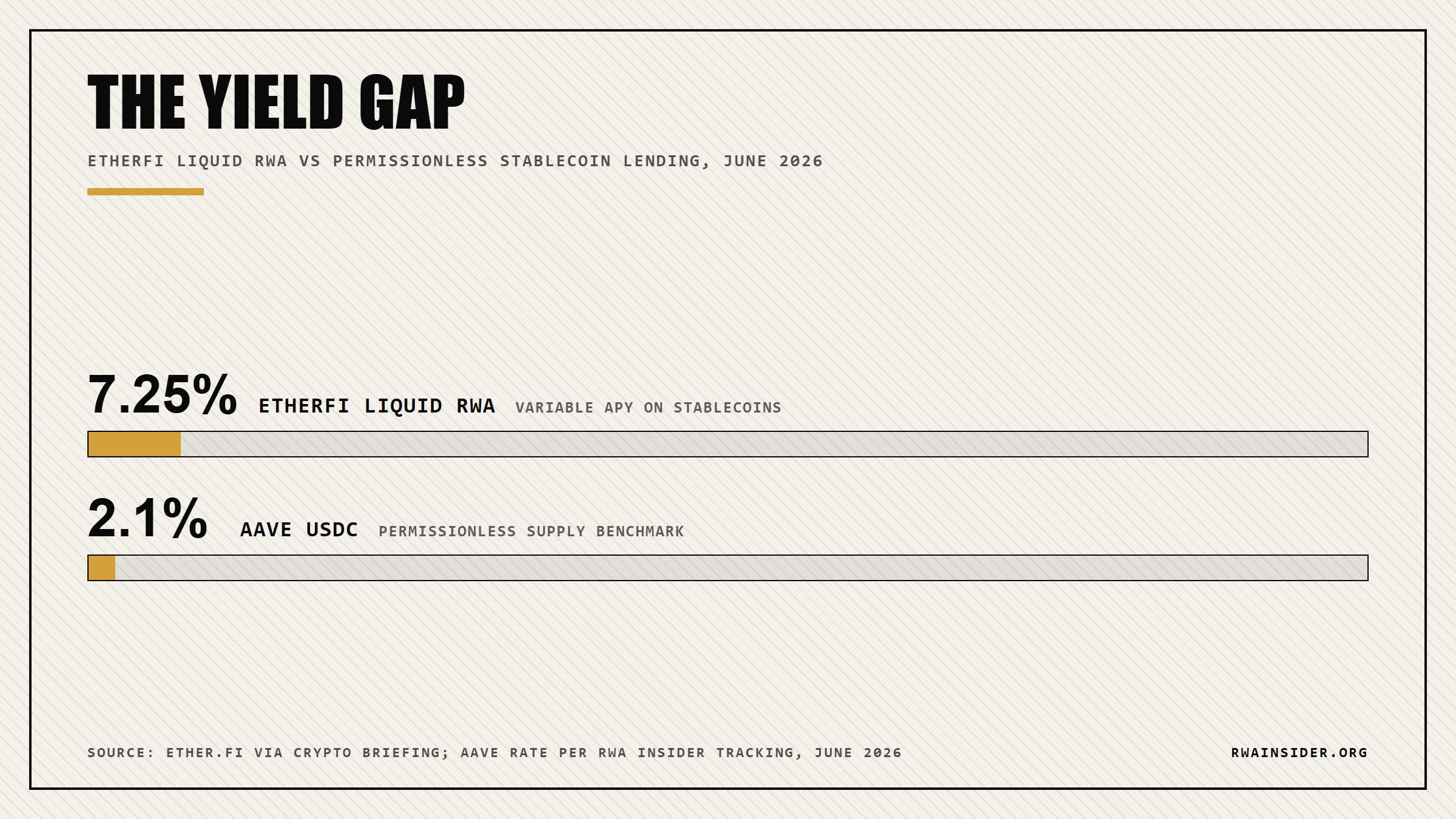
Here is the number that matters. The vault’s variable APY currently sits at 7.25%.
Permissionless USDC supply on Aave has tracked near 2.1% in our prior yield coverage.
That makes this vault pay roughly three times the rate a wallet earns lending plain stablecoins on-chain today.
The scale behind it is large. Ether.fi holds more than $6 billion in customer deposits, all of which can now reach this real-world asset yield.
Strip away the institutional packaging and this is really about a stablecoin balance that earns triple the permissionless rate while staying spendable.
Spendable is the second half of the pitch. The vault position is live as spend collateral on Ether.fi Cash at 70% loan-to-value.
A holder can earn the yield and still borrow against the position to spend through Ether.fi’s card, instead of choosing between yield and liquidity.
If you want to track how tokenized yields stack up against permissionless DeFi rates, this 5-point spread is the one to watch.
BlackRock And Fidelity Credit Behind The Yield
The 7.25% is not magic. It comes from a specific stack of tokenized credit.
The initial allocation runs into BlackRock’s iShares AAA CLO ETF, the Fidelity Total Bond ETF, and FalconX’s Credit Pool.
Those are high-grade corporate debt and collateralized loans, wrapped so a Plume vault can hold them and pass the coupon back to depositors.
Ether.fi was blunt about the limits, stating the vault “has a $25m cap” and that the “APY is variable and not guaranteed.”
That caution is the honest part. AAA CLO and bond ETF yields move with interest rates, and the $25 million cap can fill before most wallets notice it opened.
The launch also fits Ether.fi’s wider push into on-chain banking.
The company said earlier this year that Ether.fi Cash would migrate to Optimism’s OP Mainnet for faster, cheaper card payments.
What to watch is the ceiling. If Ether.fi lifts the $25 million cap, the vault stops being a pilot and becomes a real home for idle stablecoins.
Whether that 7.25% holds depends on how fast the $25 million cap fills and how the underlying ETF yields move, and the next few weeks of vault inflows will tell. If Ether.fi lifts the cap, a slice of its $6 billion could rotate out of idle stablecoins in a hurry.
For the bigger picture, see how the same Plume rails already tokenized $2.2 billion of institutional CLO yield on-chain, then decide whether 7.25% on idle stables is worth the cap race.
Frequently Asked Questions
What is EtherFi Liquid RWA?
EtherFi Liquid RWA is a new vault from Ether.fi that pays a variable yield, currently 7.25%, on stablecoins. It routes deposits through Plume into tokenized credit, including BlackRock’s iShares AAA CLO ETF, the Fidelity Total Bond ETF, and FalconX’s Credit Pool.
How much yield does Ether.fi’s Plume vault pay?
The vault’s APY is variable and not guaranteed, currently sitting at 7.25%. That is roughly three times the near 2.1% a wallet earns supplying USDC on permissionless Aave, though the rate moves with the underlying bond and CLO yields.
Can I use the EtherFi Liquid RWA position as collateral?
Yes. The vault position is live as spend collateral on Ether.fi Cash at 70% loan-to-value. A holder can keep earning the yield and still borrow against the position to spend through Ether.fi’s card.
Is the EtherFi Liquid RWA yield safe?
Ether.fi states the APY is variable and not guaranteed, and the vault opens with only a $25 million cap. The yield is backed by AAA-rated CLO and bond ETFs plus FalconX credit, so it still carries interest-rate, credit, and smart-contract risk.