$2.2B CLO Tokenized On Grvt Via Plume Yield Stack
Key Points
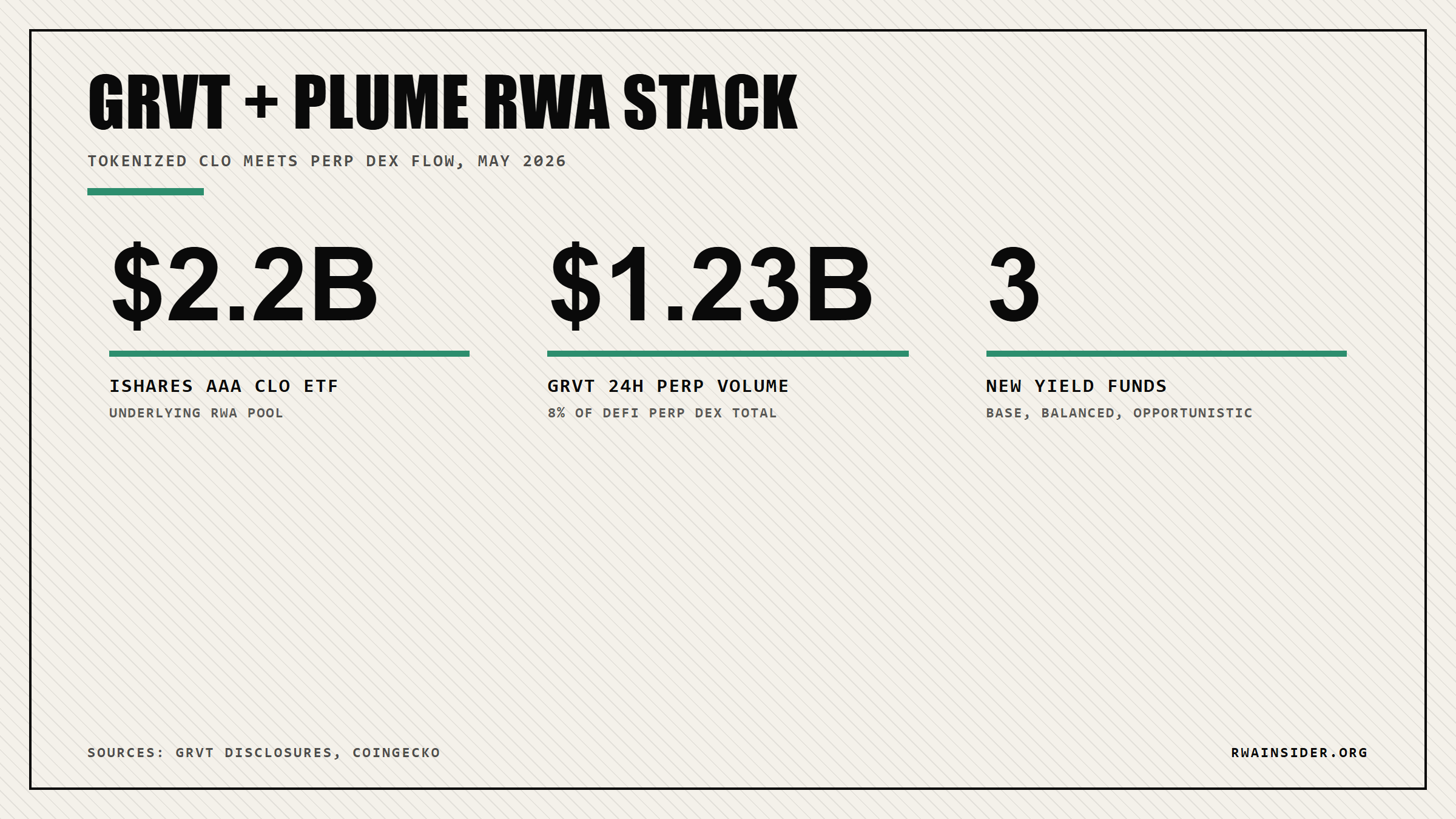
- Grvt and Plume have launched three RWA yield funds backed by the iShares AAA CLO Active ETF, holding around $2.2 billion in CLO assets.
- The funds sit inside Grvt’s perpetual venue, which handled $1.23 billion of yesterday’s $15.2 billion in DEX perpetual volume.
- Wallets on Plume can now stake institutional CLO yield against perp margin from one self-custodial balance, no separate venue required.
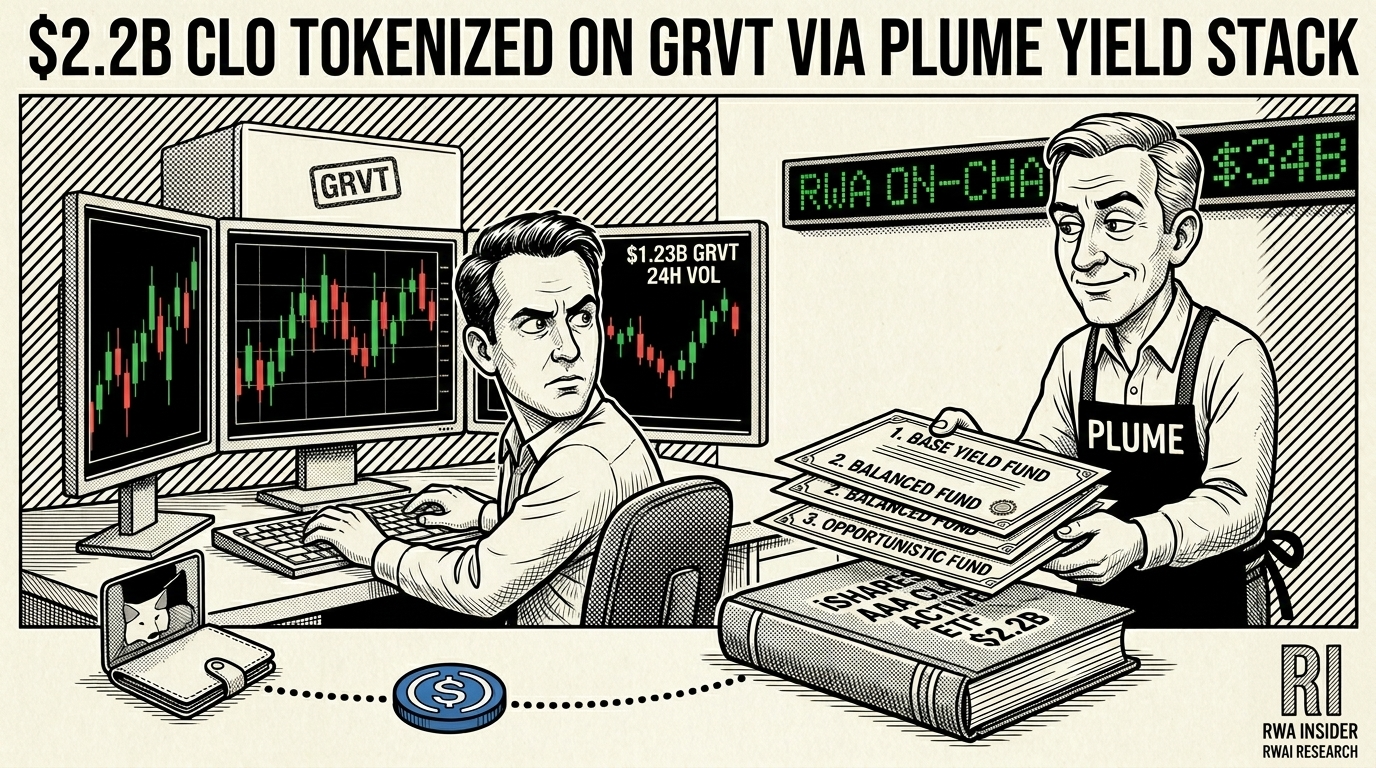
Decentralized derivatives platform Grvt has wired three tokenized real-world asset yield funds into its trading venue, partnering with tokenization specialist Plume to back the products with the iShares AAA CLO Active ETF, a $2.2 billion pool of collateralized loan obligations. Grvt’s announcement described the arrangement as merging “tokenized fixed-income exposure with Plume’s network.” For wallet holders, the angle is direct: the Base Yield Fund, Balanced Fund, and Opportunistic Fund all live inside the same self-custodial balance that Grvt traders already use for perpetual futures, no bridge or separate venue required.
Grvt Bolts $2.2B AAA CLO Onto Perp Wallets
The arrangement deploys three vehicles, the Base Yield Fund, Balanced Fund, and Opportunistic Fund, all backed by tokenized exposure to the iShares AAA CLO Active ETF.
The ETF holds AAA-rated collateralized loan obligations and totals around $2.2 billion in assets under management.
Grvt distributes the wrappers inside the perpetual trading interface its users already operate, while Plume supplies the on-chain yield infrastructure that handles the fixed-income exposure.
The technical effect is direct. A wallet posting USDC as margin on a Grvt perp can route idle balance into a tokenized CLO position without signing a separate withdrawal transaction.
In February, Grvt integrated the Aave lending protocol so traders could earn yield on margin collateral while perpetual positions stayed open.
The Plume integration extends that same logic from variable DeFi rates to fixed-income RWA exposure.
The $34B RWA Pool Where Grvt Plugs In
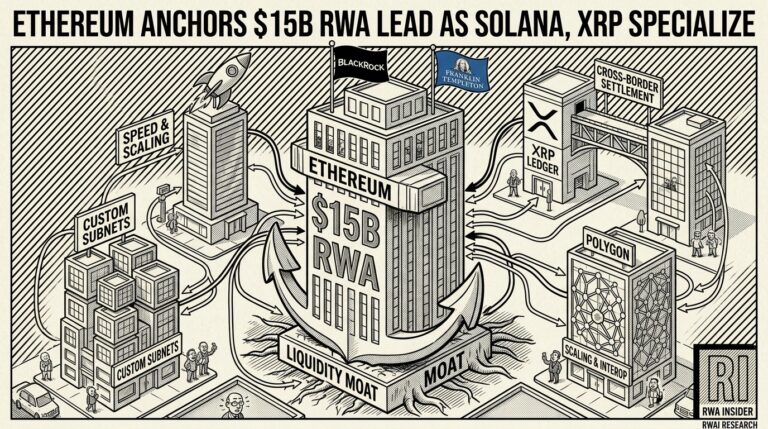
The Grvt and Plume launch lands inside a tokenized RWA market that RWA.xyz now puts at over $34 billion in on-chain value, up from roughly $5.8 billion at the start of 2025.
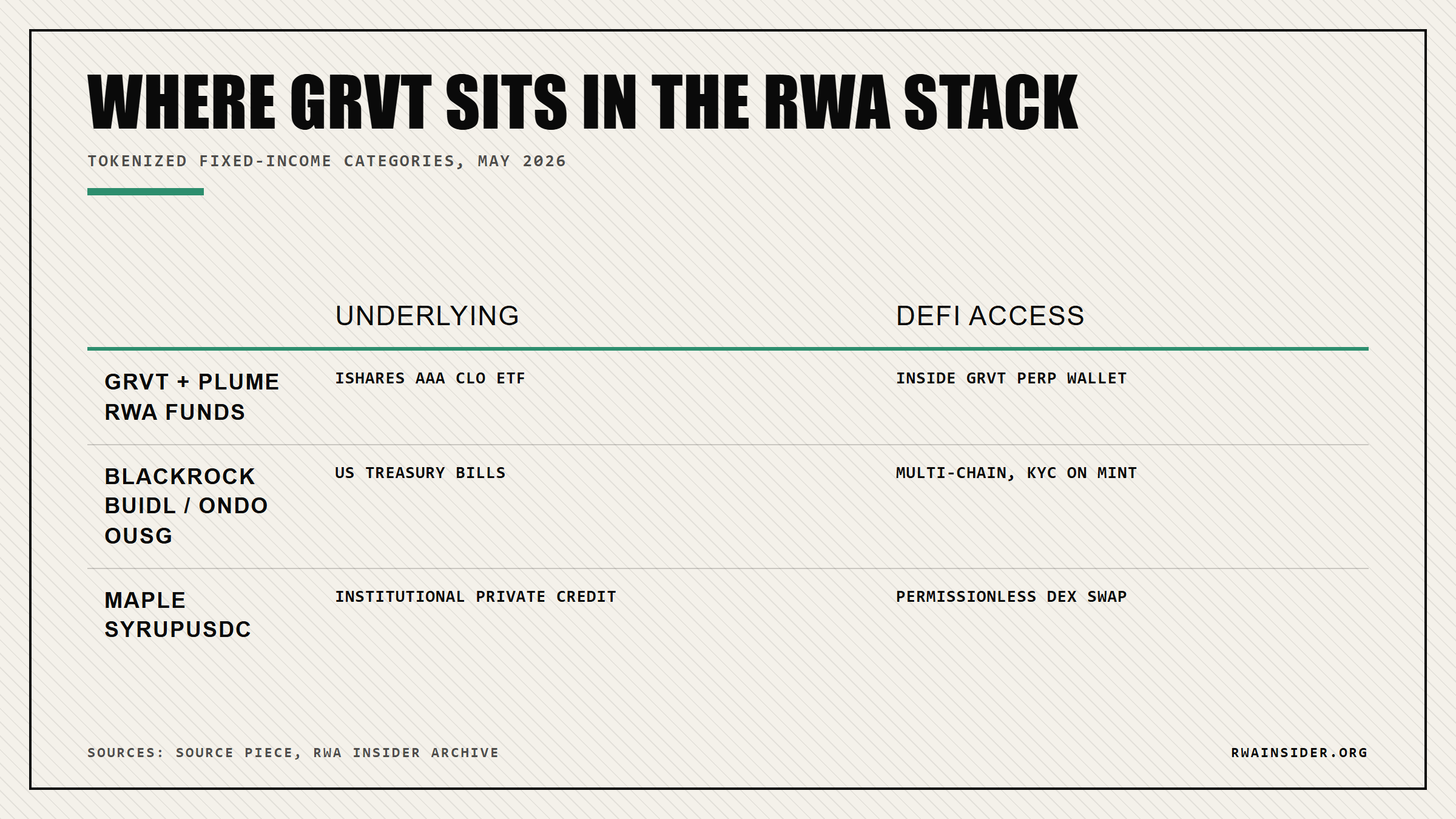
Most of that growth has come from short-duration Treasury wrappers like BlackRock’s BUIDL and Ondo Finance’s OUSG.
The Grvt funds push a different layer of fixed-income exposure on-chain, structured credit through AAA-rated collateralized loan obligations rather than government debt.
Grvt itself sits inside a perpetual DEX market that processed $15.2 billion in 24-hour volume, according to CoinGecko data Grvt cited in its announcement.
Grvt accounted for roughly $1.23 billion of that turnover, placing the venue at about eight percent of all DeFi perpetual volume tracked by CoinGecko in the same window.
Strip away the institutional packaging and this is really about idle USDC on a perp account earning fixed-income yield without the wallet ever touching a separate venue.
Maple Finance’s syrupUSDC plays a similar role on the private-credit side, packaging institutional lending yield into a token DeFi wallets can hold.
The Grvt vehicles extend that logic to publicly traded AAA CLO debt, a different asset class with its own credit and structuring risks.
What Plume’s $25M EtherFi Backing Signals
Plume already carries institutional weight.
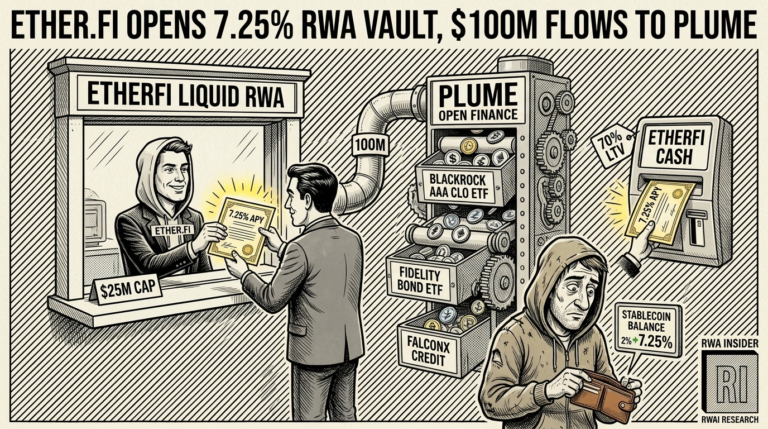
In March, EtherFi allocated $25 million to Plume’s Nest protocol to give its users exposure to tokenized yield strategies tied to institutional assets and government securities.
The new Grvt arrangement layers a perp-venue distribution channel on top of that same infrastructure.
Boston Consulting Group, in a May report, named tokenized funds, collateral, and fixed-income products as the digital-asset offerings most likely to gain broader institutional adoption over the coming decade.
The Grvt arrangement sits inside that same wave.
Securitize, the regulated transfer agent behind BlackRock’s BUIDL, said earlier this month it would partner with Hamilton Lane, OKX Ventures, and STBL to launch a stablecoin backed by tokenized private credit.
Binance added Ondo Finance tokenized equities to its Binance Alpha platform in February.
The result is a steadily widening menu of fixed-income wrappers a DeFi wallet can hold without leaving on-chain venues, a shift tracked across the RWA Insider secondary-markets coverage.
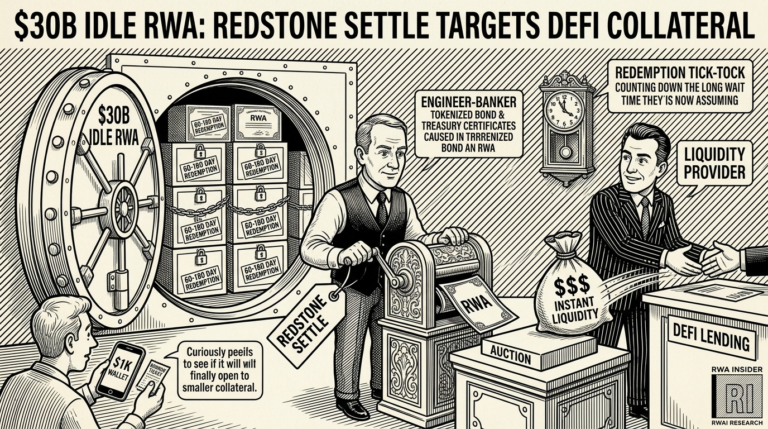
Two questions hang over the Grvt funds. What risk controls accompany tokenized fixed income on-chain, and how Plume’s redemption path holds up if perp volumes spike or fall sharply.
Self-custody removes one risk vector but leaves the smart-contract and structuring layers fully exposed.
Whether the Grvt and Plume vehicles draw real flow depends on how AAA CLO yield holds up against Treasury wrapper rates over the next quarter, and whether Plume’s redemption path scales when perp volumes whip.
Watch how tokenized fixed income reshapes DeFi yield without taking your wallet off-venue.
Frequently Asked Questions
What is the iShares AAA CLO Active ETF and why is Grvt tokenizing exposure to it?
The iShares AAA CLO Active ETF holds AAA-rated collateralized loan obligations and manages roughly $2.2 billion in assets. Grvt and Plume have built three tokenized funds that track that exposure on-chain, letting wallets earn fixed-income yield through Grvt’s existing perp trading interface.
How big is the tokenized RWA market that Grvt is entering?
RWA.xyz tracks more than $34 billion in tokenized real-world assets on-chain as of May 2026, up from about $5.8 billion at the start of 2025. The Grvt and Plume launch sits inside that broader growth wave, which has been led by short-duration Treasury wrappers from BlackRock and Ondo Finance.
How does Plume support the Grvt tokenized yield funds?
Plume supplies the on-chain yield infrastructure that wraps the underlying fixed-income exposure into transferable tokens. The same infrastructure already supports EtherFi’s $25 million allocation to Plume’s Nest protocol, made in March for tokenized yield strategies tied to institutional assets and government securities.
What are the main risks of holding tokenized AAA CLO debt on-chain?
AAA CLO debt is structured credit, so it carries underwriting and tranche-structure risks that direct Treasury bills do not. On-chain wrappers add smart-contract and redemption-path risks, and the source flags both as open questions for tokenized fixed income.