0.1 Correlation: Aave, Compound Stablecoin Yields Ignore The Fed
Key Points
- A Bank Policy Institute study of Aave and Compound found DeFi stablecoin yields have just a 0.1 correlation with the federal funds rate.
- While the effective fed funds rate sat at 25 basis points after March 2020, stablecoin yields swung between 400 and 1,600 basis points.
- If you lend USDC on Aave or Compound, plan for swings: yields neared 12% after the $130 million Cream Finance hack in 2021.
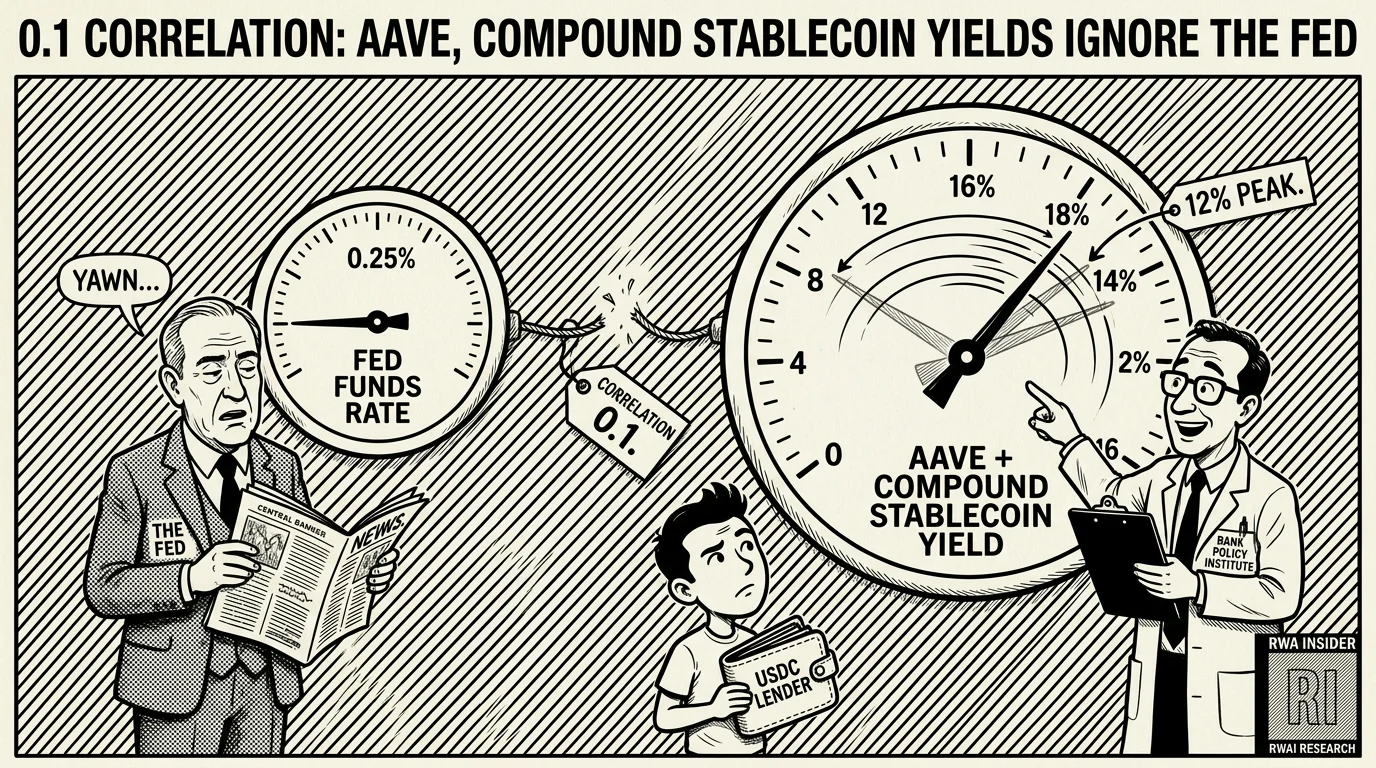
Stablecoin yields on Aave and Compound have almost no link to the effective federal funds rate, with a correlation of just 0.1. The Bank Policy Institute, a banking trade group, published the finding on October 9 in a note by Marco Macchiavelli and Laurence Bristow, who conclude that stablecoin yields are “completely divorced from traditional money market rates.” For your wallet, that cuts both ways: the rate you earn lending USDC tracks crypto leverage and panic, not the Fed, and the banks are now putting that gap on record.
Bank Policy Institute Maps Aave, Compound Yields Back To 2019
The Bank Policy Institute built a daily index of stablecoin yields on Aave and Compound, two of the largest DeFi lending protocols.
It covers the top five stablecoins by lending volume: USDT, USDC, USDS/DAI, Ethena’s USDe and PayPal’s PYUSD. The data runs from August 2019 to April 2026.
The authors pulled pool data from Steakhouse Financial and Dune Analytics, then weighted each pool by the amount lent at midnight UTC. A pool might be USDC on Aave version 3 on Base.
Their core result is a correlation of 0.1 with the effective federal funds rate, which is not statistically different from zero.
The timing matters. The GENIUS Act bars stablecoin issuers from paying yield, but it does not stop holders from lending their coins on DeFi platforms.
The law takes effect on January 8, 2027, and this note maps the one yield lane it leaves open.
Hacks, Depegs And Leverage Pushed Yields Toward 12%
On Aave and Compound, the utilization rate sets your yield: the share of a pool’s coins that borrowers have taken.
Past a set point, known as the kink, rates climb much faster with each extra unit of borrowing. That design pulls in new lenders and pushes borrowers to repay.
The study’s own example shows the math. If borrowers pay 5% and 80% of the pool is lent out, every lender earns 4%, whether or not their own coins are borrowed.
After March 2020, the effective federal funds rate sat at 25 basis points for about two years, while stablecoin yields swung between 400 and 1,600 basis points.
Stress drove the sharpest spikes. When a hacker drained $130 million from Cream Finance in October 2021, lenders fled other protocols and yields neared 12%.
The March 2023 USDC depeg, a July 2023 Curve Finance hack and an April 2026 attack that borrowed against fake collateral on Aave all sent yields jumping.
Strip away the policy framing and this is really about one thing: crypto leverage pays your stablecoin yield, and it spikes when other lenders run.
You can compare DeFi lending rates with tokenized Treasury yields as conditions shift.
What The GENIUS Act’s DeFi Lending Gap Means For Your USDC
The authors stop short of a policy ask, but their closing questions point one way.
Bank Policy Institute researchers Marco Macchiavelli and Laurence Bristow ask “what are the monetary policy implications of stablecoin yields being unanchored to money market rates?”
They also ask whether DeFi platforms can steer those yields, and for what purpose.
That line of questioning matters because lending is the door the GENIUS Act leaves open. Issuers cannot pay you yield, but an Aave pool can.
Europe is already testing that door. Our report on the ECB push to extend the MiCA yield ban to DeFi lending tracked pushback from 50,000 Europeans.
For a $1,000 USDC position, the practical read is simple. Treat a high Aave rate as a sign of heavy borrowing or stress, not a new normal.
Watch your exit too. Per the study, lenders can withdraw at any time only while the pool holds spare coins that borrowers have not taken.
High utilization means fewer spare coins, so check that figure before you chase a spike.
Whether DeFi lending stays the open lane for stablecoin yield depends on how U.S. regulators read research like this, and the GENIUS Act’s January 8, 2027 start date sets the clock.
Lending USDC on Aave or Compound? Check the pool’s utilization rate before you size up.
Frequently Asked Questions
Why don’t Aave stablecoin yields follow Fed rates?
On Aave and Compound, the utilization rate sets the yield: the share of pooled coins that borrowers have taken. Borrowing demand rises with crypto leverage, so a Bank Policy Institute study found only a 0.1 correlation with the effective federal funds rate.
How high can DeFi stablecoin yields go during a hack?
After a hacker drained $130 million from Cream Finance in October 2021, stablecoin yields neared 12% as lenders fled. A July 2023 Curve Finance hack and an April 2026 attack on Aave also caused spikes.
Can I still earn yield on USDC after the GENIUS Act?
The GENIUS Act bars stablecoin issuers from paying yield, but it does not restrict holders from lending stablecoins on DeFi platforms. The law takes effect on January 8, 2027, and lending rates will keep moving with pool utilization.
Can I withdraw my stablecoins from an Aave pool anytime?
Yes, as long as the pool holds enough spare stablecoins that borrowers have not taken. When utilization runs high, rates rise to pull in new lenders and push borrowers to repay, which frees up coins.