63 Tokenized Stocks Head To Uniswap Pools As OKX, ICE Notify SEC
Key Points
- OKX and ICE’s joint venture OKXICE notified the SEC on October 4 that it plans to trade 63 tokenized U.S. stocks 24/7.
- The SEC’s five-year Innovation Exemption from September 17 requires 30 days’ notice before launch and gives listed companies 30 days to object.
- Trades would run through permissioned Uniswap v4 pools on X Layer against USDC, USDG or USDT, so a $1,000 wallet needs approved access.
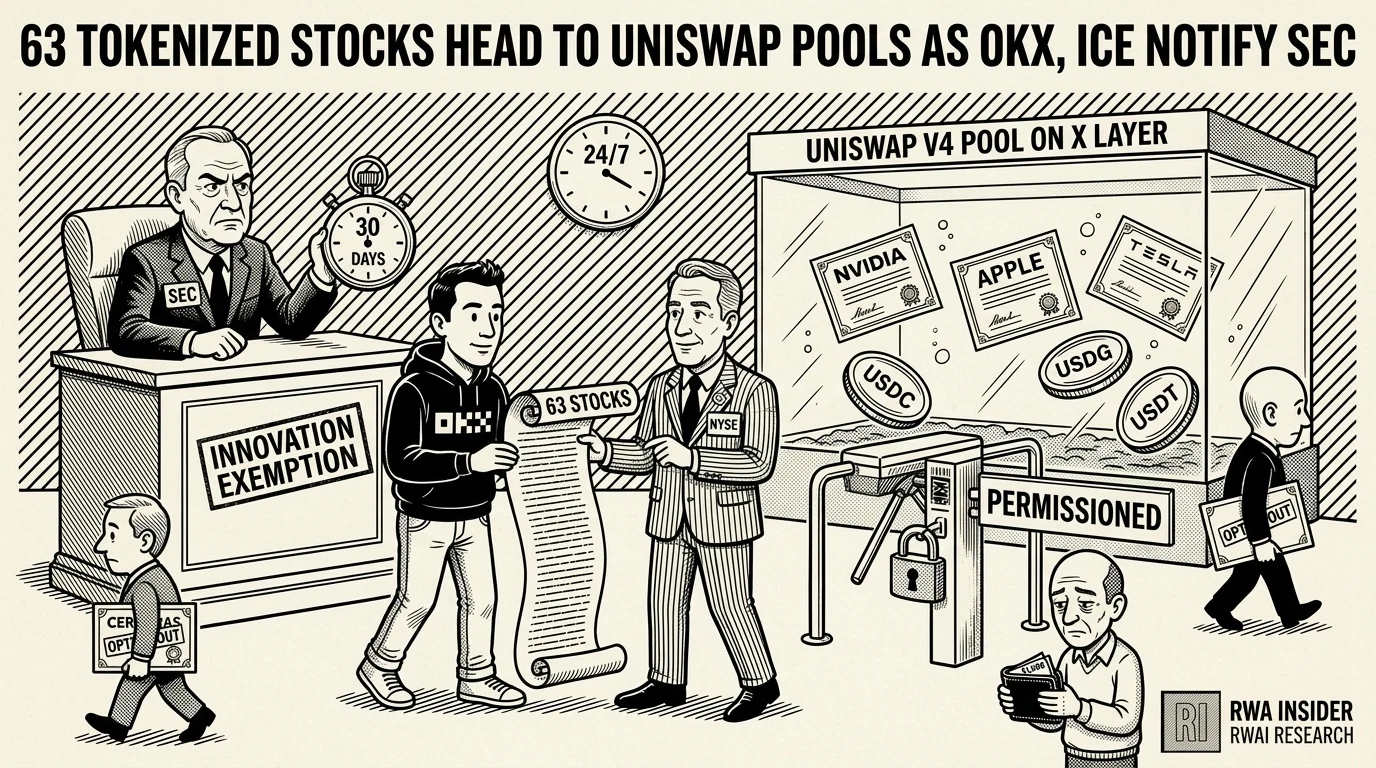
OKX and NYSE owner Intercontinental Exchange want 63 tokenized U.S. stocks, from Nvidia to Tesla, trading around the clock in Uniswap v4 pools on OKX’s X Layer blockchain. Their joint venture, OKXICE LLC, notified the SEC on October 4, and its announcement said: “Our notice includes more than 60 companies listed on U.S. stock exchanges.” For your wallet, tokenized Nvidia or Apple shares could one day swap against USDC, the stablecoin already sitting in many DeFi wallets, in a DEX pool, but only inside a permissioned venue that controls who trades.
OKXICE Files SEC Notice For 63 Tokenized Stocks
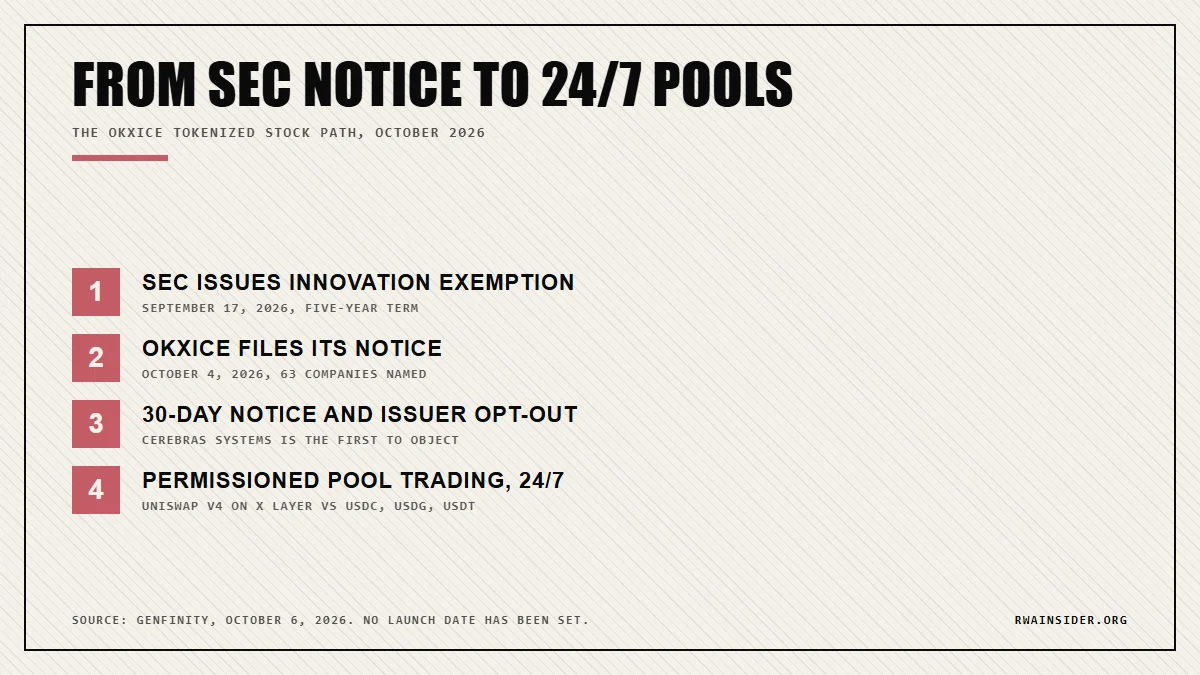
The SEC received a notice from OKXICE LLC on October 4, 2026. The venture plans a permissioned venue for trading tokenized shares around the clock.
The filing is the formal notice step under the SEC’s new exemption, not a separate sign-off on the venue itself.
OKX and Intercontinental Exchange each own 50% of the venture, first announced in March 2026. ICE had already invested in OKX.
The roster names 63 companies, including Nvidia, Apple, Microsoft and Tesla. Crypto-linked names like Coinbase, Circle, Strategy and Robinhood made the list too.
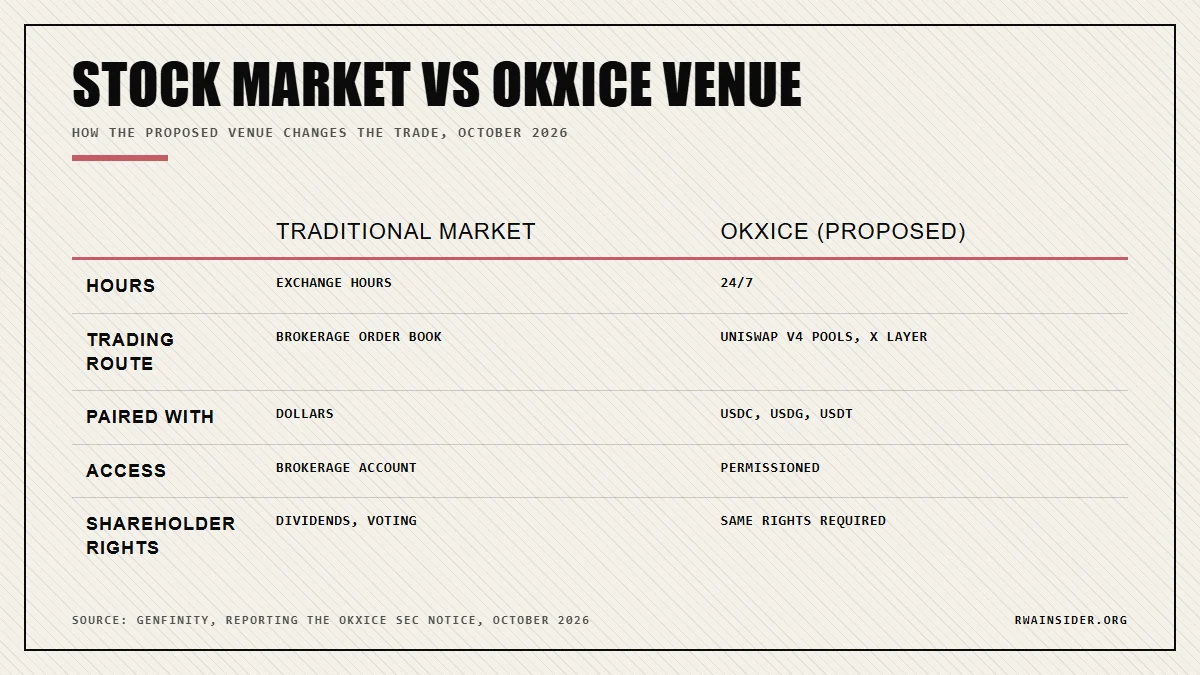
Here is the DeFi part. Each stock token would trade against USDC, USDG or USDT in Uniswap v4 liquidity pools on X Layer, OKX’s own public blockchain.
This is not open to every wallet. The venue stays permissioned and has no launch date, but it would put blue-chip equities inside AMM pools.
Uniswap v4 Pools, 3 Stablecoins And A 30-Day Clock
The rules come from the SEC’s five-year Innovation Exemption, issued on September 17, 2026.
Qualifying venues can trade tokenized U.S.-listed stocks without registering as national securities exchanges.
It is not a blanket approval. Operators must notify the SEC at least 30 calendar days before trading starts.
Each selected company also gets 30 days to object. Chipmaker Cerebras Systems already has, the first issuer to opt out.
So 63 is a starting list, not a final one. More names could drop off before launch.
Tokenized shares must also keep the same economic and governance rights as ordinary shares, including dividends and voting power.
For a DeFi user, this matters less as a Wall Street listing than as a test of whether blue-chip stock pools can hold real stablecoin liquidity on-chain.
Should you move capital? There is nothing to move into yet. The venue offers no yield, and the pools do not exist.
That design lets users swap dollar-pegged tokens for stock tokens without routing through a brokerage order book.
The chain speeds up settlement and stretches trading hours. It does not widen the list of who gets to trade.
SEC Exemption Risks: Off-Hours Drift And Custody Claims
ICE has framed the goal as giving OKX users regulated access to its futures markets and tokenized NYSE equities, pending approval.
OKX is widening its reach the same week. Reports pointed to new investment from Circle, Ripple and Standard Chartered.
The exemption itself carries a shelf life. In RWA Insider’s look at how Bitwise reads the SEC tokenized stock exemption, the risk was durability.
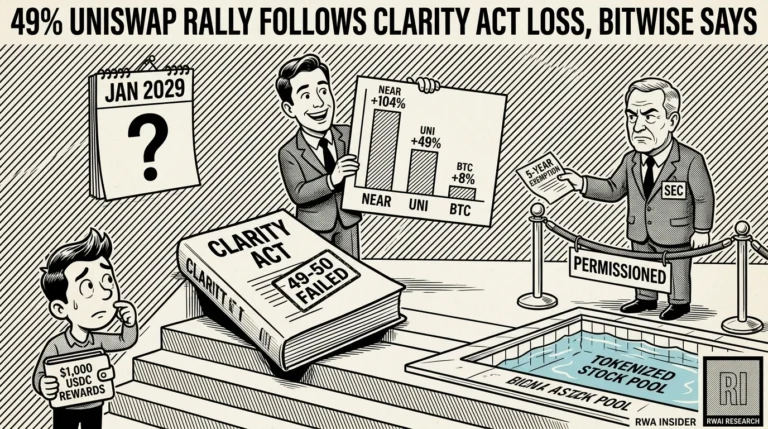
Bitwise CIO Matt Hougan warned that agency decisions protect less than laws, so a new administration in January 2029 could appoint tougher SEC leaders.
Robinhood crypto chief Johann Kerbrat said existing trading activity could run into the exemption’s caps on eligible symbols and volume.
Round-the-clock trading adds its own risks. Liquidity could thin out overnight, and token prices may drift from the real shares while traditional markets are closed.
Custody is the quieter risk. A token is a custodial claim, not legal share ownership, so check how dividends and votes reach you.
Until the venue opens, you can follow DeFi-native tokenized stock coverage across chains.
Watch the 30-day window. Every issuer objection after Cerebras shrinks the list before the first pool opens.
If OKXICE clears its 30-day window, blue-chip stocks land in AMM pools backed by stablecoin liquidity. Whether those pools ever open to permissionless wallets is what your portfolio actually depends on.
Check the issuer opt-out list before you plan any tokenized stock position on X Layer.
Frequently Asked Questions
What is OKXICE and who owns it?
OKXICE LLC is a joint venture between OKX and Intercontinental Exchange, the parent company of the New York Stock Exchange. Each company holds 50%, and the pair first announced the venture in March 2026.
Can I trade OKXICE tokenized stocks from my own wallet?
Not freely. The venue is permissioned, so access and transfers stay under compliance controls. No launch date has been set yet.
Which stablecoins will the 63 tokenized stocks trade against?
Each tokenized stock would trade against USDC, USDG or USDT in Uniswap v4 pools on X Layer, OKX’s public blockchain. That lets users swap dollar-pegged tokens for stock tokens without a brokerage order book.
Are tokenized stocks under the SEC Innovation Exemption safe?
The exemption requires the same economic and governance rights as ordinary shares, including dividends and voting. Risks remain: prices can drift from the real shares off-hours, liquidity can fragment, and a token is a custodial claim rather than direct share ownership.