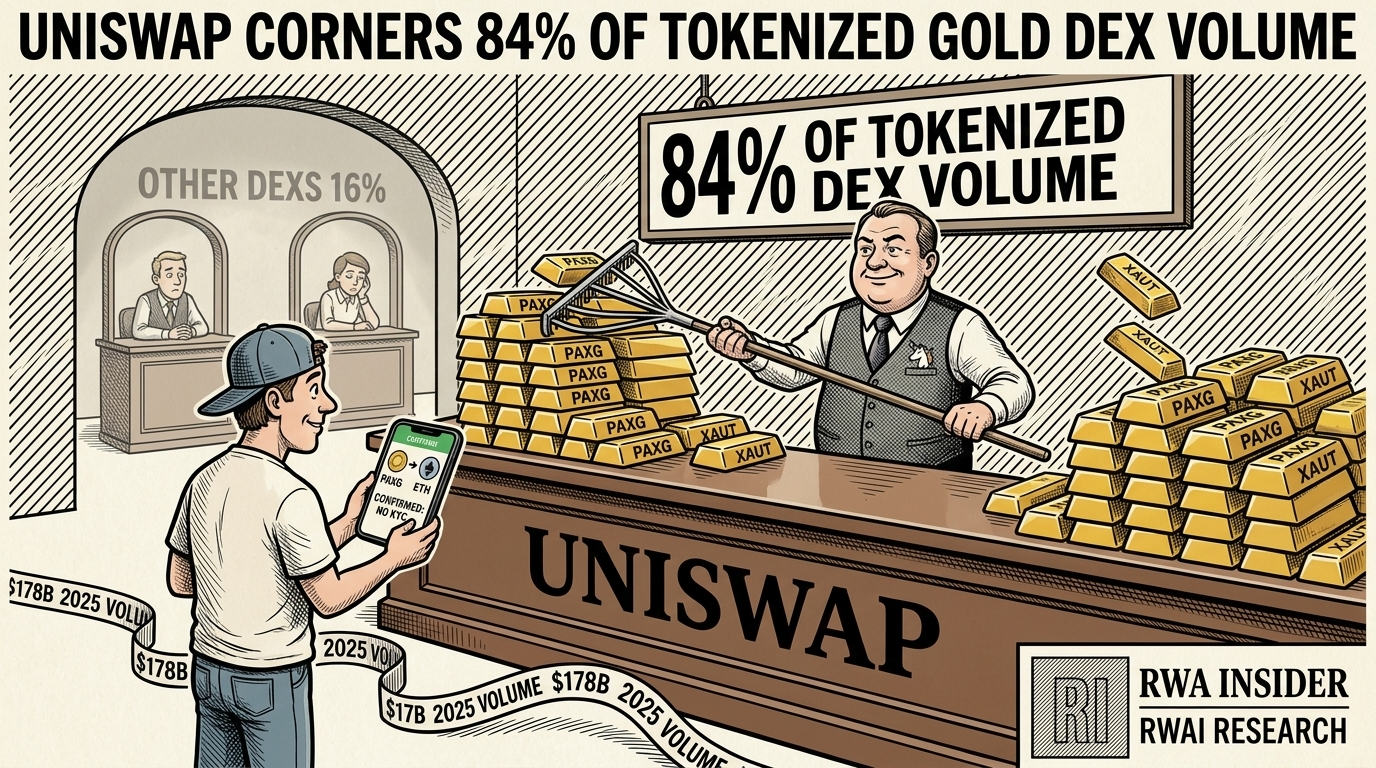
Uniswap Corners 84% Of Tokenized Gold DEX Volume
Key Points
- Uniswap now handles 84% of all tokenized gold traded across decentralized exchanges as of June 10, 2026, a near-monopoly on the segment.
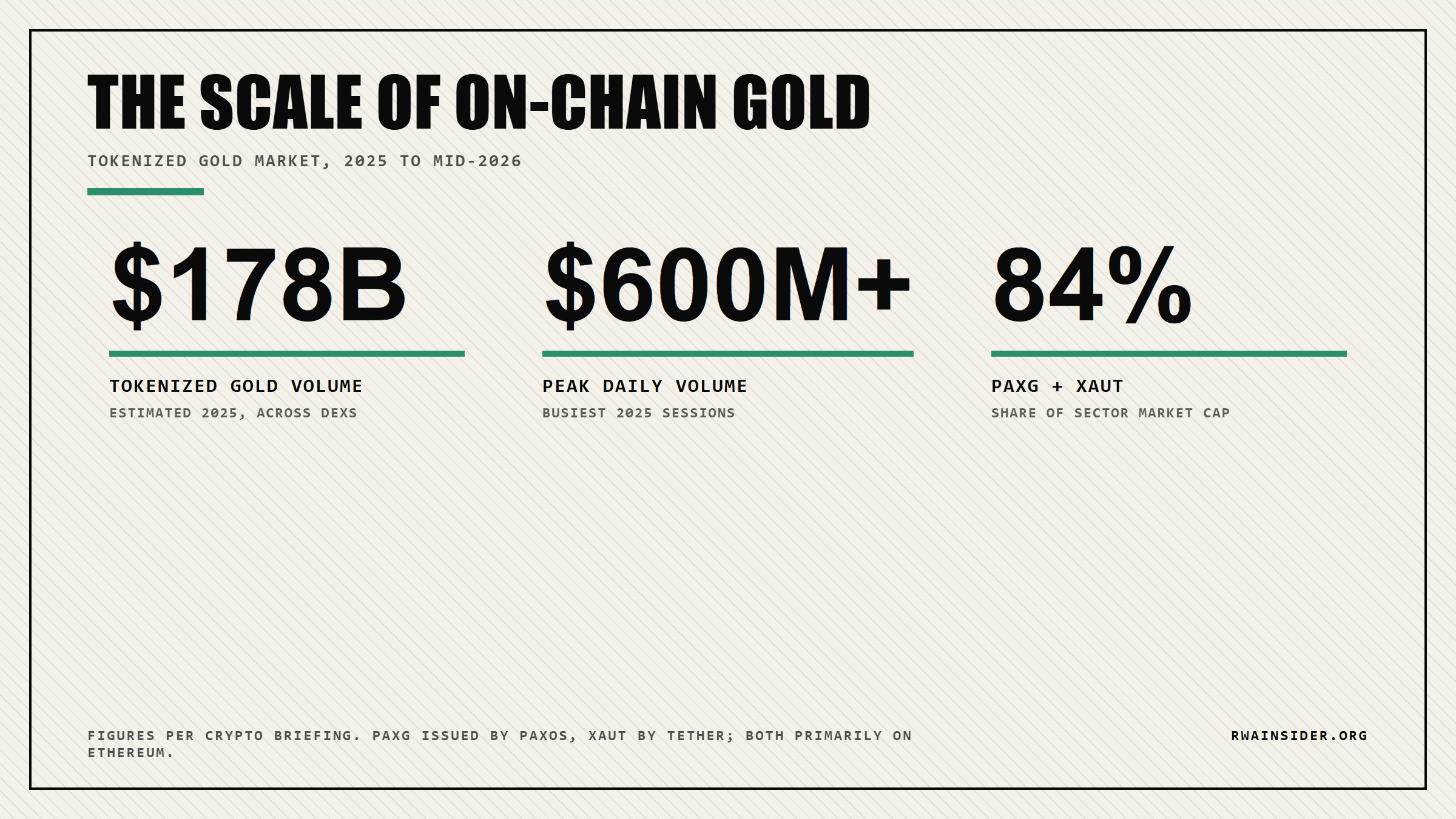
- Tokenized gold trading volume reached an estimated $178 billion in 2025, with daily peaks above $600 million during the busiest stretches.
- Any wallet can swap into PAXG or XAUt on Uniswap today with no KYC, then post the gold as collateral in DeFi lending protocols.
Uniswap now processes 84% of all tokenized gold volume traded across decentralized exchanges, a figure reported as of June 10, 2026. Crypto Briefing called it “a level of dominance that makes its grip on this niche look less like market leadership and more like a near-monopoly.” For a wallet, this is where on-chain gold actually trades: swap into PAXG or XAUt on Uniswap in minutes, with no brokerage and no KYC, then put that gold to work as collateral in DeFi lending.
Uniswap Owns 84% Of On-Chain Gold Trading
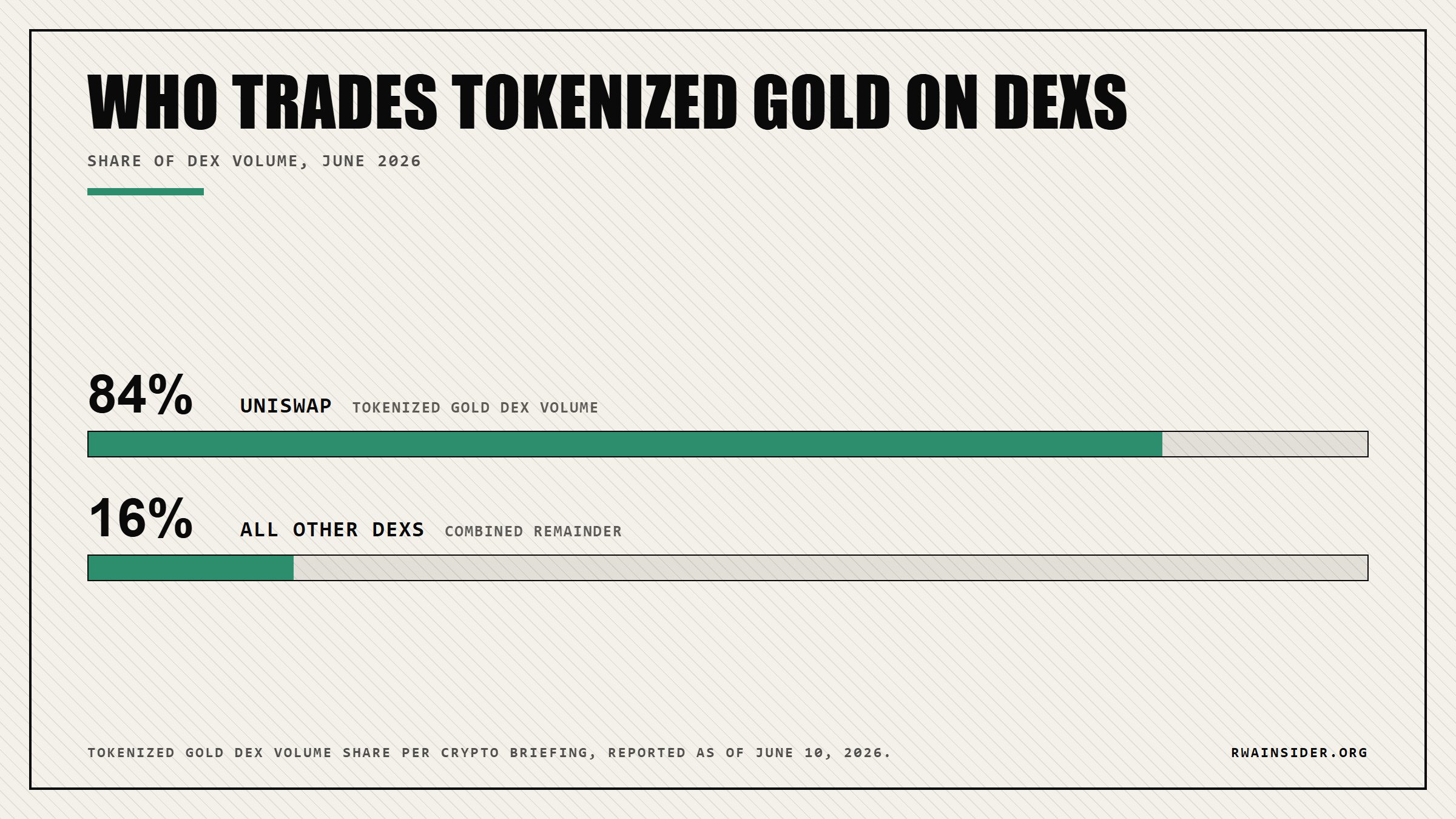
If you wanted to trade gold on a decentralized exchange this year, there was really one place to do it. Uniswap now handles 84% of all tokenized gold volume across DEXs.
That is not normal market leadership. Uniswap’s overall DEX share usually sits between 25% and 50% depending on the period and the metric.
In gold, 84% is a different animal. Tokenized gold barely existed as a trading category a few years ago, and now one venue has cornered it almost entirely.
The market is a two-horse race. PAXG, issued by Paxos, and XAUt, issued by Tether, together hold roughly 84% of the sector’s market cap, and both live primarily on Ethereum.
Each token represents one troy ounce of physical gold held in reserve, giving a wallet on-chain exposure to the metal without a vault, a futures contract, or a brokerage account.
The DeFi read is simple. This is the venue where on-chain gold actually changes hands, so this is where a $1,000 wallet goes to buy or sell it.
Where The $178B In Gold Volume Comes From
Tokenized gold trading volume reached an estimated $178 billion in 2025, a figure comparable to what traditional gold ETFs process in a year.
That number is not a projection. It is measured trading volume, and it puts on-chain gold in the same conversation as the ETF complex that has dominated gold investing for two decades.
During the busiest stretches of 2025, daily volumes topped $600 million. This is real depth, not a thin experimental market.
The pull is structural. Traditional gold markets close on weekends, ETFs need a brokerage, and physical bars need storage and insurance.
Tokenized gold trades 24/7, settles in minutes, and can be redeployed as productive capital. Both PAXG and XAUt are already integrated across DeFi as collateral in lending protocols and as components of liquidity pools.
Neither token pays a native yield, so the appeal is not income. You can see how tokenized gold trades across on-chain venues and judge the liquidity for yourself.
Strip away the monopoly framing and this is really about where a wallet can buy gold on-chain at a fair price: one venue, deep liquidity, and tight spreads.
Concentration Risk Cuts Both Ways On Uniswap
An 84% share cuts both ways. Deep liquidity on one platform means tighter spreads and better execution, and PAXG and XAUt liquidity providers earn more fees from the high volume.
The downside is concentration. If Uniswap suffered a smart contract exploit, a governance crisis, or regulatory pressure, on-chain gold would lose its main liquidity venue overnight.
Rivals have tried to pull gold liquidity onto other DEXs, but none has come close. Liquidity begets liquidity, and traders route to the venue with the tightest quotes.
The price gap between tokenized gold on Uniswap and on centralized venues also leaves room for arbitrage, and the $600 million daily peaks are deep enough to run those trades without heavy slippage.
The case for trading gold on-chain keeps getting stronger. RWA Insider has reported how Theo’s chief investment officer argues tokenized gold now sets weekend price discovery while futures desks are closed.
For a wallet holder, the practical question is access, and the answer is open: PAXG and XAUt are permissionless tokens any address can hold and trade today.
Whether Uniswap’s grip loosens depends on whether a rival DEX can bootstrap PAXG and XAUt liquidity deep enough to compete, and so far none has. Until that changes, the gold trade on-chain runs through one venue, and that is both its strength and its single point of failure.
Watching where tokenized gold liquidity pools and where a wallet gets the tightest fill is the edge that separates a clean swap from a costly one. Keep tracking the venues that actually hold the volume.
Frequently Asked Questions
How do I buy tokenized gold on Uniswap?
Connect a self-custody wallet, then swap a stablecoin or ETH for PAXG or XAUt directly on Uniswap. The trade is permissionless, settles in minutes, and needs no brokerage account or KYC on the token itself.
What is the difference between PAXG and XAUt?
PAXG is issued by Paxos and XAUt by Tether, but both represent one troy ounce of physical gold held in reserve. Both trade primarily on Ethereum and together hold roughly 84% of the tokenized gold market cap.
Is it risky that Uniswap controls 84% of tokenized gold volume?
Concentration cuts both ways. The deep liquidity gives traders tighter spreads, but it also makes Uniswap a single point of failure: a smart contract exploit or regulatory action there would disrupt the whole on-chain gold market at once.
Can tokenized gold be used as collateral in DeFi?
Yes. PAXG and XAUt are already accepted as collateral in lending protocols and used as components of liquidity pools. They pay no native yield, so the value is liquidity and collateral utility rather than income.