
50,000 Europeans Fight ECB Bid To Extend MiCA Yield Ban To DeFi
Key Points
- Europe’s central banks asked the Commission to extend MiCA’s stablecoin interest ban to crypto lending, borrowing and staking as the review closed September 30.
- Stand With Crypto EU says more than 50,000 people emailed Brussels for stablecoin rewards, and a separate petition passed 126,600 signatures.
- EU wallets lending MiCA stablecoins such as EURC carry the risk, and Aave Labs warns a wider ban hands dollar stablecoins the on-chain edge.
Europe’s central banks want MiCA’s ban on paying stablecoin holders stretched to cover crypto lending, borrowing and staking, and more than 50,000 Europeans, Circle and Aave Labs are pushing back. Responding to the European Commission’s MiCA review, which closed for comment on September 30, the European System of Central Banks wrote: “Electronic money is intended to be used for making payments and not as a means of saving.” For a wallet that lends stablecoins for yield, that sentence is the whole fight, because the central banks want lending returns caught by the same ban.
The ECB Wants MiCA’s Yield Ban On DeFi Lending
The European System of Central Banks, the group that includes the European Central Bank, filed its position as the Commission’s MiCA comment window shut.
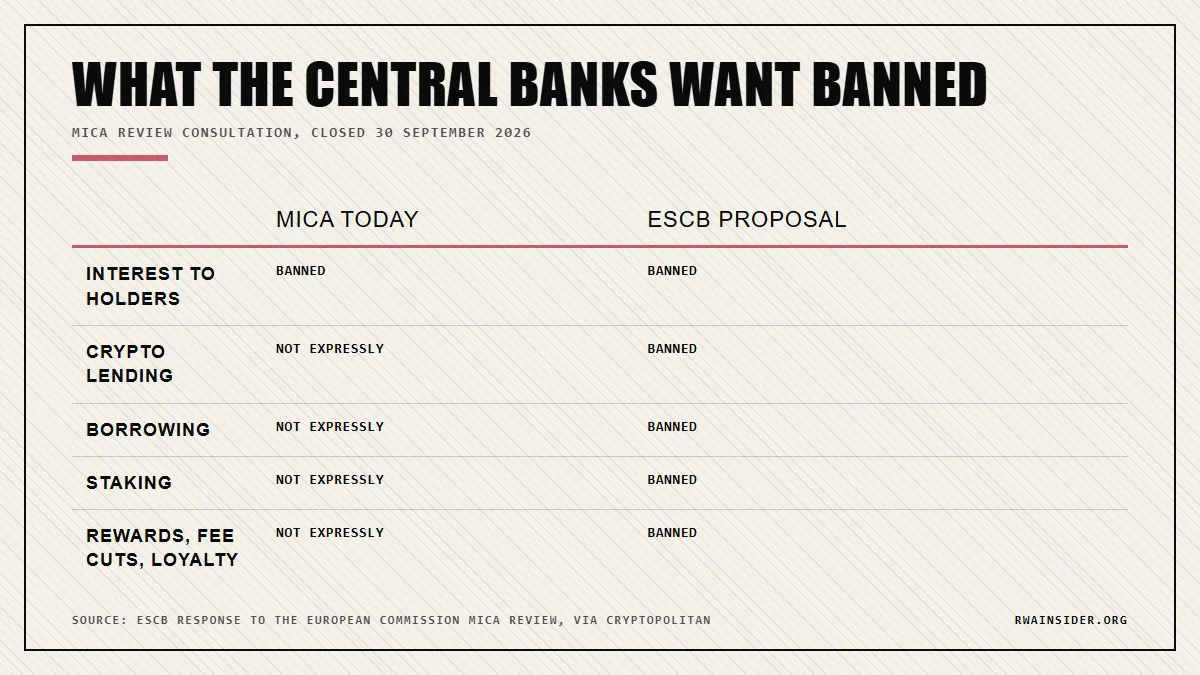
It backs keeping the current ban on paying interest to stablecoin holders. Then it goes further.
The ESCB asked regulators to extend that ban to crypto lending, borrowing and staking, and to outlaw softer perks such as rewards, fee reductions and loyalty benefits.
MiCA does not expressly ban any of those today.
The central banks’ logic is simple: once a token pays you just for holding it, it starts to look like a deposit account, which runs under different rules.
Not every regulator wants a ban.
ESMA, in its own September 30 response, proposed licensing the firms that give users access to DeFi protocols, with proportionate disclosure for staking, lending and borrowing instead.
50,000 Emails, 126,600 Signatures, 3 Compliant Coins
The pushback came mostly from outside the companies.
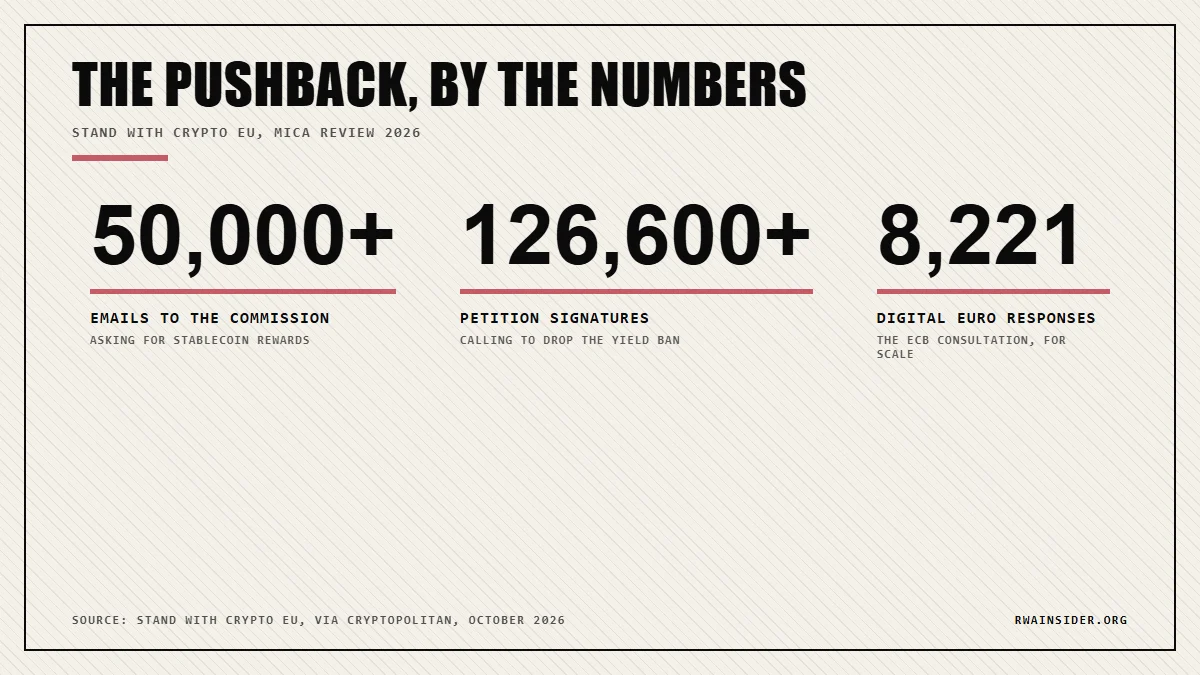
Stand With Crypto EU says more than 50,000 people emailed the Commission asking it to let regulated stablecoins offer rewards, cashback and lower fees.
A separate petition gathered over 126,600 signatures calling for the yield ban to go entirely, as long as the coin is backed by safe, interest-bearing assets.
The group says that email count ran more than six times the 8,221 responses to the ECB’s digital euro consultation. Its partners include Boerse Stuttgart Digital, IOTA and Morpho.
Circle, in its October 1 response, pointed at a thinner market. Only 3 of the 25 largest stablecoins by market cap clear MiCA today: USDC, USDG and EURC.
Strip away the consultation language and this is really about whether an EU wallet can still earn a borrower-paid return on a MiCA stablecoin.
Circle did side with the central banks on reserves. The ESCB wants to scrap the rule forcing issuers to hold 30% to 60% of reserves in bank deposits.
In its place, a set share of reserves would mature within one to five working days. Circle says the deposit floor raises exposure to banking-sector credit risk.
Aave Labs Draws The Line At Borrower-Paid Yield
Aave Labs runs Push, a MiCA-authorized service provider supervised by the Central Bank of Ireland, and its filing drew a clean line.
Lending returns are paid by borrowers who post collateral, to lenders who carry the risk, much like lending euros or bonds.
The current ban only stops issuers and platforms paying people to hold a coin.
Stretch it further, Aave Labs warned, and dollar stablecoins get the advantage in on-chain markets while MiCA stablecoins lose a key use case.
Aave founder Stani Kulechov said on X he was “disappointed” by the responses from the ECB and the European Banking Authority.
Harry Pearce Gould, general manager of Stand With Crypto EU, framed it as a competition fight. Europe “doesn’t need to copy” the US, he said, but “does need to compete with it.”
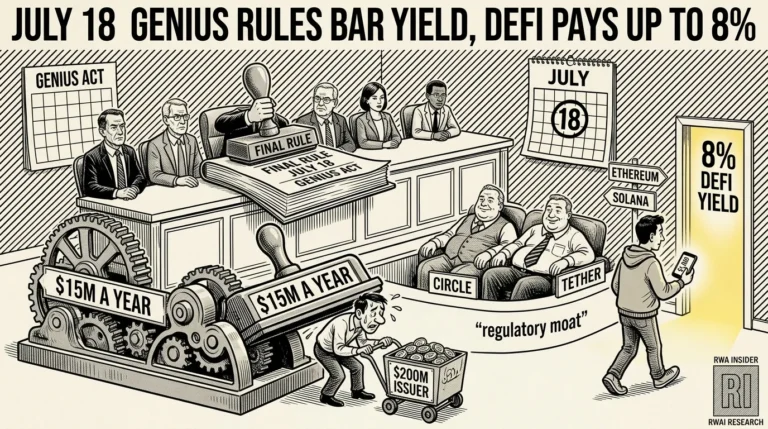
The US gap is concrete. Under the GENIUS Act, US issuers cannot pay interest directly, but exchanges there can still offer rewards.
RWA Insider flagged this fork in May, when the MiCA 2.0 review first put stablecoin yield on the table.
The Commission now has to reconcile the filings before it writes a revised MiCA. You can follow more DeFi-native stablecoin rule coverage as the draft takes shape.
If Brussels keeps lending outside the ban, MiCA stablecoins stay useful in DeFi pools. If it sides with the central banks, Aave Labs expects dollar stablecoins to take that on-chain business, and the revised MiCA draft will settle which way it goes.
Read the Commission’s draft before parking euro stablecoins in a lending pool for the long haul.
Frequently Asked Questions
What did the ECB ask the EU to ban under MiCA?
The European System of Central Banks, which includes the ECB, asked the Commission to keep MiCA’s ban on paying stablecoin holders and extend it to crypto lending, borrowing and staking. It also wants rewards, fee reductions and loyalty benefits prohibited. MiCA does not expressly ban those today.
Can I still earn lending yield on EURC or USDC in Europe?
Nothing is decided yet. The consultation closed on September 30 and the Commission still has to weigh the filings before it drafts a revised MiCA. Aave Labs has asked it to keep lending and staking outside the ban, arguing that borrowers pay that return, not the issuer.
Which stablecoins are MiCA-compliant right now?
Circle’s October 1 filing says only three of the 25 largest stablecoins by market cap clear MiCA today: USDC, USDG and EURC. Circle wants the Commission to focus on that narrow perimeter rather than on a shortage of licensed issuers.
How does the MiCA yield ban compare to the GENIUS Act?
Under the GENIUS Act of 2025, US issuers cannot pay interest directly, but exchanges there can still offer rewards. Stand With Crypto EU argues a wider MiCA ban would leave EU platforms behind, and says Europe needs to compete with the US.