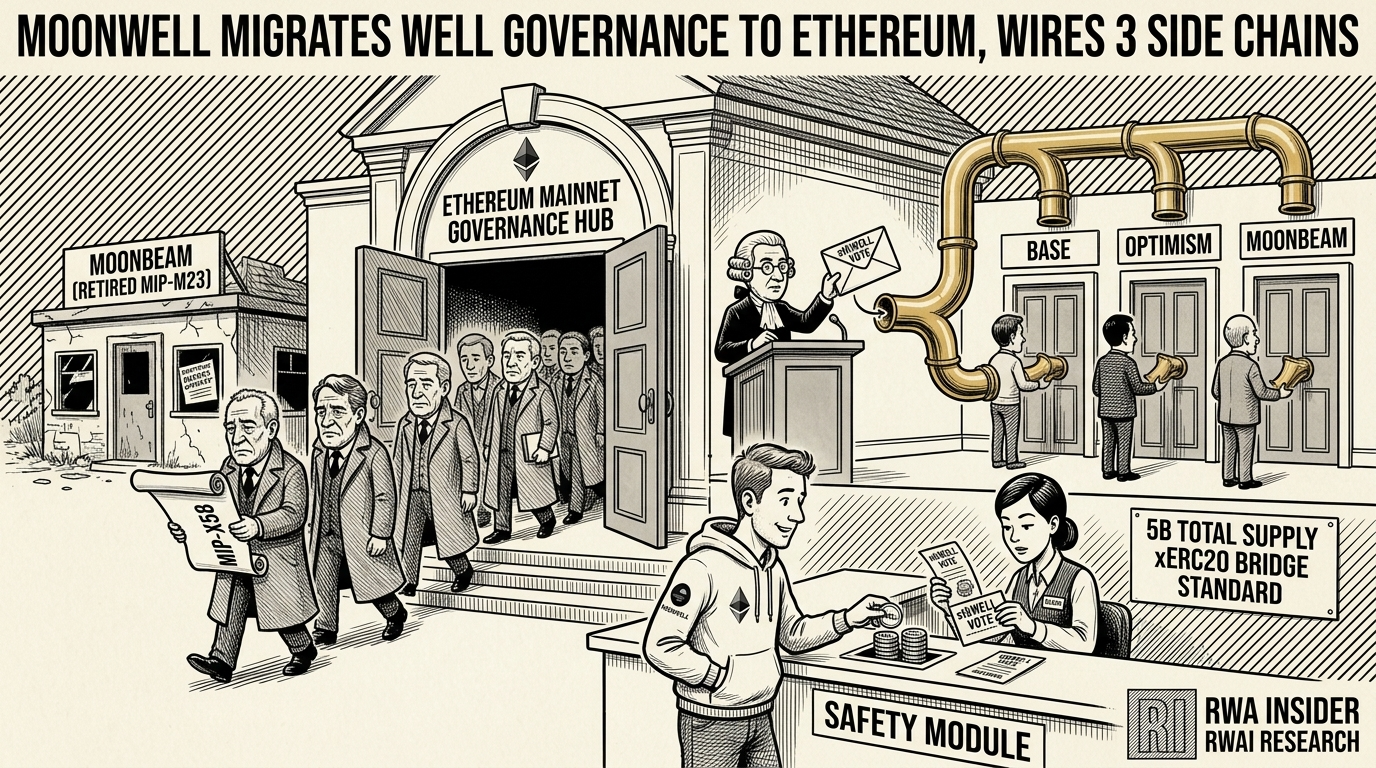
Moonwell Migrates WELL Governance To Ethereum, Wires 3 Side Chains
Key Points
- Moonwell migrated its full governance framework to Ethereum mainnet through proposal MIP-X58, voted in mid-May 2026, retiring its prior Moonbeam-based setup.
- WELL holders stake into the Safety Module to mint stkWELL, which carries both voting rights and staking rewards, mirroring Aave’s playbook.
- Stake WELL on Ethereum once and lending parameter votes cascade across Base, Optimism, and Moonbeam from any wallet in one transaction.
Moonwell pulled off the cross-chain governance pattern most DeFi protocols only talk about on Discord. The multichain lending protocol moved its full governance framework from Moonbeam to Ethereum mainnet through proposal MIP-X58, voted in mid-May 2026. The Crypto Briefing report walks through the new wiring. WELL holders stake into what the protocol formally calls the “Safety Module,” mint stkWELL, and cast votes that cascade across Base, Optimism, and Moonbeam from a single Ethereum transaction. For any wallet sitting on a side chain with WELL, that single chain is now Ethereum.
How MIP-X58 Routes Moonwell Governance Through Ethereum
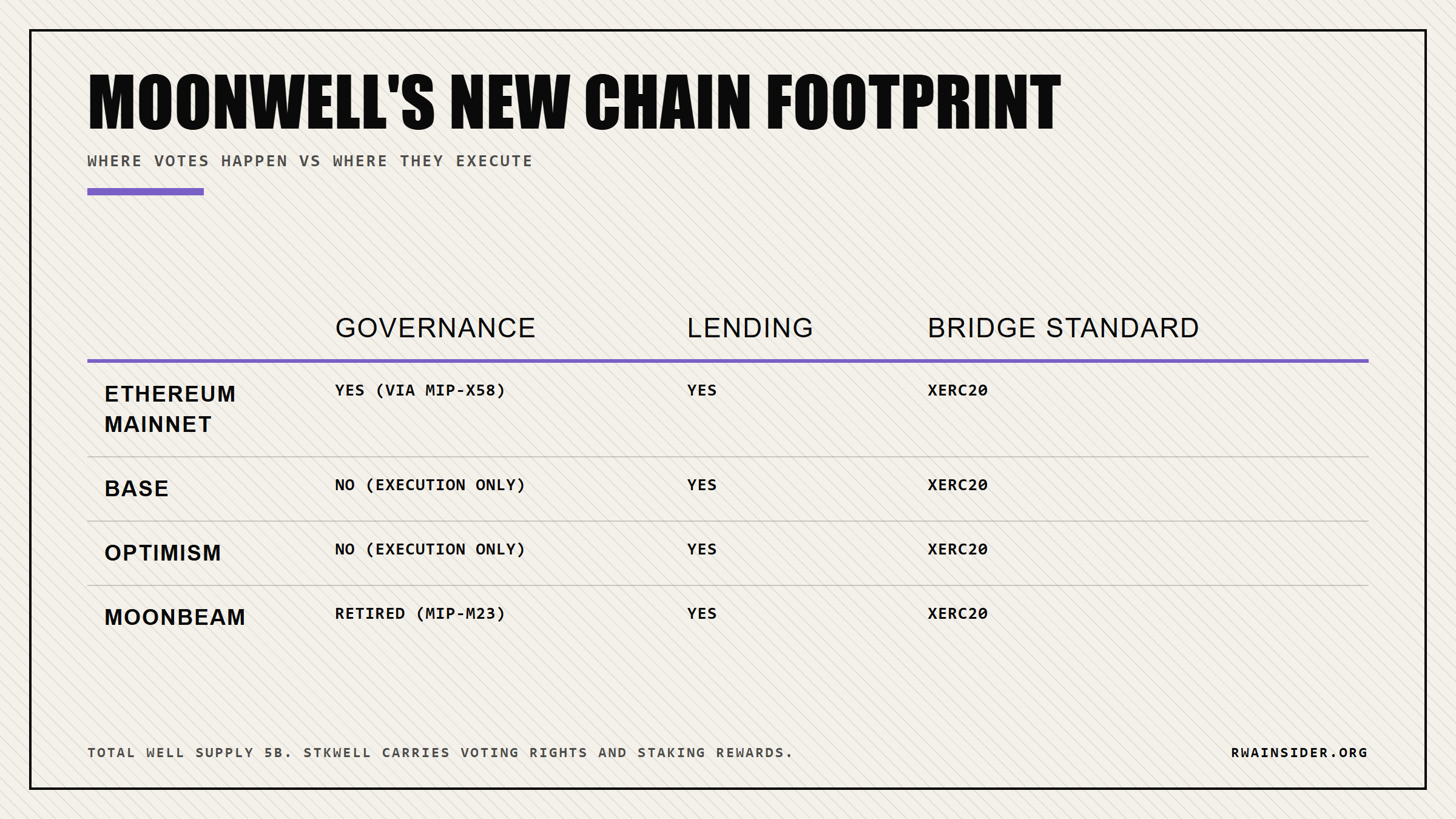
The migration runs through proposal MIP-X58, which passed the protocol’s vote in mid-May 2026 and formally retired the Moonbeam-based governance setup in place since MIP-M23.
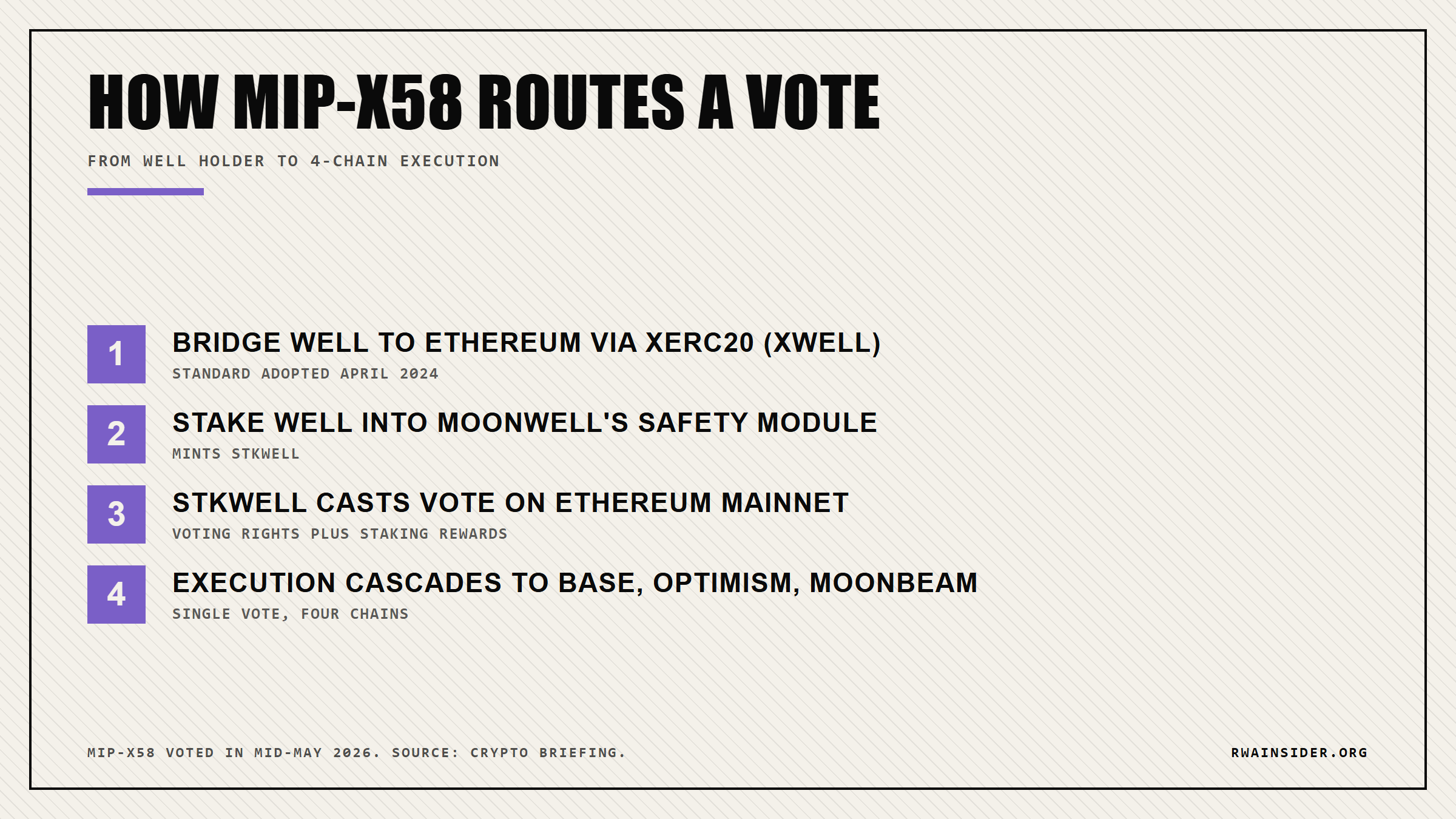
The technical foundation was poured in late April 2024, when Moonwell adopted the xERC20 standard for its WELL token under the ticker xWELL. That standard is what lets the same WELL balance exist natively across Ethereum, Base, Optimism, and Moonbeam without wrapped-token risk.
A precursor proposal, MIP-X55, opened the bridging pipe between May 13 and May 16, 2026, giving holders three days to move tokens from side chains to Ethereum before the governance hub flipped over.
Safety Module Staking And The Aave-Style stkWELL Backstop
To vote on Ethereum, WELL holders deposit tokens into Moonwell’s Safety Module. The deposit mints stkWELL, which carries both voting rights and a staking reward stream.
The Safety Module doubles as a security backstop for the protocol, a design pattern borrowed almost line for line from Aave‘s playbook. Stakers absorb shortfall risk if the lending markets face a bad-debt event, and in exchange they collect rewards layered on top of governance power.
Strip away the multichain framing and the real shift is this: a single stkWELL vote on Ethereum can change lending parameters on Base, Optimism, and Moonbeam in one transaction, which is operational infrastructure rather than a nice-to-have.
That capability sits inside Moonwell Improvement Proposals, the protocol’s formal governance mechanism. MIPs cover lending parameters, protocol upgrades, and now cross-chain executions from one chamber.
For a multichain lending protocol with markets across four chains in the broader RWA chain race, this consolidation cuts governance coordination from four forums down to one.
What 4-Chain Execution Means For Your WELL Position
For wallets holding WELL on Base or Optimism, the playbook flipped. To vote, bridge to Ethereum via xWELL, stake into the Safety Module for stkWELL, then engage in governance from there.
Voters previously needed Moonbeam-native tokens to participate, which capped active governance to a narrow Polkadot-parachain crowd. Routing through Ethereum widens the participant pool to anyone with a MetaMask or hardware wallet already set up for mainnet.
There is a cost to weigh. Ethereum gas is not Moonbeam gas. Staking transactions on mainnet can run into the tens of dollars during congestion, which makes governance uneconomic for holders with modest WELL positions and concentrates voting power among larger stakers.
WELL’s 5 billion total supply means the math matters at scale. Even a fraction staked into the Safety Module locks meaningful liquidity off the open market, creating a new demand sink alongside the standard supply pressure. Crypto Briefing’s editorial team flagged the same gas-cost trade in their May 27 report, framing it as the protocol’s central governance tradeoff.
Visit the Protocol Battles desk for more multichain governance coverage as restaking and shared sequencers push the same question across DeFi.
Whether the gas-cost trade pushes governance into the hands of larger stakers, or whether the deeper Ethereum participant pool offsets it, depends on how many side-chain WELL holders actually make the bridge over the next two months.
Track more Protocol Battles coverage from RWA Insider as multichain governance designs collide with chain-fee economics.
Frequently Asked Questions
What is Moonwell and how does its lending market work?
Moonwell is a multichain lending and borrowing protocol with active markets on Base, Optimism, and Moonbeam. Users supply collateral to earn yield or borrow against it, similar in mechanics to Aave or Compound but with markets coordinated across multiple chains.
How does stkWELL earn rewards in the Safety Module?
Staking WELL into Moonwell’s Safety Module mints stkWELL, which earns a staking reward stream while simultaneously serving as a shortfall backstop for protocol bad-debt events. The same stkWELL balance also carries voting rights in Moonwell Improvement Proposals.
Can I vote on Moonwell proposals from a Base or Optimism wallet?
Not directly. After MIP-X58, voting requires WELL on Ethereum mainnet staked into the Safety Module. Holders on Base, Optimism, or Moonbeam must first bridge their WELL to Ethereum using the xERC20 (xWELL) standard, then stake to participate in governance.
How does Moonwell’s Safety Module compare to Aave’s?
The design is closely modelled on Aave’s Safety Module: stake the governance token, absorb shortfall risk in exchange for staking rewards, and pair the stake with voting rights. The main difference is that Moonwell’s stkWELL votes execute cross-chain across Base, Optimism, and Moonbeam from a single Ethereum transaction.