$7.4B Vault Race: Morpho, Aave, Euler Split On Risk
Key Points
- A new Tiger Research report finds institutional money is splitting DeFi lending into isolated, modular markets, with about $7.4 billion now in curated vaults.
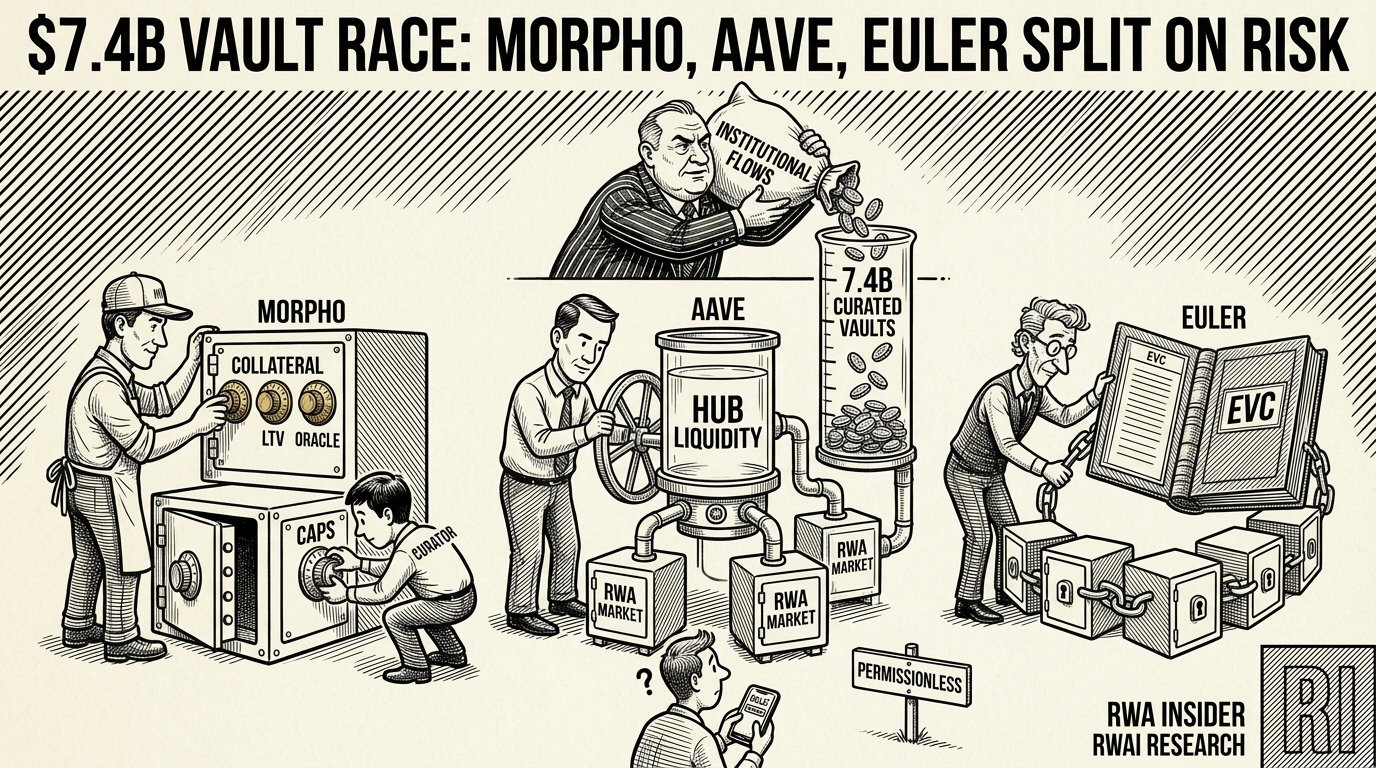
- Morpho locks market terms at launch, Aave V4 runs a hub-and-spoke design, and Euler V2 links isolated vaults after a $197 million 2023 exploit.
- Any wallet can lend in these permissionless vaults, but your risk now rides on the curator, like Steakhouse, Gauntlet or Sentora, not the whole pool.
Institutional capital is pulling DeFi lending apart, away from giant shared pools and toward modular markets that isolate risk asset by asset. That is the conclusion of a new report from Tiger Research, published through TokenPost on June 17, which estimates roughly $7.4 billion now sits in curated lending vaults and says “the main competitive axis is moving from simple liquidity provision to the quality of risk segregation.” For a wallet lending on Morpho, Aave, or Euler, that means the protocol matters less than the curator you trust with your deposit.
Tiger Research Maps DeFi Lending’s Shift To Isolated Risk
The report’s core claim is simple. When many assets share one giant pool, a loss on a single instrument can cascade across the whole system.
Tiger Research anchors that warning in history, noting how the 2008 Reserve Primary Fund broke the buck on Lehman debt worth just 1.2% of its book and drew roughly $40 billion in redemptions within two days.
Early DeFi repeated the pattern, jamming collateral, liquidation, and governance into one contract, which is why lending markets long stuck to only Bitcoin and Ethereum.
Tokenized real-world assets break that mold, since a tokenized Treasury, a private-credit note, and a tokenized stock each need different oracles, trading hours, and liquidation rules.
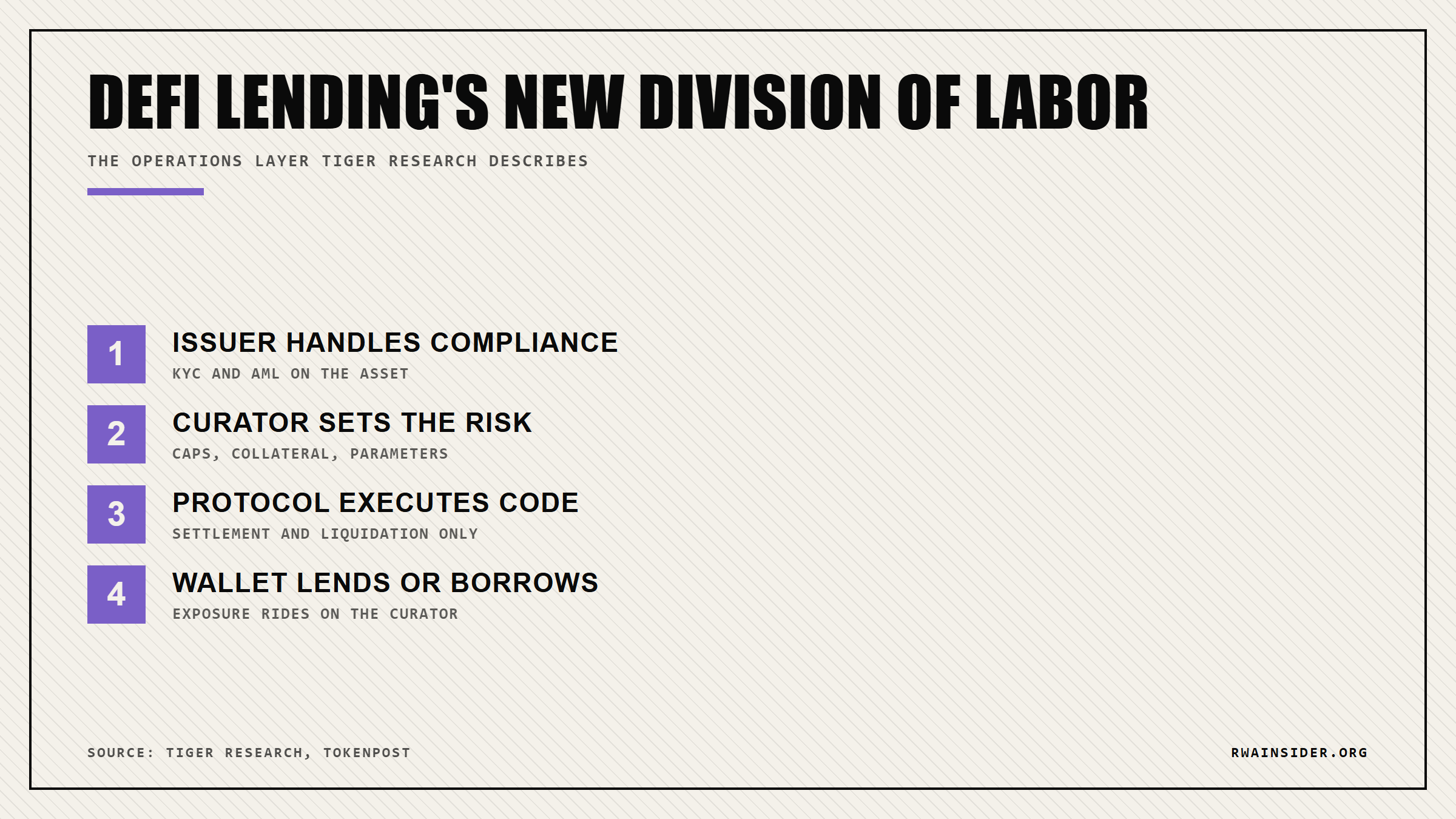
So the report splits lending into an immutable infrastructure layer that settles trades and a discretionary operations layer that picks assets and sets the risk.
For an on-chain lender, the shift changes where your risk actually lives, no longer in one shared pool, but in the specific market you pick.
Where Morpho, Aave, And Euler Now Diverge
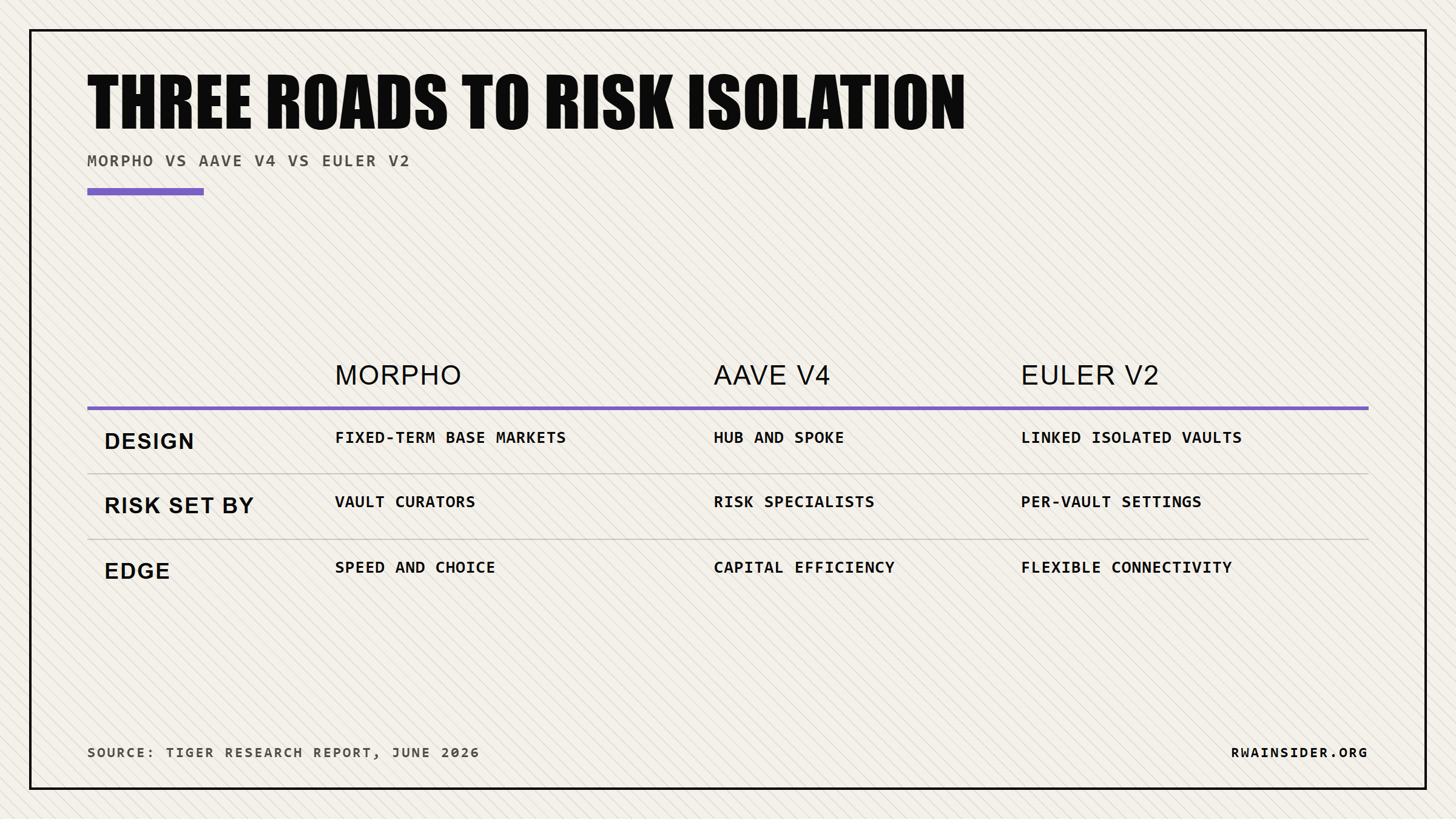
Morpho draws the sharpest line. Morpho Blue fixes a market’s collateral, loan asset, and price feed at launch, then hands risk decisions to vault curators who set the caps.
Aave takes a middle path with the hub-and-spoke design in V4, where a central hub holds liquidity and asset-specific spokes borrow against it under fixed credit lines.
That structure lets a brand-new tokenized market launch without bootstrapping its own lenders, the model behind Aave’s institution-facing Horizon, where issuers run KYC, risk specialists propose the parameters, and Chainlink feeds the prices.
Euler V2 splits the difference, linking independent credit vaults into one account so positions stay isolated but can still connect, a redesign that followed its $197 million exploit in 2023.
Through a tie-up with Ondo Finance, Euler even runs a market that accepts tokenized stocks like TSLAon as collateral against PayPal’s PYUSD.
Strip away the jargon and the contest is no longer who pools the most cash, but who manages risk best above the code.
You can see how tokenized assets keep plugging into on-chain credit across our wider coverage.
What $7.4B In Curated Vaults Means For Your Wallet
Tiger Research estimates about $7.4 billion now sits in these curated vaults, still small but growing fast as institutions back managers over pools.
The vaults already accept collateral old pools would not touch, from VanEck’s tokenized Treasury VBILL to Securitize’s AAA-rated CLO product STAC.
The firm’s conclusion is blunt: as the rails commoditize, value flows to “whoever can manage risk most effectively above them,” not to whoever owns the protocol.
The catch is curator competence. Tiger Research points to 2025 losses tied to xUSD and Stream Finance as proof that a weak vault manager can sink returns fast.
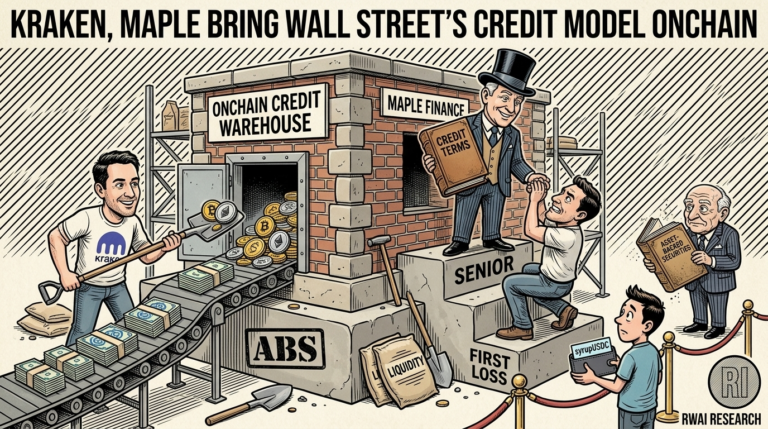
That is why capital is clustering with proven risk shops like Steakhouse, Gauntlet, and Sentora, while protocols lean on custodians such as Coinbase and Anchorage.
RWA Insider saw the same split-responsibility model when a tokenized credit fund landed as Aave Horizon collateral, with risk specialists, not a DAO, setting the terms.
The upside for a $1,000 wallet is that this all stays permissionless, anyone can lend, borrow, or even spin up a market on Morpho or Euler.
Whether modular lending scales depends on whether curators keep their record clean as billions more flow in. Until then, picking the right vault matters as much as picking the right chain.
Before you supply a single dollar to a lending vault, look past the protocol name and ask who the curator is and what they have lost before.
Frequently Asked Questions
What does risk-isolated or modular DeFi lending actually mean?
It means lending markets are built so a loss on one asset stays contained instead of draining a shared pool. Each market or vault gets its own collateral, price feed, and caps, rather than every asset sitting in one big pool with shared risk.
Can a $1,000 wallet lend in Morpho, Aave, or Euler markets?
Yes. These protocols stay permissionless, so any wallet can supply or borrow without KYC on the base layer. The trade-off is that your exposure depends on the specific vault and the curator who sets its risk parameters, not on the protocol alone.
How do Morpho, Aave, and Euler differ on risk?
Morpho fixes each market’s terms at creation and lets curators manage vault caps. Aave V4 uses a hub-and-spoke design where spokes lean on shared hub liquidity. Euler V2 links independent isolated vaults into one account, balancing separation with connectivity.
Is lending in a curated vault safe?
Isolation limits how far one bad asset can spread, but it does not remove risk. Curator skill now matters most, and Tiger Research cites 2025 losses tied to xUSD and Stream Finance as a warning. Capital is concentrating with established managers like Steakhouse, Gauntlet, and Sentora for that reason.