XRP Ledger Hits $4B, Cracks Tokenization Top 4
Key Points
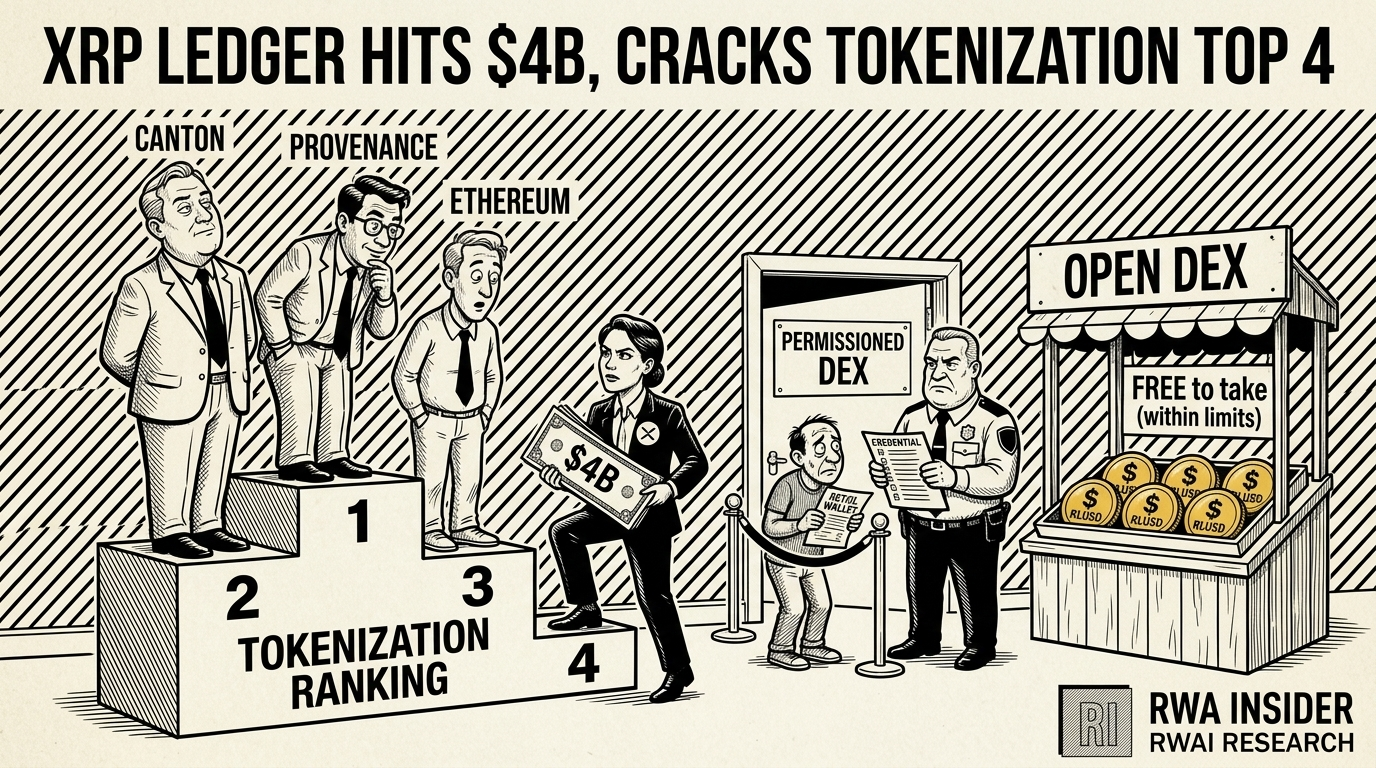
- XRP Ledger now holds about $4 billion in tokenized real-world assets, ranking fourth behind Canton, Provenance, and Ethereum.
- Evernorth Research clocks the jump at 28 times the roughly $147 million on the ledger a year earlier, driven by institutional funds.
- RippleX’s new Permissioned DEX serves verified institutions only, but any wallet can still trade RLUSD and listed tokens on XRP Ledger’s open DEX.
XRP Ledger has crossed about $4 billion in tokenized real-world assets, enough to make it the fourth-largest tokenization network in crypto, behind only Canton, Provenance, and Ethereum. Evernorth Research, whose data underpins the milestone, frames the moment bluntly: the debate is no longer whether tokenization works, but “which network will become the default settlement layer for global finance.” For a wallet holder, the number matters less than the access. RippleX’s new institution-only Permissioned DEX leaves retail with the open order book, where RLUSD still trades with no gatekeeper.
XRP Ledger’s $4B Lands It Behind Canton, Ethereum
The number comes from fresh real-world asset data crediting XRP Ledger with $4 billion in tokenized value.
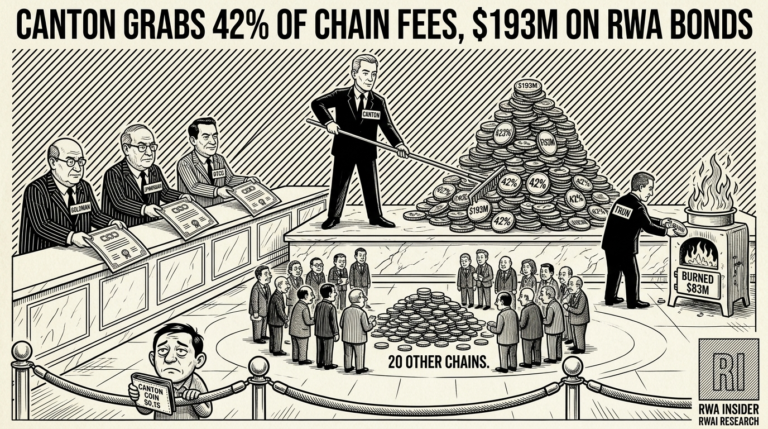
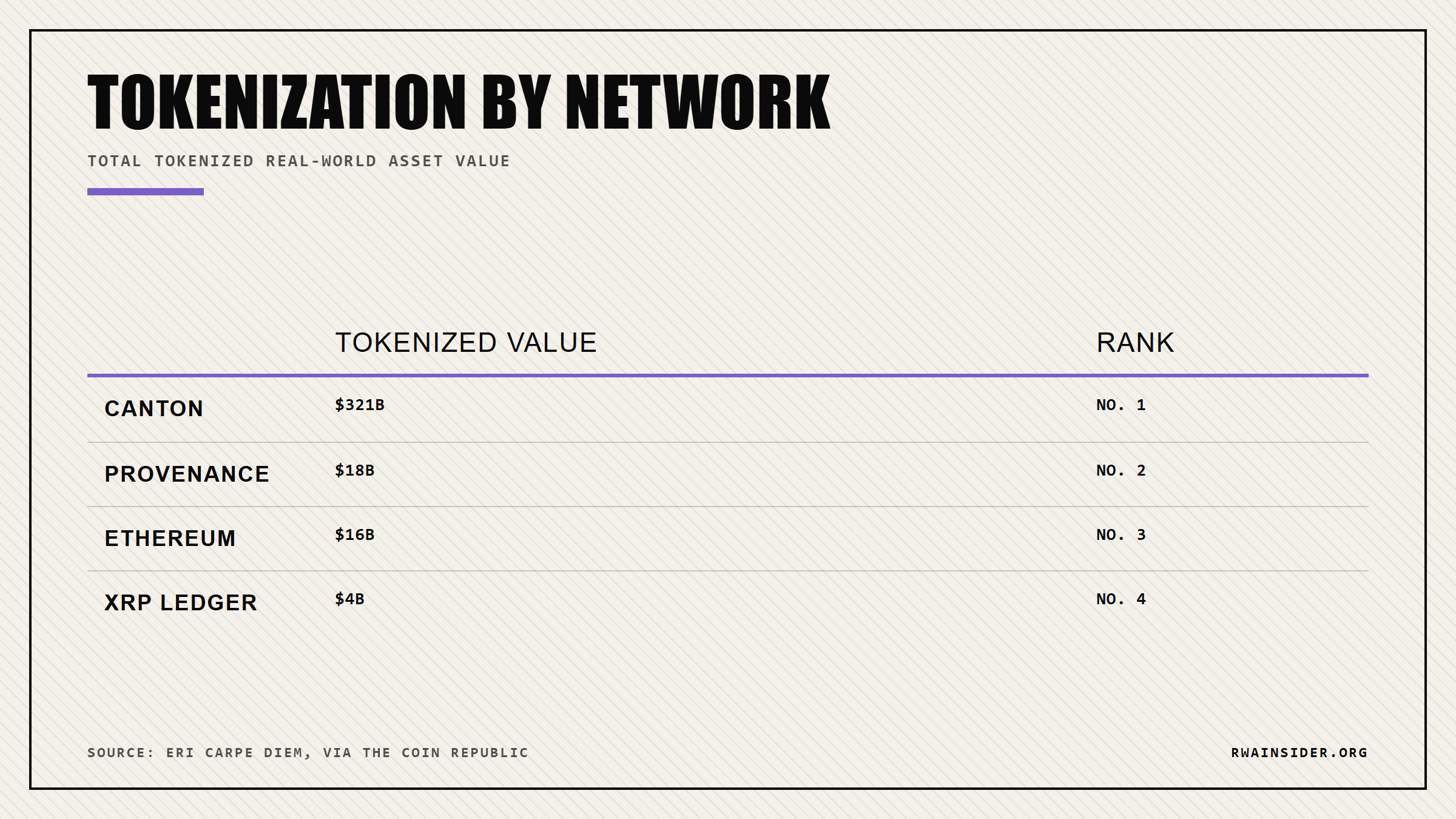
That ranks the chain fourth overall, behind Canton at about $321 billion, Provenance near $18 billion, and Ethereum around $16 billion.
XRP Ledger has spent years known for cheap cross-border payments, not tokenized assets. A seat in the top four is the part that turns heads.
The growth is institutional, not retail. Tokenized commodities backed by energy, diamond inventory tokens, senior debt, and dollar liquidity funds did the heavy lifting.
The proof of intent landed on May 6, when JPMorgan, Mastercard, Ondo Finance, and Ripple ran a live cross-border repo on the ledger using a tokenized Treasury fund. It settled in under five seconds.
Where The $4B Sits, And What A Wallet Can Trade
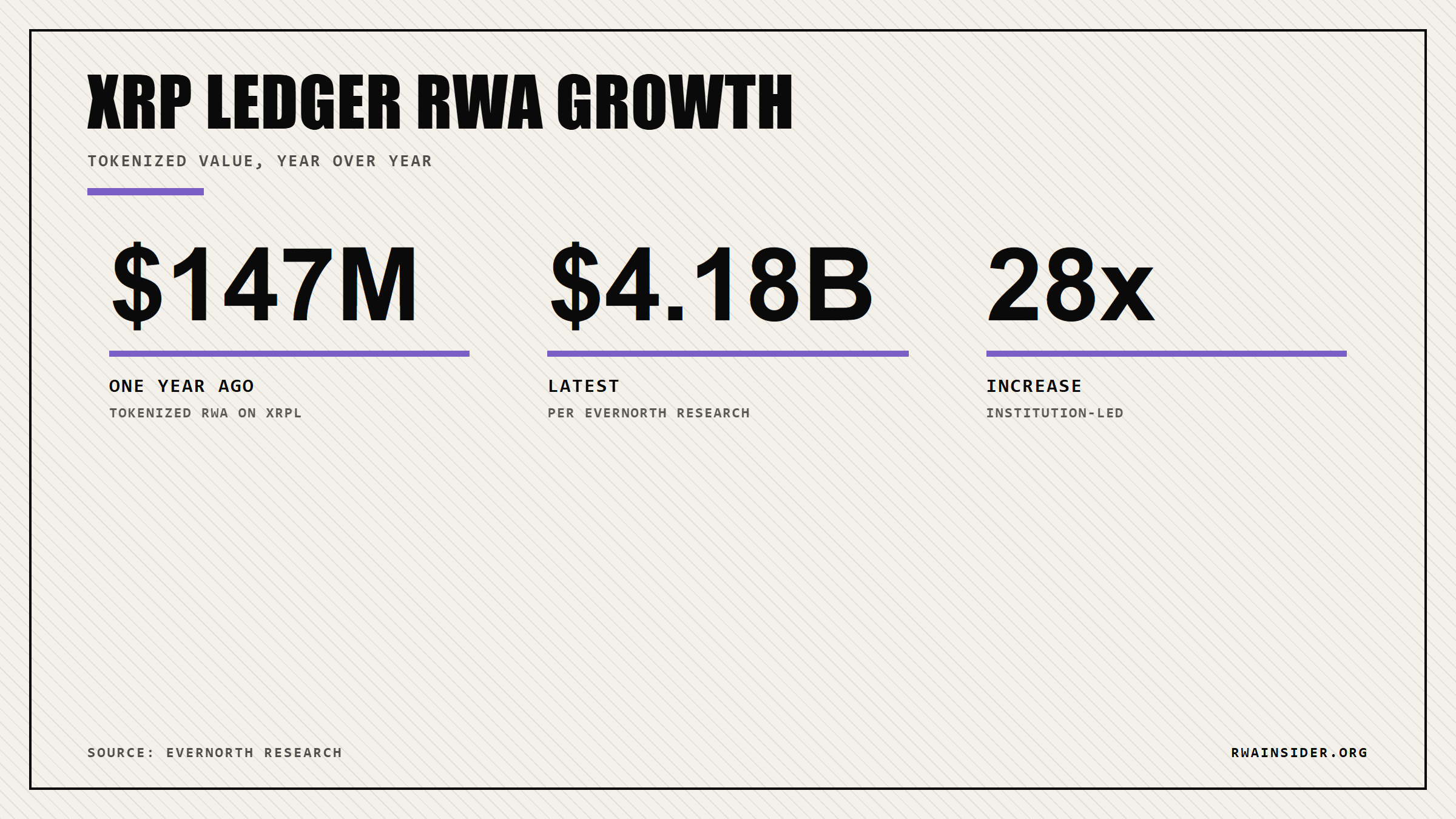
Evernorth Research pegs the climb at 28 times the roughly $147 million sitting on XRP Ledger a year ago. For a payments chain, that is a near-vertical run.
Strip away the institutional framing and the real story for a wallet is access, not the $4 billion headline.
On XRP Ledger’s built-in DEX, anyone with a wallet can trade RLUSD, Ripple’s dollar stablecoin, alongside other listed tokens. No signup, no gatekeeper, settlement in seconds.
That is the part a $1,000 wallet can actually use today. The $4 billion in funds and bonds above it is mostly walled off behind issuer onboarding.
If you are weighing whether to route capital onto the ledger, the draw is speed and sub-cent fees, not yield.
RLUSD pays no native interest, so it helps to compare how tokenized value is spreading across chains before moving funds.
Several networks are courting the same banks and asset managers, each pitching a different edge. XRP Ledger’s pitch is a public DEX that settles in seconds while it builds a separate compliant lane.
RippleX’s Permissioned DEX Locks Out Retail Wallets
RippleX, Ripple’s developer arm, is building that lane as a Permissioned DEX for verified participants, with compliance controls wired into the order book.
One early use case settles RLUSD directly against MXNB, a Mexican peso stablecoin, on-chain. It is the kind of regulated, fast rail that banks keep asking for.
The institutional tilt is not new. RWA Insider’s earlier coverage noted how Ripple CTO emeritus David Schwartz framed the ledger’s tokenized-finance push, even as its largest products stayed gated.
RippleX is also mapping a multi-year quantum-security upgrade, aiming for a full transition before the end of 2028.
The goal is to blunt a harvest-now, decrypt-later attack, where data captured today is cracked by future machines.
The concentration cuts both ways. Institution-led growth can reverse as fast as it arrived if a few large issuers pull back.
For retail, though, there is nothing to wait for. The open DEX is live and permissionless now. The Permissioned DEX is a parallel track, not a replacement.
Whether XRP Ledger keeps its top-four seat depends on whether that institutional pipeline keeps flowing past the next quarter. For a wallet, the open DEX is what actually matters, and it is not going anywhere.
Keep an eye on which chain the next billion in tokenized funds picks. The winner for institutions is rarely the one your wallet can actually touch.
Frequently Asked Questions
What does it mean that XRP Ledger is the fourth-largest tokenization network?
It means about $4 billion in real-world assets, such as funds, bonds, and commodities, are now issued on XRP Ledger. Only Canton, Provenance, and Ethereum hold more tokenized value.
Can I buy RLUSD on XRP Ledger without KYC?
Yes. RLUSD and other listed tokens trade on XRP Ledger’s built-in open DEX permissionlessly, with no account signup. The new Permissioned DEX is separate and limited to verified institutions.
How does XRP Ledger compare to Canton for tokenization?
Canton leads by a wide margin at roughly $321 billion in tokenized value versus XRP Ledger’s $4 billion. XRP Ledger’s edge is a permissionless public DEX, while Canton focuses on permissioned institutional rails.
Is the growth on XRP Ledger driven by retail or institutions?
It is overwhelmingly institutional. Tokenized commodities, senior debt, and dollar liquidity funds drove the 28-fold jump from about $147 million a year ago, not retail trading.