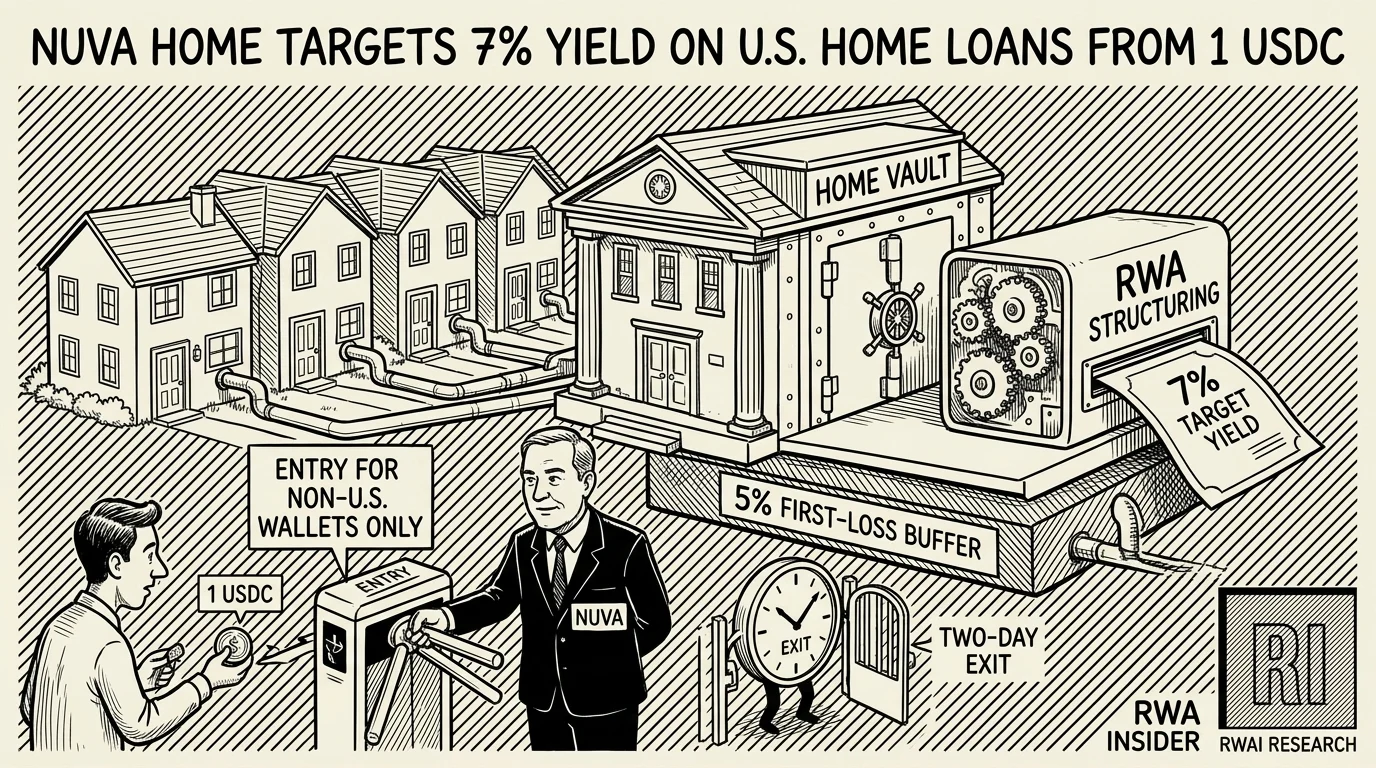
NUVA HOME Targets 7% Yield On U.S. Home Loans From 1 USDC
Key Points
- NUVA, created by Animoca Brands and Nuva Labs, launched HOME, an ERC-20 token targeting a 7% annual return from U.S. home equity loans.
- U.S. HELOC balances reached $460 billion in the second quarter, while Figure’s consumer-loan marketplace processed $4.3 billion in volume.
- Eligible non-U.S. wallets can enter HOME from 1 USDC with no lockup, though withdrawals take about two business days to settle.
NUVA, the real-world asset marketplace from Animoca Brands and Nuva Labs, has launched HOME, a token that targets a 7% annual return from a vault of U.S. home equity lines of credit, with entry from 1 USDC. Nuva Labs CEO Anthony Moro told CoinDesk: “Traditional securitization was built primarily for institutional investors.” For your wallet, that changes the entry ticket. A loan class usually sold through securitizations and private-credit funds now sits inside an ERC-20 token, as long as you are outside the U.S. and the other excluded jurisdictions.
NUVA’s HOME Vault Opens U.S. HELOCs From 1 USDC
HOME comes from NUVA, the RWA marketplace created by Animoca Brands and Nuva Labs.
The token tracks a pooled vault. It will first hold home equity lines of credit, or HELOCs, originated through Figure Technology Solutions.
A HELOC lets a homeowner borrow against the equity in their property, typically at a variable rate of interest.
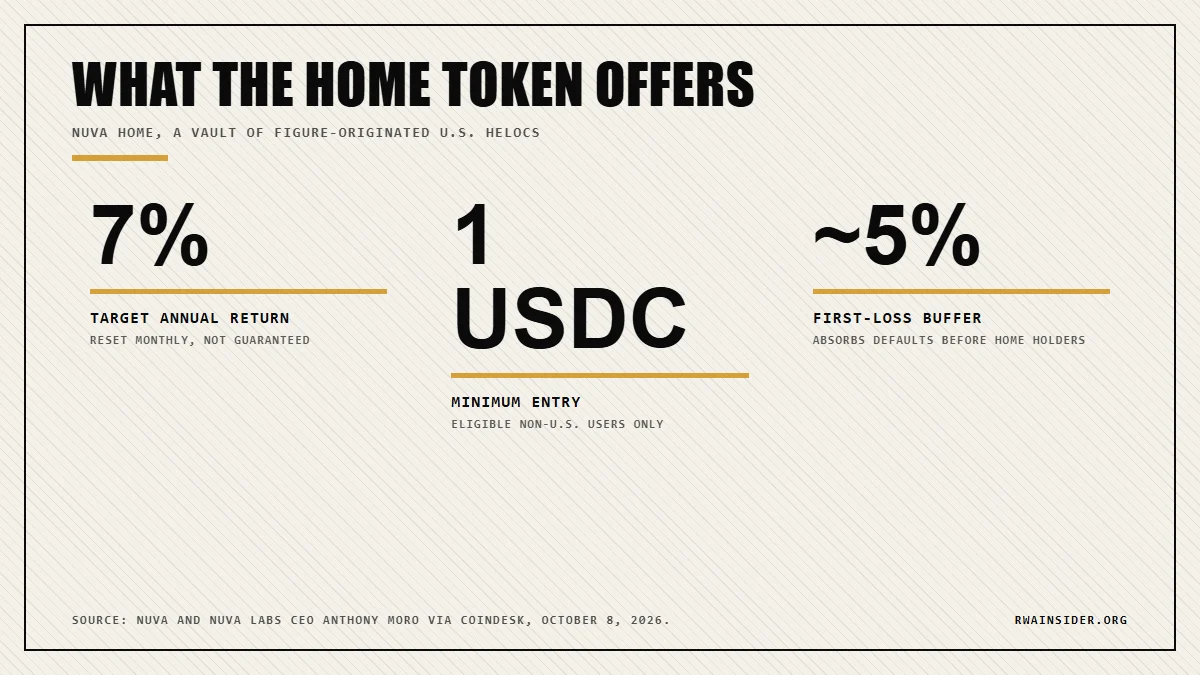
NUVA targets a 7% annual return, reset monthly. Interest income and loan performance flow into the vault’s net asset value, and that value sets the token price.
You do not own individual loans. You hold a token built on Ethereum’s ERC-20 standard, tied to the whole basket, starting from 1 USDC.
Access is limited to eligible non-U.S. users. The U.K., Hong Kong, China, the British Virgin Islands and sanctioned jurisdictions are also excluded.
NUVA enforces those limits through wallet screening and IP address blocking.
Where HOME’s 7% Target Yield Actually Comes From
The yield comes from U.S. homeowners paying interest on their credit lines. That market is large.
U.S. HELOC balances reached $460 billion in the second quarter, according to Federal Reserve Economic Data.
They rose by $13 billion that quarter, the 17th straight quarterly increase, according to the New York Fed.
Figure’s consumer-loan marketplace processed $4.3 billion in volume in the second quarter.
Of that, $2.8 billion went through Figure Connect, where whole-loan buyers purchase loans.
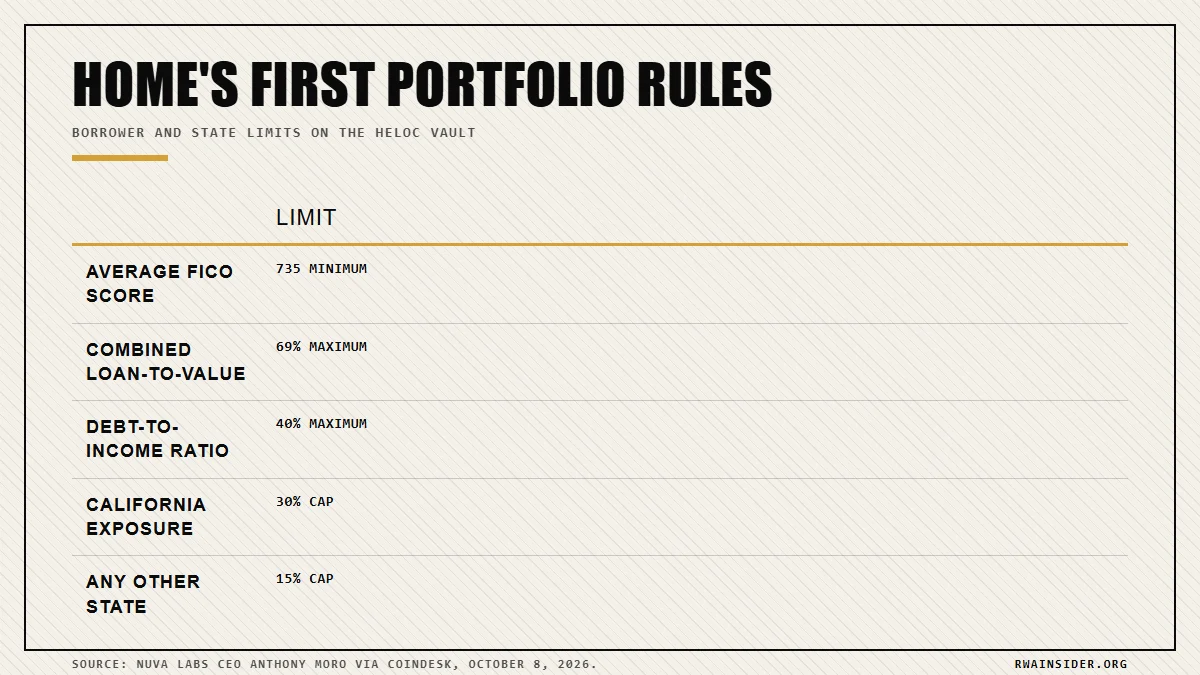
HOME’s first portfolio sets borrower limits: an average FICO score of at least 735, a combined loan-to-value of no more than 69% and a debt-to-income ratio of no more than 40%.
California exposure is capped at 30%, and every other state at 15%.
For a DeFi user, this matters less as a mortgage story than as a new 7% target yield you can enter with spare change and exit without a lockup.
The 7% is a target, not a promise, and it moves with loan performance.
CoinDesk’s report gives no DeFi benchmark rate, so check HOME against your current stablecoin lending rate.
Then compare tokenized yield products across DeFi before you move capital.
Moro’s 5% Buffer And The HOME Liquidity Test
HOME is not the first tokenized private-credit product. Maple Finance built onchain lending pools for institutional borrowers, and Centrifuge has brought credit and structured products onchain.
Figure already tokenizes HELOCs on its Provenance blockchain. HOME’s twist is the wrapper: a managed vault behind one tradable, composable token instead of a conventional fund.
Moro, a 22-year BNY Mellon veteran, frames it as distribution, not invention. “HOME is not trying to create demand for residential credit from scratch,” he said.
The exit terms deserve the closest read. There is no lockup, but withdrawals take about two U.S. business days.
A 5% liquidity sleeve covers smaller redemptions. Larger exits may need loans sold through Figure Connect or over the counter.
A first-loss equity slice, roughly 5% of the vault’s value, absorbs defaults before they reach HOME holders. Moro said it does not remove credit or liquidity risk.
Private credit is already finding its way into DeFi lending, as when Aave Horizon took Midas mGLOBAL as collateral.
NUVA also plans to put loan-level data onchain, including delinquency, borrower-credit and loan-to-value metrics. Watch that feed before you size a position.
If HOME’s loan-level data holds up and a DeFi lending market accepts the token as collateral, a 7% home-loan yield becomes composable. Until then, it is a hold-and-redeem product.
Weigh HOME’s 7% target against your current stablecoin yield, and its two-day exit, before you move a dollar.
Frequently Asked Questions
What is NUVA’s HOME token and how does it work?
HOME is an ERC-20 token from NUVA, the RWA marketplace created by Animoca Brands and Nuva Labs. It gives holders exposure to a managed vault of Figure-originated U.S. home equity lines of credit. Holders own the token, not individual loans.
How much yield does the HOME token pay?
NUVA targets a 7% annual return, reset monthly. Interest income and loan performance feed the vault’s net asset value, which sets the token price. The 7% is a target, not a guaranteed rate.
Can U.S. wallets buy HOME tokens?
No. HOME is only open to eligible non-U.S. users, and the U.K., Hong Kong, China, the British Virgin Islands and sanctioned jurisdictions are also excluded. NUVA enforces this with wallet screening and IP address blocking.
How fast can I get my USDC back, and what protects me from defaults?
There is no lockup, but withdrawals take about two U.S. business days, and a 5% liquidity sleeve covers smaller redemptions. A first-loss slice of roughly 5% of the vault absorbs defaults first, though credit and liquidity risk remain.