
$2.2B XRP Ledger Beats Ethereum On Commodities, Not Holders
Key Points
- XRP Ledger added about $2.2 billion in tokenized commodity market cap in 2026 through October 6, ahead of Ethereum’s roughly $1.6 billion.
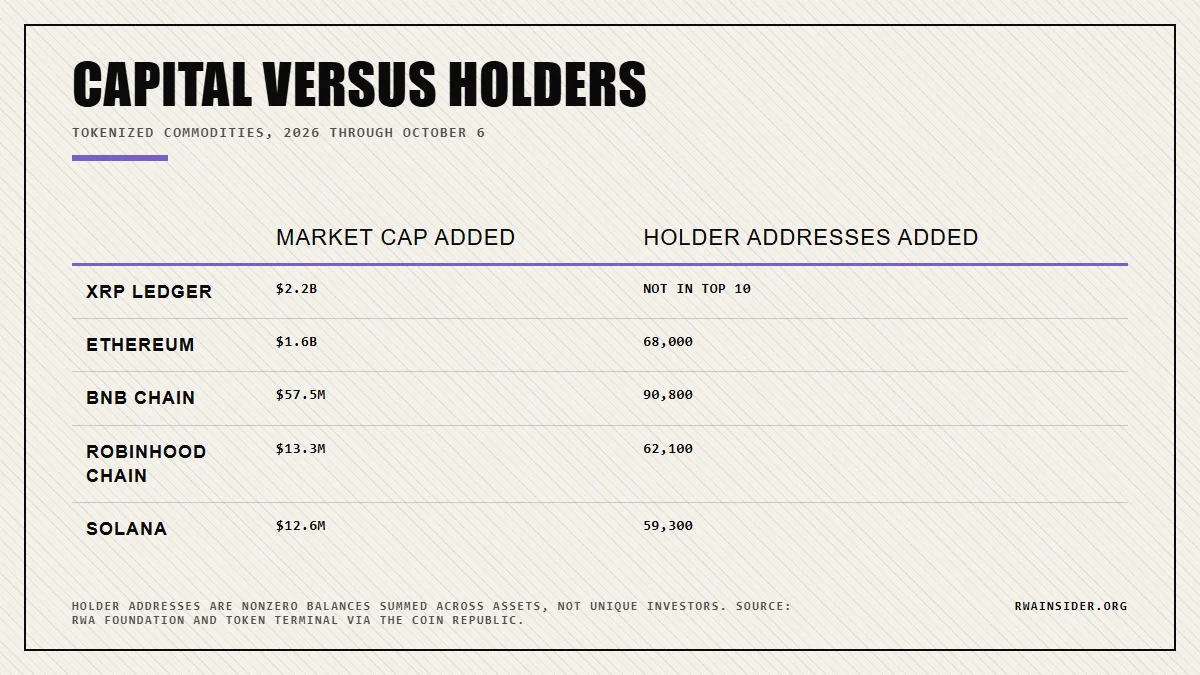
- BNB Chain added 90,800 commodity holder addresses and Ethereum 68,000, while XRP Ledger failed to make the top 10 for holder growth.
- For a $1,000 wallet, holder growth on BNB Chain, Ethereum and Solana is the clearer sign of where tokenized commodities are spreading into ordinary wallets.
XRP Ledger added about $2.2 billion in tokenized commodity market cap this year through October 6, the biggest gain of any chain tracked by RWA Foundation and Token Terminal, ahead of Ethereum’s roughly $1.6 billion. The Coin Republic, reporting the data, flagged the catch: XRPL “did not rank among the top 10 networks for commodity holder-address growth.” For your wallet, that gap says more than the headline number. Capital piled onto XRPL, but the new holders of tokenized commodities showed up on BNB Chain, Ethereum and Solana.
XRP Ledger’s $2.2B Commodity Lead Over Ethereum
The ranking comes from a year-to-date report by RWA Foundation and Token Terminal, covering growth through October 6.
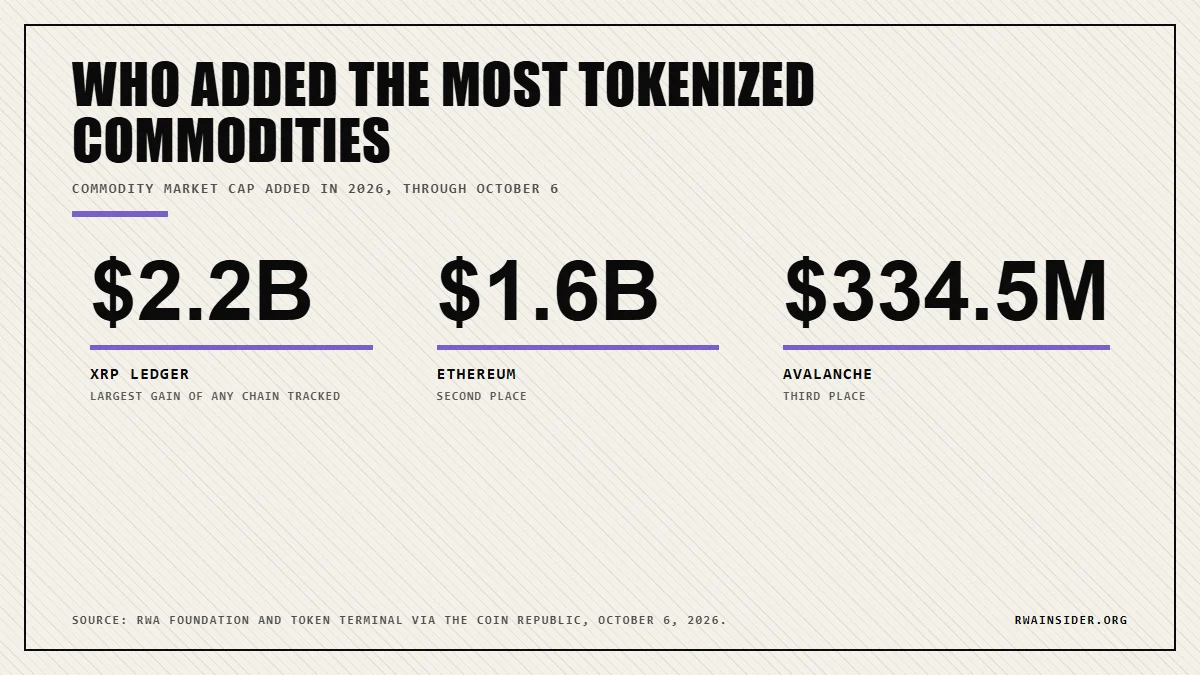
The XRP Ledger added about $2.2 billion in tokenized commodity market cap.
Ethereum added roughly $1.6 billion. Together, the two chains took close to 90% of commodity market-cap growth across the networks shown.
Avalanche came third with $334.5 million. Every other listed chain stayed under $60 million.
BNB Chain added $57.5 million, Base $14.2 million, Robinhood Chain $13.3 million and Solana $12.6 million.
Market cap here means circulating asset value as reported by Token Terminal. It measures how much value sits on a chain, not how many wallets hold it.
BNB Chain Adds 90,800 Commodity Holders As XRPL Misses Top 10
Switch to holder growth and the leaderboard changes completely.
BNB Chain led with 90,800 new commodity holder addresses. Celo added 74,600 and Ethereum 68,000.
Robinhood Chain and Solana followed with 62,100 and 59,300. Base added 4,800.
XRP Ledger, the capital leader, did not appear in the top 10 at all. Arc, Sui, HyperEVM and Plasma completed that list with fewer than 2,000 addresses each.
Ethereum is the only chain near the top of both lists, second on capital at $1.6 billion and third on holders at 68,000.
For a DeFi user, this matters less as a chain-share race than as a map of where tokenized commodities are spreading into ordinary wallets.
Big capital growth without holder growth suggests large positions held by a small number of addresses. That makes the headline figure a weak guide for a $1,000 buyer.
Read the holder data with care too. The report counts addresses with nonzero balances and sums them across assets without removing duplicates.
So these are address counts, not counts of individual investors.
The same split shows up in tokenized funds. Stellar added the most fund market cap but only 840 holder addresses, while Ethereum led fund holder growth with 7,400.
There is no yield to compare here. The report tracks market cap and addresses, not returns.
Before you pick a chain, track how RWA capital and holders shift across chains in our DeFi-native coverage.
Wintermute’s $15B Gold Call And XRPL’s Holder Problem
XRP Ledger’s wider numbers look stronger than its commodity holder count. It ranked third for overall RWA growth excluding stablecoins, adding $2.4 billion.
It also added $182.1 million in tokenized funds and $949.5 million in stablecoins, fifth in that sector.
Its 2,500 new fund holder addresses put it fourth, behind Ethereum, Base and Plasma.
Leadership splits by sector. BNB Chain led RWA growth excluding stablecoins at $3.7 billion, and tokenized stocks at $1.2 billion.
Stellar followed in that ranking at $2.7 billion, while Solana added $1.6 billion and Avalanche $1.0 billion.
Tron led stablecoins with $12.7 billion added. Solana led tokenized credit funds with $237.1 million, about 41% of that sector’s growth.
On holders, BNB Chain topped three sectors: stablecoins, commodities and stocks. That includes 38.3 million additional stablecoin holder addresses.
Demand for on-chain commodities is not in doubt. Wintermute CEO Evgeny Gaevoy expects the tokenized gold market to reach $15 billion in 2026.
He made that call when Wintermute opened an OTC desk for Pax Gold and Tether Gold.
The open question is whether XRPL’s commodity value starts reaching more wallets. Watch the next holder-growth report, not the next market-cap chart.
If XRP Ledger’s commodity capital starts pulling in holders, its lead turns into a market. Until then, BNB Chain, Ethereum and Solana are where the new wallets are going.
Compare holder growth, not just market cap, before you buy a tokenized commodity on any chain.
Frequently Asked Questions
Which blockchain added the most tokenized commodities in 2026?
XRP Ledger added about $2.2 billion in tokenized commodity market cap through October 6, per RWA Foundation and Token Terminal. Ethereum added roughly $1.6 billion, and Avalanche came third with $334.5 million.
Where are new tokenized commodity holders showing up?
BNB Chain led with 90,800 new commodity holder addresses, followed by Celo at 74,600 and Ethereum at 68,000. Robinhood Chain added 62,100 and Solana 59,300, while XRP Ledger missed the top 10.
Do holder addresses show how many people own tokenized commodities?
Not exactly. The report counts addresses with nonzero balances and adds them up across assets without removing duplicates, so one person can count more than once. Treat it as a rough signal of how widely an asset is spreading.
What does XRPL’s commodity lead mean for my wallet?
Treat it as a capital figure, not a sign of a busy market. XRPL’s growth came without matching holder growth. Before you buy any tokenized commodity, check how many wallets hold it and on which chain.