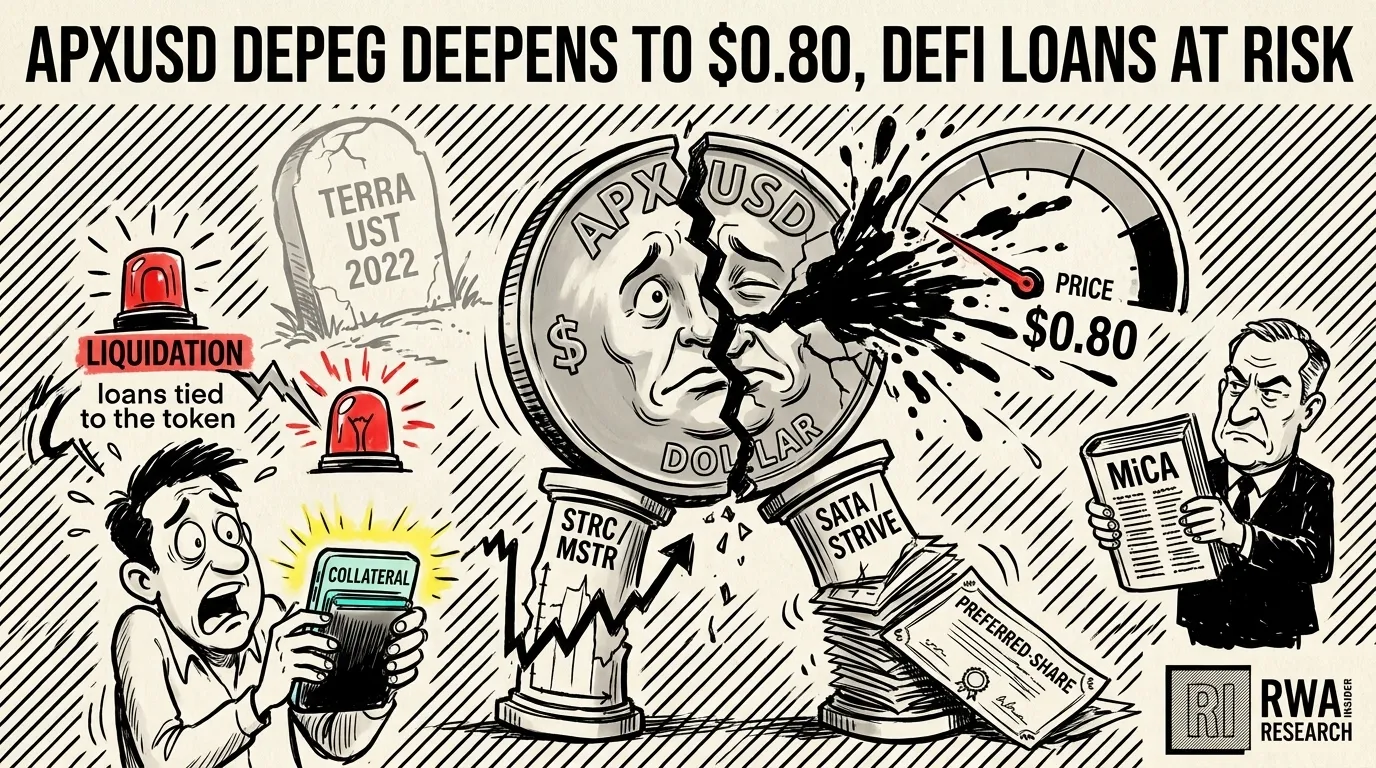
apxUSD Depeg Deepens To $0.80, DeFi Loans At Risk
Key Points
- apxUSD, the synthetic dollar from Apyx, has slid to $0.80, a 20% loss, as the assets backing it come under heavy stress.
- The token holds no cash reserves, leaning instead on STRC, a tokenized MicroStrategy stock, and SATA preferred shares from Strive to hold its 1-to-1 peg.
- Any wallet using apxUSD as collateral on a DeFi lending market now faces forced liquidation if the price drops further below $0.80.
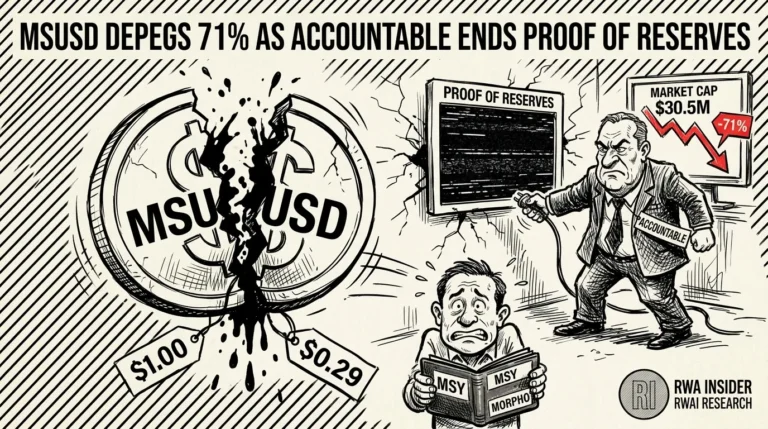
Apyx’s synthetic dollar apxUSD has lost its grip on the dollar, sliding to $0.80 and shedding 20% of its value as the tokenized stocks and preferred shares backing it wobble. CryptoRank, relaying a BitcoinWorld report, said the slide is “raising fresh concerns about the stability of synthetic asset-backed stablecoins.” For a wallet holder, the danger is direct: apxUSD is wired into DeFi lending markets as collateral, so a deeper drop can trigger automatic liquidations on loans you thought were safe.
Inside apxUSD’s Slide To $0.80
apxUSD is a synthetic dollar issued by Apyx, built to trade at a steady $1.00. It has now fallen to $0.80, a 20% drop from its intended peg.
This is not a glitch in the smart contract. The break traces straight back to what stands behind the token.
Instead of holding cash, apxUSD is issued against STRC, a tokenized version of MicroStrategy stock, and SATA preferred shares from Strive. Both are equity-linked, and both have wobbled.
When that collateral slips, the token has nothing softer to lean on, and the dollar peg gives way.
apxUSD does not sit still in wallets either. It circulates through DeFi lending markets and trading pairs, so the slide is already rippling well past the token itself.

STRC And Strive: The Collateral Under Stress
MicroStrategy stock has swung hard in recent weeks, dragged around by Bitcoin’s price because the company holds so much of it on its balance sheet.
STRC, the tokenized wrapper around that stock, inherits every one of those swings. When MSTR drops, STRC drops with it.
The second leg is SATA, preferred shares from Strive, which may be facing its own liquidity and valuation strain.
Stack two shaky equity-linked assets under a token that promises a fixed dollar, and the math turns fragile fast.
Strip away the stablecoin label and apxUSD is really a leveraged bet on MicroStrategy’s stock wearing a dollar’s clothes.
That is the opposite of how cash-backed coins work. USDC and USDT hold dollars and short-term Treasuries, so each $1 token is matched by close to $1 in reserves. You can see how cash-backed tokenized dollars have held their pegs through the same volatile stretch.

What Sub-$0.80 apxUSD Means For DeFi Wallets
Here is where it gets practical. apxUSD is not just parked in wallets; it is posted as collateral inside lending protocols across DeFi.
A sustained drop below $0.80 can push those positions underwater and fire automatic liquidations, which dump more apxUSD onto the market and drive the price lower still.
That feedback loop, not the headline price alone, is the real danger for a $1,000 wallet.
When RWA Insider first flagged this token slipping to $0.93, Apyx framed the gap as a deliberate design feature rather than a fault. At $0.80, that framing is far harder to defend.
Regulators are circling as well. The European Union’s MiCA rules already demand strict reserves and transparency, and an incident like this hands other jurisdictions a reason to follow.
One steadying note: the damage so far looks contained to apxUSD and its direct holders, not the wider stablecoin market, where USDC and USDT remain near $1.00.
The line to watch is simple: whether apxUSD holds $0.80 or keeps sliding toward the next liquidation cascade.
Whether apxUSD ever reclaims its dollar depends entirely on STRC and Strive’s shares finding a floor, and the next few trading sessions will tell. Until that collateral steadies, every loan backed by the token is a liquidation waiting for a trigger.
If you hold apxUSD or borrow against it, the safe move is to watch the $0.80 line and your loan health, not the promise of a quick recovery.
Frequently Asked Questions
What is apxUSD and why did it fall to $0.80?
apxUSD is a synthetic dollar from Apyx, designed to hold a 1-to-1 peg with the US dollar. It fell to $0.80, down 20%, because it is backed by tokenized stocks rather than cash, and that collateral lost value while confidence in its redemption mechanics eroded.
Can I still use apxUSD as collateral in DeFi?
You can, but it is risky. apxUSD is accepted as collateral in several lending protocols, and a deeper slide below $0.80 can trigger automatic liquidations on loans backed by it. Many users are cutting exposure or topping up with safer collateral.
How is apxUSD different from USDC or USDT?
USDC and USDT hold cash and short-term Treasuries roughly 1-to-1, so their reserves match the tokens in circulation. apxUSD instead holds STRC, a tokenized MicroStrategy stock, and Strive preferred shares, which swing with equity and Bitcoin prices, making its peg far more fragile.
Is the apxUSD depeg like the TerraUSD collapse?
The mechanism differs, since apxUSD is collateral-backed rather than algorithmic like TerraUSD in 2022. The core risk is the same, though: if the backing assets fall or turn illiquid, the peg cannot hold. So far the damage looks contained to apxUSD, not the broader market.