Coinbase Backs ProShares GENIUS ETF For Stablecoin Reserves
Key Points
- Coinbase made an undisclosed investment in the ProShares GENIUS Money Market ETF (IQMM), a fund launched in February 2026 for stablecoin reserves.
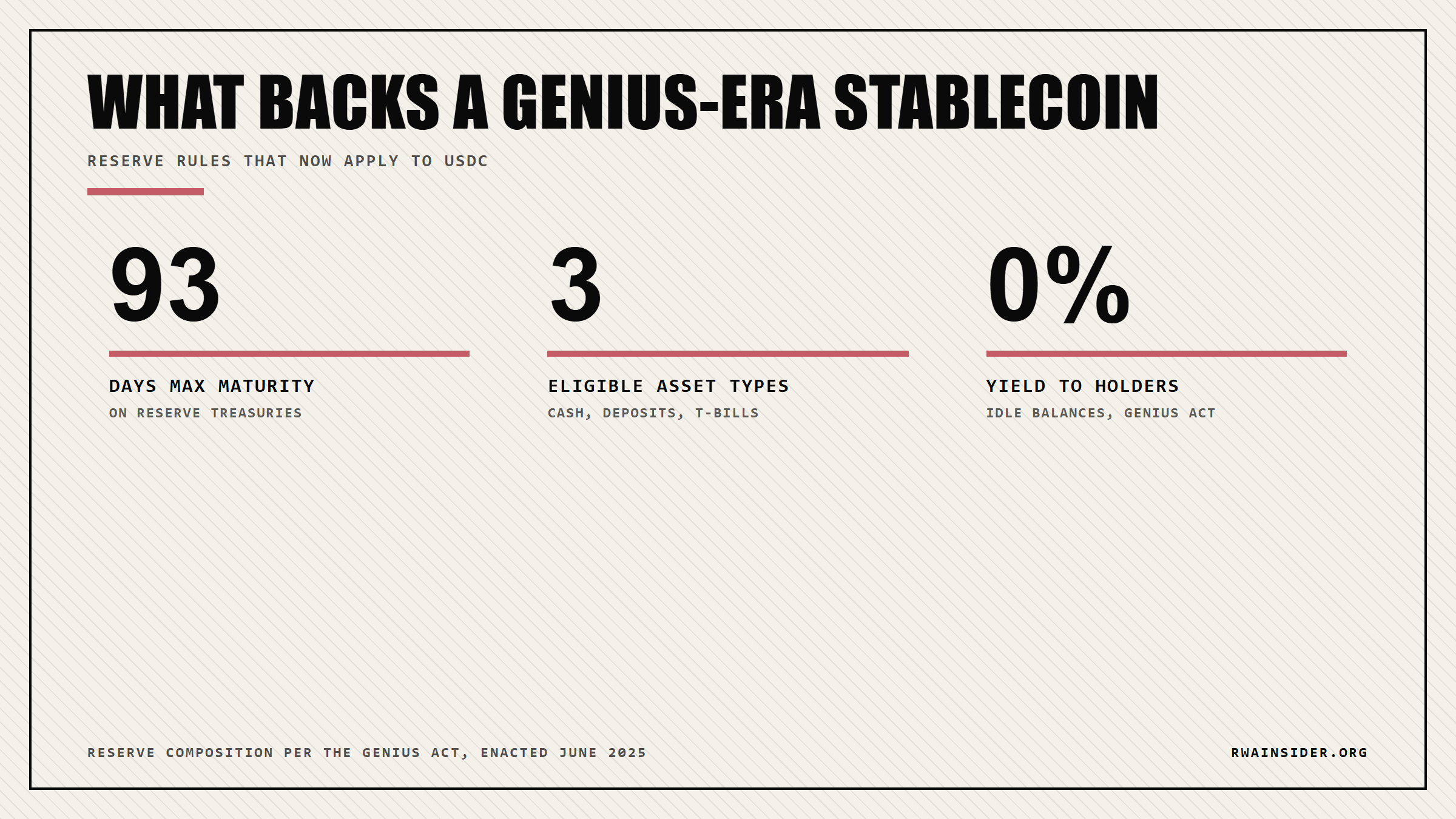
- IQMM holds only short-term US Treasuries and cash instruments maturing in 93 days or less, the assets the GENIUS Act counts as stablecoin reserves.
- No $1,000 wallet can buy IQMM, yet it backs USDC, and the CLARITY Act will decide whether issuers ever pay you yield on idle balances.
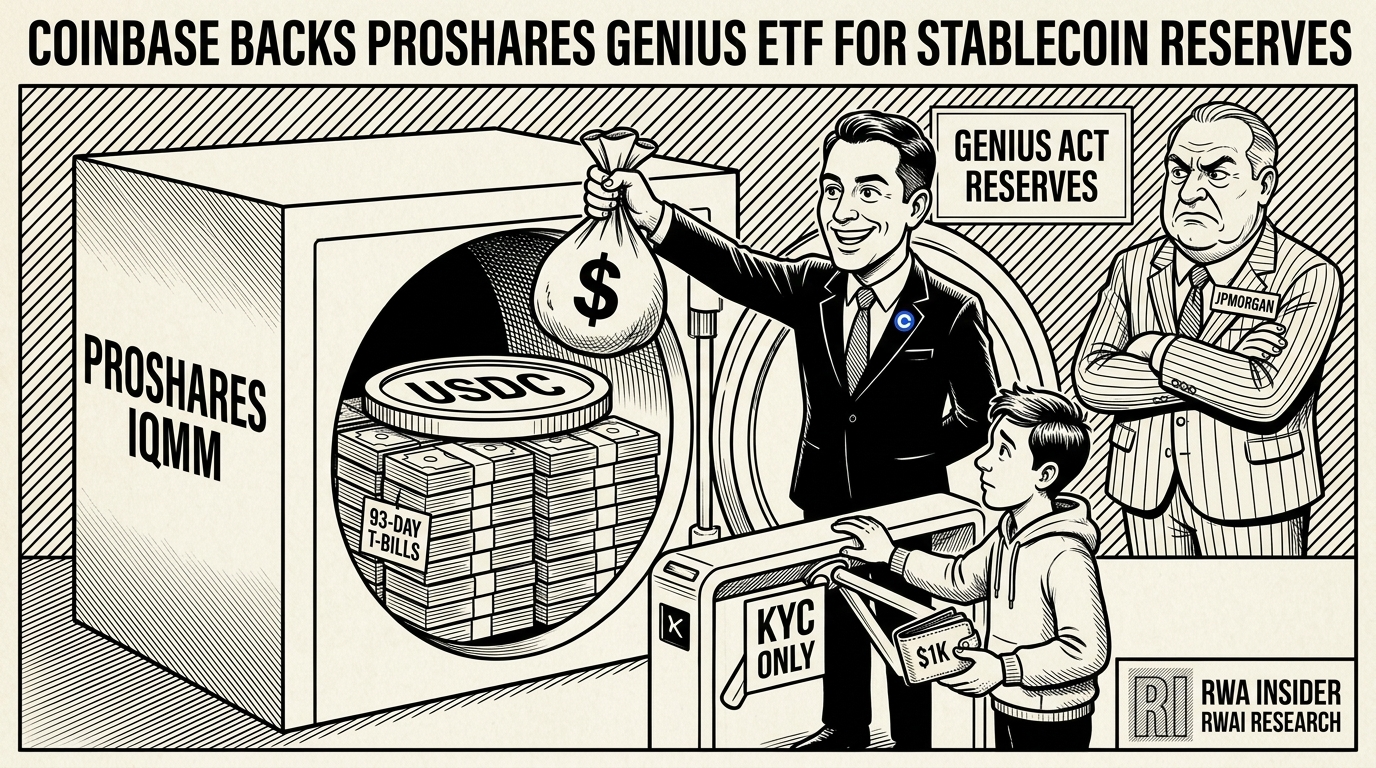
Coinbase has quietly put its own money behind the plumbing that backs stablecoins. The exchange said Tuesday it made an undisclosed investment in the ProShares GENIUS Money Market ETF, ticker IQMM, a fund built to hold the short-term Treasuries and cash that the GENIUS Act now lets stablecoin issuers use as reserves. Coinbase’s chief policy officer, Faryar Shirzad, has called the wider rulebook the “biggest financial regulatory bill” since Dodd-Frank. For anyone holding USDC, this is a bet on who controls, and profits from, the assets sitting under your dollar.
Coinbase Buys Into ProShares’ IQMM Fund
The move is small in disclosure and large in signal. Coinbase said it took an undisclosed stake in the ProShares GENIUS Money Market ETF, a fund that trades under the ticker IQMM.
IQMM launched in February and holds nothing exotic.
It buys short-term US Treasuries and cash-equivalent instruments that mature in 93 days or less, the exact asset types the GENIUS Act now blesses as stablecoin reserves.
Coinbase framed the buy as a fit with its stablecoin business and cash management.
It is the main infrastructure partner for Circle’s USDC, so a deeper pool of regulated reserve vehicles serves it directly.
None of this touches a self-custody wallet. IQMM is a brokerage product, not a token you swap on a DEX. The relevance is what sits one layer down: the Treasuries that keep your USDC worth a dollar.

The 93-Day Rule Behind Your USDC
The GENIUS Act, signed in June 2025, set the rulebook IQMM is built around. Issuers must back every token with highly liquid assets: cash, bank deposits, and short-term US Treasuries.
That is why a 93-day maturity cap matters. Short paper is easy to sell at par in a panic, which is the whole point of a reserve that has to redeem on demand.
Strip away the press release and this is really about who pockets the yield those Treasuries throw off. Under the GENIUS Act, that is the issuer and its partners, not the wallet holding the coin.
For a holder, idle USDC pays you nothing by law.
The permissionless route still does: supplying USDC into a lending market like Aave earns a live supply rate, a gap RWA Insider has tracked near two percent in recent months.
You can follow how the stablecoin reserve and yield rules keep shifting across DeFi as the framework fills in.
The CLARITY Act Fight Over Stablecoin Yield
The bigger question is whether that law ever changes.
The Digital Asset Market CLARITY Act would set market-structure rules, and lawmakers bolted on stablecoin yield provisions that reopen the issuer-yield debate.
Coinbase’s chief policy officer, Faryar Shirzad, has framed the CLARITY Act as the biggest financial regulatory overhaul since Dodd-Frank.
The bill cleared the Senate Banking Committee last month and now waits on a full floor vote.
The pushback is loud.
JPMorgan chief executive Jamie Dimon said last week that banks would fight the bill in its current form, warning that letting crypto firms pay yield on stablecoin balances would tilt the field against deposits.
Timing is the wild card. White House crypto adviser Patrick Witt has pointed to the stretch around July 4 for advancing market-structure law, though the schedule is far from settled.
Coinbase just bought a stake in the rails under your stablecoin. Whether you ever earn a cut of the Treasury yield those rails throw off comes down to one fight in the Senate, and the next few weeks will show which way it breaks.
For the running scorecard on that fight, see our breakdown of the idle-balance yield ban that survived the latest CLARITY draft.
Frequently Asked Questions
What is the ProShares GENIUS Money Market ETF?
It is a fund trading as IQMM that launched in February 2026. It holds only short-term US Treasuries and cash instruments maturing in 93 days or less, and is one of the first ETFs built specifically for stablecoin reserve management.
Can a retail DeFi user buy IQMM?
No. IQMM is a publicly traded ETF accessed through a brokerage account, not a token you can swap on a DEX. The closest permissionless equivalent is supplying USDC into an on-chain lending market like Aave.
Does holding USDC earn yield under the GENIUS Act?
Not from the issuer. The GENIUS Act bars stablecoin issuers from paying interest on idle balances. Permissionless lending markets such as Aave still pay a live supply rate, and the CLARITY Act could reopen issuer-paid yield.
When could the CLARITY Act pass?
The bill cleared the Senate Banking Committee last month and awaits a full Senate floor vote. White House crypto adviser Patrick Witt has pointed to the period around July 4, 2026, though the timeline remains uncertain.