$4.1B Tether Buffer Halves, USDT Faces GENIUS Audit Test
Key Points
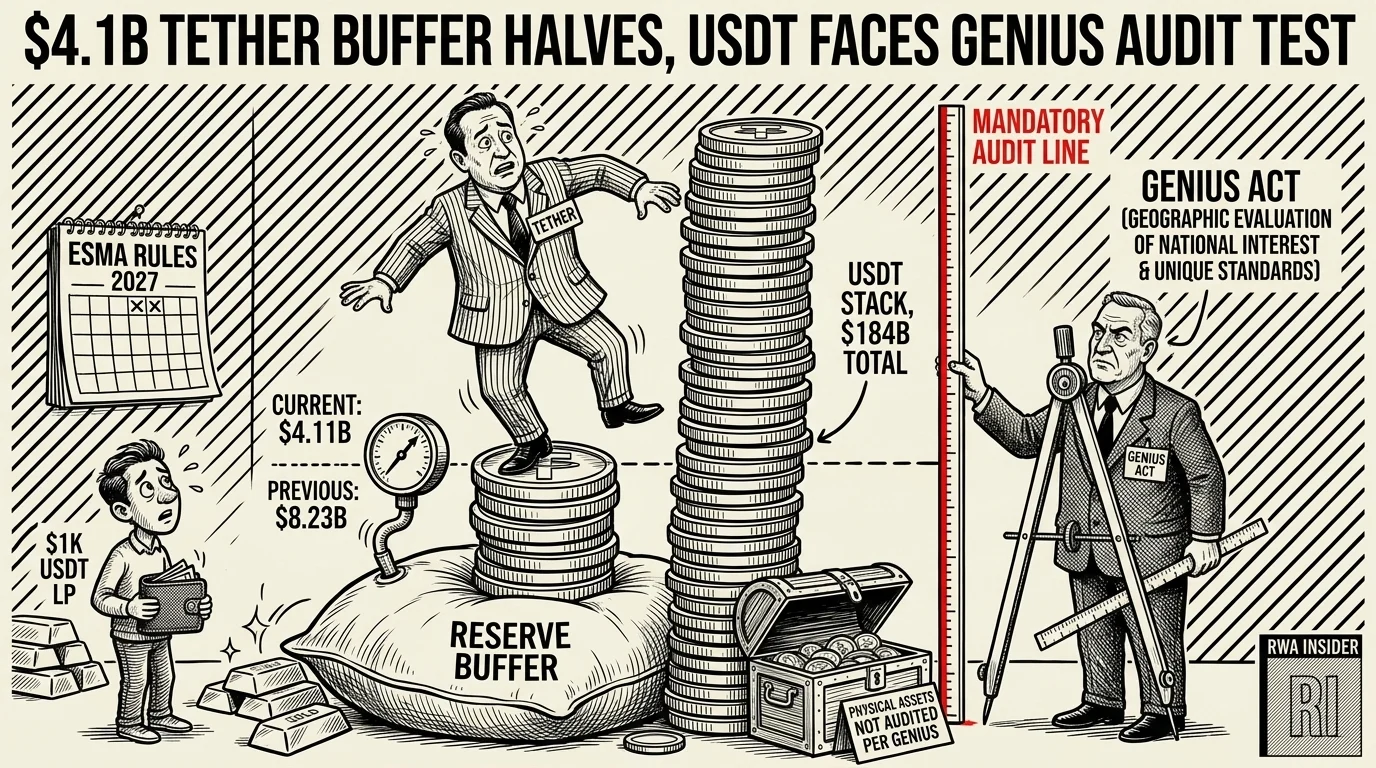
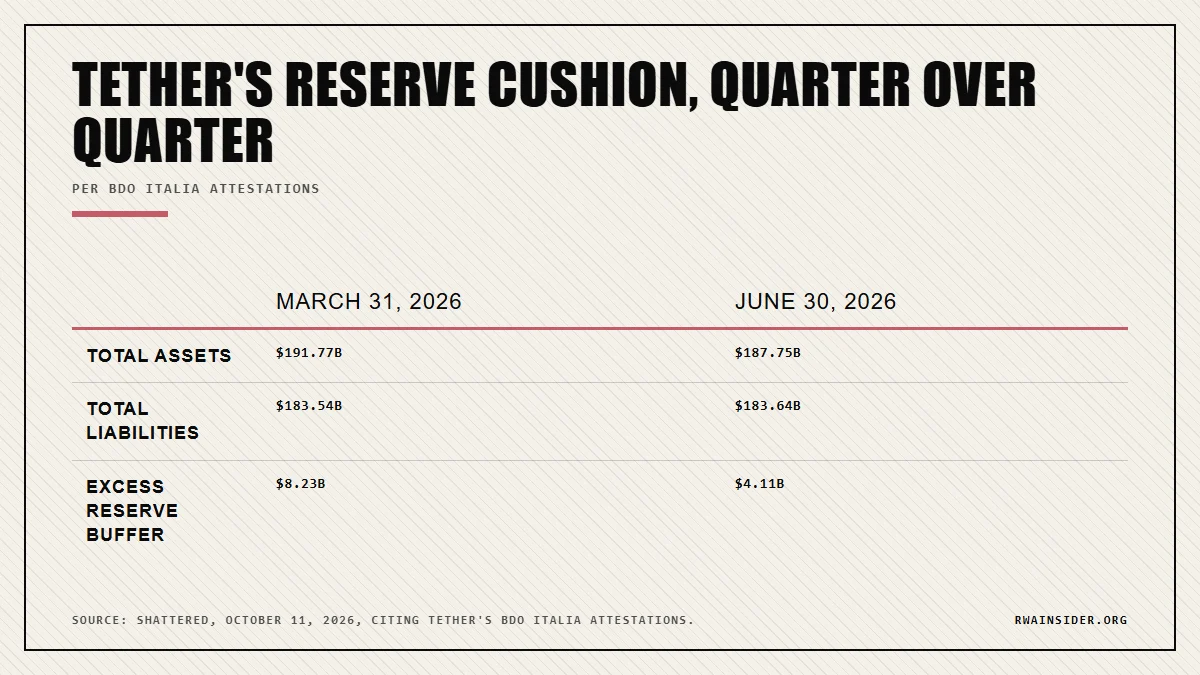
- Tether’s excess reserves fell from $8.23 billion on March 31 to $4.11 billion on June 30, according to its BDO Italia attestation.
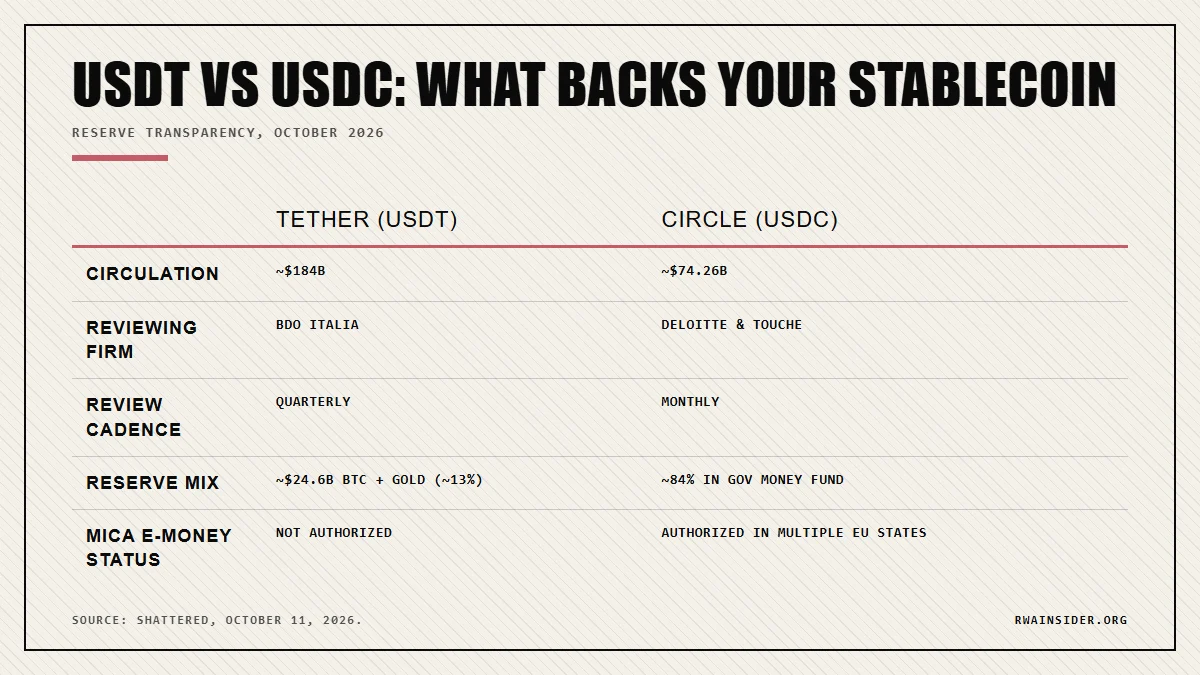
- The GENIUS Act demands audited annual statements above $50 billion outstanding, and Tether’s USDT circulates at roughly $184 billion, more than 3x the line.
- USDT liquidity providers should weigh $24.6 billion of Tether reserves in Bitcoin and gold, assets the GENIUS Act’s eligible reserve list leaves out.
Tether’s reserve buffer, the gap between what it holds and what it owes USDT holders, fell to $4.11 billion on June 30, down from $8.23 billion three months earlier. Shattered’s Daniel Roth, writing on October 11, called the compliance gap between Tether and Circle “a regulatory deadline with a dollar figure attached.” For your wallet, that matters because USDT and USDC together underpin a large share of on-chain liquidity, and a thinner cushion leaves less room for error behind every USDT pool you touch.
Tether’s $4.11B Buffer Meets The GENIUS Act Audit Line
Tether issues USDT, the stablecoin on one side of a huge share of DeFi trading pairs and lending markets.
Its Q2 2026 attestation from BDO Italia listed $187.75 billion in assets against $183.64 billion in liabilities on June 30.
On March 31, assets stood at $191.77 billion against $183.54 billion owed. Assets fell nearly $4 billion while liabilities grew about $100 million.
Then the rulebook caught up. A Congressional Research Service summary on October 2 confirmed that GENIUS Act issuers above $50 billion outstanding must file audited annual financial statements.
USDT circulates at roughly $184 billion. Shattered reports that Tether has never produced a full Big Four audit, relying on quarterly BDO Italia attestations instead.
The difference is not cosmetic. An attestation checks reserves on one date, while an audit tests controls and transactions across a full year.
Where $24.6B Of Tether’s Backing Falls Outside GENIUS Rules
The audit is only half the problem. Section 4 of the GENIUS Act also limits which assets count as reserves.
The list covers cash, Fed and insured bank deposits, short-dated T-bills, Treasury repo and government money funds. Bitcoin and gold are not on it, per a Galaxy Digital breakdown.
Tether held about $5.80 billion in Bitcoin and $18.84 billion in gold on June 30.
Together that is roughly $24.6 billion, or about 13% of reported assets. That slice dwarfs the $4.11 billion cushion sitting on top of it.
Circle built USDC differently. About $62.5 billion of its $74.26 billion in reserves, roughly 84%, sits in a government money fund managed by BlackRock.
Strip away the audit jargon and this is really about one thing: how much of the dollar behind your USDT US regulators will actually count.
The market has not flinched yet. Tether’s market cap has held near $184 billion through early October, per CoinDesk’s tracker.
A steady peg says nothing about the reserve fight behind it. Before you rotate stablecoins, compare stablecoin issuer risk across our DeFi-native RWA coverage.
Circle’s Head Start And USDT’s January 8 MiCA Deadline
Europe is running its own clock. ESMA set January 8, 2027 as a deadline tied to USDT’s status under MiCA, according to an October 8 CryptoTicker report.
USDT still lacks e-money token authorization in the EU. Circle already holds it in multiple EU jurisdictions.
That matters if you reach DeFi through an EU exchange or wallet provider. They may have to restrict USDT for EU customers unless Tether wins approval first.
Shattered’s Daniel Roth expects Tether to face mounting pressure to commission a full Big Four audit, or explain why the $50 billion threshold does not apply, within two to three reporting quarters.
Roth also expects regulators to zero in on the Bitcoin and gold. Tether could trim them or seek a carve-out for legacy holdings as guidance firms up through 2027.
One claim to park for now: reports that KPMG finished a full Tether audit in August 2026. Other reporting contradicts it, and no signed report has surfaced.
Tether’s issuer power has already hit DeFi users, as our report on Tether freezing USDT inside THORChain’s Tron vaults showed.
Watch two signals now: a Big Four audit announcement, and any EU exchange notice on USDT pairs before January 8.
Whether USDT keeps its place as DeFi’s default pair depends on a signed audit and an EU license, and the next two quarters will tell.
Holding USDT in a DeFi pool? Check how much of your stablecoin exposure rides on one issuer’s next attestation.
Frequently Asked Questions
Is USDT still fully backed after Tether’s buffer dropped?
Tether’s Q2 2026 attestation from BDO Italia listed $187.75 billion in assets against $183.64 billion in liabilities on June 30, a $4.11 billion excess. That excess was $8.23 billion on March 31. An attestation confirms reserves on a single date, not across the full year.
Does the GENIUS Act force Tether to get a full audit?
The GENIUS Act requires any stablecoin issuer with more than $50 billion outstanding to submit audited annual financial statements. USDT circulates at roughly $184 billion, so the rule applies to Tether unless it qualifies for an exemption that has not been publicly detailed.
Can I still use USDT through EU exchanges after January 8, 2027?
ESMA set January 8, 2027 as a deadline tied to USDT’s status under MiCA, and USDT has no e-money token authorization in the EU yet. Unless Tether secures it, EU-based exchanges and custodians may have to restrict USDT for customers in the bloc.
How do USDC reserves compare with Tether’s?
About $62.5 billion of USDC’s $74.26 billion in reserves, roughly 84%, sits in a government money fund managed by BlackRock, which fits the GENIUS Act’s permitted categories. Tether reports about $24.6 billion in Bitcoin and gold, which the law’s list leaves out. That gap does not make USDC risk-free.