$3.8B Arbitrum Stablecoin Base Adds Native Paxos USDG
Key Points
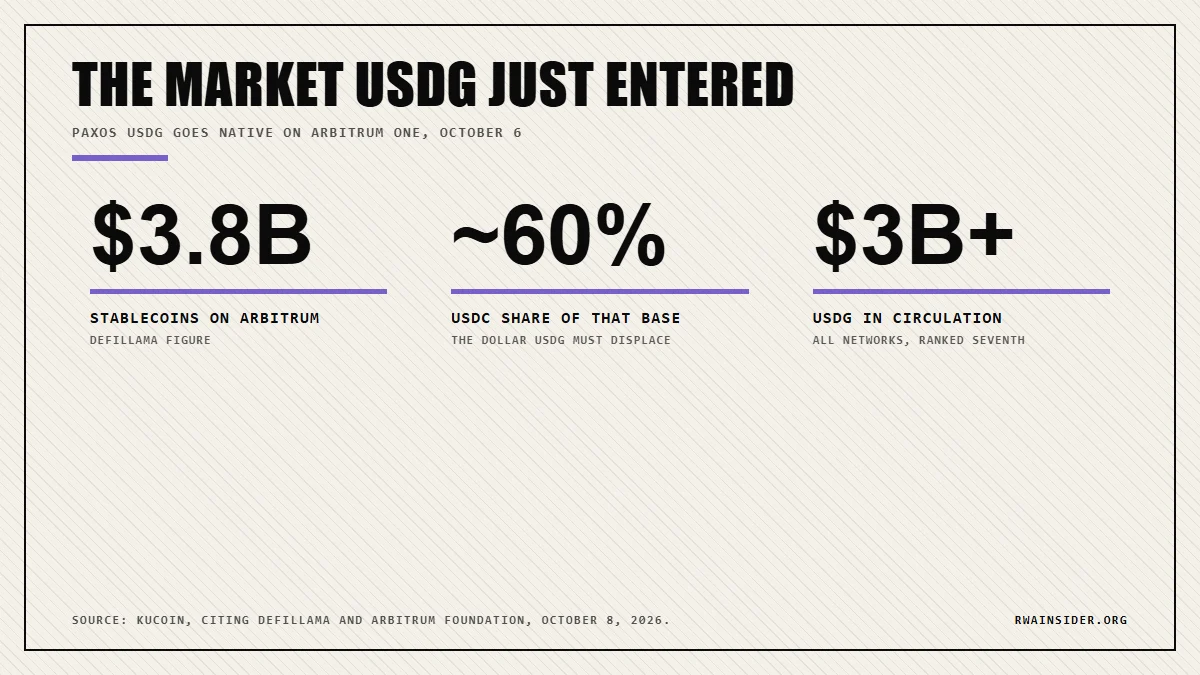
- Paxos began issuing USDG natively on Arbitrum One on October 6, entering a chain that holds about $3.8 billion in stablecoins.
- Circle’s USDC holds roughly 60% of Arbitrum’s stablecoins, while USDG carries more than $3 billion in circulation and ranks seventh by market cap.
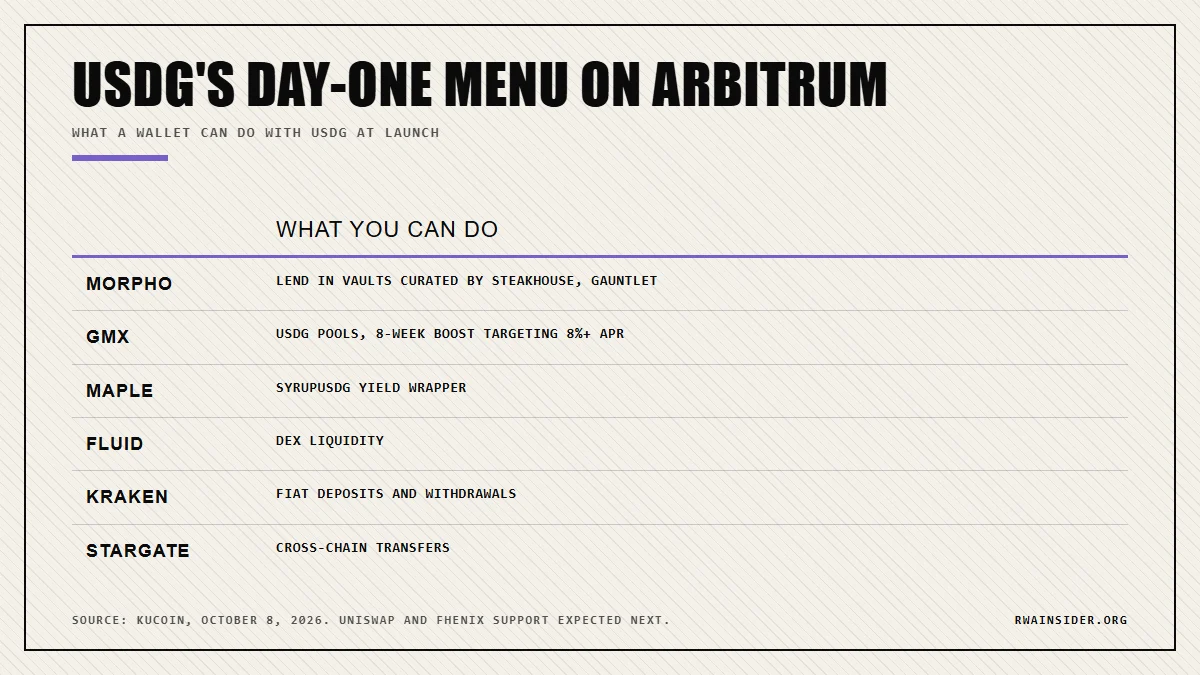
- Arbitrum wallets can already use USDG in Morpho lending vaults, Maple’s syrupUSDG wrapper and GMX pools targeting above 8% APR for eight weeks.
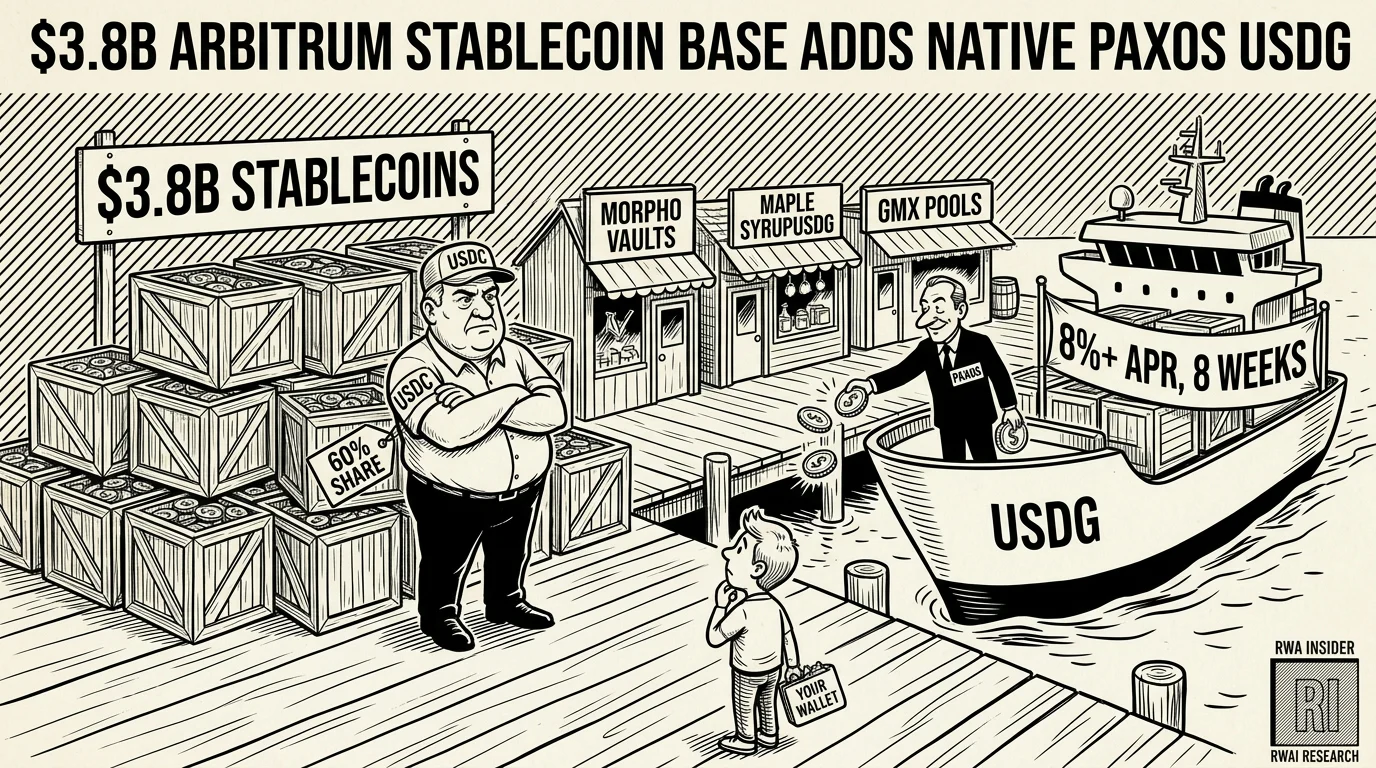
Paxos began minting its Global Dollar, USDG, natively on Arbitrum One on October 6, entering a chain that holds about $3.8 billion in stablecoins, roughly 60% of it Circle’s USDC. KuCoin reported that the move lets Arbitrum “participate directly in reserve income generated by the stablecoin held on its rails.” For your wallet, the change is practical: USDG arrived with day-one homes on Morpho, GMX and Maple, so a new regulated dollar is already usable as collateral, a trading pair and a yield source.
Paxos USDG Goes Native On Arbitrum One
Paxos now mints USDG directly on Arbitrum One instead of relying on bridged versions.
That makes Arbitrum the newest member of the Global Dollar Network, the Paxos-led group of more than 150 partners that includes Robinhood, Kraken, OKX and Mastercard.
Native issuance matters for your wallet. No wrapped token sits between you and the dollar, so there is no extra bridge layer to price in.
USDG is backed one-to-one by U.S. dollar cash and cash equivalents in segregated accounts, and Paxos publishes monthly attestations.
Paxos issues it through a Singapore entity supervised by the Monetary Authority of Singapore and a European entity under MiCA rules.
Kraken handles fiat deposits and withdrawals, and Stargate moves USDG between Arbitrum and other chains.
Where The 8% USDG Yield On Arbitrum Comes From
Under the Global Dollar Network model, a share of the reserve income goes to partners that create demand: here, Arbitrum and its eligible builders.
For a wallet holder, the yield comes from putting USDG to work in DeFi.
GMX has launched an eight-week liquidity boost on USDG-paired pools, targeting annualized rates above 8%.
That rate is a promotional target, not a floor. After the window closes, organic trading fees and network incentives are expected to carry the liquidity.
Morpho runs USDG lending vaults curated by Steakhouse and Gauntlet. Maple offers syrupUSDG, a yield wrapper, and GMX has a dedicated GLV(USDG) vault.
Fluid supplies DEX liquidity, and Uniswap and Fhenix are expected to add support next.
Arbitrum has already seeded roughly 7 million ARB, worth more than $10 million, into early incentive programs.
An ArbitrumDAO proposal asks for 100 million ARB more for its DRIP incentive program, plus treasury assets for USDG liquidity. It still needs a vote.
For a DeFi user, this matters less as a stablecoin licensing story than as a fresh pool of incentive-funded yield on a dollar you can redeem one-to-one.
KuCoin’s report gives no benchmark rate for USDC on Arbitrum, so set the 8% target against what your current stablecoin position pays.
You can compare stablecoin and RWA yields across DeFi before you rotate.
USDC’s 60% Share And The Arbitrum Stablecoin Fight
Brendan Ma, Head of Investment Strategy at the Arbitrum Foundation, said the ecosystem had not previously shared in the growth and economics of stablecoins.
In his telling, USDG gives both the network and its builders a direct stake.
That is the real contest. Circle’s USDC holds roughly 60% of Arbitrum’s $3.8 billion stablecoin base, so USDG has to win share from capital already deployed.
Rival alliances want the same float. OpenUSD has support from Mastercard, Visa, Stripe, Coinbase and Shopify, while Qivalis is backed by 37 European banks.
USDG also has to move. Most of its roughly $3.09 billion supply sat on X Layer, Robinhood Chain and Solana at launch.
Before you deposit, check who curates the vault, because Morpho vault risk rides on the curator, not the whole pool.
Watch three signals: USDG pool depth on GMX and Fluid, its share of Arbitrum’s stablecoins, and the ArbitrumDAO vote on 100 million ARB.
If USDG keeps its pools deep after GMX’s eight-week boost ends, Arbitrum gets a second core dollar. If the capital leaves with the incentives, USDC’s 60% share stays intact.
Check the boost end date and the Morpho vault curator before you move stables into USDG.
Frequently Asked Questions
What is Paxos USDG and who regulates it?
USDG, the Global Dollar, is a dollar stablecoin issued by Paxos Digital Singapore, supervised by the Monetary Authority of Singapore, and by Paxos Issuance Europe under MiCA. It is backed one-to-one by cash and cash equivalents in segregated accounts, with monthly attestations.
Where can I earn yield on USDG on Arbitrum?
Morpho runs USDG lending vaults curated by Steakhouse and Gauntlet, and Maple offers the syrupUSDG yield wrapper. GMX has a GLV(USDG) vault and an eight-week boost on USDG pools targeting above 8% APR, which is a promotional target, not a guaranteed rate.
How does USDG compare to USDC on Arbitrum?
USDC holds roughly 60% of the chain’s stablecoins, so it is still the default dollar there. USDG has more than $3 billion in circulation across all networks, and its Global Dollar Network shares part of the reserve income with partners such as Arbitrum.
How do I get USDG onto Arbitrum?
Kraken supports fiat deposits and withdrawals of USDG, and Stargate moves the token between Arbitrum and other supported chains. USDG stays redeemable one-to-one for U.S. dollars through Paxos.