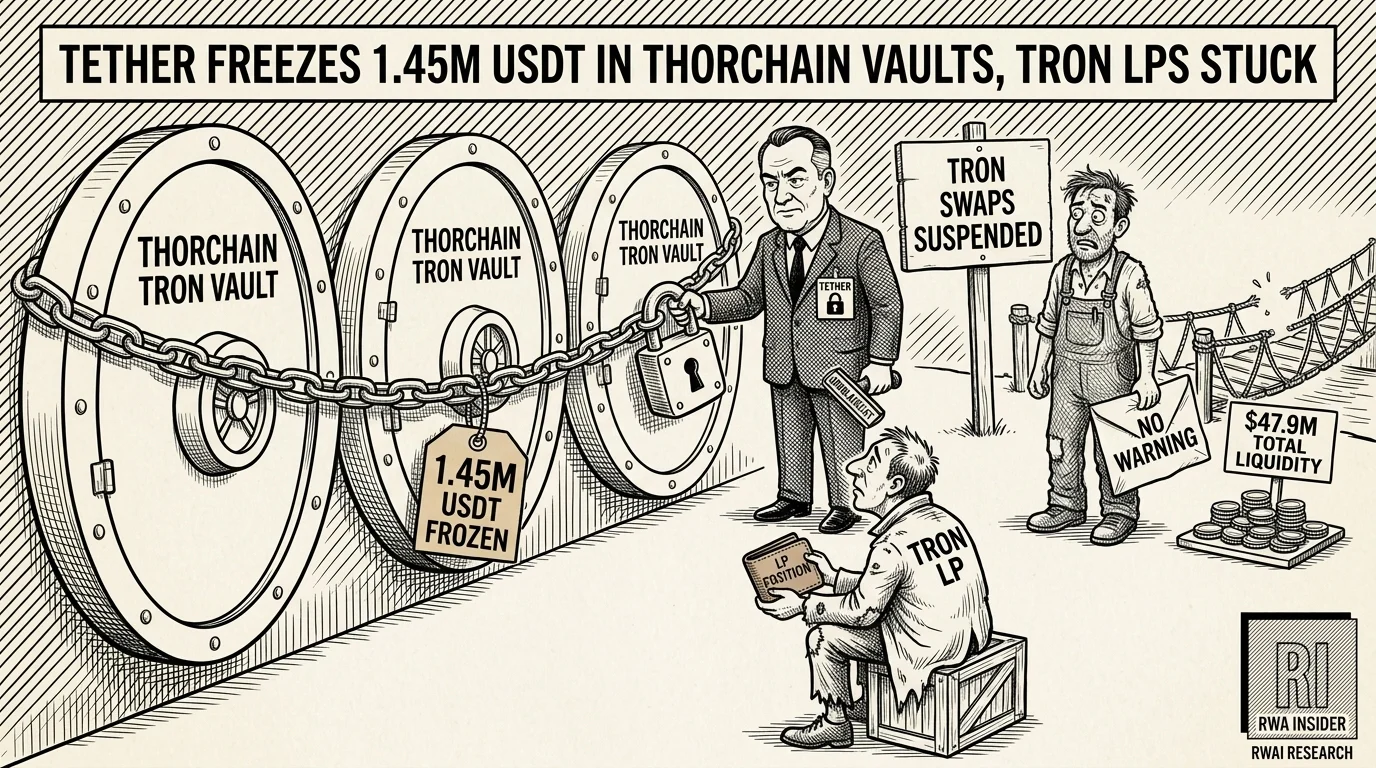
Tether Freezes 1.45M USDT In THORChain Vaults, Tron LPs Stuck
Key Points
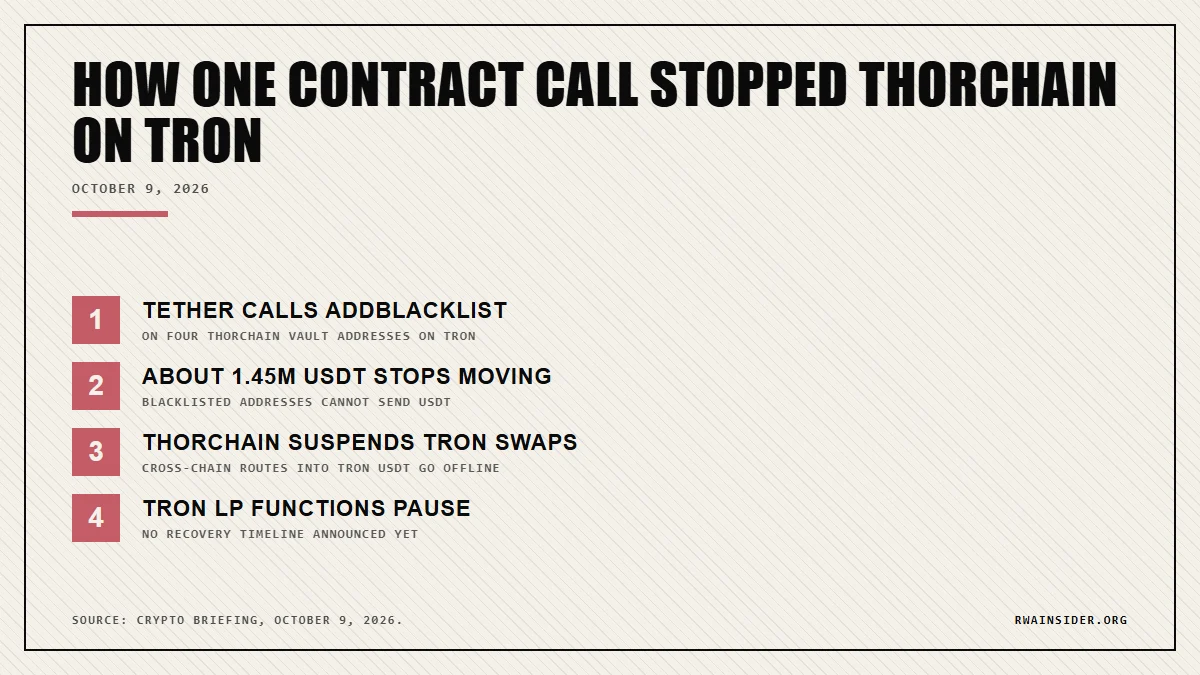
- Tether blacklisted four THORChain vault addresses on Tron on October 9, freezing about 1.45 million USDT and knocking Tron swaps offline.
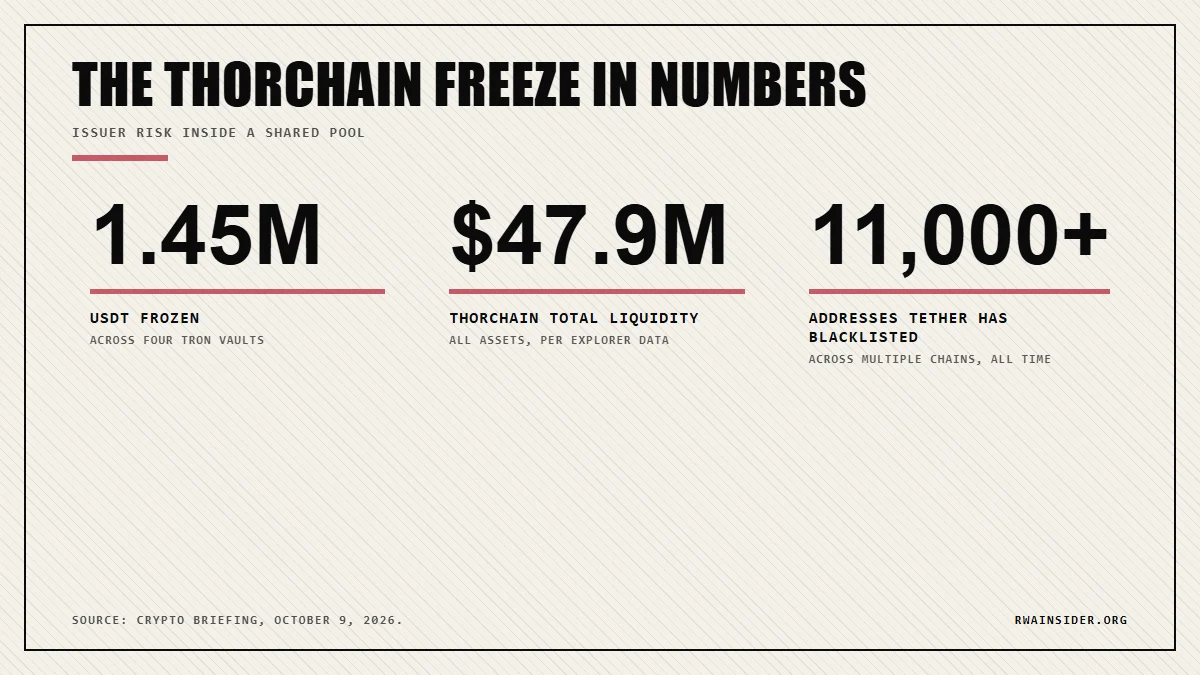
- THORChain secures roughly $47.9 million in total liquidity, while Tether has blacklisted more than 11,000 addresses across chains over its history.
- With four Tron vaults frozen and no recovery timeline, THORChain liquidity providers should treat any USDT pool as exposed to Tether’s blacklist.
Tether froze about 1.45 million USDT on October 9 by blacklisting four THORChain vault addresses on Tron, and the protocol’s Tron swaps went dark almost at once. Crypto Briefing reported the freeze the same day and summed up the lesson in one line: “A protocol can refuse to censor at its own layer and still be censored at the asset layer.” For your wallet, that means a permissionless pool is only as permissionless as the least neutral token sitting inside it.
Tether Blacklists Four THORChain Vaults On Tron
THORChain runs swaps between native assets on different chains, like Bitcoin into USDT on Tron, with no wrapped tokens and no centralized exchange in the middle.
Its vaults hold the pooled assets that fill those swaps. On October 9, Tether blacklisted four of the Tron vault addresses.
The roughly 1.45 million USDT inside them can no longer move. THORChain suspended Tron swaps and the related liquidity-provider functions.
Tether did this through a function in its TRC-20 contract called addBlackList. Once Tether calls it on an address, that address cannot send USDT.
Tether’s contracts on Ethereum carry similar blacklist powers.
Those vaults are the plumbing. Freeze four of them and the Tron route stops cold, whatever the rest of the network is doing.
THORChain has not published a full account of the incident or a date for restoring service.
1.45M Frozen USDT Against $47.9M In THORChain Liquidity
THORChain secures about $47.9 million in total liquidity across all assets, according to recent explorer data cited by Crypto Briefing.
The frozen USDT is a small slice of that. But it sat on a route users rely on to reach stablecoins on Tron.
Freezes are routine for Tether. The issuer has blacklisted more than 11,000 addresses across multiple chains, often after law enforcement requests.
Those freezes have locked up billions in value over the years. Most of them hit wallets tied to individual bad actors.
This one hit shared infrastructure that serves many users at once. A wallet freeze targets one holder, while a vault freeze stalls everyone using the route.
For a DeFi user, this matters less as a compliance action than as proof that issuer risk travels with every USDT you deposit into a shared pool.
If you provide liquidity on THORChain’s Tron side, your capital sits in pools that are now partly frozen, with no announced recovery plan.
There is no yield to compare here. The live question is whether capital in those pools can leave at all.
Before you route stablecoins through any cross-chain pool, track issuer and protocol risk across our DeFi-native RWA coverage.
THORChain’s Bitget Call And What Tron LPs Watch Next
THORChain co-founder Chad Barraford said the team got no advance notice from Tether before the freeze.
The timing raises questions. In late September, THORChain chose not to block addresses linked to the $387.5 million Bitget hack.
Crypto Briefing notes that its reporting does not establish whether Tether’s freeze is tied to that decision.
The order of events is still awkward for THORChain. First the protocol declined to censor. Then a centralized issuer froze its vaults.
The wider point is structural. A swap protocol can stay neutral at its own layer, yet every USDT moving through it still answers to Tether.
USDT travels on decentralized rails, but whether it travels at all is Tether’s call. THORChain was built to route around gatekeepers, and it just found where the gate sits: inside the token contract.
The people most exposed are Tron-side liquidity providers. They are still waiting to learn what happens to their positions.
Freeze controls are also being built into newer stablecoin stacks, as our look at Cardano’s stablecoin freeze and seize toolkit covered.
Watch two things now. Will THORChain set a recovery timeline for Tron swaps, and will Tether explain or reverse the freeze?
If Tether lifts the blacklist, Tron LPs get their swaps back and the episode fades. If it holds, every pool that pairs against USDT carries a risk its smart contracts cannot code away.
Holding USDT in a cross-chain pool? Check which chain it sits on and whether its issuer can freeze that address.
Frequently Asked Questions
Why did Tether freeze THORChain’s vaults on Tron?
Tether has not explained the basis for the October 9 freeze. The company often blacklists addresses after law enforcement requests, and reporting has not established a link to THORChain’s earlier refusal to block Bitget hack addresses.
How much USDT is frozen in the THORChain vaults?
About 1.45 million USDT sits frozen across four THORChain vault addresses on Tron. THORChain holds roughly $47.9 million in total liquidity across all assets, so the frozen amount is a small share, but it cut off the Tron swap route.
Can I still swap USDT on Tron through THORChain?
Not right now. THORChain suspended Tron swaps and the related liquidity-provider functions after the freeze. It has not given a timeline for restoring them.
Is USDT safe to use in DeFi liquidity pools?
USDT carries issuer risk. Tether’s contracts on Tron and Ethereum include a blacklist function that stops a frozen address from sending USDT, and Tether has blacklisted more than 11,000 addresses over its history. Any pool holding USDT depends on Tether leaving its address alone.