$300B Stablecoins Face Untested Run Risk, FSB Warns G20
Key Points
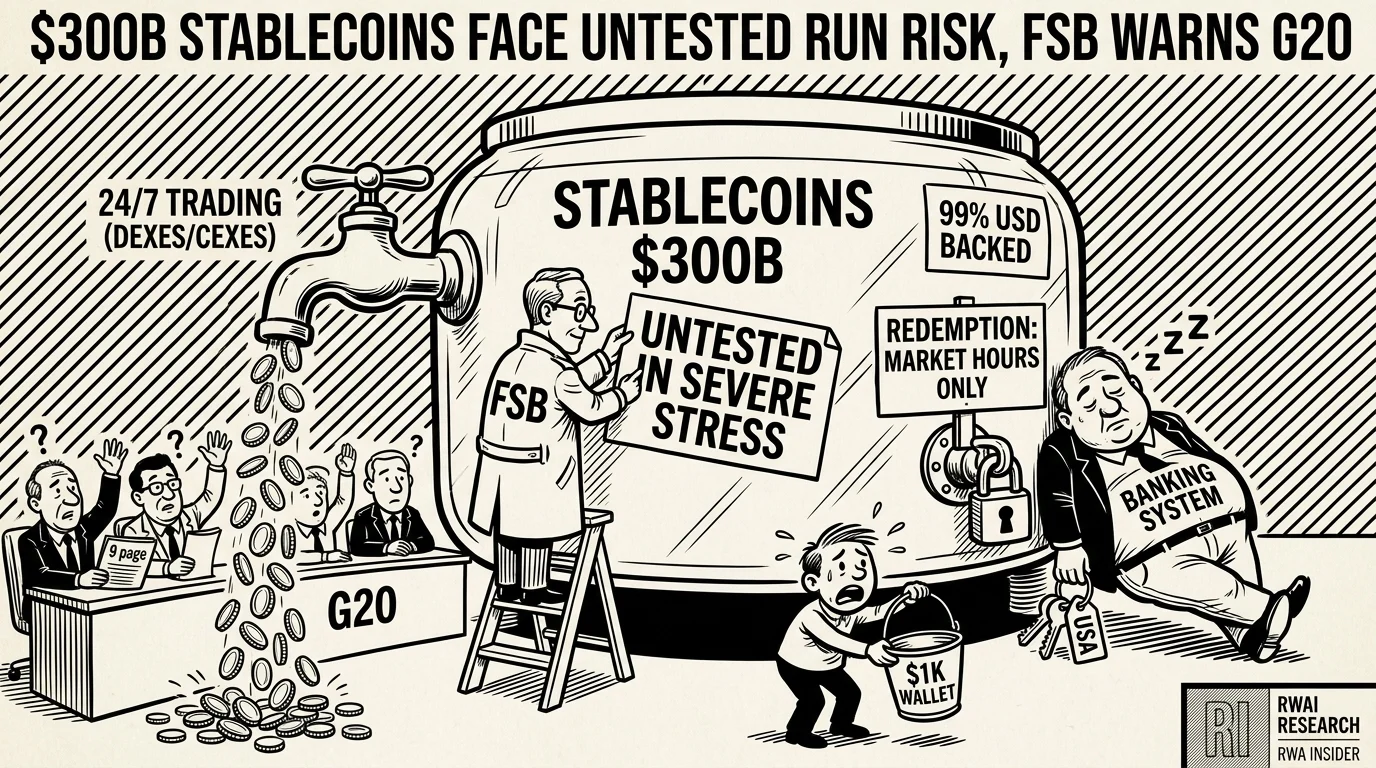
- The Financial Stability Board told G20 finance ministers on October 12 that the $300 billion stablecoin market remains untested in severe stress and insolvency.
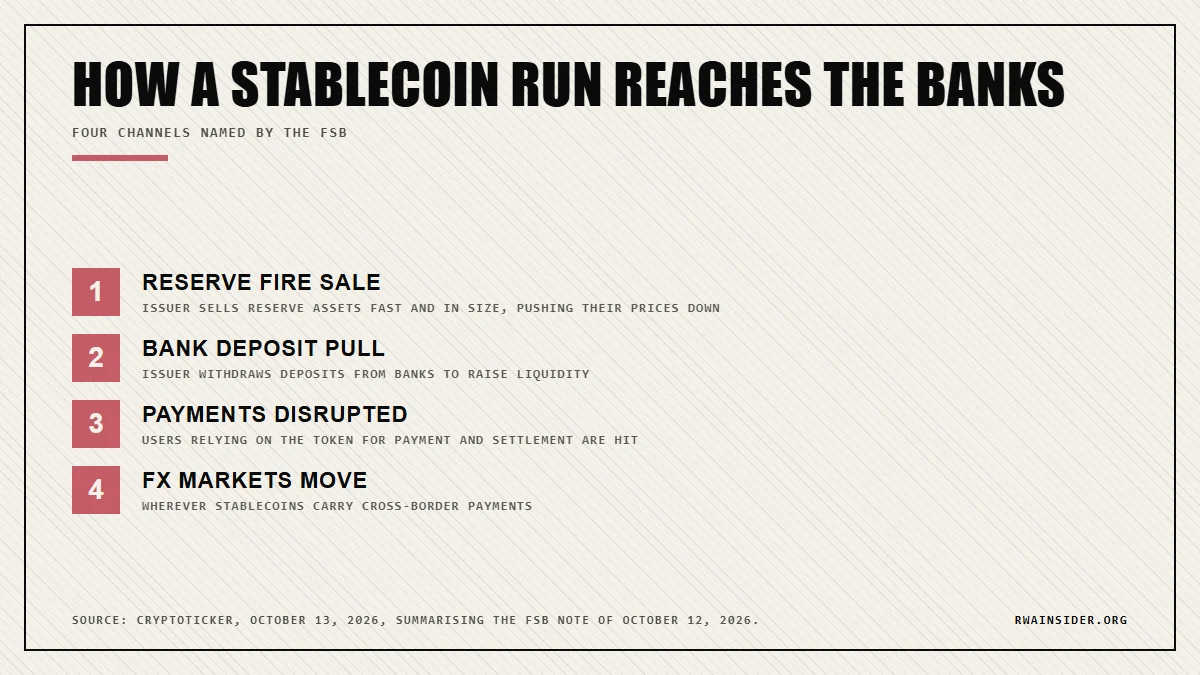
- About 99% of stablecoin value sits in dollar-pegged tokens, and the FSB’s nine-page note names four channels a run could use to reach banks.
- The FSB flags a gap between 24/7 stablecoin trading and market-hours redemption, so a $1,000 DeFi wallet’s depeg exit is DEX pool depth.
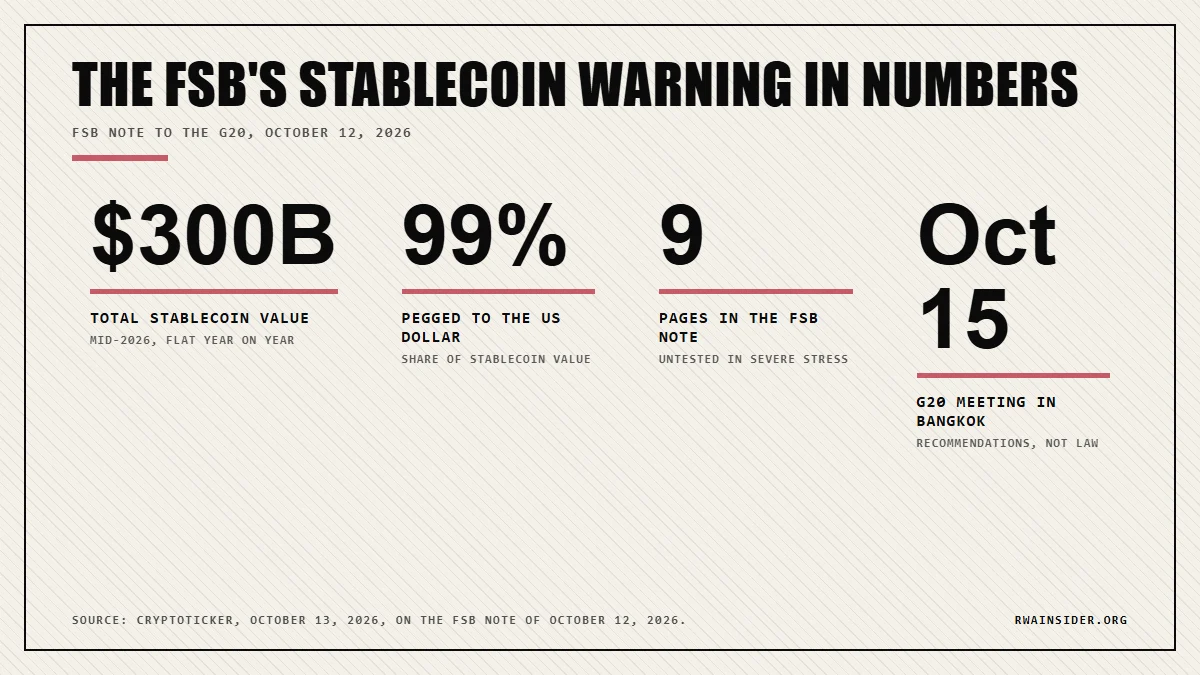
The Financial Stability Board told the G20 on October 12 that the $300 billion stablecoin market has no proven playbook for a large issuer failure. “Global stablecoins and national regulatory frameworks remain untested in severe stress and insolvency,” the FSB wrote in a nine-page note sent with a letter from its chair, Andrew Bailey, ahead of the October 15 G20 meeting in Bangkok. For your wallet, that means the dollar tokens sitting in your DeFi pools rest on rescue rules nobody has run under real pressure.
What The FSB’s Nine-Page Stablecoin Note Tells The G20
The Financial Stability Board coordinates central banks, finance ministries and supervisors across the large economies. It writes recommendations, not laws.
Its note, “Global Stablecoin Arrangements: Cross-border vulnerabilities and financial stability monitoring,” builds on the FSB’s 2023 recommendations and a 2025 review of how countries applied them.
The core problem is borders. An issuer can sit in one country, hold reserves in a second, trade on exchanges in a third and serve holders everywhere.
No single supervisor sees the whole picture. Unlike a bank, an issuer may not even know who holds its tokens or where they live.
For on-chain users, that blind spot is literal. Supervisors lean on private data providers, because pseudonymous blockchains rarely show who holds a token or why.
The note also states that some issuers have chosen to operate from weakly regulated or unregulated jurisdictions.
Why 99% Dollar Pegs And 24/7 Trading Raise Depeg Risk
The FSB puts total stablecoin value at about $300 billion at mid-2026, practically unchanged from a year earlier.
Roughly 99% of that sits in tokens pegged to the US dollar. A holder outside the US who parks in a dollar token carries currency risk on top of issuer risk.
The sharper warning is about time. Stablecoins trade around the clock, but redemptions and reserve management run through traditional markets with opening hours.
Under stress, selling can build in hours when the reserve side cannot act. If redemptions fail to keep up with demand, the peg comes under pressure.
Strip away the G20 language and this is really about who gets a full dollar back when a stablecoin wobbles.
CryptoTicker spells it out: in a depeg, only holders who can redeem directly with the issuer receive full value. Everyone else sells at the market price.
That makes secondary market depth your exit. The FSB names deep, liquid secondary markets as the force that lets arbitrage pull a token back to its peg.
Before you pick a dollar token for a pool, compare stablecoin issuer risk across our DeFi-native RWA coverage.
MiCA, Reserve Quality And The October 15 G20 Checkpoint
The note binds no one. FSB recommendations only take effect once each country writes them into its own law.
The European Union has done much of that already with MiCA. Single-currency stablecoins there count as e-money tokens, offered only by authorised e-money or credit institutions.
MiCA also requires reserves held apart from the issuer’s own assets and gives holders a claim to redemption at par. Other jurisdictions are still working through that step.
The FSB calls reserve quality the decisive lever. Illiquid or low-grade reserves in a country that skipped the 2023 recommendations sharpen both liquidity and operational risk.
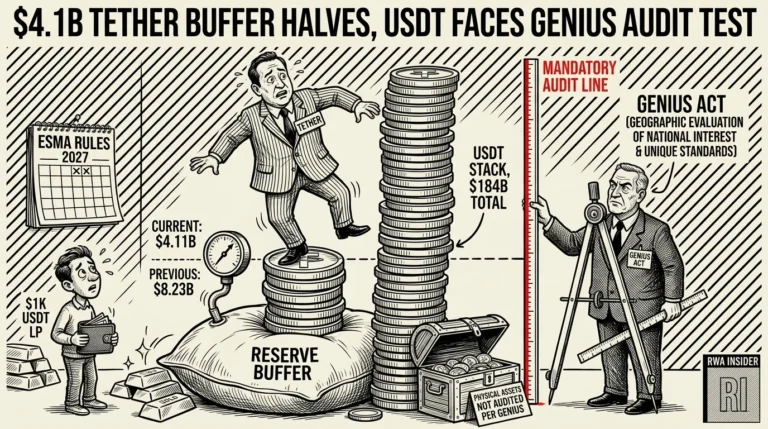
Shattered’s Daniel Roth has argued that Tether faces mounting pressure to commission a full Big Four audit within two to three reporting quarters, as our report on Tether’s shrinking reserve buffer and the GENIUS Act audit line covered.
Custody is the other lever you control. A stablecoin on an exchange is a claim on that exchange, which stacks a second layer of uncertainty on any issuer failure.
A wallet whose keys you hold removes that middle layer, though backing up those keys becomes your job.
Whether stablecoin rules hold under a real run depends on how fast G20 members turn these recommendations into law, and the October 15 Bangkok meeting is the next checkpoint.
Holding dollar tokens in a DeFi pool? Check which issuer stands behind each one and how deep its exit liquidity runs.
Frequently Asked Questions
What did the FSB tell the G20 about stablecoins?
On October 12, 2026, the Financial Stability Board sent the G20 a nine-page note warning that global stablecoins and national rules remain untested in severe stress and insolvency. It flagged cross-border gaps, unclear insolvency law and weak data. The note is not binding.
Do I get $1 back if my stablecoin depegs?
Your legal claim to full value continues as long as the issuer can pay. In practice, CryptoTicker notes, only holders who can redeem directly with the issuer receive full value in a depeg, while everyone else sells at the market price. Deep secondary markets help arbitrage pull a token back to its peg.
Why does a 99% dollar share matter if I live outside the US?
The FSB says about 99% of the roughly $300 billion stablecoin market is pegged to the US dollar. If your home currency is not the dollar, a stablecoin holding also carries exchange-rate risk that no issuer discloses.
Is it safer to keep stablecoins on an exchange or in my own wallet?
On an exchange, you hold a claim against that exchange rather than the token itself, which adds a second layer of risk if the issuer fails. A self-custody wallet removes that layer, but you become responsible for backing up your keys.