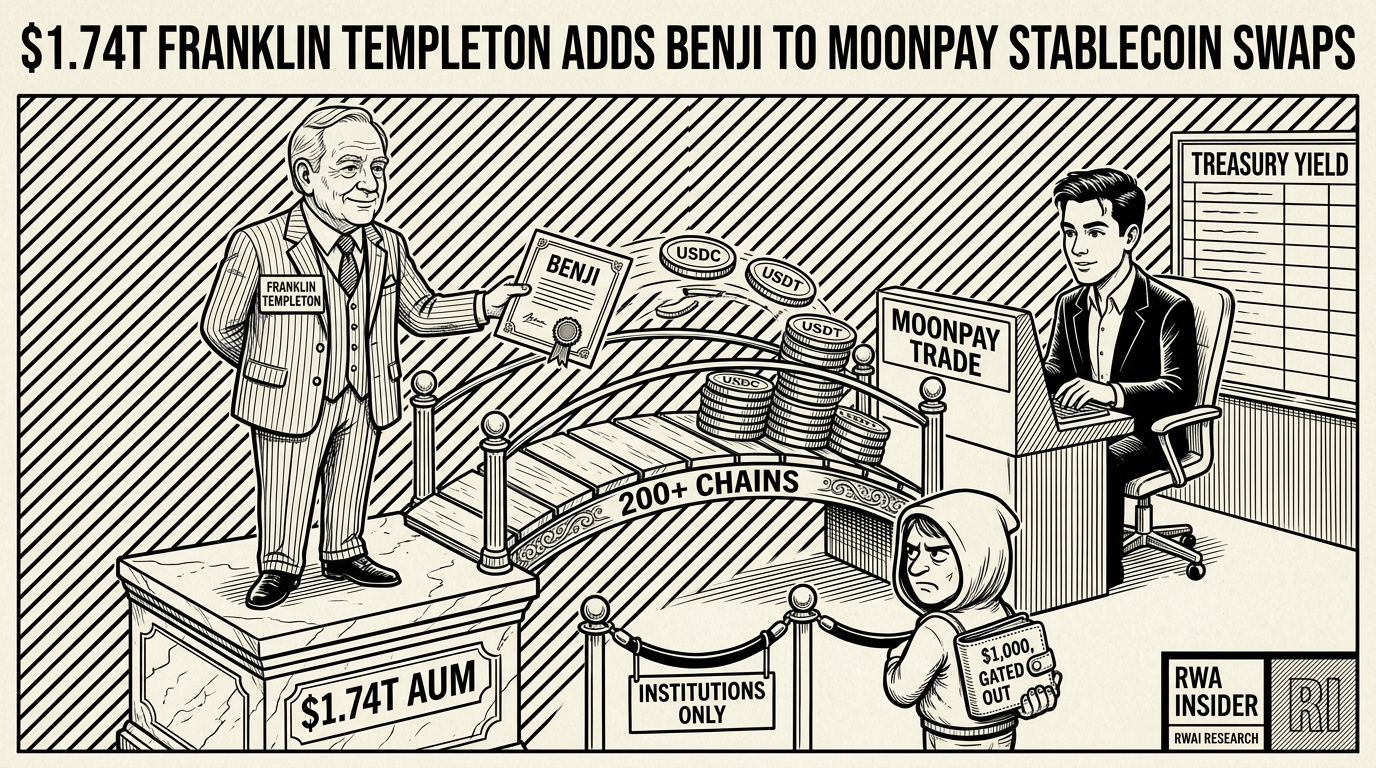
$1.74T Franklin Templeton Adds BENJI To MoonPay Stablecoin Swaps
Key Points
- Franklin Templeton, a $1.74 trillion asset manager, added its BENJI tokenized money market fund to MoonPay Trade for on-chain stablecoin swaps.
- Institutions can swap USDC, USDT, and other stablecoins for BENJI, the first U.S.-registered mutual fund to launch on a public blockchain in 2021.
- No $1,000 wallet can use MoonPay Trade yet, but the same BENJI Treasury yield reaches retail through Ondo Finance tokenized products after one-time KYC.
Franklin Templeton added its BENJI tokenized money market fund to MoonPay Trade on Tuesday, letting institutional clients swap stablecoins like USDC and USDT for a fund that holds short-term U.S. Treasuries. Sandy Kaul, the firm’s head of innovation and digital assets, said tokenized money market funds “become more useful when they can move at the speed and with the programmability of digital asset networks.” For a DeFi wallet, the signal is not the swap itself, which stays gated to institutions, but where that yield is heading: onto the same on-chain rails your wallet already runs on.
Franklin Templeton Wires BENJI Onto MoonPay Trade
Franklin Templeton added BENJI, its tokenized money market fund, to MoonPay Trade, the institutional on-chain execution platform the company launched in late May 2026.
BENJI is the on-chain share class of the Franklin OnChain U.S. Government Money Fund, known as FOBXX. It launched in 2021 as the first U.S.-registered mutual fund to run on a public blockchain.
The integration lets institutions swap USDC, USDT, and other stablecoins for BENJI directly on-chain, instead of wiring cash through a fund administrator over days.
Franklin Templeton said the setup can support treasury management, portfolio rebalancing, collateral use, and liquidity provision.
The platform leans on MoonPay’s recent acquisitions: Decent for cross-chain routing, DFlow for trade execution, and Sodot for key management.
Here is the catch for on-chain users.
MoonPay Trade is gated to institutions, a single API into more than 200 blockchains under compliance controls, so a $1,000 wallet cannot route through it today.
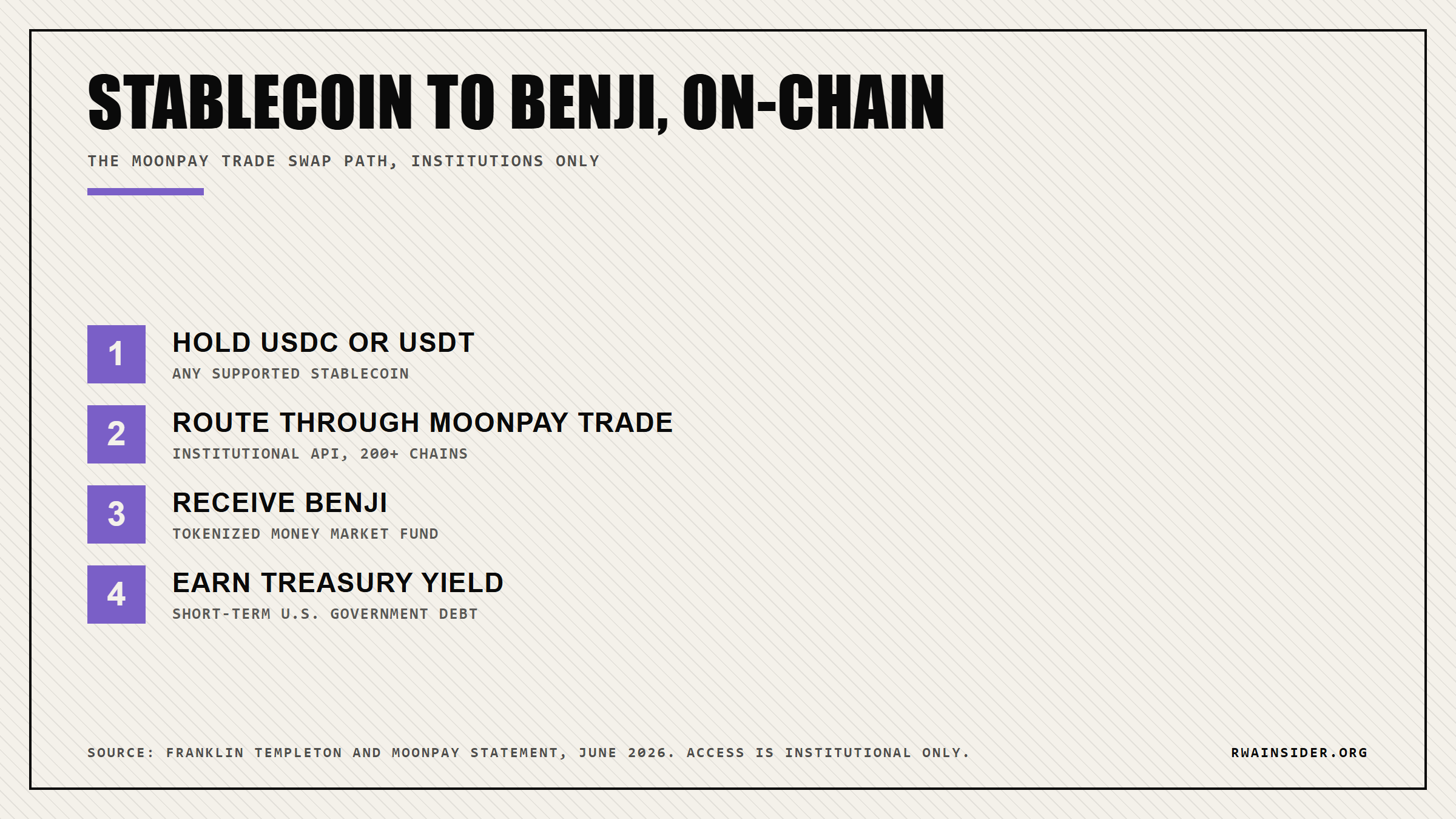
BENJI Yield Versus Permissionless Aave USDC
The $1.74 trillion figure is Franklin Templeton’s total assets under management from its latest quarterly report, not the size of this deal.
It still makes the firm one of the largest traditional managers moving real money onto public chains, alongside its work with Kraken parent Payward, Binance, and Ondo Finance.
Strip away the partnership language and this is really about a Treasury yield that has lived behind bank walls inching toward the wallets that run DeFi.
BENJI holds short-term U.S. government debt, the same engine behind the tokenized Treasuries DeFi users already chase.
Money market funds rarely settle in seconds, and that speed is the change MoonPay is selling.
When a fund like that can move at stablecoin pace, the yield stops being a quarterly statement and starts being a balance you can act on.
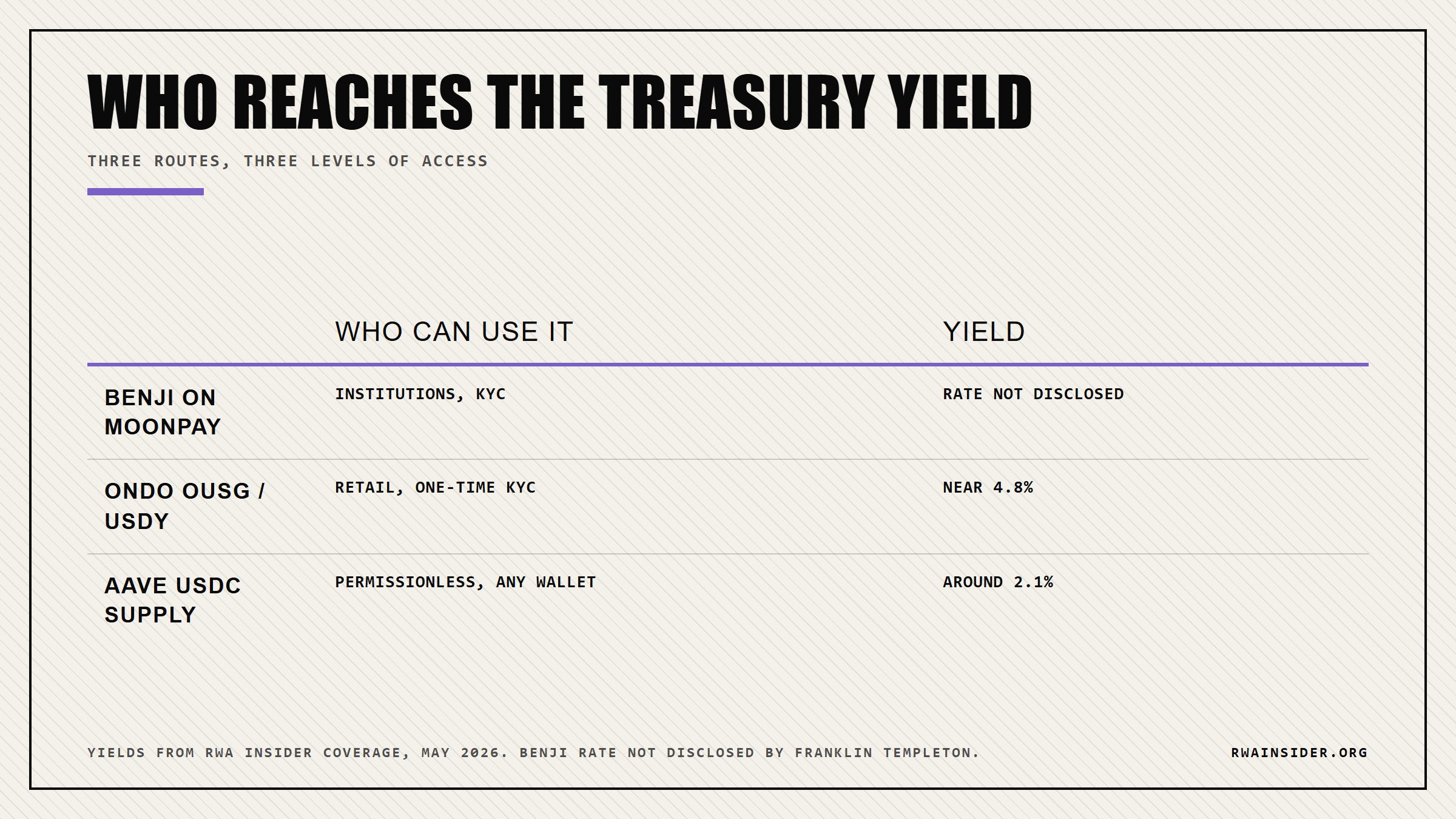
RWA Insider’s earlier coverage put tokenized Treasuries like Ondo’s OUSG near 4.8% against Aave USDC around 2.1% on permissionless supply, a gap of roughly 270 basis points.
You can see how RWA Insider tracks the tokenized-treasury yield gap as more of that supply moves on-chain.
Caroline Pham And What Opens BENJI To Retail
Caroline Pham, the former acting chair of the Commodity Futures Trading Commission who now runs MoonPay Institutional as CEO, said tokenized money market funds can improve liquidity and capital efficiency once institutions plug into the on-chain financial system.
She framed the Franklin Templeton tie-up as proof of the infrastructure now forming under institutional digital asset adoption.
BENJI is not standing still.
Franklin Templeton already tokenizes products with Kraken parent Payward, backs BENJI as off-exchange collateral on Binance, and works with Ondo Finance to tokenize a basket of ETFs.
In April 2026 the firm agreed to buy 250 Digital, a CoinFund spinoff, to widen its crypto business.
Each tie-up pushes the same tokenized fund onto another venue retail already uses.
The race is no longer who tokenizes a Treasury fund, but who connects it to the deepest stablecoin liquidity first.
The question for a wallet holder is permission, not technology.
The moment a route like this opens to non-institutional addresses, a Treasury yield that beats permissionless stablecoin lending becomes something a $1,000 balance can hold.
Whether that Treasury yield ever lands in a permissionless wallet depends on when MoonPay and Franklin Templeton drop the institutional gate, and the next integration will tell. Until then, the swap is real but the door stays shut to retail.
For the live version of this gap, see how a tokenized Treasury already out-yields permissionless Aave USDC for retail wallets today.
Frequently Asked Questions
What is BENJI and how does it work?
BENJI is the on-chain share class of Franklin Templeton’s Franklin OnChain U.S. Government Money Fund, known as FOBXX. It launched in 2021 as the first U.S.-registered mutual fund to run on a public blockchain, and it holds short-term U.S. Treasuries that pass yield to holders.
Can a retail wallet swap stablecoins for BENJI on MoonPay Trade?
No. MoonPay Trade is an institutional platform with KYC controls and a single API across more than 200 chains. A $1,000 wallet cannot route through it today, though retail can reach similar Treasury yield through Ondo Finance products after a one-time identity check.
How does BENJI yield compare to Aave USDC?
Franklin Templeton has not disclosed BENJI’s current rate, but the fund tracks short-term U.S. Treasuries. Comparable tokenized Treasuries like Ondo’s OUSG have paid near 4.8%, against Aave USDC around 2.1% on permissionless supply, a spread of roughly 270 basis points.
Who is Caroline Pham and why does her MoonPay role matter?
Pham is the former acting chair of the Commodity Futures Trading Commission and now serves as CEO of MoonPay Institutional. Her move signals MoonPay’s push into regulated institutional on-chain trading, the rail now carrying the Franklin Templeton BENJI integration.