$3B XRPL Drafts 3 AMM Curves For Stablecoin, RWA Trades
Key Points
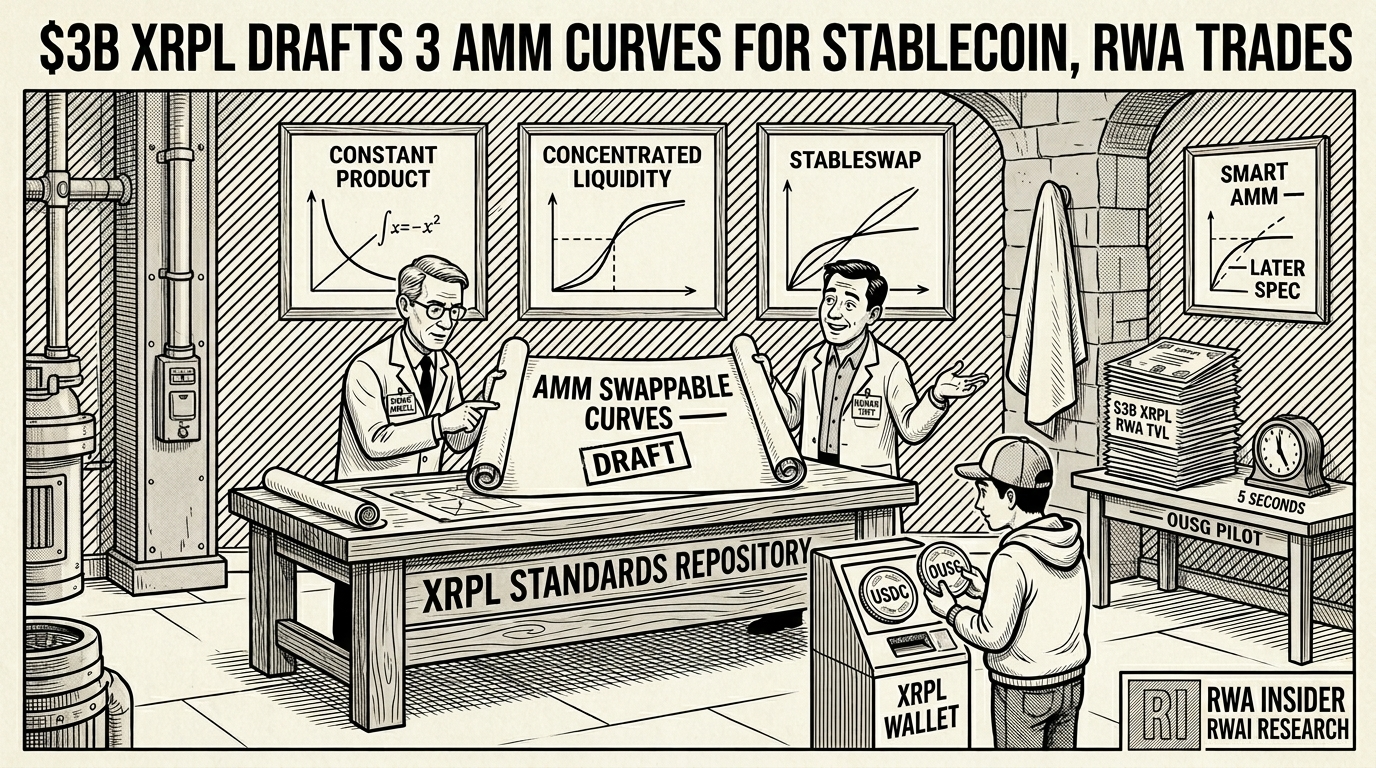
- XRP Ledger devs filed a draft ‘AMM Swappable Curves’ amendment adding three pool curve types: constant product, concentrated liquidity, and StableSwap.
- Over $3 billion in tokenized real-world assets sit on XRPL, including a Ripple and JPMorgan pilot that redeemed Ondo’s OUSG in under 5 seconds.
- Once activated, wallets trading stablecoins or tokenized Treasuries on XRPL would face tighter quoted spreads from concentrated liquidity and StableSwap pools.
XRP Ledger core developers Denis Angell and Roman Thpt filed a draft amendment that would let liquidity providers pick between three pool designs when they create new XRPL automated market maker pools. The proposal, titled “AMM Swappable Curves,” notes that the current single-curve setup “can waste deposited capital when assets usually trade close together,” including stablecoins and correlated pairs. For wallets routing tokenized Treasury or stablecoin trades through XRPL, the upgrade promises tighter quoted spreads without forcing any migration of existing positions.
Three Curves, One Pool: How XRPL AMM Swappable Curves Works
The XRP Ledger Standards repository published the draft on May 26 2026, with Angell and Thpt outlining three curve types as selectable options at pool creation.
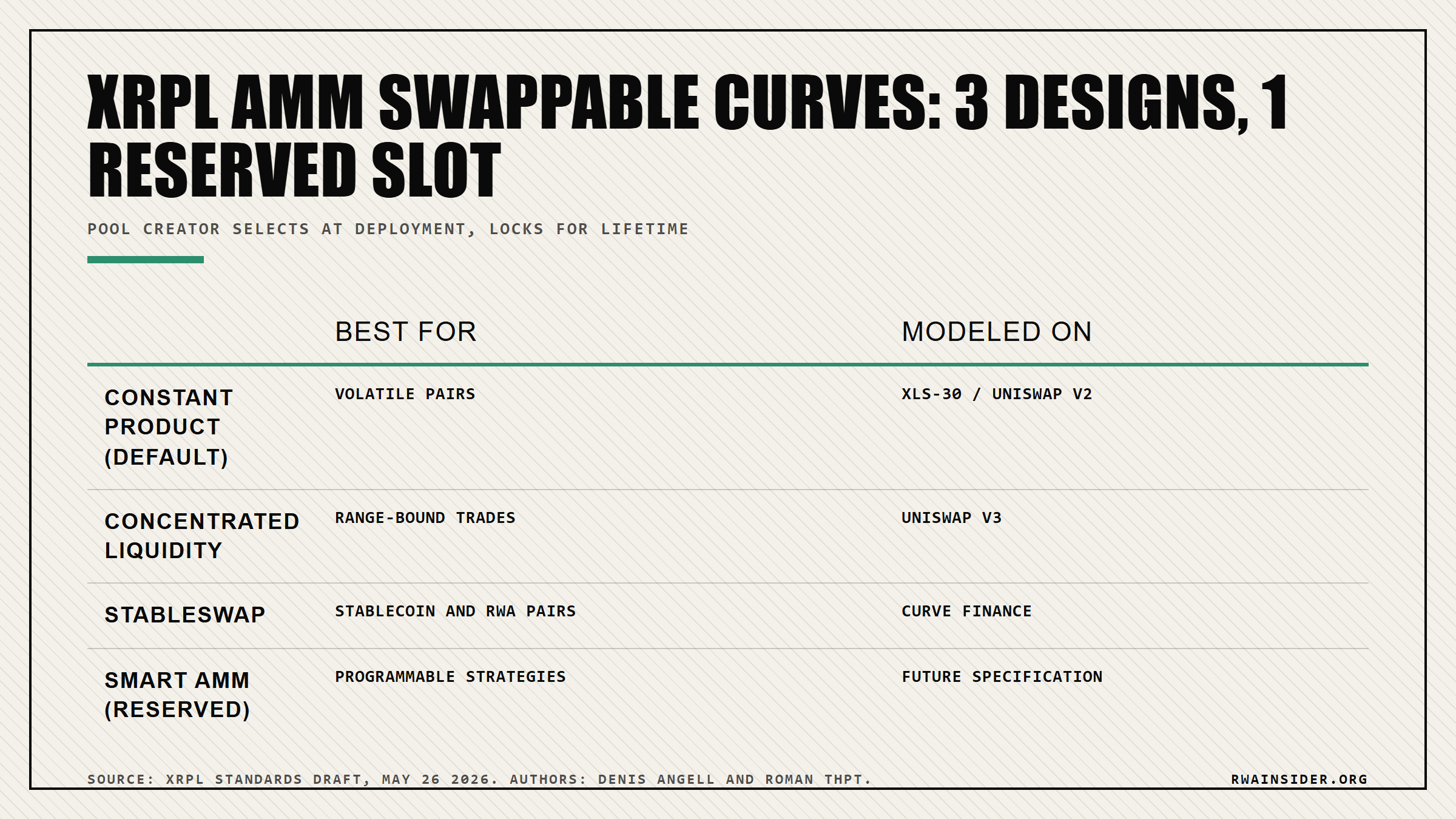
Constant product, the current model under XLS-30, spreads liquidity across the full price range and stays the default.
Concentrated liquidity, modeled after Uniswap V3, lets providers concentrate capital in a narrow price band where most trading actually happens.
StableSwap, the design pioneered by Curve Finance on Ethereum, optimizes for assets that trade close to a 1:1 ratio, like stablecoin pairs and tokenized Treasuries against USDC.
The chosen curve locks for the pool’s lifetime, while existing pools stay on constant product without forced migration.
A fourth curve type, Smart AMM, is reserved in the draft for a later specification covering fully programmable curve models.
What Concentrated Liquidity Means For Tokenized Treasury Trades
Over $3 billion in tokenized real-world assets now sit on the XRP Ledger, including a Ripple and JPMorgan-linked tokenized Treasury pilot that processed a redemption of Ondo Finance‘s OUSG in under 5 seconds on May 7.
Today, every XRPL AMM pool prices those tokens across the entire 0-to-infinity range.
Most XRPL stablecoin and Treasury trading happens within a tight band around par, which means a large share of pooled liquidity sits idle.
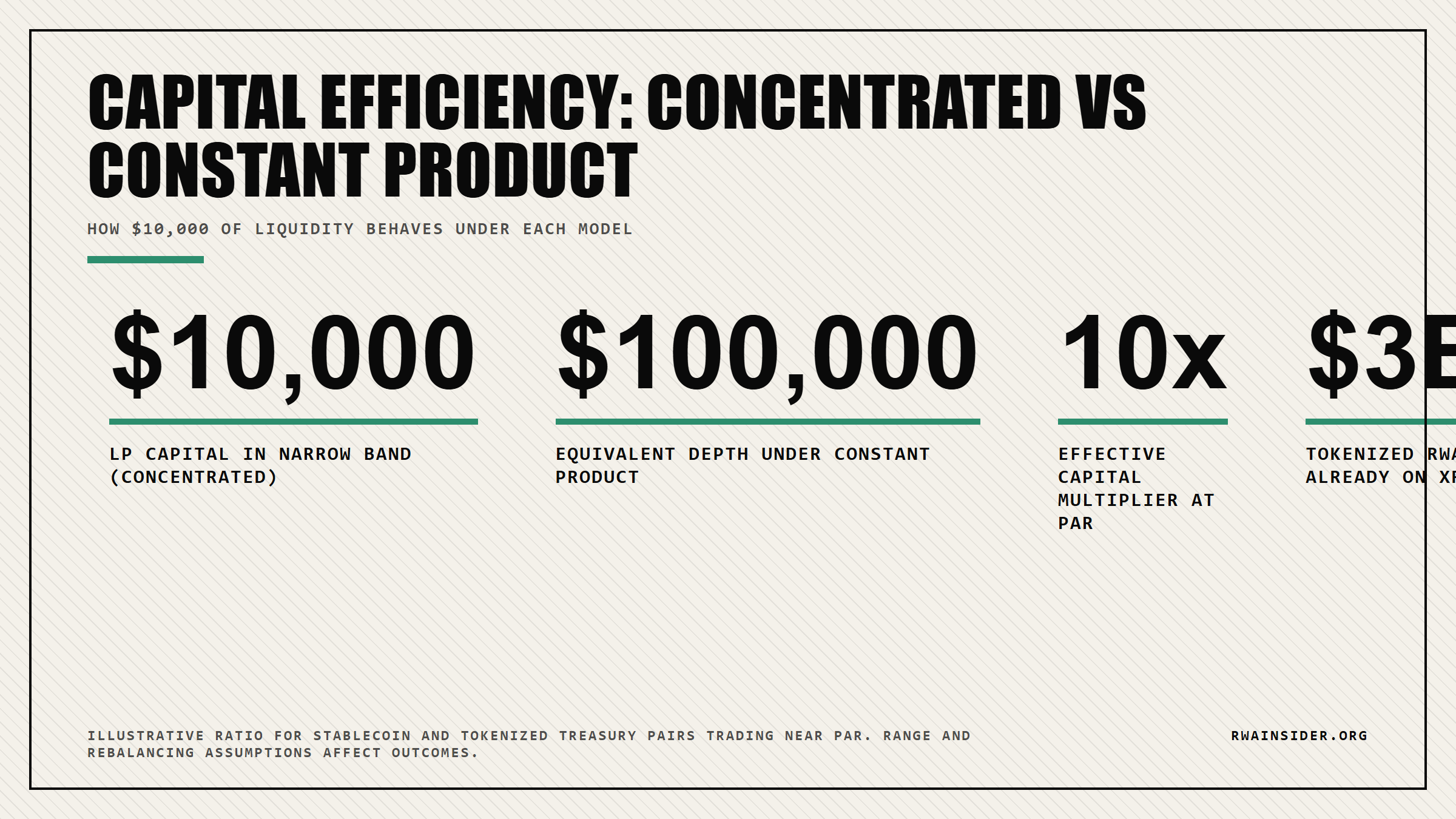
Strip away the academic framing and the shift is concrete: a liquidity provider supplying $10,000 to an OUSG/USDC pool under concentrated liquidity could deliver the same trading depth as $100,000 under the current constant product model, depending on the range chosen.
Curve’s StableSwap demonstrated this pattern in 2020 by quoting tighter spreads on stablecoin pairs than Uniswap V2 could, and it has held across every chain that adopted it.
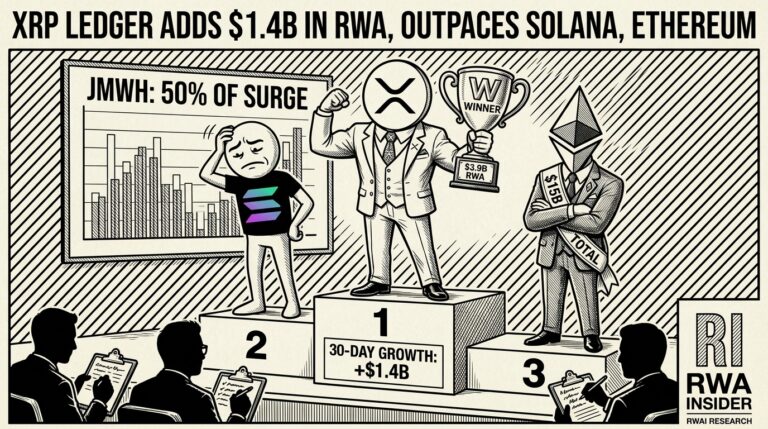
RWA Insider tracked XRPL’s tokenized footprint earlier this month in coverage of the XRP Ledger’s $1.4 billion RWA growth, where 302 distinct RWA products were already trading on the chain.
The AMM upgrade would tighten the execution layer beneath that asset stack.
From Draft To Amendment Vote: The Path To XRPL Activation
The proposal sits at draft stage and requires a separate XRPL amendment vote before activation.
XRPL’s existing AMM, introduced under XLS-30 and activated on mainnet on March 22 2024, sets the procedural template for what comes next.
Angell and Thpt frame Smart AMM in their draft as a reserved slot for a fully programmable curve model, signaling that the three-curve set in the current proposal is the first installment of a deeper redesign rather than the endpoint.
That sequencing matters for DeFi users tracking the chain.
If concentrated liquidity activates on XRPL within the next two amendment cycles, stablecoin and tokenized Treasury trades on the chain would move closer to Uniswap V3 and Curve V2 execution quality.
Two structural questions remain unresolved.
First, validator timing: XRPL amendments require formal validator buy-in through a vote, which has historically slowed adoption of optional upgrades that benefit specific user segments rather than the chain as a whole.
Second, LP fragmentation: introducing three curve types may split liquidity across more pools, which would deepen capital efficiency for power LPs but thin out depth for casual market makers comparing one pool’s quote to another.
Visit the Secondary Markets desk for more XRPL liquidity coverage as the draft moves toward an amendment vote.
Whether concentrated liquidity tightens XRPL’s stablecoin and Treasury markets depends on validator turnout and how quickly liquidity providers reroute capital from existing pools, both of which the next two amendment cycles will decide.
Track XRPL liquidity design and tokenized Treasury flows on RWA Insider as the AMM Swappable Curves draft moves through validator review.
Frequently Asked Questions
What is the XRPL AMM Swappable Curves proposal?
It is a draft XRP Ledger amendment authored by core developers Denis Angell and Roman Thpt that would let liquidity providers choose between three curve types when they create new AMM pools: constant product, concentrated liquidity, and StableSwap. The chosen curve would lock for the pool’s lifetime.
How is concentrated liquidity different from XRPL’s current AMM model?
XRPL’s current XLS-30 AMM uses a single constant product curve that spreads liquidity across the entire price range. Concentrated liquidity, modeled after Uniswap V3, lets providers focus capital in a narrow band, which sharpens depth where most trading actually happens but exposes liquidity providers to higher impermanent loss if the price moves outside their range.
Will my existing XRPL AMM positions need to migrate?
No. The draft is explicit that existing AMM pools stay on the constant product curve without forced migration. The new curve choices apply only to pools created after the amendment activates.
How does this benefit tokenized Treasury and stablecoin trades on XRPL?
Concentrated liquidity and StableSwap are designed for assets that trade near a fixed ratio, including stablecoin pairs and tokenized Treasuries like Ondo’s OUSG, which already settled a Ripple, JPMorgan, and Mastercard pilot on XRPL in under 5 seconds in May 2026. Tighter curve fit means deeper effective liquidity and lower slippage for these markets.