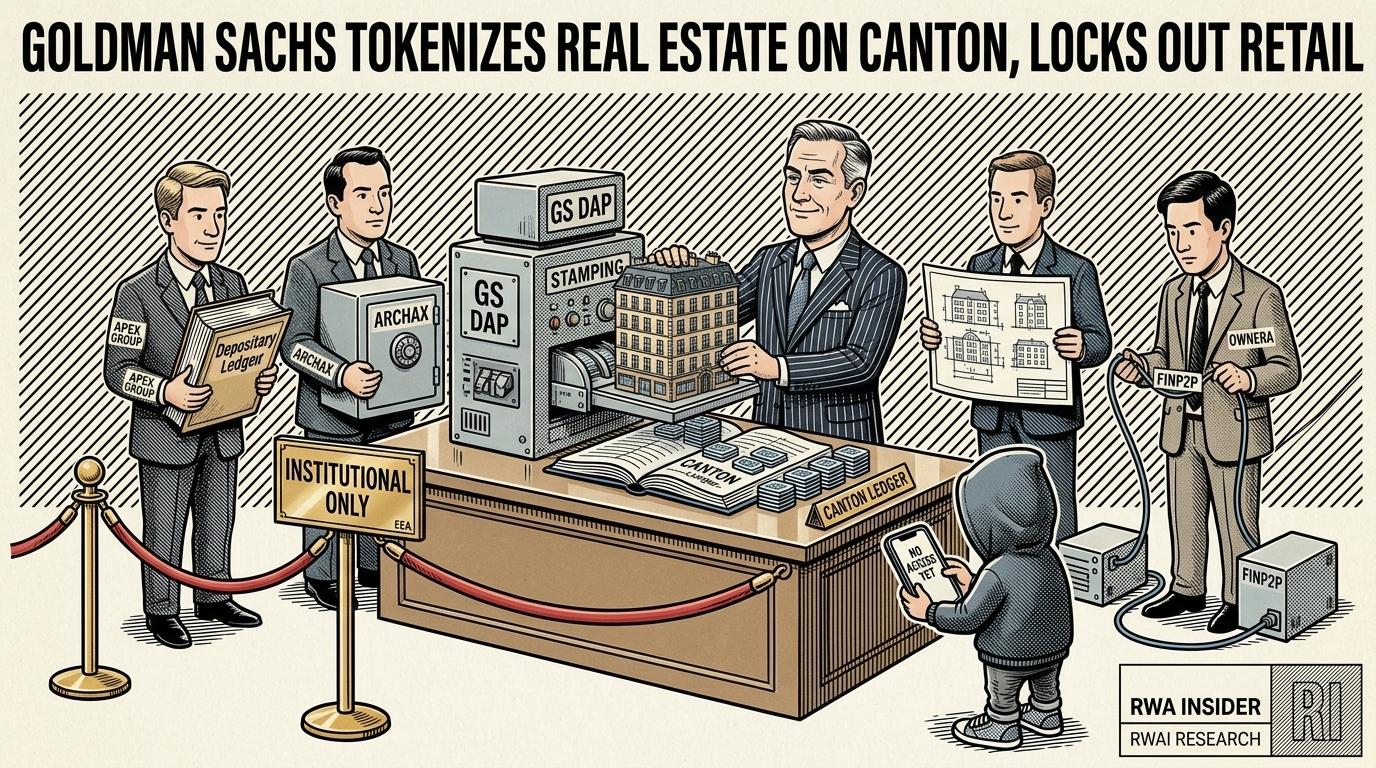
Goldman Sachs Tokenizes Real Estate On Canton, Locks Out Retail
Key Points
- Goldman Sachs issued the first blockchain-native tokens for the LRC Tokenized Real Estate Fund on April 27, 2026, through its GS DAP platform.
- Apex Group, which services over $3.5 trillion in assets across 52 countries, handles fund management, administration, and depositary duties for the Luxembourg vehicle.
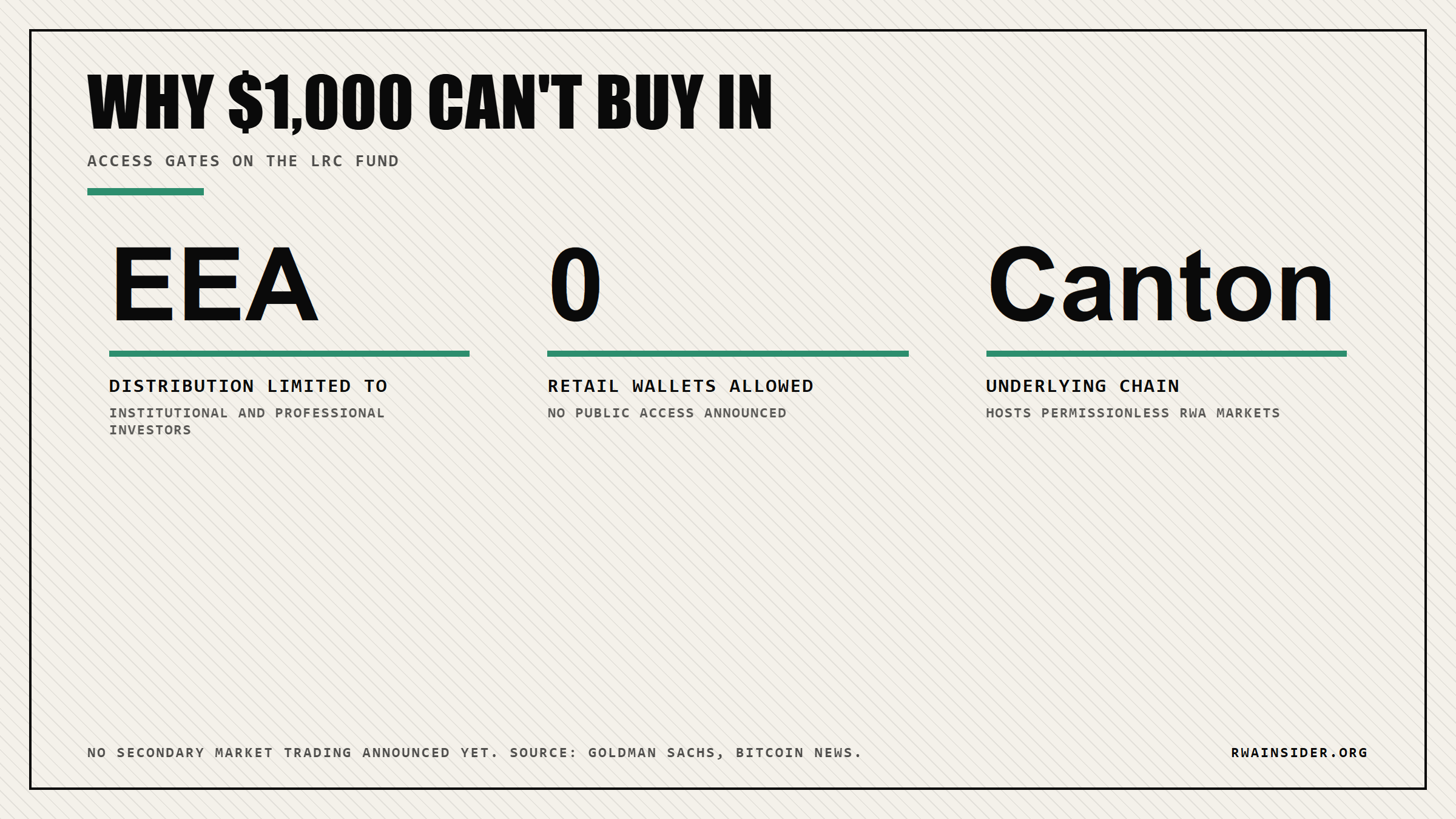
- No $1,000 wallet can buy in right now, yet the fund runs on the Canton Network, the same chain hosting permissionless real-world asset trading.
Goldman Sachs has issued the first blockchain-native shares of a tokenized real estate fund on its GS DAP platform, working with Apex Group, Archax, LRC Group, and Ownera. The LRC Tokenized Real Estate Fund, a Luxembourg-domiciled vehicle first minted on April 27, 2026, surfaced publicly this week, as reported by Bitcoin News. For a wallet holder it stays out of reach, EEA-only and built for institutions, yet it lands on the Canton Network, the chain already running permissionless real-world asset markets.
Goldman Sachs Mints LRC Shares On GS DAP
GS DAP “enables precise investment in real estate assets while opening a path to more seamless share transferability in the future,” said Mathew McDermott, Global Head of Digital Assets at Goldman Sachs.
The first tokens for the fund were minted on April 27, 2026, inside a regulated Luxembourg structure, with public details only emerging in early June.
GS DAP is Goldman’s permissioned ledger, built on the Canton Network using DAML smart contracts, and it handles issuance, settlement, custody, and transfer in one place.
The platform has already carried tokenized money market funds and a European Investment Bank digital bond, so real estate joins an existing pipeline rather than starting a new one.
For now the fund is institutional-only, with no retail access and no secondary market, but the venue is the real story: it sits on Canton, where permissionless real-world asset trades already clear.
Where The $3.5 Trillion Stack Leaves Your Wallet
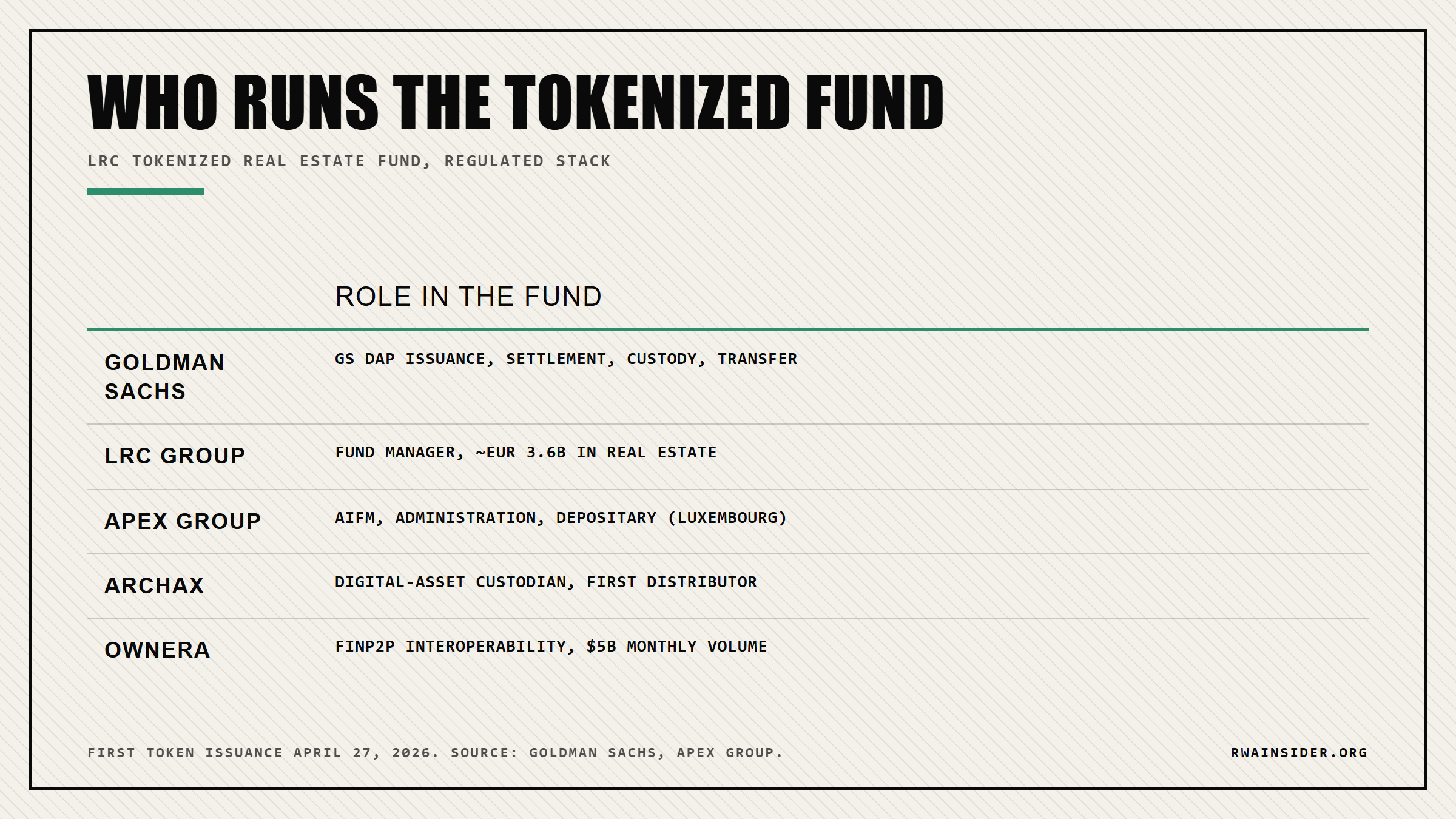
Apex Group services more than $3.5 trillion in assets across 52 countries and acts as the fund’s manager, administrator, and depositary through its Luxembourg operations.
That figure is Apex’s entire book, not the size of this fund. The LRC vehicle’s own assets under management, holdings, and performance have not been disclosed.
LRC Group manages around €3.6 billion in UK and pan-European residential property today and has handled more than €10 billion since it was founded in 1995.
Ownera supplies the interoperability layer through its open-source FinP2P technology, which the firm says orchestrates $5 billion in monthly trading volume across networks and chains.
Tokenized Treasuries pay roughly 4% to 5% and reach wallets after a one-time check, while this fund offers no such number, only ownership records on a private ledger.
Strip away the $3.5 trillion headline and this is really about which chain owns the pipes when real estate finally trades on-chain, not a yield you can earn today.
There is no published yield rate, so the usual comparison against on-chain lending does not apply. You can compare how other tokenized assets reach retail wallets across our coverage.
Canton And Ownera Hold The Path To Retail
Agnes Mazurek, Global Head of Digital Assets at Apex Group, said tokenization at institutional scale “depends on trusted, regulated infrastructure,” adding that real estate is a natural starting point that fits established fund models without weakening investor protections.
Real estate has long trailed tokenized Treasuries and money market funds, held back by distribution complexity and heavy servicing requirements.
This deal answers both by stacking regulated providers inside existing rules rather than routing around them, the pattern BlackRock has followed while pushing tokenized fund and bond products through 2025 and 2026.
The forward question is transferability. Ownera’s FinP2P connects separate blockchains, and Canton already hosts permissionless venues, so the tokens have somewhere to go the moment Goldman opens the gate.
Canton is the same chain where a self-custody wallet can already trade tokenized stocks and gold on a 20x perpetual exchange, a live preview of what retail real estate access could one day resemble.
Whether that day arrives depends on regulators and on Goldman’s appetite to widen the allowlist beyond professional investors.
Goldman built the rail, but tokenized real estate only reaches a self-custody wallet if GS DAP opens transfers beyond its institutional allowlist. Until that happens, retail watches the pipes get laid on Canton.
See how a permissionless venue already trades tokenized assets on the same chain in our look at Canton’s first 20x perpetual RWA exchange.
Frequently Asked Questions
What is the Goldman Sachs tokenized real estate fund?
The LRC Tokenized Real Estate Fund is a Luxembourg-domiciled vehicle whose shares Goldman Sachs issued as blockchain-native tokens on its GS DAP platform, with the first issuance on April 27, 2026. LRC Group manages the underlying UK and pan-European residential property.
Can I buy the LRC fund with a $1,000 wallet?
No. The fund is limited to institutional and professional investors across the European Economic Area, with no retail access and no secondary market trading announced. A self-custody wallet cannot hold the token today.
What chain is the Goldman Sachs fund built on?
It runs on GS DAP, Goldman’s permissioned platform built on the Canton Network using DAML smart contracts. Canton already hosts permissionless real-world asset trading through venues like Canborsa.
Does the tokenized real estate fund pay yield?
No yield rate, assets under management, or portfolio details have been published. Unlike tokenized Treasuries that pay roughly 4% to 5% and are reachable after a one-time check, this fund discloses no income figure, so there is nothing for a wallet to earn yet.