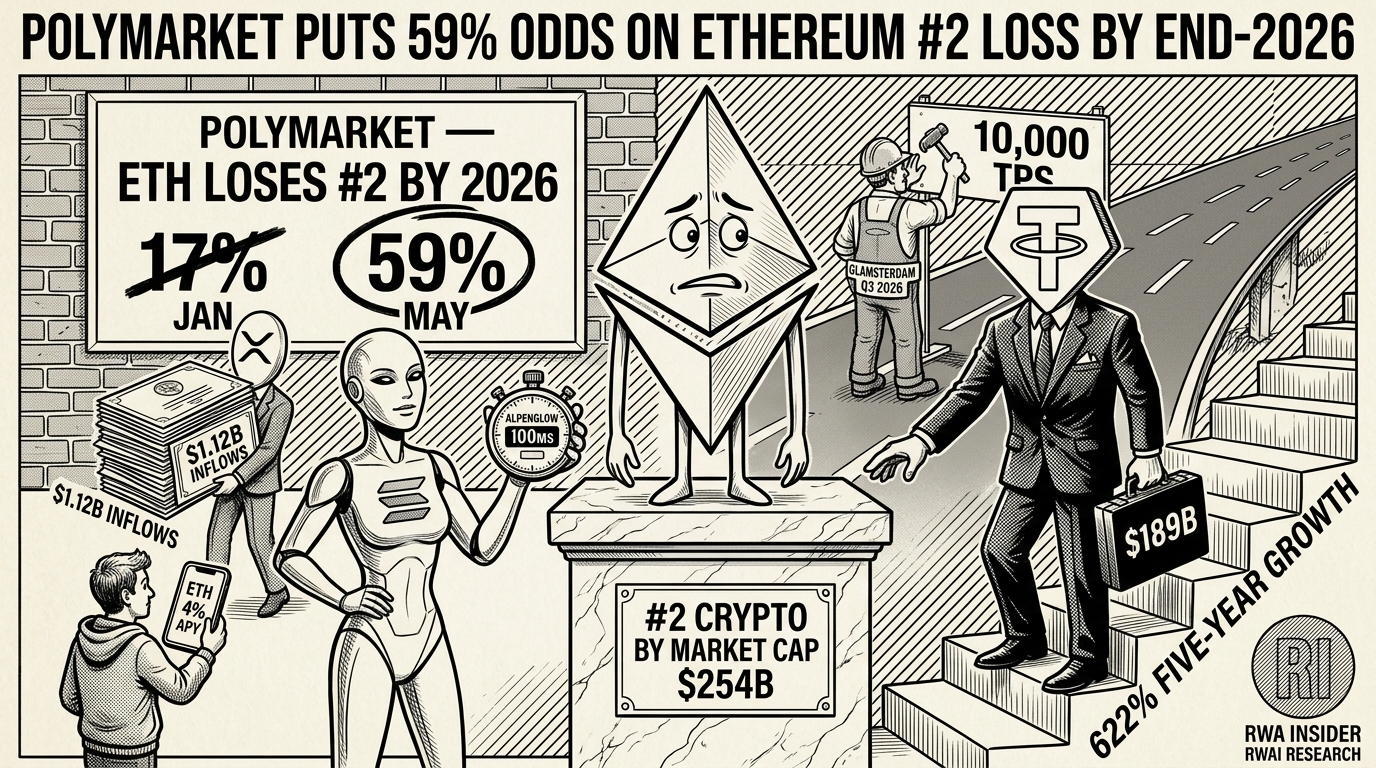
Polymarket Puts 59% Odds On Ethereum #2 Loss By End-2026
Key Points
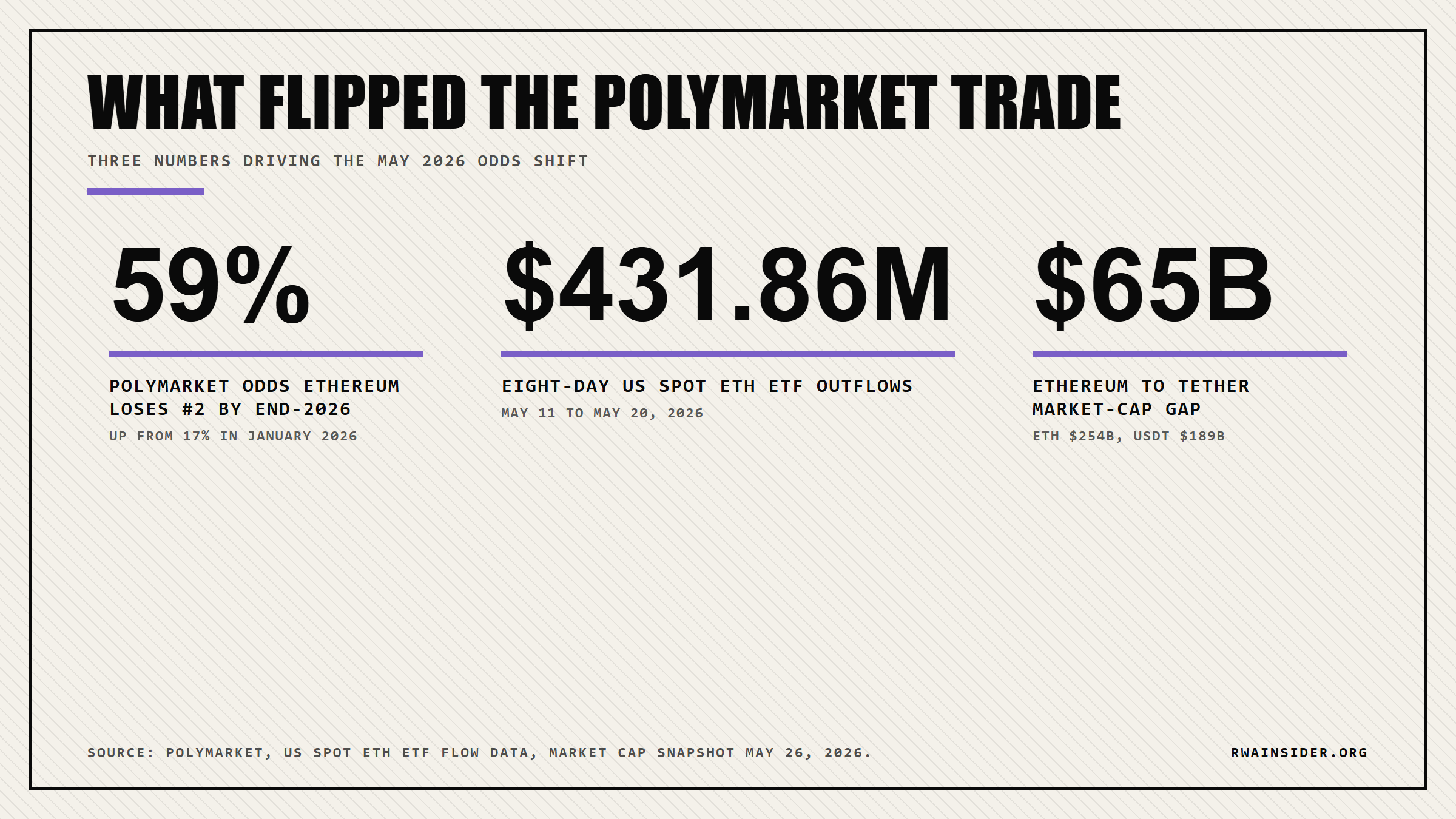
- Polymarket traders moved the odds of Ethereum losing its number two crypto position before the end of 2026 to 59% from 17% in January after $431.86M in eight-day ETF outflows.
- BlackRock’s ETHB launched on Nasdaq in March 2026 paying 1.9% to 2.2% annualized staking yield, while Charles Schwab opened direct ETH spot trading to 39 million account holders on May 13, 2026.
- A DeFi wallet staking ETH natively through Lido or Rocket Pool collects around 4% APY, roughly double the ETHB rate, while watching the Glamsterdam upgrade cut Q3 2026 gas fees by 78%.
Polymarket traders now place the odds of Ethereum losing its number two crypto position before the end of 2026 at 59%, up from 17% in January, after eight consecutive days of US spot ETH ETF outflows totalling $431.86 million between May 11 and May 20. JPMorgan said in May that ETH needs stronger network growth and DeFi adoption to reverse its underperformance against Bitcoin, with Tether’s market cap now within $65 billion of Ethereum. For a DeFi wallet holding ETH, the question is whether mainnet settlement value erodes faster than the Glamsterdam upgrade can restore it.
Polymarket Sentiment Flips As ETH ETF Outflows Top $431M
The Polymarket odds on Ethereum losing its number two spot before the end of 2026 climbed from 17% in January to 59% by May, driven by three simultaneous pressures.
US spot Ethereum ETFs posted eight consecutive days of net outflows between May 11 and May 20, totalling $431.86 million. April had ended a five-month outflow streak with $355.98 million in net inflows.
The May reversal gave back $260.18 million of that recovery in under three weeks.
Ethereum still leads on absolute market cap at roughly $254 billion, with Tether at $189 billion and the gap now around $65 billion.
Goldman Sachs cut its Ethereum ETF holdings by roughly 70% in Q1 2026, reducing total ETH exposure to around $114 million, while JPMorgan said in May that ETH needs stronger network growth and DeFi adoption to reverse its underperformance against Bitcoin.
The pullback extends beyond ETFs as institutional desks reduce broader ETH exposure ahead of the Glamsterdam catalyst.
BlackRock ETHB And Schwab Open New ETH Yield Rails
Polymarket momentum aside, the institutional rails being built around ETH have widened rather than narrowed.
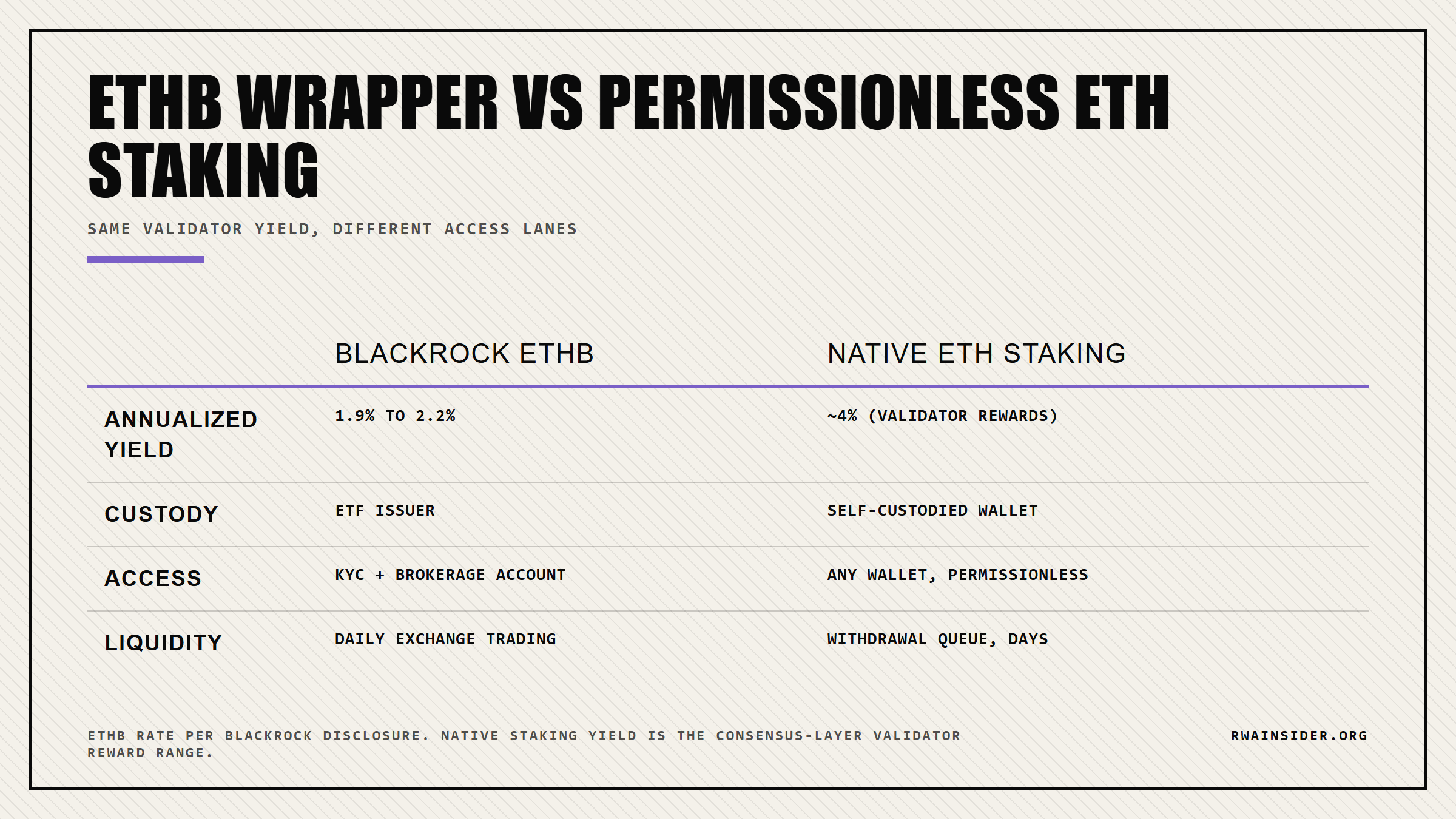
BlackRock launched ETHB on Nasdaq in March 2026, the first major US Ethereum ETF that lets holders earn staking yield. The fund pays roughly 1.9% to 2.2% annualized on a monthly basis.
Charles Schwab followed on May 13, 2026, opening direct spot Ethereum trading to its 39 million account holders.
Strip away the wrapper and a DeFi user can still capture the same validator yield without the custodian. A wallet staking ETH natively through Lido or Rocket Pool collects around 4% APY, roughly double the ETHB rate, and the position remains permissionless.
BitMine, one of the largest institutional ETH holders, has accumulated 5.2 million ETH (about 4.3% of supply), with 90% actively staked through its MAVAN validator network for over $300 million in annualized staking revenue.
This builds on our earlier read on Ethereum’s settlement-layer lead over Solana and XRP, which framed the chain-share race RWA Insider has been tracking through 2026.
Glamsterdam And Base’s $50B Squeeze On Mainnet Value
Standard Chartered calculated that Coinbase’s Base alone removed $50 billion from ETH’s market cap by diverting transaction fees away from mainnet.
Every transaction that settles on a Layer 2 is revenue Ethereum’s base layer does not collect, and that diversion has been accelerating as Layer 2 activity grows.
The counterweight is the Glamsterdam upgrade, now targeting Q3 2026 after the original June window slipped following testnet delays. Glamsterdam introduces parallel transaction processing and a projected 78% reduction in gas fees.
The gas limit moves from 60 million to 200 million per block, and processing capacity targets around 10,000 transactions per second, roughly tenfold the current 1,000 TPS throughput.
Standard Chartered’s $40,000 ETH price target by 2030 rests on stablecoin dominance. Over 60% of all stablecoins in circulation, roughly $150 billion, currently settle on Ethereum mainnet, giving the network a settlement lead that BlackRock and Schwab are actively building on.
If you want to map current ETH yield options against the upgrade timeline, browse RWA Insider’s DeFi-native yield coverage for the latest reads.
The Polymarket trade is essentially a bet that Tether’s 622% five-year market-cap growth outruns Ethereum’s stablecoin settlement moat between now and the end of 2026.
Whether Ethereum holds the number two ranking through 2030 may matter less than whether it holds the settlement-layer position underneath every major stablecoin and tokenized asset. The next two ETF cycles and the Glamsterdam launch will tell.
Track more Protocol Battles coverage from RWA Insider as the ETH, SOL, and XRP chain-share race tightens through 2026.
Frequently Asked Questions
Why are Polymarket odds on Ethereum losing its #2 crypto spot at 59%?
Polymarket traders have priced in eight straight days of US spot Ethereum ETF outflows totalling $431.86 million, Tether’s market cap closing the gap to within $65 billion of Ethereum, and Goldman Sachs cutting its Ethereum ETF position by roughly 70% in Q1 2026. The combined signal shifted odds from 17% in January to 59% by May.
How does BlackRock’s ETHB compare to staking ETH directly through Lido?
ETHB pays roughly 1.9% to 2.2% annualized staking yield via a monthly distribution, with custody handled by the ETF issuer and KYC required at the brokerage level. Native staking through Lido or Rocket Pool pays closer to 4% APY, keeps the position permissionless and self-custodied, and exposes the user to protocol-level smart contract risk rather than custodian risk.
What does the Glamsterdam upgrade change for ETH gas fees in Q3 2026?
Glamsterdam targets a 78% reduction in gas fees, a gas limit raise from 60 million to 200 million per block, and processing capacity of around 10,000 transactions per second versus the current 1,000 TPS. If the upgrade ships on schedule, mainnet recaptures activity that has been migrating to Layer 2s like Base.
Can I still stake ETH without KYC if institutional flows shift to ETHB?
Yes. Lido, Rocket Pool, and EigenLayer all support permissionless ETH staking from any wallet without KYC. ETHB and other ETF wrappers route through custodians, but the underlying yield source (validator rewards) is identical. The DeFi-native rate currently sits around 4% APY versus 1.9% to 2.2% on ETHB.