dotUSD Launches 1:1 USDT Mint On Polkadot, Clashes With MiCA
Key Points
- Polkadot launched dotUSD on mainnet on October 8 after referendum 1944, a dollar stablecoin minted 1:1 against USDT with no issuer behind it.
- Phase two swaps USDT backing for DOT vaults built on Liquity v2, with the proposal’s example using a 150% collateral ratio.
- Users can mint dotUSD against USDT on Polkadot in self-custody today, while ESMA wants EU-licensed platforms to wind down non-compliant stablecoins within three months.
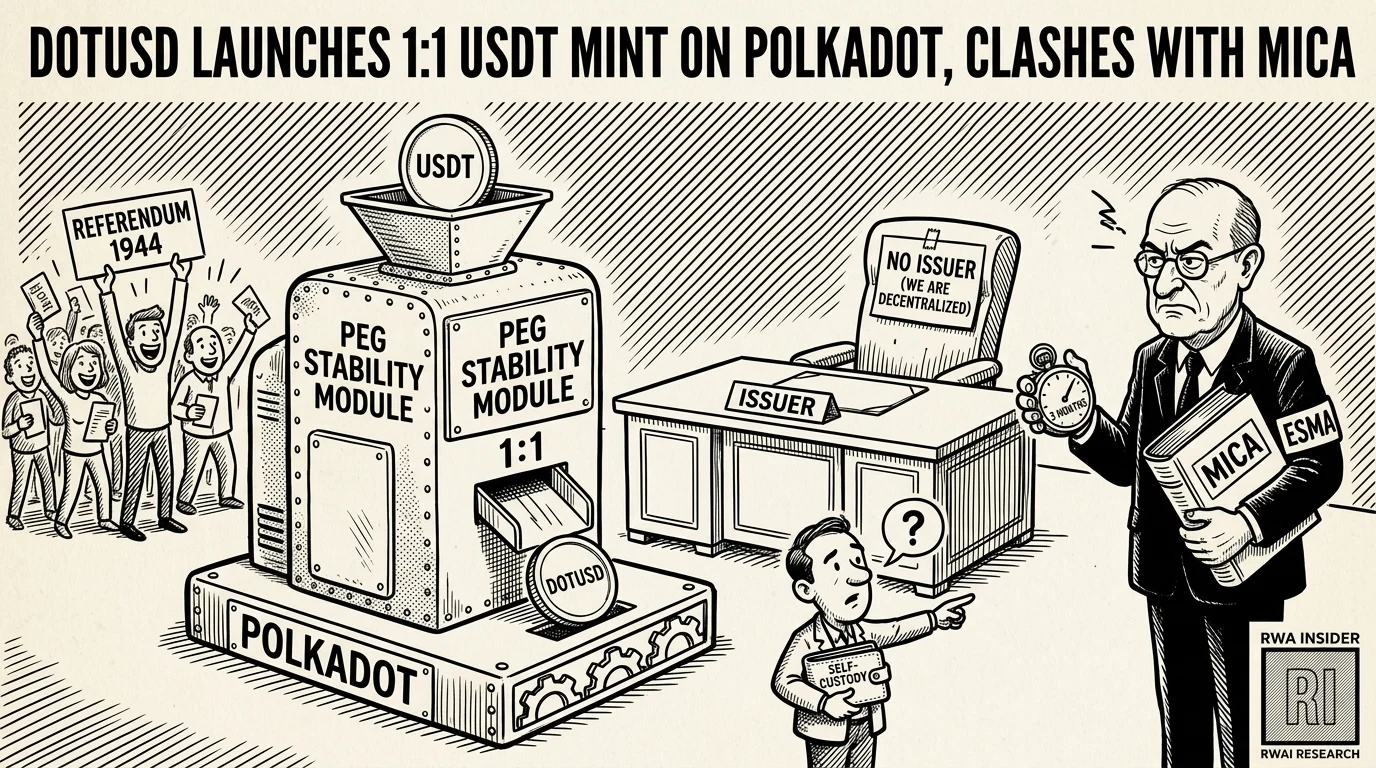
Polkadot’s dotUSD went live on mainnet on October 8, a dollar stablecoin that users mint 1:1 against USDT and that has no issuer at all. Referendum 1944, titled “dotUSD: A Native Stablecoin for Polkadot,” was tabled by the Polkadot Community Foundation and executed after DOT holders approved it, CryptoTicker reported. For your wallet, the hook cuts both ways: dotUSD is an on-chain dollar run by code and token-holder votes, but no company stands behind it when the peg slips, and MiCA has no box for that.
dotUSD Goes Live On Polkadot With No Issuer
Polkadot is rolling out dotUSD in two stages, and the first one leans on a stablecoin you probably already hold.
In phase one, you mint dotUSD 1:1 against USDT through a Peg Stability Module, a contract that swaps two tokens at a fixed rate, up to a cap.
No company runs it. Responsibility sits with a shifting majority of DOT holders voting in OpenGov.
So every dotUSD today carries a slice of the risk in the USDT reserves behind it.
Phase two cuts that tie. You lock DOT in a vault and mint dotUSD worth less than the collateral you posted.
The design follows Liquity v2 and its BOLD stablecoin: a price oracle, a stability pool that absorbs bad positions, plus liquidations and redemptions.
How big is it? CoinGecko lists dotUSD as a stablecoin, but its price and supply still read zero the day after launch.
150% Collateral, $1.15 DOT And A 3-Month ESMA Clock
The proposal’s worked example uses a collateral ratio of 150%. Lock $1,000 of DOT and you mint at most about $666 of dotUSD.
That buffer protects the peg, not you. If DOT falls below the required ratio, the vault liquidates your collateral with no action on your part.
DOT traded at $1.15 around launch, up 2.85% in 24 hours while the total crypto market fell 4.69%, per CoinGecko figures cited by CryptoTicker.
The proposal expects phase two vaults to pull DOT out of circulation. That is a forecast, not a measurement.
Then there is the clock. On October 8, ESMA, the EU securities watchdog, told MiCA-licensed platforms to stop serving EU clients in non-compliant stablecoins.
National supervisors should make those platforms wind down existing holdings within three months. Tokens in your own wallet are not covered.
Strip away the governance vote and this is really about whether you want a dollar with no one to call when it slips below $1.
Before you mint, compare how other stablecoins handle peg and reserve risk.
MiCA Has No Slot For An Issuer-Free Stablecoin
MiCA needs a licensed issuer behind every stablecoin. Per Germany’s BaFin, only credit institutions or e-money institutions may issue a token tied to one currency.
dotUSD has no issuer by design, so nobody can file the white paper or hold the licence that rule demands.
CryptoTicker called the launch “cleanly described in technical terms and unfinished in regulatory ones.”
Phase one adds a second problem. dotUSD rests on USDT, a token that EU-licensed platforms are already winding back.
Not every EU voice wants DeFi regulated harder.
Peter Kerstens, a MiCA architect and European Commission adviser, said in June he saw no clear problem with DeFi, as our report on Kerstens and the EU’s DeFi rulebook debate covered.
ESMA’s opinion shows supervisors take a harder line once a stablecoin has no one answerable for it.
For EU users, self-custody on the Polkadot chain is the realistic route for now.
That route has its own cost: a lost private key is gone for good, and phase two adds liquidation risk on top.
Watch three things: the size of the mint cap, the date DOT vaults open, and whether any EU platform keeps dotUSD access.
If DOT vaults open and hold the peg without USDT, dotUSD becomes an on-chain dollar with no issuer to fail. Until then, its backing still runs through USDT.
Holding DOT? Check the liquidation ratio before you lock it in a dotUSD vault.
Frequently Asked Questions
What is dotUSD and who issues it?
dotUSD is a dollar-pegged stablecoin that went live on Polkadot’s mainnet on October 8, 2026. It has no issuer: DOT holders steer it through the OpenGov voting system, and referendum 1944 approved the launch.
How do I mint dotUSD right now?
In phase one, you mint dotUSD 1:1 against USDT through a Peg Stability Module, subject to a cap. That means today’s dotUSD carries a share of the risk in the USDT reserves behind it.
Can I use DOT as collateral to mint dotUSD?
Not yet. Phase two plans DOT vaults modelled on Liquity v2, and the proposal’s example uses a 150% collateral ratio, so $1,000 of DOT mints at most about $666 of dotUSD. If DOT drops below the required ratio, the vault can liquidate your collateral.
Can EU users buy dotUSD on a regulated exchange?
Probably not. ESMA told MiCA-licensed platforms on October 8 to stop serving EU clients in non-compliant stablecoins and to wind down existing holdings within three months. That deadline covers platforms, not tokens in your own wallet, so self-custody on Polkadot remains the route.