
$17.1M Fund Inflows Put Stellar Past Ethereum For A Day
Key Points
- Stellar pulled in $17.1 million of tokenized fund growth in 24 hours, edging Ethereum at $16.0 million and Polygon at $5.9 million.
- Stellar’s real-world asset base has grown 360% since the end of last year, reaching a record $3.5 billion to $4 billion.
- Most of that sits in regulated funds like BENJI and USDY, while $367.7 million in USDC gives Stellar wallets the open entry point.
Stellar took first place in daily tokenized fund inflows, adding $17.1 million over 24 hours against $16.0 million for Ethereum and $5.9 million for Polygon. U.Today reported the RWA.xyz and Token Terminal figures on October 9, after the RWA Foundation posted that Stellar “led with +$17.1M, just ahead of” Ethereum. For your wallet, the scoreboard matters less than what sits behind it: mostly regulated funds, plus a $367.7 million USDC base that a self-custody wallet can actually use.
Stellar’s $17.1M Day Tops Ethereum’s $16.0M
Stellar led every chain in tokenized fund growth over the past 24 hours, according to RWA.xyz and Token Terminal data cited by U.Today.
The gap was narrow. Stellar added $17.1 million, Ethereum added $16.0 million and Polygon added $5.9 million.
The longer trend carries more weight. Stellar’s real-world asset base has grown 360% since the end of last year, to a record $3.5 billion to $4 billion.
That climb lifts Stellar to third place by tokenized assets under management, behind only Ethereum and BNB Chain.
One caveat on framing. The RWA Foundation’s chart tracks tokenized fund market cap growth, which U.Today reports as net inflows, and a single day can flip tomorrow.
For DeFi users, this is a scoreboard of regulated products, not of open liquidity pools.
Where Stellar’s $3.5B To $4B In RWA Actually Sits
Three jurisdictions supply most of the money, and almost none of it is a retail pool.
France leads. The Spiko Amundi Overnight Swap Fund (EUR), a government bond fund under the EU’s UCITS framework, holds $1.29 billion, the largest asset on the network.
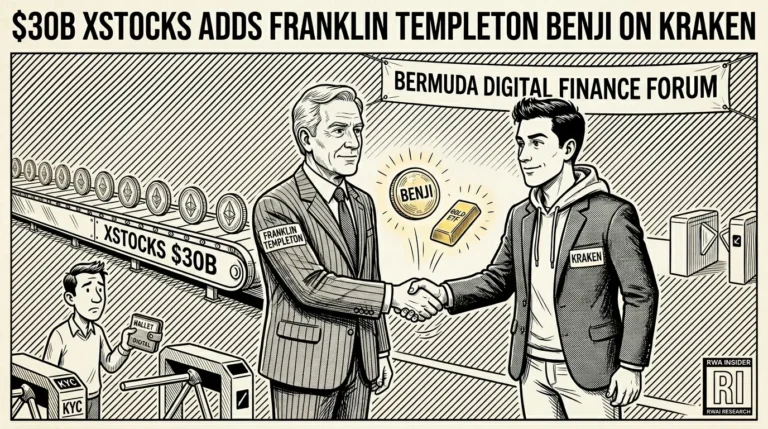
In the U.S., Franklin Templeton’s BENJI money market fund holds $521.1 million, and Ondo’s USDY fund holds $537.1 million.
Luxembourg adds the Yuleba Bond 2030, a $500 million corporate credit instrument.
Then comes the cash leg. Circle’s USDC holds $367.7 million on Stellar and serves as the settlement gateway for the RWA sector.
That sector logs 707,248 active addresses and $10.72 billion in monthly transfer volume.
For a DeFi user, this matters less as a chain ranking than as a test of whether fund tokens and USDC on Stellar ever meet in the same open pool.
The source gives no fund yields, so there is no rate to stack against Aave. Check each product’s eligibility rules before you chase BENJI or USDY exposure on Stellar.
You can compare tokenized fund flows across rival chains as the daily numbers move.
DTCC, Tradable And XRPL Shape Stellar’s Next Test
The next catalysts are already lined up. DTCC has confirmed plans to connect its tokenization service to Stellar, bringing Russell 1000 stocks and major ETFs on-chain.
The network expects that boost in the first half of 2027. Separately, the Tradable platform is preparing to integrate up to $1 billion in private credit assets.
Neither opens a door for a self-custody wallet yet. Our coverage of Stellar’s record Soroban TVL found its DeFi pools still small, with about $3.4 million in daily DEX volume.
That piece also cited Circle strategy chief Dante Disparte, who has argued that yield is a job for DeFi protocols once the base coin is secured.
The rivalry has a split, too. U.Today notes that XRP Ledger, also co-created by Jed McCaleb, leads in commodities, anchored by Justoken’s $2.22 billion JMWH energy contracts.
Stellar is collecting bank capital and government bonds instead, which splits the RWA market into debt on one chain and industrial assets on the other.
Watch whether Stellar’s lead holds for a week, not a day. One strong session is a data point; a run of them is a trend.
If fund tokens on Stellar start reaching Soroban pools, the inflow race turns into a yield race. Until then, the scoreboard belongs to regulated funds, not your wallet.
Already hold USDC on Stellar? Check pool depth on Soroban before you move size off Ethereum.
Frequently Asked Questions
Why did Stellar beat Ethereum in tokenized fund inflows?
Stellar added $17.1 million in tokenized fund growth over 24 hours, against $16.0 million for Ethereum, per RWA.xyz and Token Terminal data. Regulated funds such as the Spiko Amundi fund, BENJI and USDY drive Stellar’s RWA base.
Which tokenized funds are the biggest on Stellar?
The Spiko Amundi Overnight Swap Fund (EUR) leads with $1.29 billion. Ondo’s USDY holds $537.1 million, Franklin Templeton’s BENJI holds $521.1 million and the Yuleba Bond 2030 accounts for $500 million.
Can I use Stellar RWA tokens in DeFi pools?
Not on the strength of this data. Most of Stellar’s RWA value sits in regulated funds with their own eligibility rules. The open entry point is USDC, which holds $367.7 million on Stellar and acts as the settlement gateway for the RWA sector.
What could push Stellar’s RWA market higher in 2027?
DTCC plans to connect its tokenization service to Stellar, bringing Russell 1000 stocks and major ETFs on-chain, with the boost expected in the first half of 2027. The Tradable platform is also preparing to integrate up to $1 billion in private credit assets.