
31.4% Tranche: Exponent Splits Solana RWA Yield
Key Points
- Exponent Finance launched V2 risk tranching on Solana on June 24, splitting RWA yield into a 6.4% senior tranche and a 31.4% junior tranche.
- The first market wraps ONyc, a reinsurance asset from OnReFinance, behind a $2.5 million alpha cap and over $200,000 in launch rewards.
- Any Solana wallet can pick srONyc for a protected 6.4% or jrONyc chasing 31.4%, while supplying USDC to Aave pays near 2%.
Exponent Finance, a yield exchange on Solana, shipped its V2 platform on June 24 and brought risk tranching to on-chain real-world-asset yield, opening with a single market that splits a reinsurance asset into a roughly 6.4% senior slice and a 31.4% junior slice. Exponent calls the V2 system an “enhanced liquidity engine,” and the design lets depositors choose protection or leverage instead of one blended rate. For a wallet earning about 2% supplying USDC to Aave, that is a choice between a buffered 6.4% and a 31.4% bet, both built on insurance risk that does not move with crypto prices.
Exponent V2 Splits ONyc Reinsurance Into Two Tranches
Exponent Finance, a yield exchange on Solana, shipped its V2 platform on June 24 and brought risk tranching to on-chain real-world-asset yield.
Risk tranching splits one yield stream into layers. Exponent Finance opened with a single market built on ONyc, a reinsurance asset from OnReFinance.
That market breaks into two tokens. The senior tranche, srONyc, targets about 6.4% with downside protection built in.
The junior tranche, jrONyc, aims for roughly 31.4% and absorbs losses first in exchange for the bigger number.
The structure is a layered cake. Junior depositors cushion the senior layer above them, eating any shortfall before senior holders feel it.
V2 also adds Strategy Vaults, pre-built positions that auto-allocate across yield markets so a wallet does not have to manage tranches by hand.
Where The 31.4% Junior Yield Comes From
The yield traces back to insurance, not crypto. ONyc is a reinsurance asset, so its return comes from premiums that do not move with token prices.
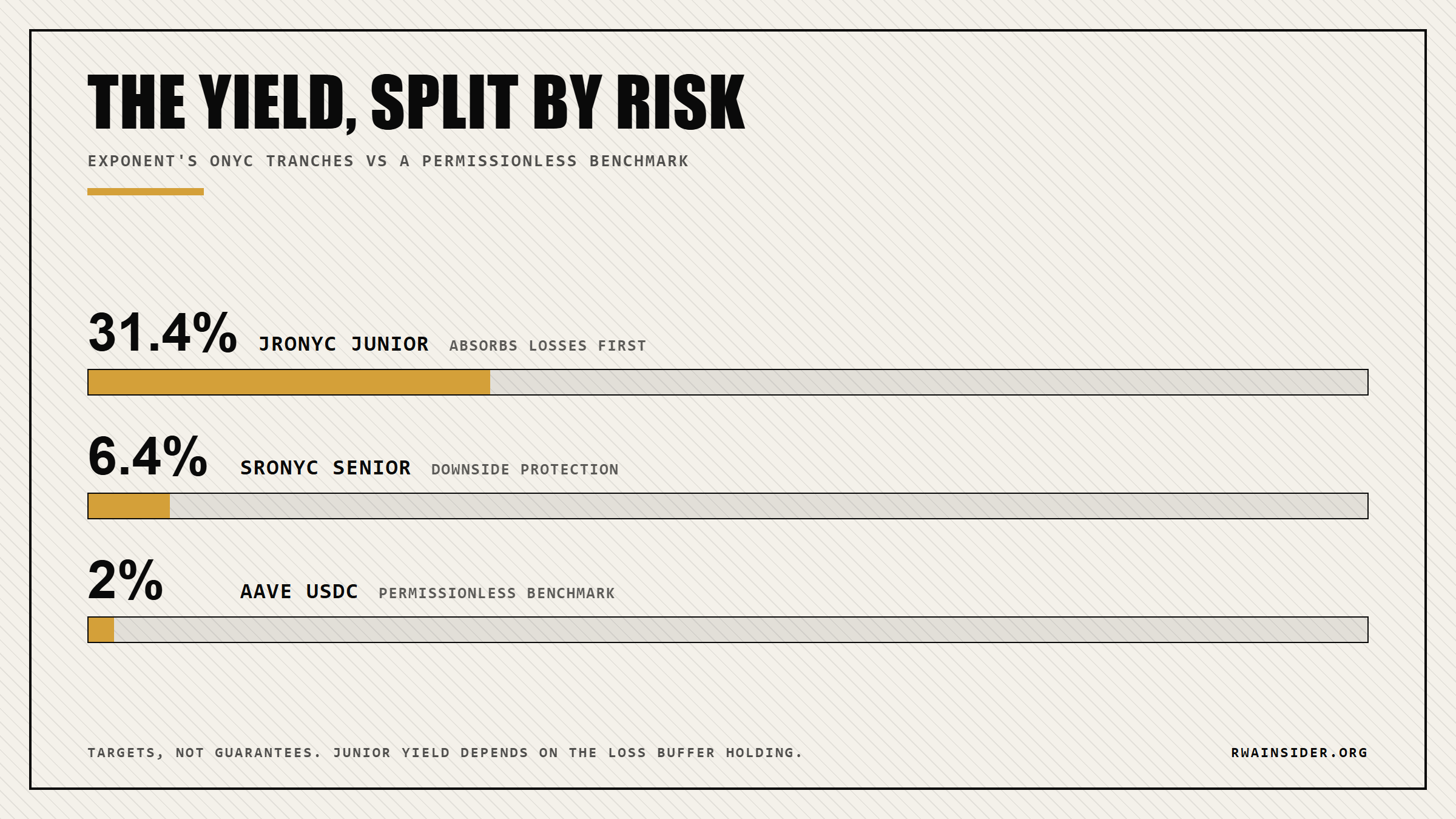
Exponent slices that one stream by risk. Junior holders earn the 31.4% target by standing first in line for losses, while senior holders trade upside for a protected 6.4%.
Set that against a wallet supplying USDC to Aave, which pays close to 2% today.
The senior tranche is roughly three times that benchmark with a buffer underneath it. The junior tranche is about fifteen times it, with real loss risk attached.
Strip away the tranche jargon and this is really a choice about which slice of someone else’s insurance risk a wallet wants to hold.
The alpha phase is deliberately small. Exponent capped it at $2.5 million to stress-test the design, with over $200,000 in rewards for early depositors.
The protocol is not new. Exponent launched on mainnet in 2024, has run billions in volume without a breach, completed 12 tier-1 audits, and raised about $7.1 million across two rounds.
For how these rates stack up, track tokenized yields against DeFi benchmarks.

BarnBridge Tried Tranches, Now Solana Gets Its Turn
Risk tranching has a history in DeFi. Protocols like Tranche Finance and BarnBridge built similar layers on Ethereum in earlier cycles.
Adoption stayed thin. High gas costs and weak underlying yields made the extra complexity hard to justify, and most of those products faded.
The pitch this time is the yield source.
Reinsurance pays a return that does not track crypto, the kind of structured real-world yield Theo co-founder Ari Pingle has argued tokenized assets can generate outside reserve interest.
For a wallet, the catch sits in the junior layer. Senior protection only holds while enough risk-hungry capital fills jrONyc to absorb losses first.
If junior demand dries up, the senior buffer thins. The $2.5 million cap keeps the experiment small while Exponent watches that balance.
Access runs through a Solana wallet rather than an account and approval, and Exponent says it plans to expand past ONyc into other yield markets.
Whether the protected 6.4% holds depends on enough risk-hungry capital filling the junior tranche, and the alpha’s $2.5 million cap will reveal how that balance behaves before Exponent scales beyond ONyc.
For another RWA play that builds yield from structure instead of bank reserves, see how Theo turns a gold-basis trade into stablecoin yield.
Frequently Asked Questions
What is Exponent Finance’s risk tranching?
It is a V2 feature on the Solana yield exchange Exponent that splits one yield stream into two tokens. The senior tranche (srONyc) takes a lower, protected return, while the junior tranche (jrONyc) takes a higher return and absorbs losses first. The first market is built on ONyc, a reinsurance asset from OnReFinance.
How much do the srONyc and jrONyc tranches pay?
The senior srONyc tranche targets roughly 6.4% APY with downside protection, and the junior jrONyc tranche targets around 31.4% APY in exchange for taking losses first. By comparison, supplying USDC to Aave pays close to 2% today. These are targets, not guaranteed rates.
Can I deposit into Exponent’s tranches without an account?
Exponent is a permissionless Solana protocol, so a Solana wallet can interact with V2 directly rather than opening an account. The alpha phase is capped at $2.5 million in total deposits, so capacity, not access, is the main limit early on.
Is the senior tranche actually safe?
The senior srONyc tranche has a structural buffer because junior jrONyc holders absorb losses first, but that protection depends on enough junior capital sitting underneath it. It is also an alpha-stage product with a $2.5 million cap, and the underlying reinsurance risk still applies.