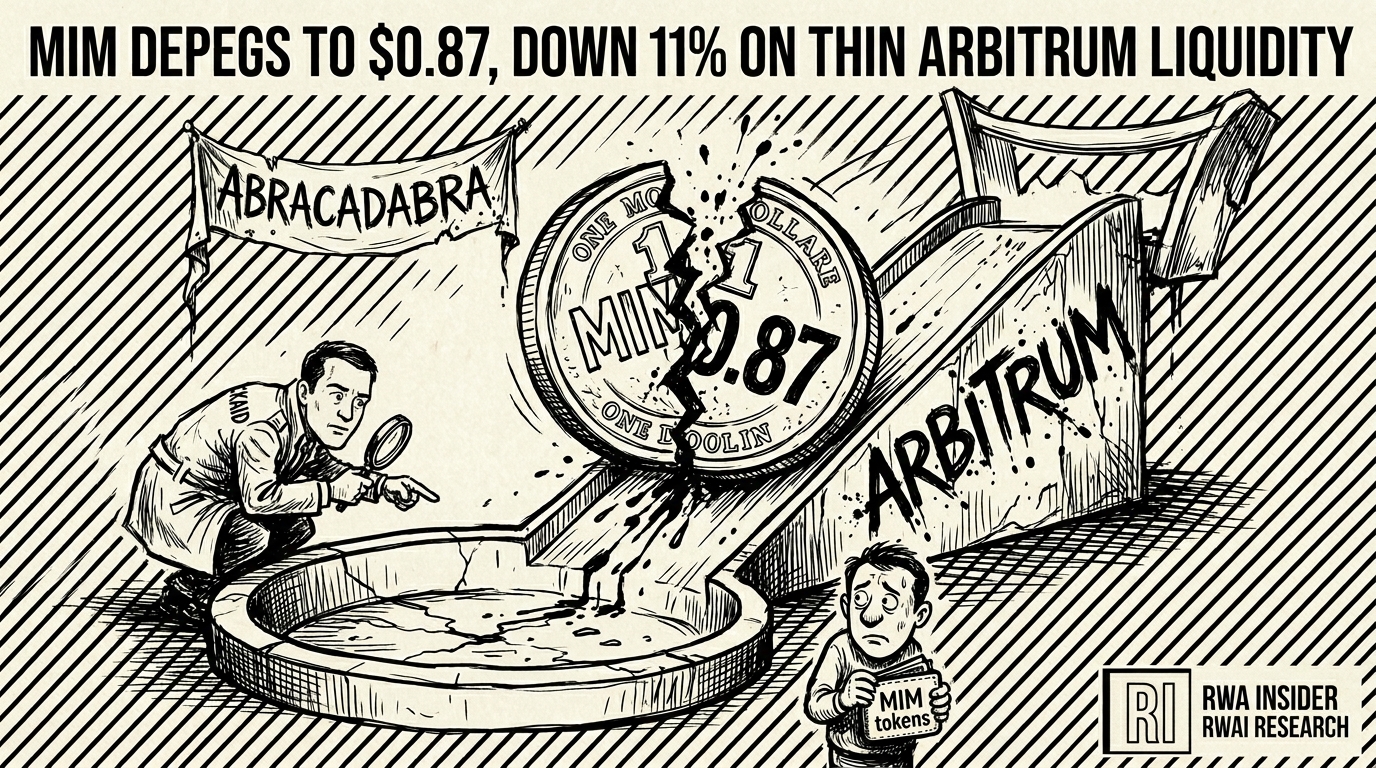
MIM Depegs To $0.87, Down 11% On Thin Arbitrum Liquidity
Key Points
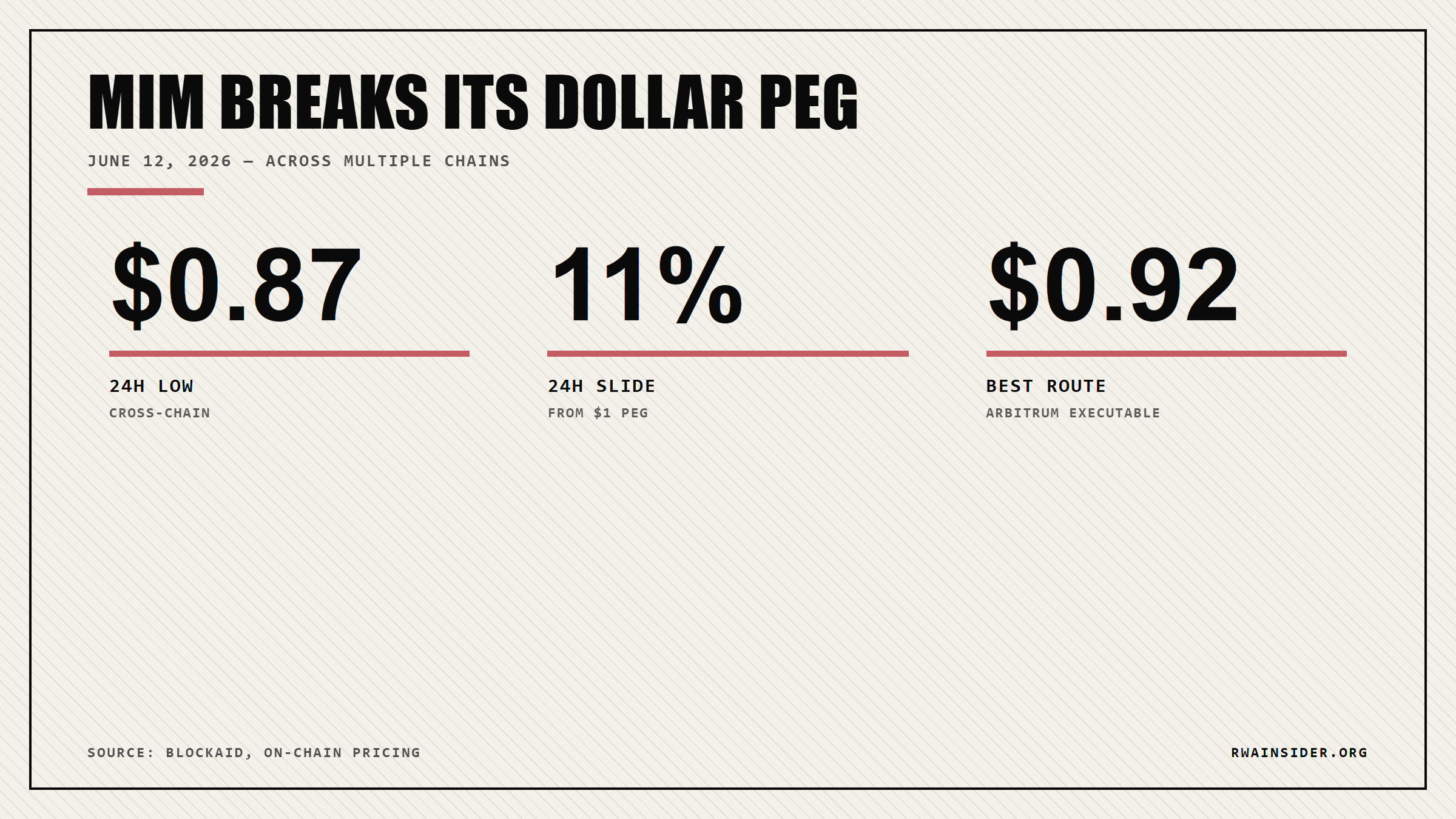
- Abracadabra’s dollar stablecoin MIM fell as low as $0.87 on June 12, an 11% slide across multiple chains in 24 hours.
- Security firm Blockaid traced the depeg to thin Arbitrum pool liquidity, with MIM quoted at $0.91 to $0.92 on executable routes.
- Holders on Arbitrum can only exit MIM near $0.90 today, and the Curve gauge meant to refill liquidity is still six days from a vote.
MIM, the dollar-pegged stablecoin issued by DeFi lending protocol Abracadabra, broke from its $1 target on June 12, sliding as low as $0.87 across Arbitrum and other chains in an 11% drop over 24 hours. Blockchain security firm Blockaid flagged the break on Arbitrum and attributed it to “thin and imbalanced liquidity in Arbitrum pools,” not a protocol exploit, in reporting published by Cryptopolitan. For anyone holding MIM or borrowing against it on Abracadabra, the distinction matters less than the exit price: selling into a thin pool now means a discount of up to 13 cents on the dollar.
MIM Slides To $0.87 As Arbitrum Pools Thin Out
Abracadabra‘s MIM, a dollar token minted against yield-bearing collateral, fell as low as $0.87 on June 12. The slide hit several chains at once.
The break was first flagged on Arbitrum, where MIM changed hands at $0.91 to $0.92 on executable routes. Across other chains the token sank to $0.871, an 11% drop in 24 hours.
Blockaid, the security firm that caught it, said the cause was thin and imbalanced liquidity in Arbitrum pools, not a contract exploit. That distinction matters, but it does not change the number a seller sees.
MIM is the native stablecoin of Abracadabra, a DeFi lending protocol where any wallet can mint the token against deposits. When pool liquidity thins, every holder trying to exit fights for the same shallow order book.
USDe And USX Show The $0.87 Pattern Is Not New
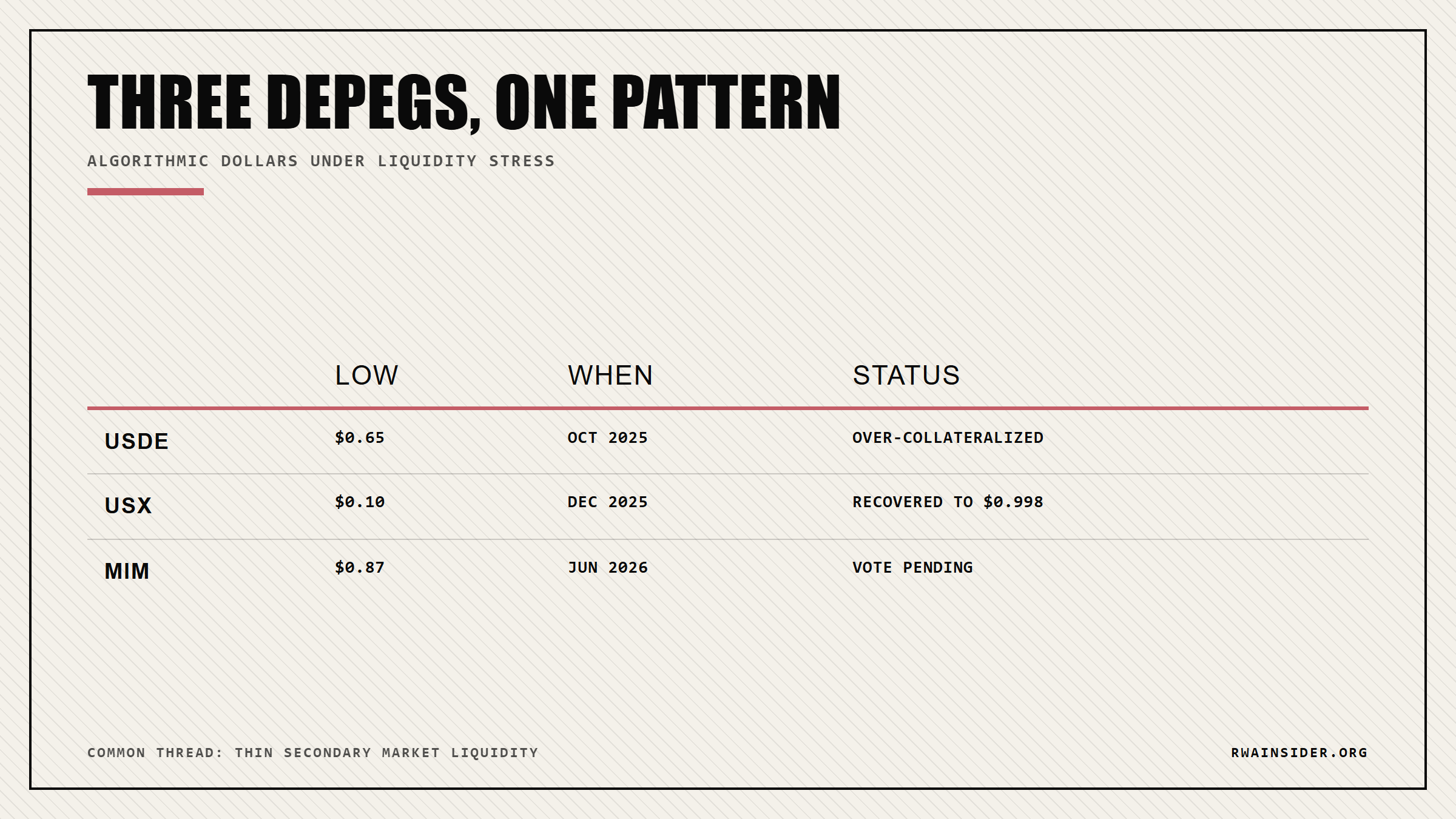
MIM is not the first algorithmic dollar to crack under liquidity stress. Ethena’s USDe, the third-largest stablecoin by market cap, fell to $0.65 on Binance in October 2025 during a market-wide selloff.
More than $19 billion in leveraged positions were wiped out in under 24 hours that day. Ethena Labs later said USDe stayed over-collateralized throughout, and Binance confirmed the dislocation started on its own platform.
Ethena then proposed a buyback of up to $95 million, about 1.2% of its backing assets, to mop up USDe whenever it traded below $0.99.
In December 2025, Solstice Finance’s USX crashed to $0.10 on Solana before liquidity injections pulled it back to $0.998. Solstice blamed a secondary market liquidity drain while primary redemptions kept working.
Strip away the protocol branding and this is really a liquidity story: a stablecoin is only worth a dollar if someone will actually pay a dollar for it.
Reserve-backed tokens like USDC and USDT rarely break this way, which is the case RWA Insider keeps making in its coverage of what actually backs a stablecoin.
Abracadabra’s Curve Gauge Vote Is Six Days Away
Abracadabra has a fix in motion. The team submitted a governance proposal on June 11 to add a MIM-2Pool gauge on Curve, aiming to deepen on-chain liquidity.
If the seven-day vote passes, the pool earns CRV emissions that could pull in new liquidity providers. The proposal landed one day before the depeg, and the vote closes in roughly six days.
A wallet holding MIM does not vote unless it also holds Abracadabra governance tokens, so most retail holders can only watch and decide whether to exit now or wait for the pool to refill.
Blockaid framed the break as a liquidity problem rather than a solvency one, which means deeper pools should in theory restore the peg. None of that helps the holder staring at a discount today.
The protocol announced Abracadabra V2 in March 2026, pitching a shift toward a private banking experience. For now, traders holding MIM on Arbitrum are watching pool depth for any sign of stabilization.
Whether MIM climbs back to a dollar depends on liquidity returning before confidence leaves, and the next six days of the Curve vote will tell. Until the pool deepens, the peg is only as strong as the thin order book holding it.
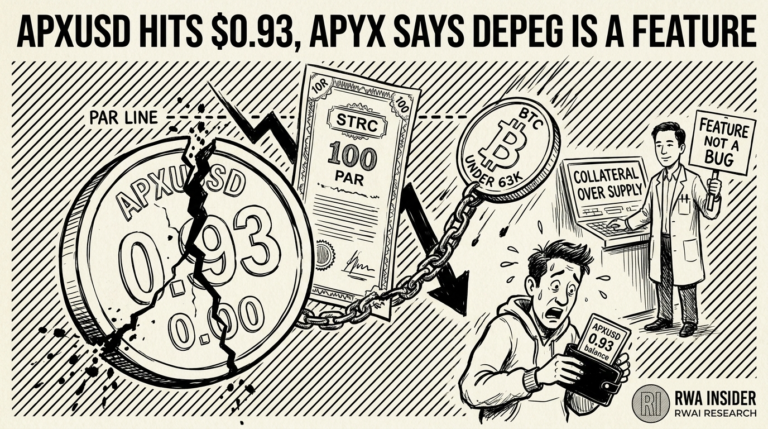
Watching which dollars hold and which snap is the whole game now. See how another issuer spun its own slide below par as intentional design, not a failure.
Frequently Asked Questions
What made MIM lose its dollar peg?
Blockaid traced the slide to thin and imbalanced liquidity in Arbitrum pools rather than a hack or insolvency. MIM traded between $0.871 and $0.92 across chains on June 12, an 11% move in a day.
Can I still sell MIM right now?
Yes, but on a thin pool you accept a discount. Executable routes on Arbitrum quoted $0.91 to $0.92, while the cross-chain low touched $0.87, and selling size into shallow liquidity pushes the price down further.
Have other algorithmic stablecoins depegged like this?
Yes. Ethena’s USDe fell to $0.65 on Binance in October 2025, and Solstice’s USX dropped to $0.10 on Solana in December 2025 before recovering near $1. Thin secondary market liquidity was the common thread.
Will the Curve gauge vote fix MIM’s peg?
A passed vote makes the MIM-2Pool eligible for CRV emissions, which can attract liquidity providers over time. The seven-day vote closes in about six days and does nothing for the current shortfall.