180-Day RWA Redemptions Go Instant On Symbiotic Liquid Lane
Key Points
- Symbiotic launched Liquid Lane, a network that swaps tokenized funds and private credit for USDC instantly instead of redemption windows up to 180 days.
- The tokenized real-world asset market has crossed $33 billion, yet most of those assets still cannot be redeemed on demand, co-founder Misha Putiatin said.
- For DeFi users the draw is the yield: market makers fund exits with shared collateral earning redemption spreads plus Aave and Morpho lending income.
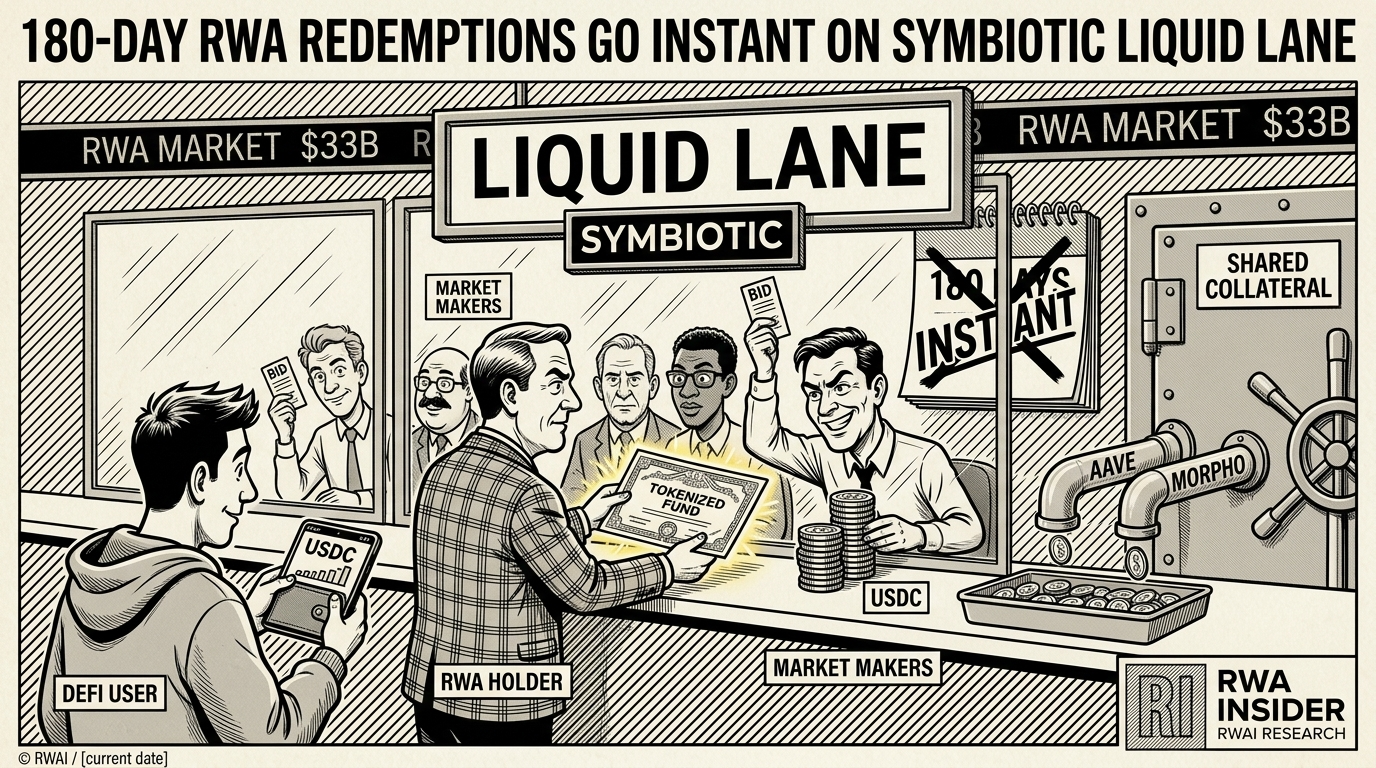
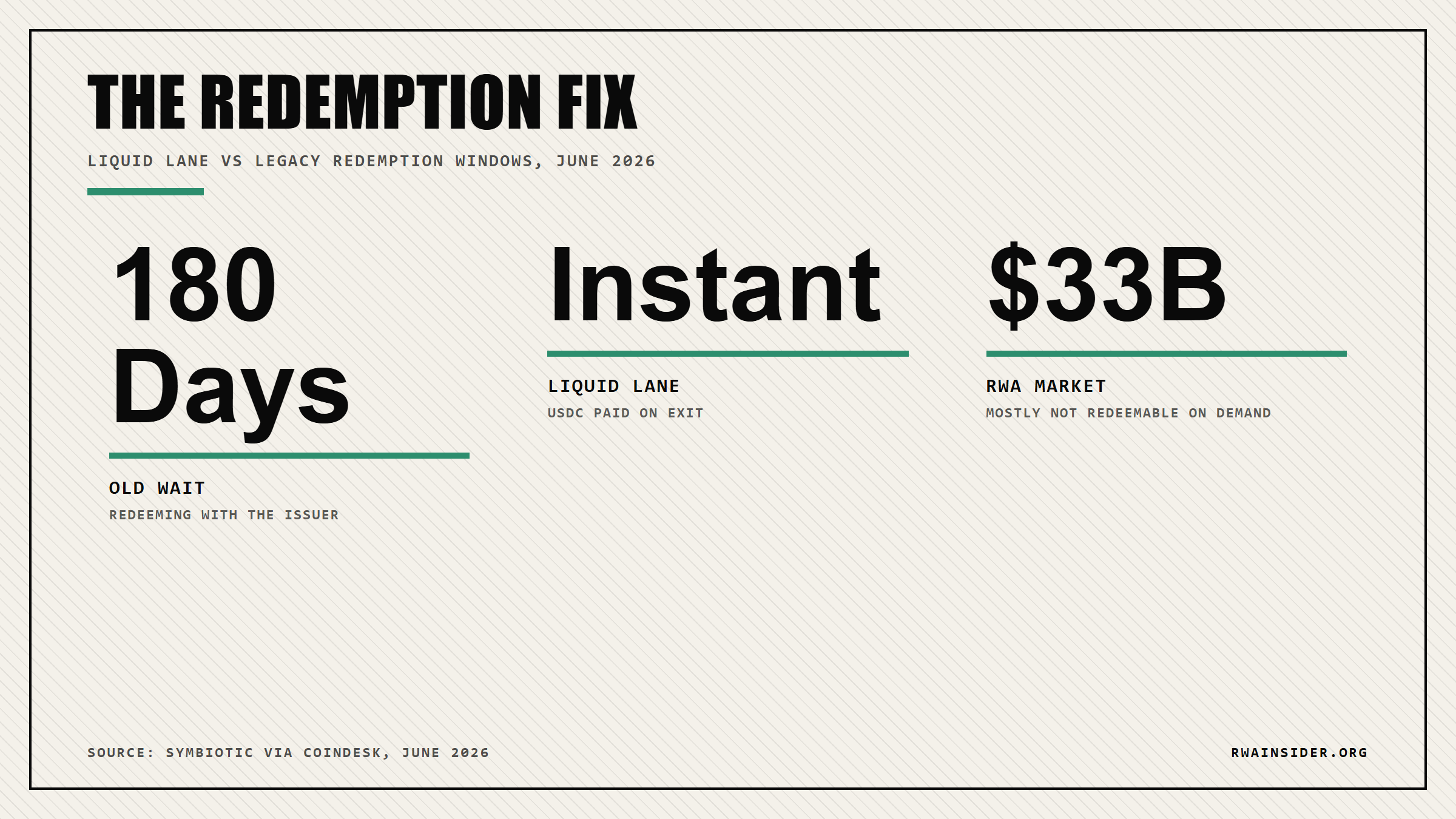
Symbiotic rolled out Liquid Lane this week, a network that swaps tokenized funds, private credit, and other real-world assets for USDC almost instantly, instead of redemption windows that can stretch as long as 180 days. “The RWA market has crossed $33 billion, but most of those assets still can’t be redeemed on demand,” Symbiotic co-founder Misha Putiatin told CoinDesk, adding that liquidity now gets priced at a premium. For anyone holding a tokenized asset, the translation is direct: what you own onchain can finally exit onchain, without a months-long wait for the issuer to wire cash.
How Liquid Lane Turns A 180-Day Wait Into Instant USDC
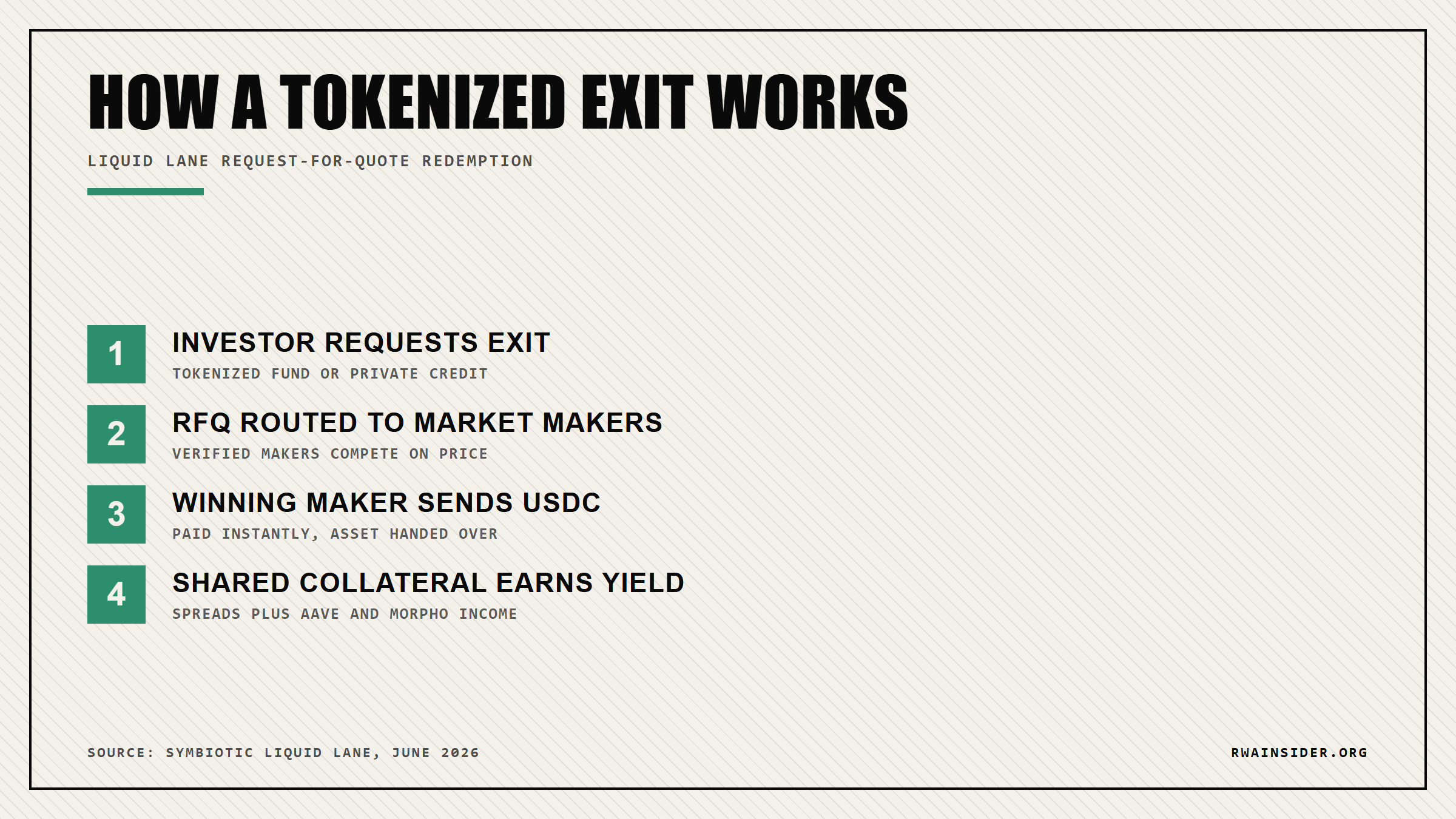
The product is called Liquid Lane, and it does one thing: it lets a holder of a tokenized fund or private credit position exit for USDC almost immediately.
Symbiotic built it as a market, not a pool.
When you want out, your redemption request is routed through a request-for-quote system to a network of verified market makers.
They compete on price, the winning bidder hands you USDC on the spot and takes the tokenized asset, and the issuer settles the underlying in the background.
That last part is the trick. The asset already lived onchain, but the cash behind it was still stuck in redemption windows that could run as long as 180 days.
Liquid Lane swaps that wait for a live bid, the way any liquid market prices an exit.
Where The Yield Sits: Aave, Morpho, Shared Collateral
The scale is what makes the bottleneck expensive.
The tokenized real-world asset market has crossed $33 billion, yet most of it cannot be redeemed on demand.
Citi expects tokenized assets to reach $5 trillion by 2030, and BCG and Ripple project nearly $19 trillion by 2033.
Strip away the institutional framing and this is really about exit risk: the gap between an asset you can sell today and one the issuer returns in six months.
The DeFi-native part is how the liquidity gets funded.
Instead of a dedicated pool for each issuer, Liquid Lane runs on shared collateral that backs several issuers at once.
That collateral earns three ways: the spread on each redemption, lending income from Aave and Morpho, and returns from other Symbiotic-powered apps.
Symbiotic does not publish a fixed rate for the strategy, so the number to watch is whether the stacked yield keeps enough market makers competing, the same race now unfolding across other RWA secondary-market venues.
Grove’s $1B Basin And The Race To Own RWA Exits
Symbiotic is not the only one chasing this.
Last month Grove launched Basin, a $1 billion liquidity network backed by BlackRock and Janus Henderson, also built to fund stablecoin redemptions against tokenized fund positions.
The shared theme is shared infrastructure: liquidity and collateral that span many products instead of one pool per fund.
Symbiotic came out of crypto’s restaking sector before turning its vault architecture toward credit, insurance, stablecoins, and tokenized assets, and it now says it secures more than $550 million across dozens of applications.
“What do we do best as a blockchain industry? We democratize access,” co-founder Misha Putiatin said. “We give access to something that was not available before, and we streamline it so it’s more efficient.”
The honest caveat: the assets you can redeem here, like Fasanara’s mGLOBAL credit fund and Midas issuances, are still mostly institutional, KYC-gated products.
A $1,000 wallet cannot route a retail position through Liquid Lane today.
Whether instant redemptions stay cheap depends on how many market makers keep competing once the launch shine wears off, and the next few months of Liquid Lane volume will show whether $33 billion in tokenized assets finally trades like it lives onchain. Until retail-accessible funds plug in, the fix mostly serves the institutions that already priced their way around the problem.
See why most tokenized funds still shut public DeFi wallets out of the very liquidity they need, then weigh how easily your own onchain positions could actually exit.
Frequently Asked Questions
What is Symbiotic’s Liquid Lane?
Liquid Lane is a redemption network from Symbiotic that lets holders of tokenized funds, private credit, and other real-world assets exit for USDC almost instantly. A redemption request is routed to competing market makers, and the winning bidder delivers stablecoins on the spot while the issuer settles the underlying asset in the background.
How long do tokenized asset redemptions normally take?
Redeeming a tokenized fund directly with its issuer can take weeks or as long as 180 days, because the cash leg often stays tied to traditional finance rails. Liquid Lane compresses that to a near-instant USDC payout by sourcing a live market-maker bid instead of waiting on the issuer.
Can a $1,000 wallet use Liquid Lane today?
Not directly. The assets it redeems, such as Fasanara’s mGLOBAL credit fund and Midas issuances, are mostly institutional, KYC-gated products. The DeFi-native part is the yield: market makers fund exits with shared collateral that earns redemption spreads plus Aave and Morpho lending income.
How does Liquid Lane compare to Grove’s Basin?
Both build shared liquidity for tokenized fund redemptions rather than isolated pools. Grove’s Basin is a $1 billion network backed by BlackRock and Janus Henderson. Liquid Lane uses a request-for-quote auction to competing market makers and shared collateral that also earns Aave and Morpho yield.