$1T Raydium Lists RAY On Robinhood, Revolut Apps
Key Points
- Raydium’s RAY token landed on both Robinhood and Revolut this week, the first DeFi-native token to appear on both consumer finance apps at once.
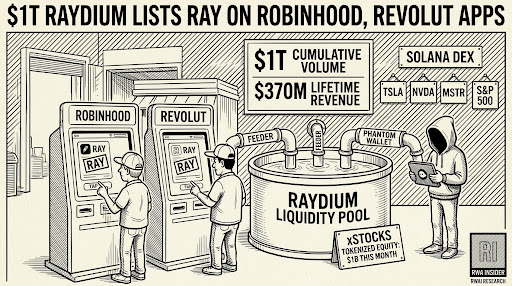
- Raydium has processed over $1 trillion in cumulative trading volume and generated $370 million in lifetime protocol revenue from its Solana liquidity pools.
- Self-custody Phantom wallets on Solana, Robinhood retail accounts, and Revolut users now all trade RAY against the same on-chain liquidity pool.
Raydium, the highest-volume decentralized exchange on Solana, became the first DeFi-native token live on both Robinhood and Revolut this week, with the RAY token listed back to back across the two consumer finance apps. The listings landed on May 28 alongside fresh protocol data showing more than $1 trillion in cumulative trading volume routed through Raydium’s Solana liquidity pools. “There is currently no other DeFi token on both Robinhood and Revolut,” said Ben Ungvari, Chief Marketing Officer at Raydium. For a Phantom wallet holder, those same pools just gained 75 million new sources of order flow.
Raydium RAY Lands On Robinhood And Revolut Apps
The Robinhood listing went live alongside Revolut’s, with both apps adding RAY within weeks of each other after a year of sustained on-chain growth from Raydium.
Both platforms have been selective with DeFi assets, and the back-to-back additions make RAY the first token from a Solana-based decentralized exchange available on either consumer finance app.
The data trail behind the listings is what consumer-finance compliance teams look for.
Protocol activity, trading volume, and revenue are all verifiable on-chain through the Blockworks Raydium Analytics Dashboard, with figures echoed in the protocol’s Q1 2026 Tokenholder Report.
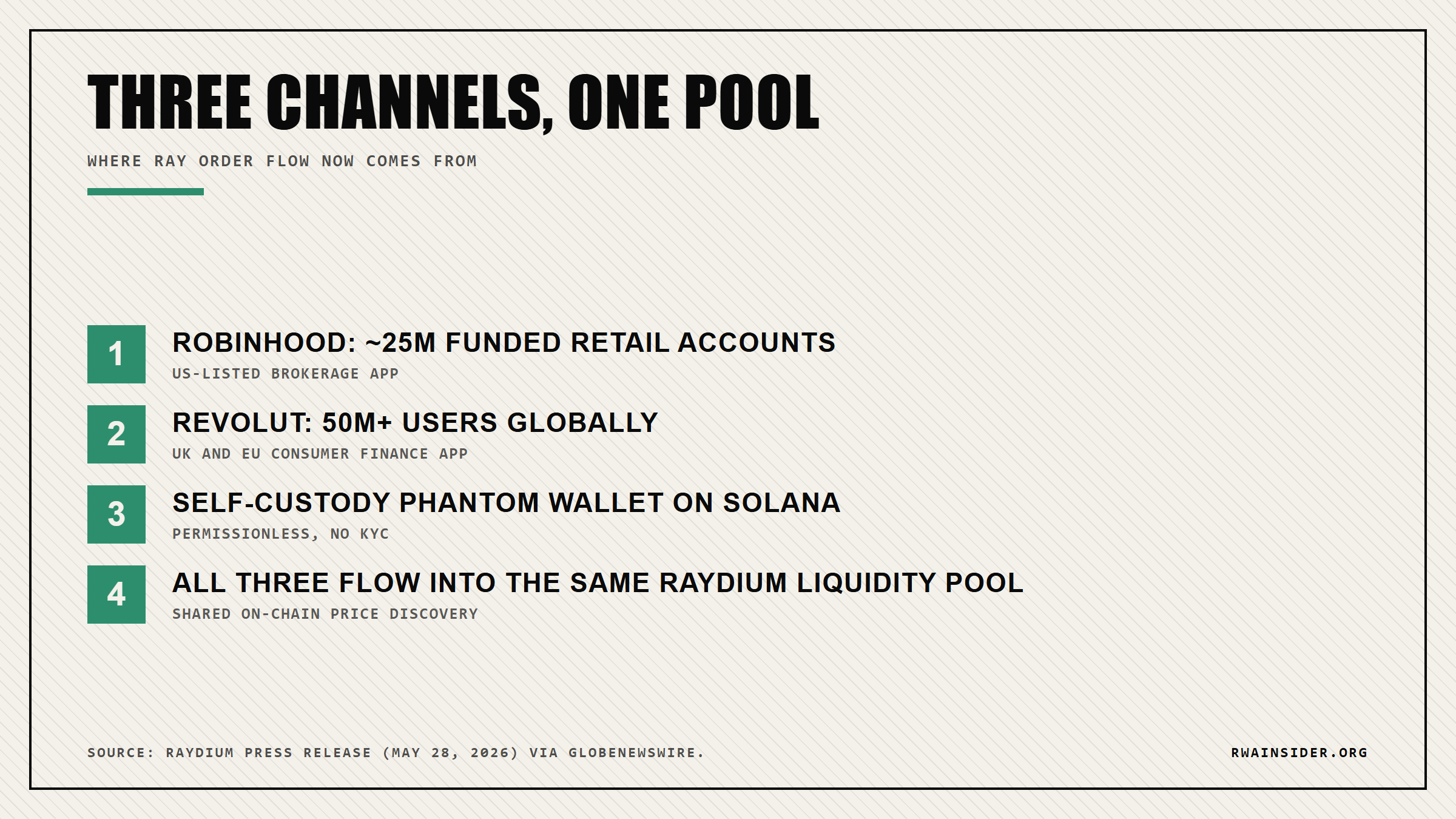
Robinhood reports roughly 25 million funded retail accounts. Revolut has more than 50 million users globally.
Their combined reach now overlaps the US, UK, and EU under a single trading flow that routes back into the same Solana liquidity pool.
Where The $1 Trillion And $370M Numbers Live
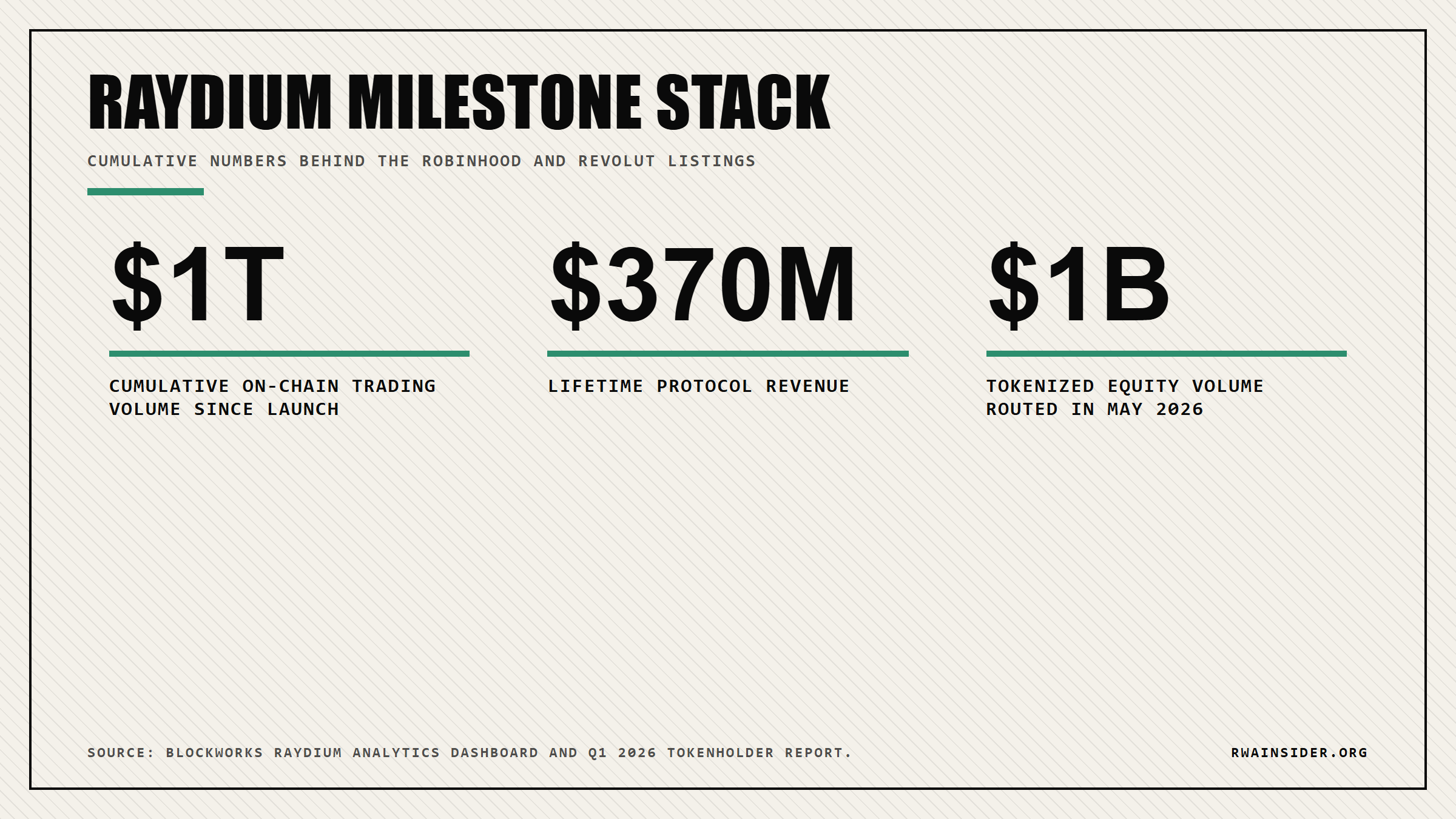
Raydium has facilitated over $1 trillion in cumulative on-chain trading volume and generated $370 million in lifetime protocol revenue.
The protocol remains the highest-volume decentralized exchange on Solana across the most recent measurement periods.
Tokenized equity volume on Raydium crossed $1 billion this month.
Tesla, Nvidia, Strategy (MSTR), and the S&P 500 route through Raydium liquidity pools via xStocks and related issuer partnerships.
The same pools host Circle’s USDC and PayPal USD (PYUSD), issued by Paxos, on the stablecoin side.
Raydium is also the main trading venue for PRIME, the RWA consortium led by Figure (Nasdaq: FIGR), which has originated more than $19 billion in home equity loans on-chain.
Strip away the consumer-app framing and the real shift is this. Institutional and tokenized real-world flow on Solana now reaches the same Raydium pools that a Robinhood retail account just gained access to.
That reframe is what makes this a chain-share story, not a token listing story.
What 75 Million Retail Accounts Mean For Solana Liquidity
The reframe Ungvari laid out is the one worth tracking.
“A Robinhood user, a Revolut user, and a self-custody wallet holder are now trading RAY against the same underlying pool of on-chain liquidity,” said Ben Ungvari, Chief Marketing Officer at Raydium.
“For the first time, a DeFi-native asset has made this possible at this scale, and it changes what distribution for an on-chain protocol actually looks like,” Ungvari added.
Bloomberg, Reuters, and Business Insider have all reported the U.S. Securities and Exchange Commission is evaluating frameworks for tokenized equities and blockchain-based settlement systems.
Raydium’s listings land inside that regulatory window, which adds weight to xStocks routing institutional flow through Solana DEX pools rather than centralized order books.
For a self-custody wallet holder, the practical effect is liquidity depth.
RAY trades on Robinhood and Revolut now share order flow with the same Phantom wallet that has been trading the token on Solana since launch.
For more on how chains are picking specialties around RWA flow, the chain-share desk tracks Ethereum’s RWA lead against Solana’s speed angle.
Whether Robinhood and Revolut treat RAY as a one-off DeFi line item or open the door to more Solana DEX tokens depends on how the first quarter of retail volume sits with their compliance desks. Either way, the chart Raydium is now trying to defend lives on consumer-finance home screens, not just Phantom wallet activity feeds.
Track more Secondary Markets coverage on tokenized equity distribution from RWA Insider as the SEC frameworks land.
Frequently Asked Questions
What is Raydium and how does it work?
Raydium is a Solana-based automated market maker and on-chain liquidity protocol. It runs concentrated liquidity pools and lets anyone create a permissionless pool for native tokens, tokenized US-listed equities, and other real-world assets traded on Solana.
How much volume has Raydium processed?
Raydium has processed more than $1 trillion in cumulative trading volume and generated $370 million in lifetime protocol revenue since launch. The protocol remains the highest-volume decentralized exchange on Solana by daily and monthly turnover.
Can I trade RAY without a Robinhood or Revolut account?
Yes. The RAY token trades on Raydium itself with no Robinhood or Revolut account required. Any Solana wallet such as Phantom can swap into RAY through Raydium’s permissionless liquidity pools without KYC.
What tokenized stocks trade through Raydium pools?
Tokenized shares of Tesla, Nvidia, Strategy (MSTR), and the S&P 500 trade through Raydium pools via the xStocks integration. Raydium is also the main trading venue for PRIME, the RWA consortium led by Figure that has originated over $19 billion in home equity loans on-chain.