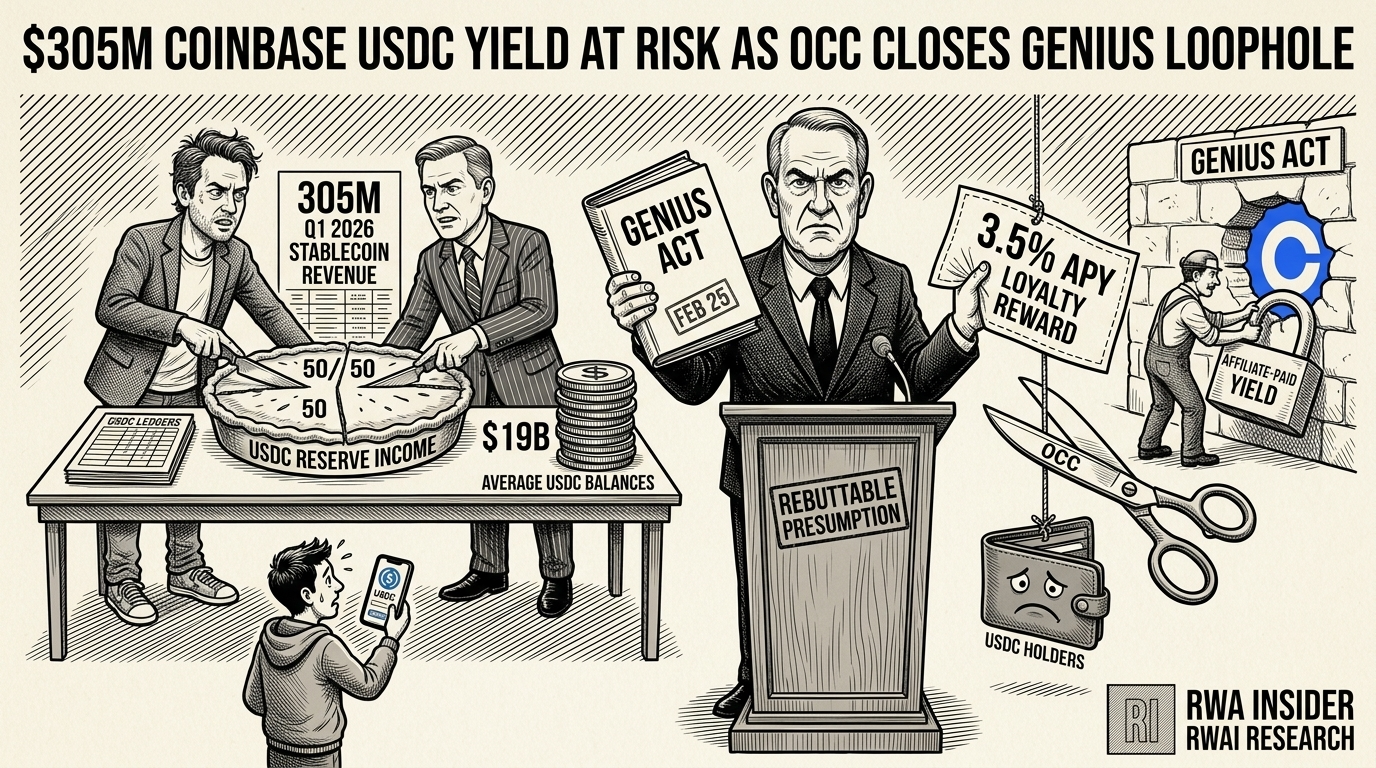
$305M Coinbase USDC Yield At Risk As OCC Closes GENIUS Loophole
Key Points
- OCC’s February 25 proposed rule treats coordinated issuer-affiliate yield arrangements as prohibited under the GENIUS Act, targeting Coinbase’s USDC reward structure.
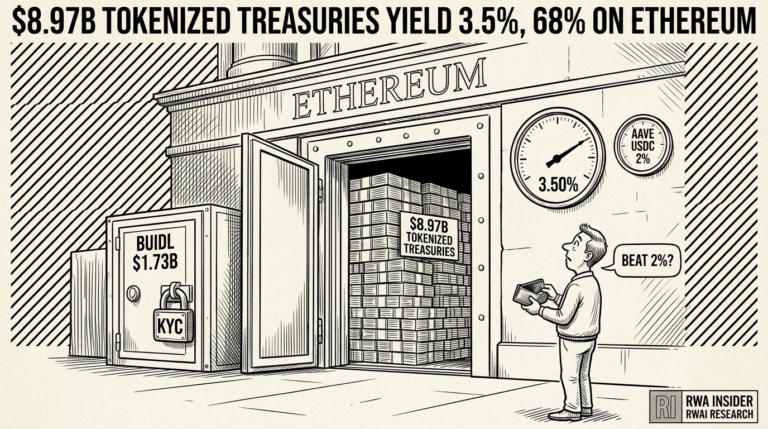
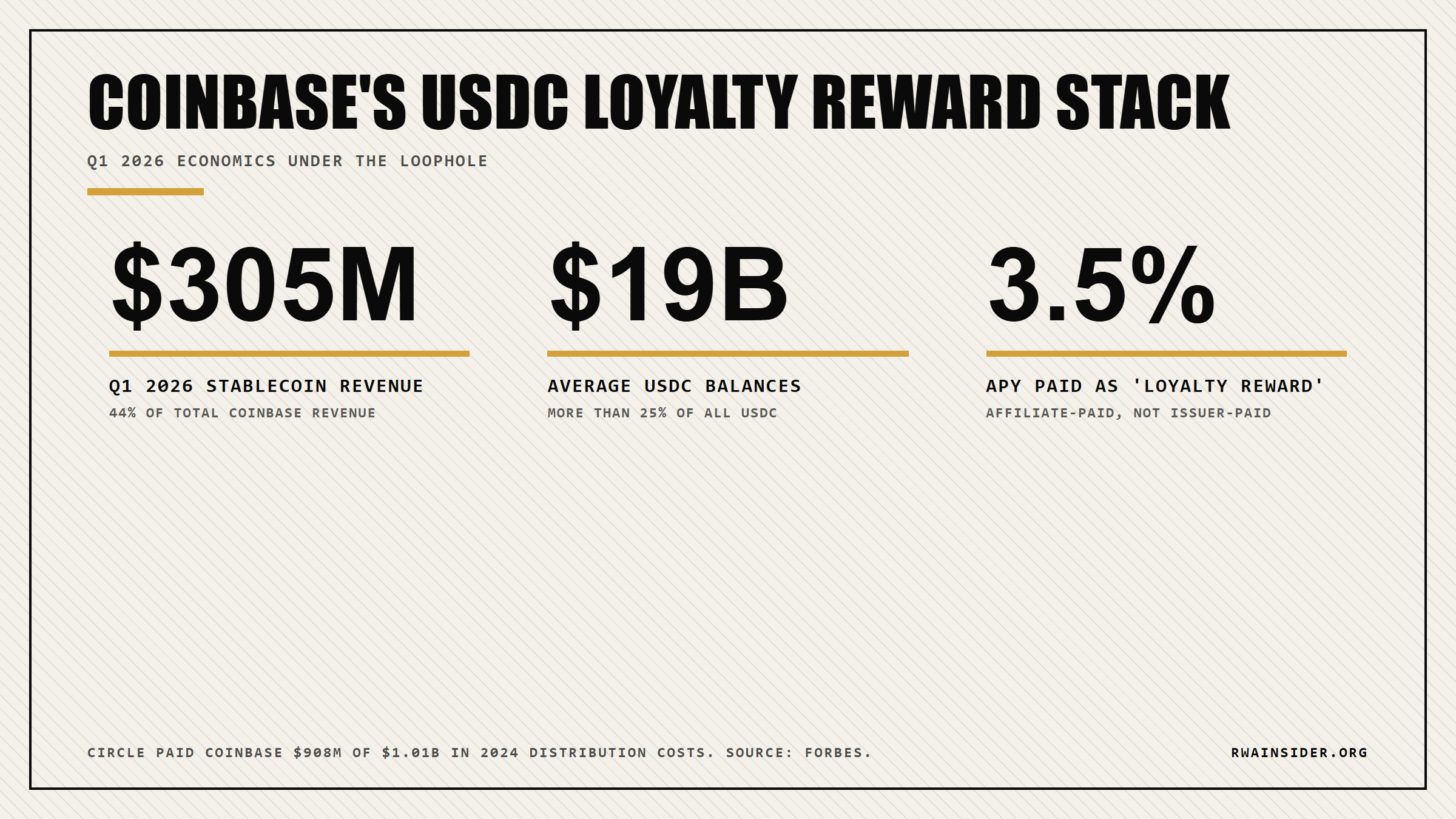
- Coinbase reported $305 million in Q1 2026 stablecoin revenue, with $19 billion in average USDC balances and a 3.5% APY paid as ‘loyalty rewards.’
- DeFi users earning the 3.5% USDC reward on Coinbase face a direct hit if the OCC rule finalizes; tokenized bank deposits will absorb the flow.
Coinbase reported $305 million in Q1 2026 stablecoin revenue, the single largest line inside a subscription business that now contributes 44% of total revenue. Forbes contributor Zennon Kapron framed the structure on May 20, 2026, noting Coinbase pays USDC holders 3.5% APY as ‘loyalty rewards’ under a 50/50 revenue share with Circle, an arrangement the GENIUS Act’s issuer-paid yield ban did not capture. For DeFi users earning the 3.5% reward on USDC balances inside the Coinbase app, the question is whether the OCC’s February 25 rebuttable presumption survives industry challenge.
Inside The 3.5% USDC Loyalty Reward And The 50/50 Revenue Share
Forbes contributor Zennon Kapron called the arrangement “what the GENIUS Act, signed in July 2025, was supposed to make impossible.”
Circle issues USDC. Coinbase pays USDC holders 3.5% APY as a “loyalty reward.” Under the 50/50 reserve-income partnership disclosed in Circle’s S-1, Coinbase keeps 100% of reserve income on USDC held on its platform and 50% on USDC held elsewhere.
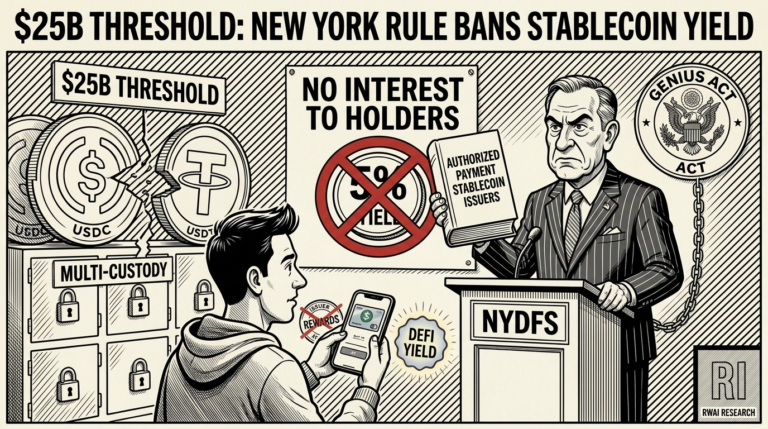
The reward sits structurally outside the statute as enacted. The GENIUS Act prohibits payment stablecoin issuers from paying yield on the token. The drafters wrote the prohibition narrowly: issuer-paid yield was banned, affiliate-paid yield was not addressed.
In 2024, Circle paid Coinbase $908 million of its $1.01 billion in total distribution costs, an amount larger than Circle’s net income.
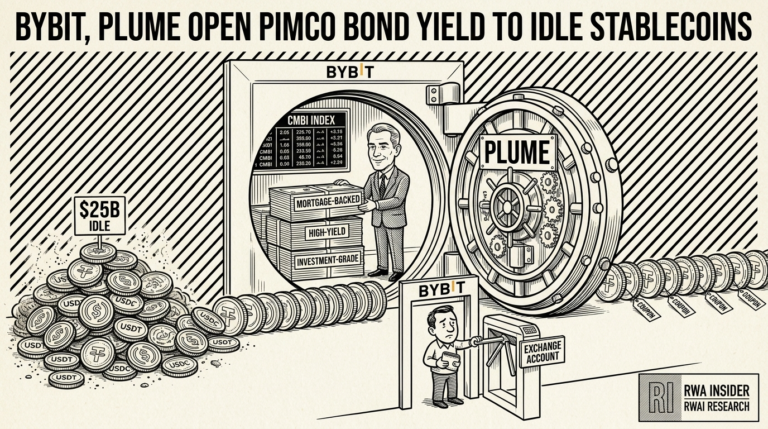
Coinbase’s Q1 2026 disclosures put average USDC balances inside its products at $19 billion. The platform now holds more than a quarter of all USDC in circulation.
How OCC’s Rebuttable Presumption Closes The Coinbase-Shaped Hole
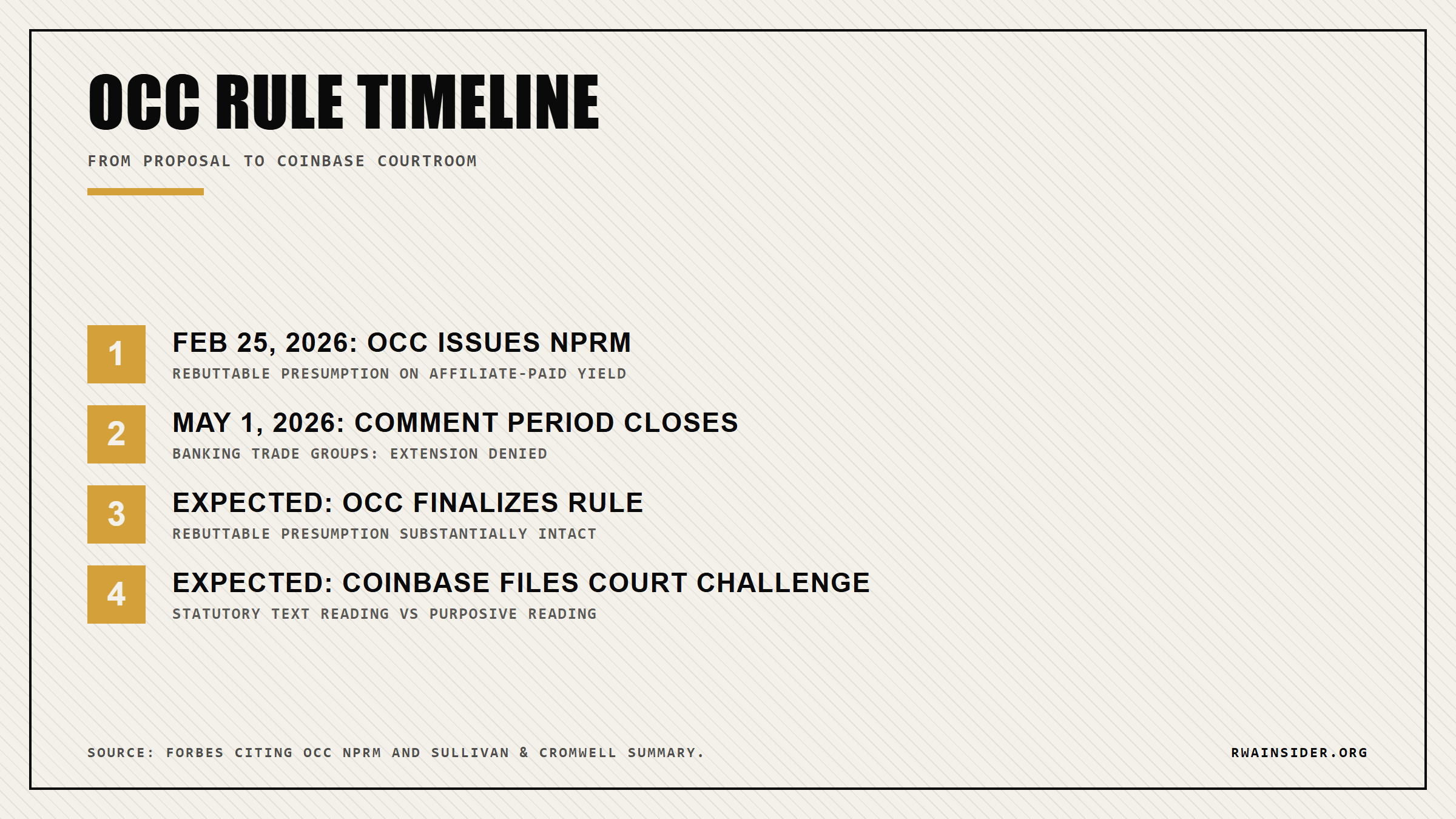
The OCC‘s February 25, 2026 notice of proposed rulemaking introduces a rebuttable presumption that any coordinated issuer-affiliate yield arrangement is itself a prohibited yield arrangement under the GENIUS Act.
The agency defines “related third party” to include any person paying interest as a service to stablecoin holders, plus any white-label distributor on whose behalf an issuer issues coins.
That definition captures the Coinbase-Circle structure as it operates today. The rebuttable presumption inverts the burden of proof: the parties must prove the affiliate-paid yield is not connected to holding, use, or retention of the stablecoin.
Strip away the legal mechanics and the practical question for a wallet earning 3.5% on USDC at Coinbase is whether that yield survives the final rule or quietly disappears in the next earnings disclosure.
Readers can track the OCC, FDIC, and Treasury rules as they converge on the GENIUS Act framework.
The comment period closed May 1, 2026. Banking trade groups asked for an extension; the OCC declined.
The political math favours the OCC. Banking-side lobbying outweighs exchange-side lobbying inside a Republican-appointed Comptroller’s office on a regulatory question the GENIUS Act already conceded.
What Happens When The 3.5% Reward Disappears From USDC
The Sullivan & Cromwell summary of the proposed rule is direct: “any economic arrangement that ties holder rewards to stablecoin balances is captured.”
Coinbase repackaged the rewards program in February 2026, moving the 3.5% APY behind the Coinbase One paid subscription tier. The redesign does not change the underlying mechanic.
This builds on our earlier read on FDIC’s GENIUS Act implementation. The FDIC rule and the OCC rule address different layers of the same statute, and both target the affiliate-paid yield pathway that Coinbase relies on.
As Forbes’ Kapron framed it, “the OCC’s interpretive choice converts it into exchange regulation,” collapsing the distinction the GENIUS Act drafters wrote between issuance and distribution.
For DeFi users, the practical move is to map current USDC reward sources against the rule timeline. JPMorgan’s deposit token, which went live on Base in late 2025, is positioned to absorb institutional flow that exchange-tier rewards no longer attract.
The forward read is whether Coinbase challenges the final rule in court on statutory text grounds, and whether tokenized bank deposits replace exchange-side rewards as the dominant US dollar yield rail.
Whether the OCC’s reading survives industry challenge depends on whether the post-Loper Bright court considers the agency’s interpretation reasonable in light of statutory purpose. The final rule and the first lawsuit will tell.
Track more The Yield Gap coverage from RWA Insider as the US stablecoin yield rails finalize.
Frequently Asked Questions
Why does the OCC consider Coinbase’s USDC reward a GENIUS Act violation?
The OCC’s February 25, 2026 proposed rule introduces a rebuttable presumption that any coordinated arrangement between a stablecoin issuer and an affiliate or related third party to pay holders yield is itself a prohibited yield arrangement. Coinbase’s 3.5% APY ‘loyalty reward’ on USDC, paid under a 50/50 reserve income share with Circle, fits squarely inside that presumption.
How much is at stake for Coinbase if the rule finalizes?
Coinbase reported $305 million in Q1 2026 stablecoin revenue, with $19 billion in average USDC balances inside its products, more than a quarter of all USDC in circulation. If the rewards mechanic disappears, the bull case for Coinbase that assumes USDC reserve income compounds for years takes a direct hit.
Will I lose my 3.5% USDC reward on Coinbase?
If the OCC’s reading survives industry challenge in court, the rebuttable presumption forces the reward off the platform. Coinbase has signalled it will challenge on statutory text grounds. The earliest signal will be how the final rule treats the Coinbase One subscription-tier rewards structure adopted in February 2026.
What replaces the exchange-side stablecoin yield if it goes away?
Tokenized bank deposits, which sit cleanly outside the GENIUS Act because they are not stablecoins, are positioned to absorb the flow. JPMorgan’s deposit token went live on Base in late 2025 and is already positioned for institutional demand. Exchanges will likely reprice USDC rewards downward as the presumption hardens.