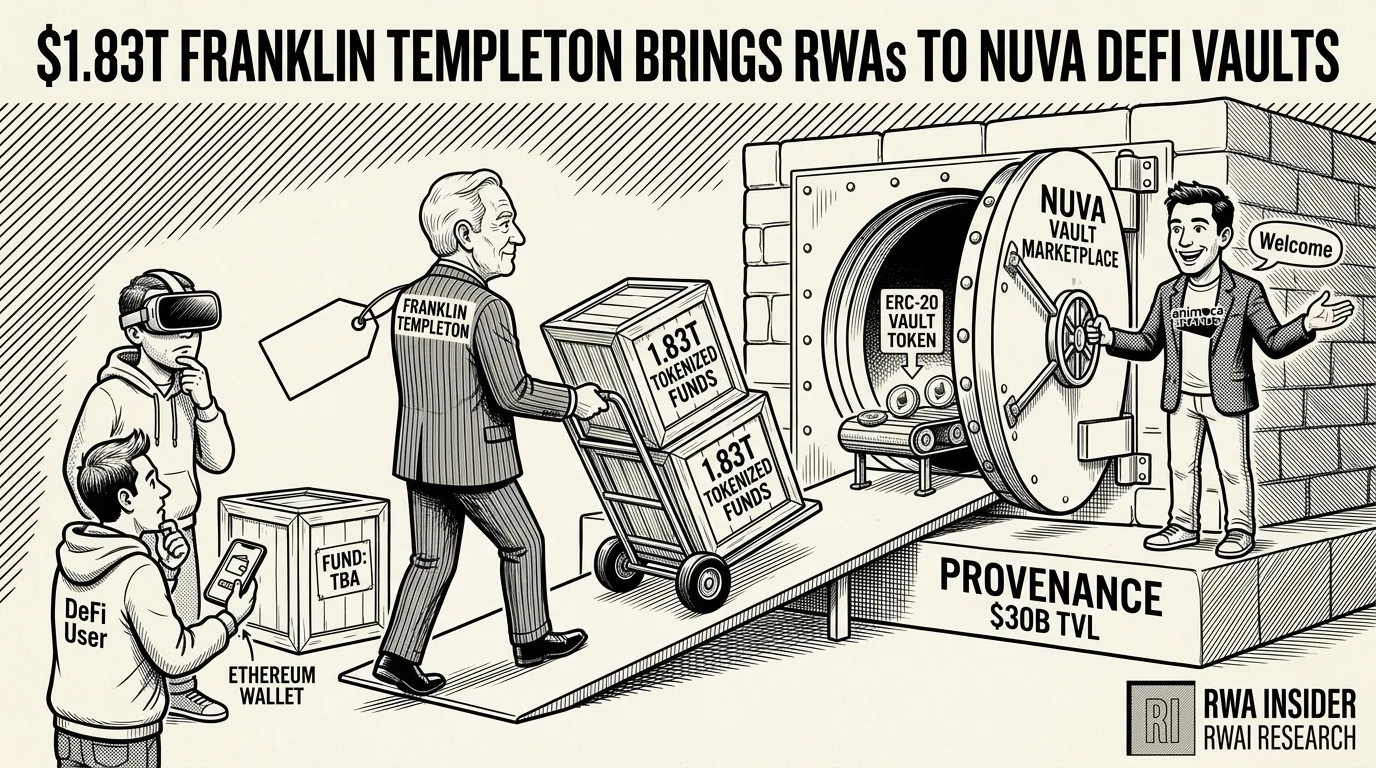
$1.83T Franklin Templeton Brings RWAs To NUVA DeFi Vaults
Key Points
- Franklin Templeton, which manages $1.83 trillion, and Animoca Brands will bring tokenized real-world assets to NUVA, the Animoca-backed vault marketplace.
- NUVA launched in May 2026 with vaults for Provenance Blockchain assets, a network holding over $30 billion in total value locked on September 24.
- NUVA launched with two Ethereum vaults whose ERC-20 tokens work as DeFi collateral, but no Franklin Templeton fund or launch date is set.
Franklin Templeton, a $1.83 trillion asset manager, will bring tokenized real-world assets to NUVA, the vault marketplace backed by Animoca Brands. The two firms announced the deal on October 9, and Animoca co-founder Yat Siu said the meeting of traditional finance and digital assets has gone “from the theoretical to being a real infrastructure play.” For your wallet, the hook is the wrapper: NUVA turns vault deposits into ERC-20 tokens that DeFi apps can lend, trade and accept as collateral, so Franklin Templeton assets would arrive in a format DeFi already reads.
Animoca’s NUVA Vaults Open To Franklin Templeton Assets
Franklin Templeton and Animoca Brands announced a strategic collaboration on October 9 to bring tokenized RWAs to NUVA.
Until now, NUVA has drawn its assets from the Provenance Blockchain. The deal opens the vaults to what the firms call “a broader base of asset issuers.”
Animoca Brands and Nuva Labs, formerly Provenance Blockchain Labs, co-incubated NUVA, which launched in May 2026.
Here is how it works. You deposit into a vault that holds yield-bearing real-world assets, and you get back an ERC-20 token that represents your claim on them.
That shared token standard is the point. DeFi apps can plug those tokens into lending, trading and collateral.
The catch: neither firm has named which Franklin Templeton funds will appear, on which chains, or when.
$30B Provenance Base, $1.83T Manager: The Numbers Behind NUVA
NUVA went live on Ethereum with two flagship vaults. nvYLDS tracks YLDS, a Treasury-linked yield asset from Figure.
The second, nvPRIME, gives exposure to Figure’s portfolio of home equity lines of credit. Chainlink supplies the pricing data that lenders need to value both tokens.
The Provenance Blockchain held more than $30 billion in total value locked as of September 24, up from above $23 billion at NUVA’s May launch, according to Genfinity.
Read that number carefully. It covers the whole Provenance network, not deposits inside NUVA vaults, and no vault deposit figure was disclosed.
Franklin Templeton brings scale of a different kind: $1.83 trillion in assets under management as of August 31.
The firm launched its BENJI money market fund token on Stellar in 2021. It describes BENJI as the first U.S.-registered fund to record share ownership on a public blockchain.
No yield figures came with this announcement, so there is no rate to compare against your stablecoin lending yield yet.
For a DeFi user, this matters less as an asset manager partnership than as a pipeline that could turn regulated fund shares into collateral you can actually post.
You can track how tokenized funds reach DeFi collateral markets as more issuers sign on.
Sandy Kaul’s Next Phase And What NUVA Wallets Should Watch
Sandy Kaul, Head of Digital Assets and Innovation at Franklin Templeton, framed the deal as a step past simple tokenization.
“The next phase is about expanding how those assets can be accessed, utilized and integrated into increasingly digital investment ecosystems,” Kaul said.
Siu added that “by combining battle-tested asset management with decentralized distribution, Nuva is expanding how institutional investors access RWAs.”
Note the audience in that line: institutional investors. Nothing in the announcement says the Franklin Templeton assets will be permissionless.
NUVA’s own track record sets expectations. Its HOME vault for U.S. home equity loans, which targets 7%, admits only eligible non-U.S. wallets, enforced through wallet screening and IP blocking.
The two firms also launched a four-part research series and plan to explore tokenized cultural assets, with details promised later this year.
For a $1,000 wallet, there is nothing to deposit yet. Watch for three disclosures: the fund names, the chains, and which wallets get access.
If NUVA lists a Franklin Templeton fund as an ERC-20 token that DeFi lenders accept as collateral, the tokenized fund race moves on-chain. Until the firms name a product, it is a waiting game.
Holding stablecoins on Ethereum? Keep an eye on NUVA’s vault list for the first Franklin Templeton listing.
Frequently Asked Questions
What is the NUVA vault marketplace?
NUVA is a vault marketplace co-incubated by Animoca Brands and Nuva Labs, launched in May 2026. Users deposit into vaults that hold yield-bearing real-world assets and receive ERC-20 tokens that represent a claim on those assets.
Which Franklin Templeton funds will be available on NUVA?
Neither company has named specific funds, chains or launch dates. Franklin Templeton runs the BENJI money market fund token, but the October 9 announcement does not say BENJI will join NUVA.
Can I use NUVA vault tokens as DeFi collateral?
NUVA’s vault tokens follow the ERC-20 standard, so DeFi applications can use them for lending, trading and collateral. Chainlink supplies the pricing data that lenders need to value them.
Is the $30 billion Provenance figure money inside NUVA?
No. The more than $30 billion in total value locked covers the whole Provenance Blockchain as of September 24, 2026. The companies did not disclose how much sits inside NUVA vaults.