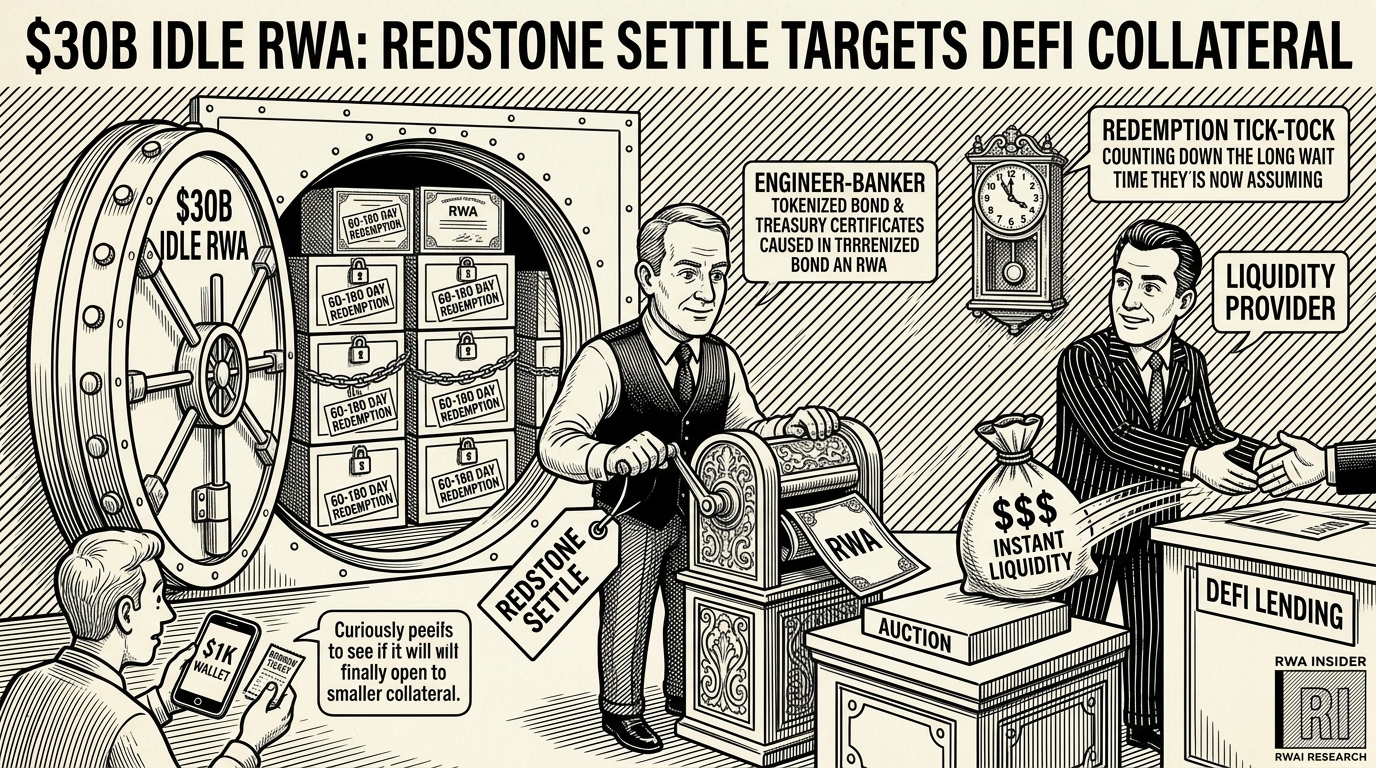
$30B Idle RWA: RedStone Settle Targets DeFi Collateral
Key Points
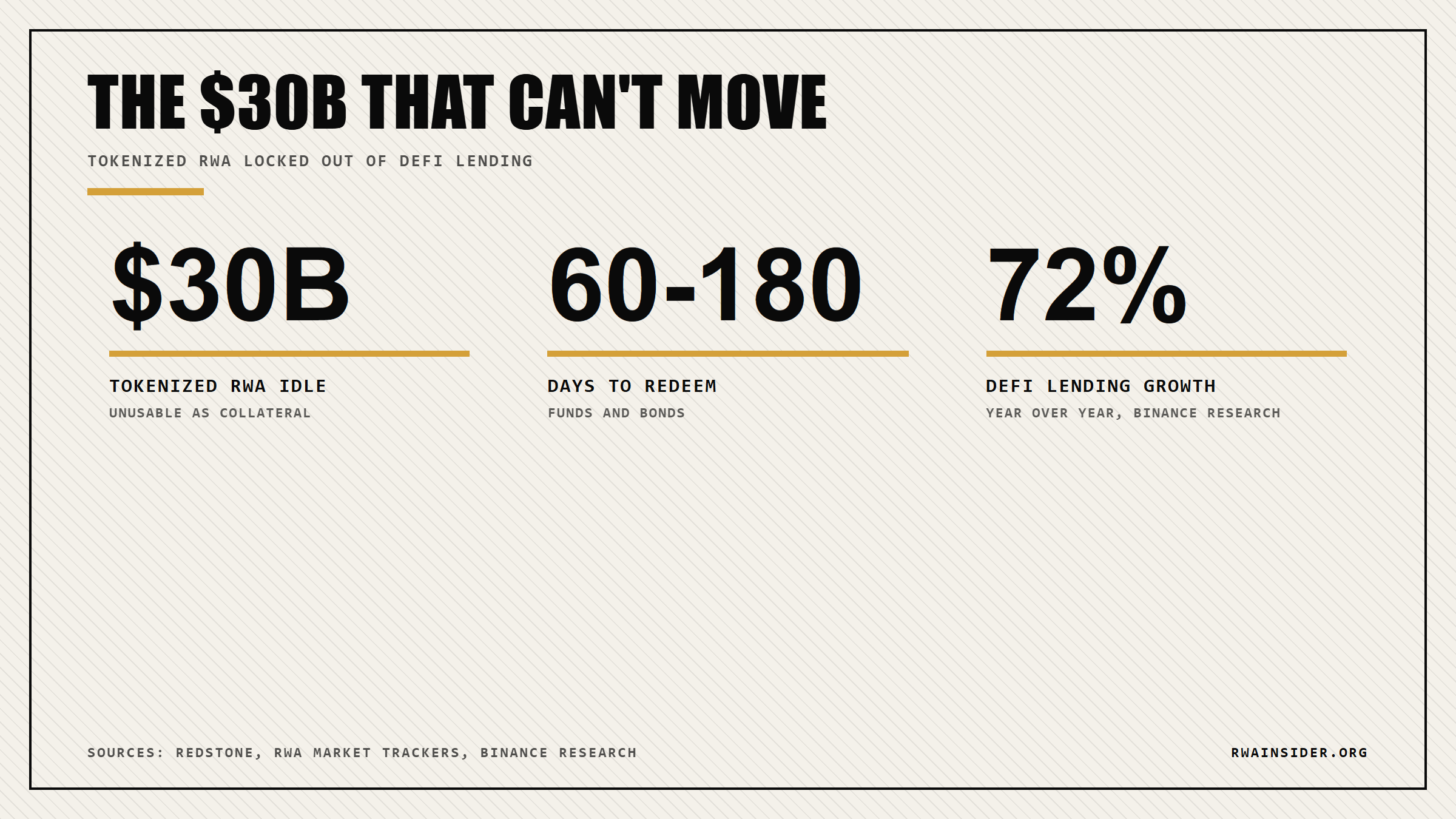
- RedStone launched RedStone Settle, a settlement layer built to make more than $30 billion of idle tokenized real-world assets usable as DeFi collateral.
- Tokenized funds and bonds carry 60 to 180 day redemption windows, a timing gap that has locked them out of Aave-style liquidations until now.
- A $1,000 wallet still cannot borrow against tokenized Treasuries today, but RedStone Settle is the missing piece that could open those markets.
RedStone, the decentralized oracle provider, has launched RedStone Settle, a settlement layer built to make tokenized real-world assets usable as collateral in DeFi lending markets. The Baar, Switzerland company says the design could put more than $30 billion of tokenized assets sitting idle on-chain to work, matching public RWA market trackers. For a wallet holder, that is the gap between owning a yield-bearing bond token that just sits there and one you can borrow against.
Not everyone shares that optimism.
“There’s still this idea that tokenizing something illiquid will somehow magically make it a liquid asset, which is just not true,” Oya Celiktemur of Ondo Finance said on a panel at Paris Blockchain Week this month.
RedStone Settle Attacks The $30B Idle RWA Wall
RedStone built its name as an oracle, feeding price data to on-chain apps. RedStone Settle is a different product.
It is plumbing that lets DeFi lending protocols accept tokenized assets they currently turn away.
Most tokenized funds, bonds, and private credit notes cannot be posted as collateral on a major lending market today.
That locks an estimated $30 billion of yield-bearing assets out of the pools where DeFi users put capital to work, RedStone says, citing public RWA market data.
RedStone calls this an infrastructure fix, not an asset fix. It changes the settlement mechanics around a loan, not the redemption terms of the fund or bond underneath it.
Why Aave Liquidations Reject 180-Day Bonds
The blocker is timing. A lending market like Aave survives by liquidating bad collateral in seconds.
Tokenized real-world assets do not move that fast. Funds and bonds carry redemption windows of 60 to 180 days, so a liquidator cannot cash one out on demand.
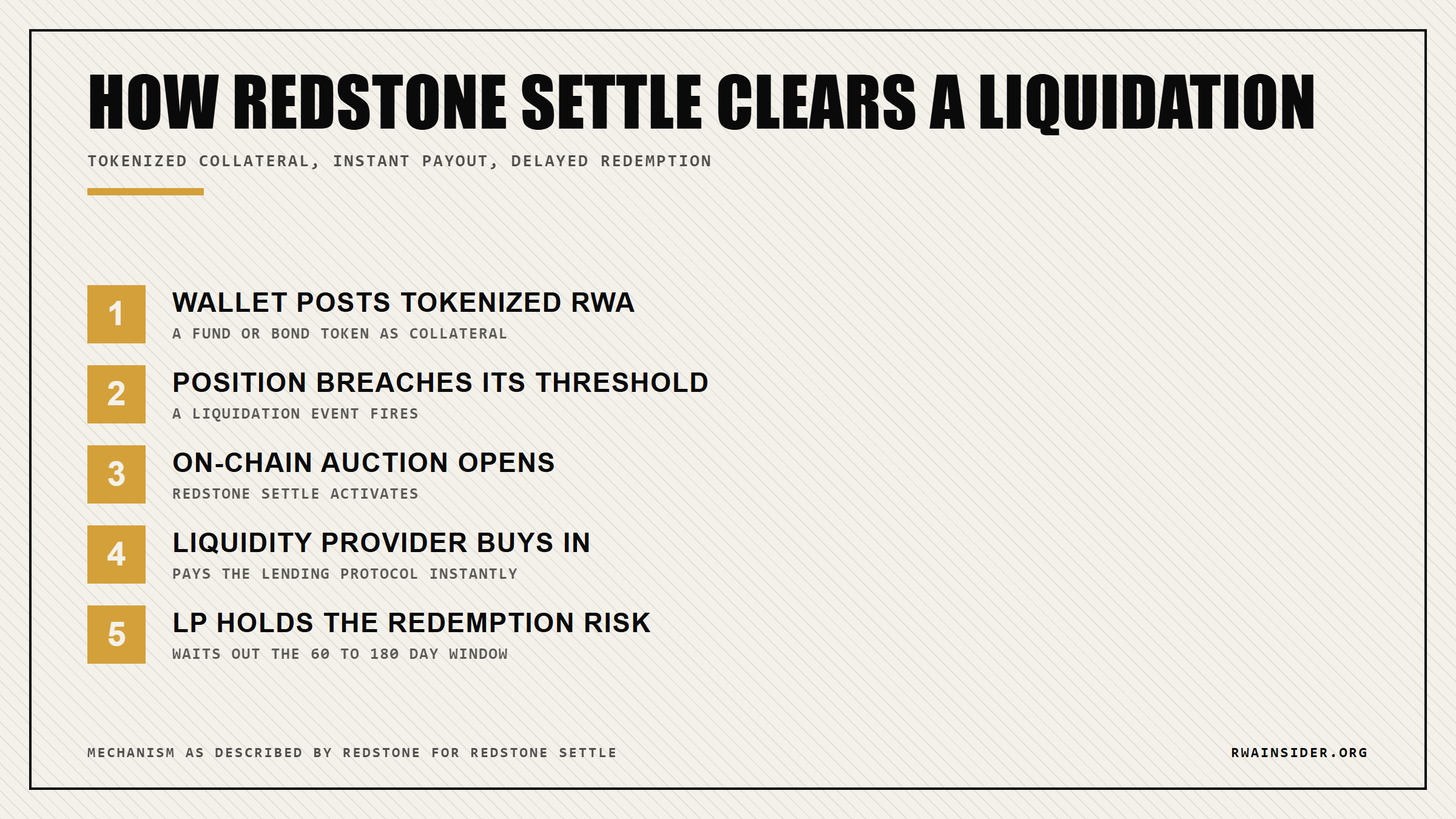
RedStone Settle bridges that gap with an on-chain auction. When a liquidation fires, liquidity providers bid to buy the position immediately, pay the lender, and absorb the redemption wait themselves.
Strip away the press release and this is really about who eats the delay: the protocol stops carrying redemption risk, and a liquidity provider takes it on for a fee.
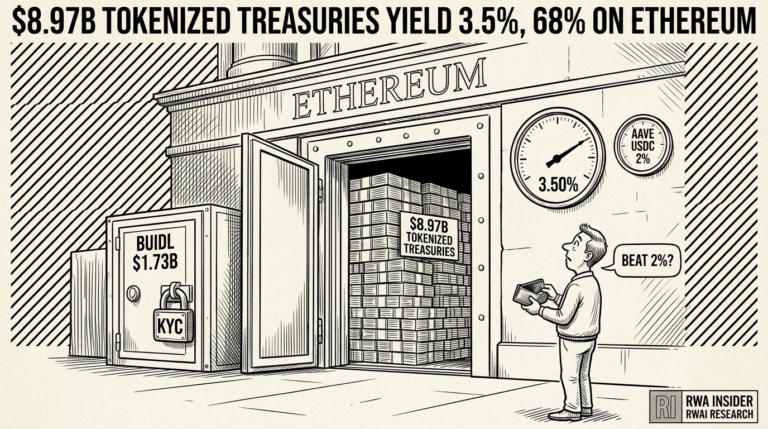
The stakes are a yield gap. The idle tokens, led by tokenized US Treasuries, pay roughly 4%, while a wallet supplying USDC to Aave has lately earned closer to 2%.
Until now a holder picked one or the other. RedStone Settle is built so the same Treasury token can earn its yield and back a stablecoin loan at once.
That is the composability thesis you can explore across more DeFi-native RWA coverage.
Ondo’s Liquidity Warning Meets A 72% Boom
Not everyone is sold on tokenization fixing liquidity. Oya Celiktemur of Ondo Finance has argued that moving an asset on-chain does not automatically make it tradable or easy to deploy.
RedStone Settle is a direct answer to that critique. It does not pretend the underlying bond is liquid; it adds a buyer of last resort so a lending protocol can treat it as if it were.
The timing helps. DeFi lending grew 72% year over year through September, per Binance Research, driven partly by institutions using stablecoins and tokenized collateral.
The catch is adoption. RedStone Settle is infrastructure that protocols must integrate, so a $1,000 wallet cannot borrow against a tokenized bond the day it ships.
Whether that $30 billion actually moves depends on which lending markets wire in RedStone Settle, and how much liquidity providers charge to sit through a 180-day redemption. Until a protocol you can reach without a gatekeeper switches it on, the unlock stays theoretical.
If your tokenized Treasuries are sitting idle, it is worth seeing how other funds already crossed into Aave’s lending markets.
Frequently Asked Questions
What is RedStone Settle and how does it work?
RedStone Settle is a settlement layer from oracle provider RedStone that lets DeFi lending protocols accept tokenized real-world assets as collateral. When a loan is liquidated, an on-chain auction lets liquidity providers buy the position instantly, so the protocol gets paid without waiting on a 60 to 180 day redemption.
Can I borrow against a tokenized Treasury in DeFi right now?
Not yet in most markets. Tokenized funds and bonds are still rejected by major lending protocols because they cannot be liquidated fast enough. RedStone Settle is designed to change that, but a lending market has to integrate it before a retail wallet can use those assets as collateral.
How much tokenized RWA is sitting idle in DeFi?
RedStone estimates more than $30 billion of tokenized real-world assets are currently unusable as collateral, a figure in line with public RWA market trackers. Tokenized US Treasuries and private credit make up the largest segments of that total.
Why hold a tokenized Treasury instead of supplying stablecoins to Aave?
Tokenized US Treasuries pay roughly 4%, while supplying USDC to Aave has recently earned closer to 2%. The drawback has been that the Treasury token just sits there, but tools like RedStone Settle aim to let it earn yield and back a loan at the same time.