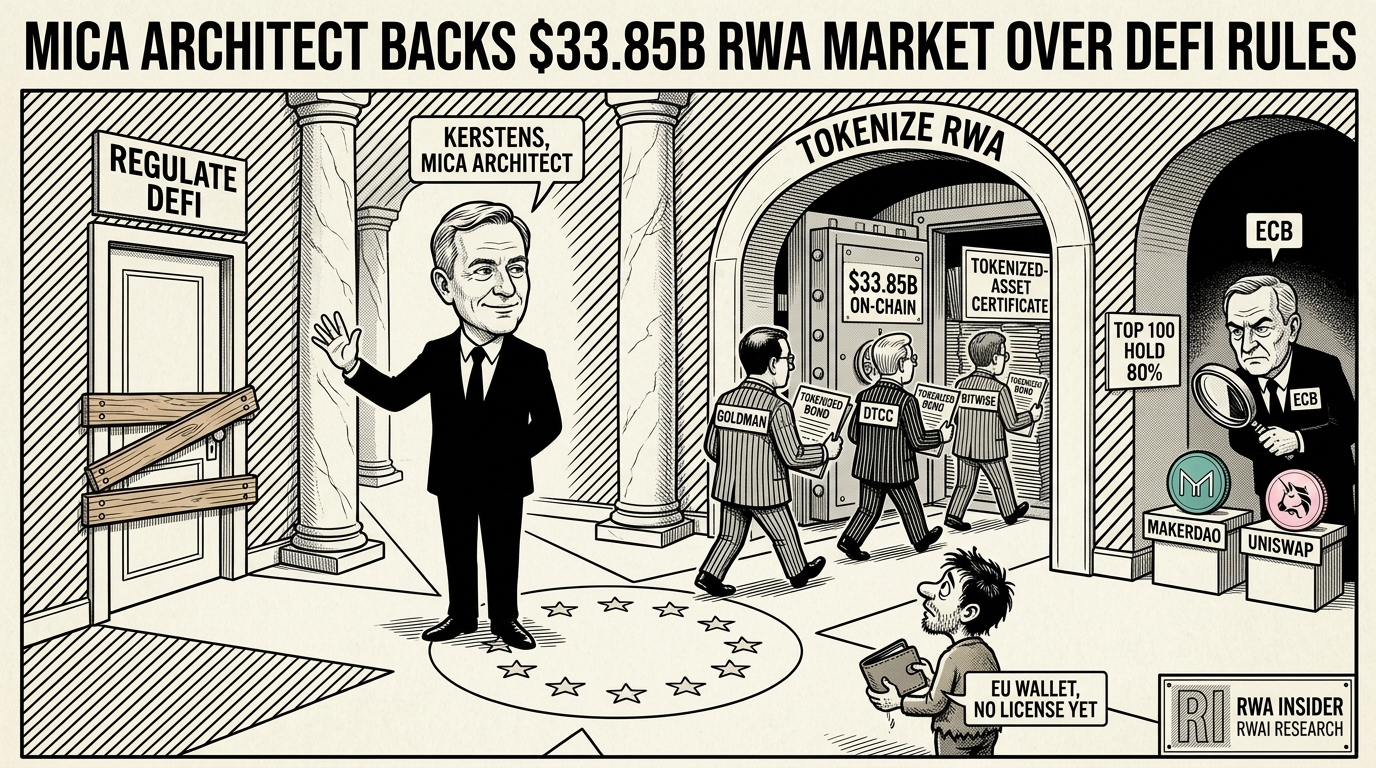
MiCA Architect Backs $33.85B RWA Market Over DeFi Rules
Key Points
- A MiCA architect, Peter Kerstens, told the EU to prioritize tokenization over new DeFi rules, with $33.85 billion already tokenized on-chain.
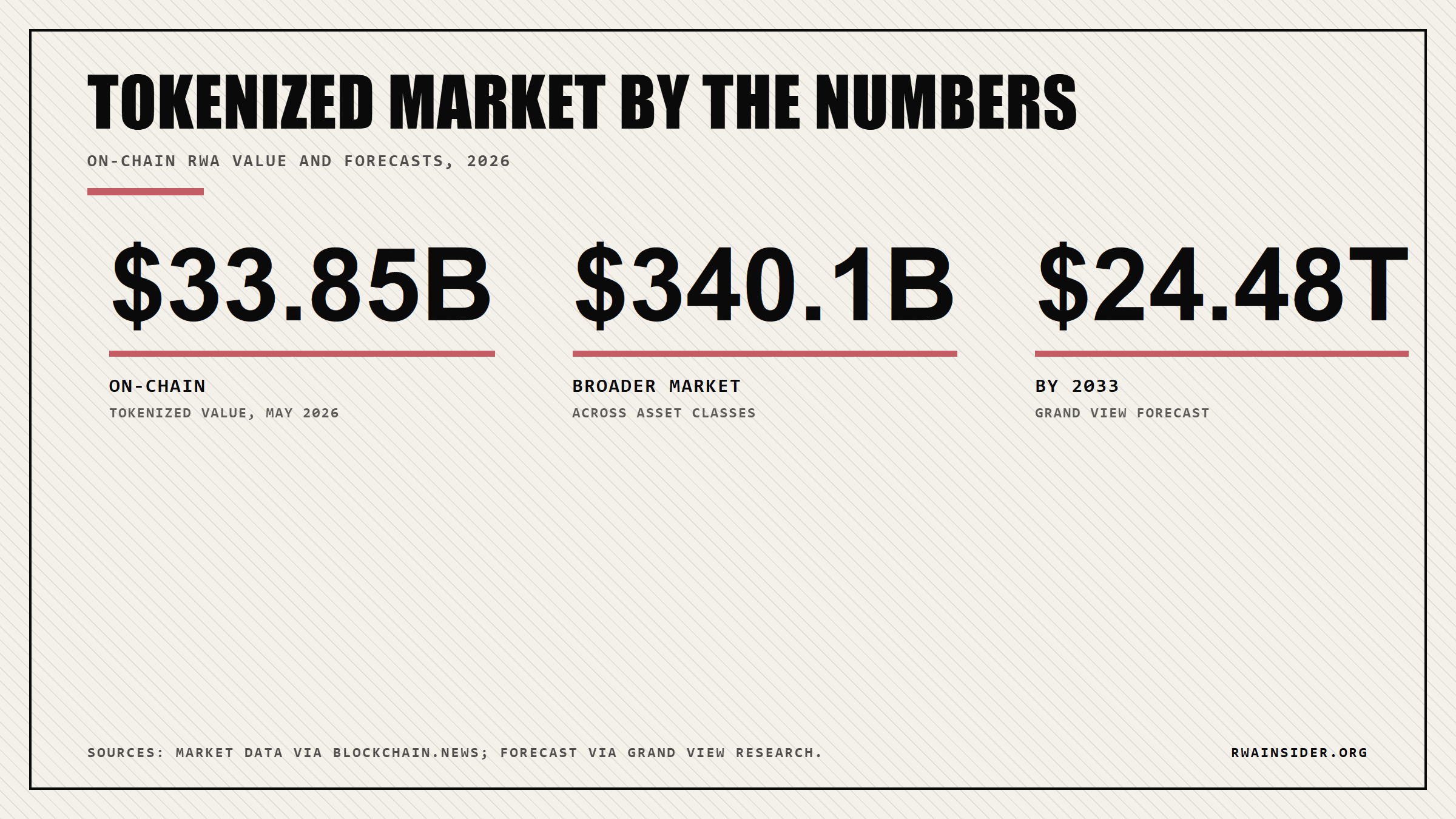
- On-chain tokenized value reached $33.85 billion by May 2026 inside a $340.1 billion broader market, with forecasts near $24.48 trillion by 2033.
- For EU wallets, it signals permissionless apps like Uniswap and MakerDAO may avoid MiCA licensing, even as July 1 forces exchanges to comply.
Peter Kerstens, an architect of the European Union’s MiCA regulation and an adviser to the European Commission, told a Monaco summit that the bloc should spend its energy tokenizing real-world assets instead of writing fresh rules for DeFi. “I don’t see what the problem is [with DeFi]. And if there is no problem, why should it be regulated?” he said at the WAIB Summit. For a wallet holding $1,000 of tokens, that is a rare signal from inside Brussels that permissionless protocols may dodge the licensing regime the rest of crypto now faces.
Kerstens Tells The EU To Skip A DeFi Rulebook
Kerstens helped write MiCA, the EU’s flagship crypto law, and now advises the European Commission on what comes next for digital assets.
Speaking at the WAIB Summit in Monaco, he argued that a second act aimed at DeFi would regulate a problem he does not believe exists.
He also warned that policing DeFi would force the EU to invent entirely new legal doctrines, because the code runs across decentralized networks rather than through a company a regulator can summon.
That stance is unusual from a person who helped build the rulebook now binding every centralized exchange in Europe.
The catch for on-chain users is access, not theory. Nothing about this changes what a wallet can do today.
What it shapes is whether front-ends like a decentralized exchange ever need an EU license to serve European users, or stay open the way they are now.
The European Commission is reviewing how well MiCA works through a public consultation, and that review decides whether DeFi gets pulled into scope at all.
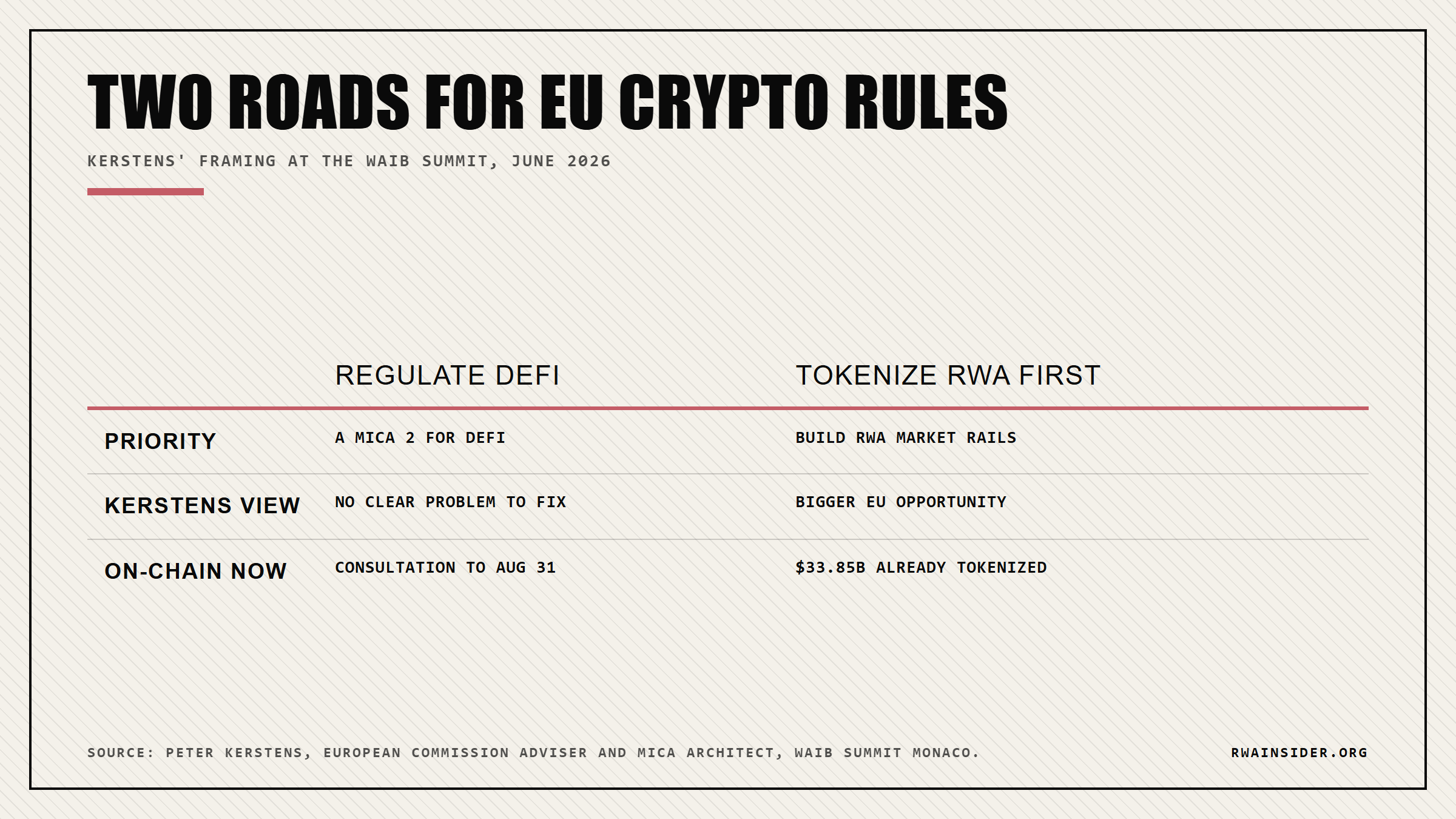
Where The $33.85B Tokenized Market Sits Now
Tokenization turns ownership of real assets, from real estate to private credit and funds, into blockchain tokens that settle in minutes and split into fractions a small wallet can hold.
Those tokens can embed compliance and transfer rules directly in the smart contract, which is part of why regulators see them as easier to supervise than open DeFi.
As of May 2026, about $33.85 billion in value sits tokenized on-chain, one slice of a broader $340.1 billion market spread across asset categories.
Grand View Research projects the global tokenization market could reach $24.48 trillion by 2033, the kind of forecast that explains why Brussels wants rails before it writes rules.
The institutions are not waiting for the debate to settle. Goldman Sachs-linked infrastructure and a coming DTCC tokenization service both advanced this month.
Bitwise has flagged plans to manage a $267 million tokenized fund, another sign that regulated money sees the same opportunity Kerstens describes.
Strip away the Brussels framing and this is really about whether the wallet you already use to swap on a DEX ever needs a license to keep doing it.
You can follow how regulation reshapes on-chain RWA access as the consultation runs its course this summer.
What The ECB Says About MakerDAO, Uniswap
Not everyone shares Kerstens’ relaxed read. A March 2026 report from the European Central Bank questioned whether DAOs are decentralized enough to sit outside MiCA at all.
Its researchers found that more than 80% of governance tokens in major protocols, including MakerDAO and Uniswap, were concentrated among the top 100 holders.
That concentration is the crux of the whole argument.
If a regulator decides a handful of holders effectively control a protocol, the decentralization defense that keeps DeFi out of scope starts to crack.
The timeline matters for anyone holding governance tokens or trading on these venues. The MiCA review consultation stays open until August 31, 2026.
Its outcome, combined with the broader push toward tokenization, will shape the EU’s digital asset strategy into 2027 and beyond.
Watch the consultation responses from DeFi protocols themselves, because their argument for staying unlicensed now has to answer the ECB’s concentration data directly.
For now, MiCA’s transition period ends on July 1, when crypto service providers must hold a license or leave the bloc.
That deadline hits centralized exchanges first, long before it ever reaches a self-custody wallet swapping tokens on-chain.
Whether Uniswap and MakerDAO stay permissionless in Europe comes down to which argument wins the consultation that closes August 31. Until Brussels decides, EU wallets operate in a gap that could close in either direction.
The EU has already floated a path to bring DeFi protocols under a licensing regime, so the same review that spares tokenization could still pull permissionless apps into scope.
Frequently Asked Questions
What did the MiCA architect say about regulating DeFi?
Peter Kerstens, an architect of the EU’s MiCA rules and a European Commission adviser, said he sees no clear problem with DeFi and questioned why it should be regulated at all. He argued the EU should prioritize tokenizing real-world assets over writing a MiCA 2 aimed at DeFi.
When does the MiCA transition period end?
MiCA’s transition period ends on July 1, 2026. After that date, crypto asset service providers operating in the EU must hold a MiCA license or stop serving the bloc. The deadline applies to centralized providers, not directly to self-custody wallets.
How large is the tokenized RWA market in 2026?
About $33.85 billion in value was tokenized on-chain as of May 2026, inside a broader $340.1 billion market across asset categories. Grand View Research projects the global tokenization market could reach $24.48 trillion by 2033.
Can I still use Uniswap or MakerDAO in the EU without a license?
For now, yes, because permissionless protocols sit outside MiCA’s current scope. A European Central Bank report flagged that more than 80% of governance tokens in protocols like MakerDAO and Uniswap sit with the top 100 holders, which could test that exemption. The MiCA review consultation closes August 31, 2026.