
$100M Ether.fi RWA Vault Built On Midas Vault OS
Key Points
- Ether.fi committed $100 million to a new Liquid RWA vault built on Midas Vault OS, its second vault running on the infrastructure.
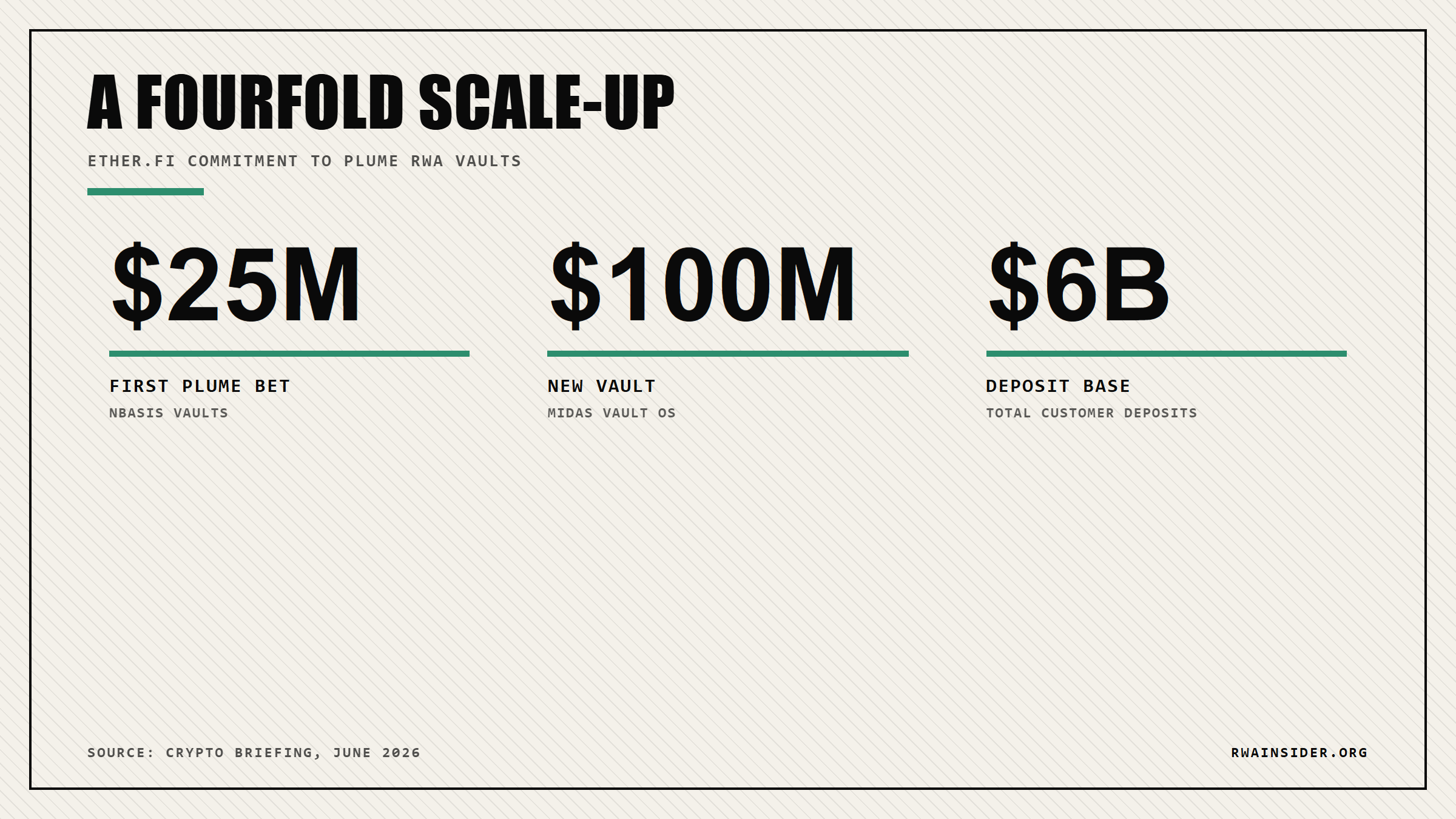
- The $100 million allocation is a fourfold jump from the $25 million Ether.fi first put into Plume’s Nest nBASIS vaults.
- Any Ether.fi user can tap AAA-rated CLOs and bond ETFs in-app, drawing on a deposit base above $6 billion.
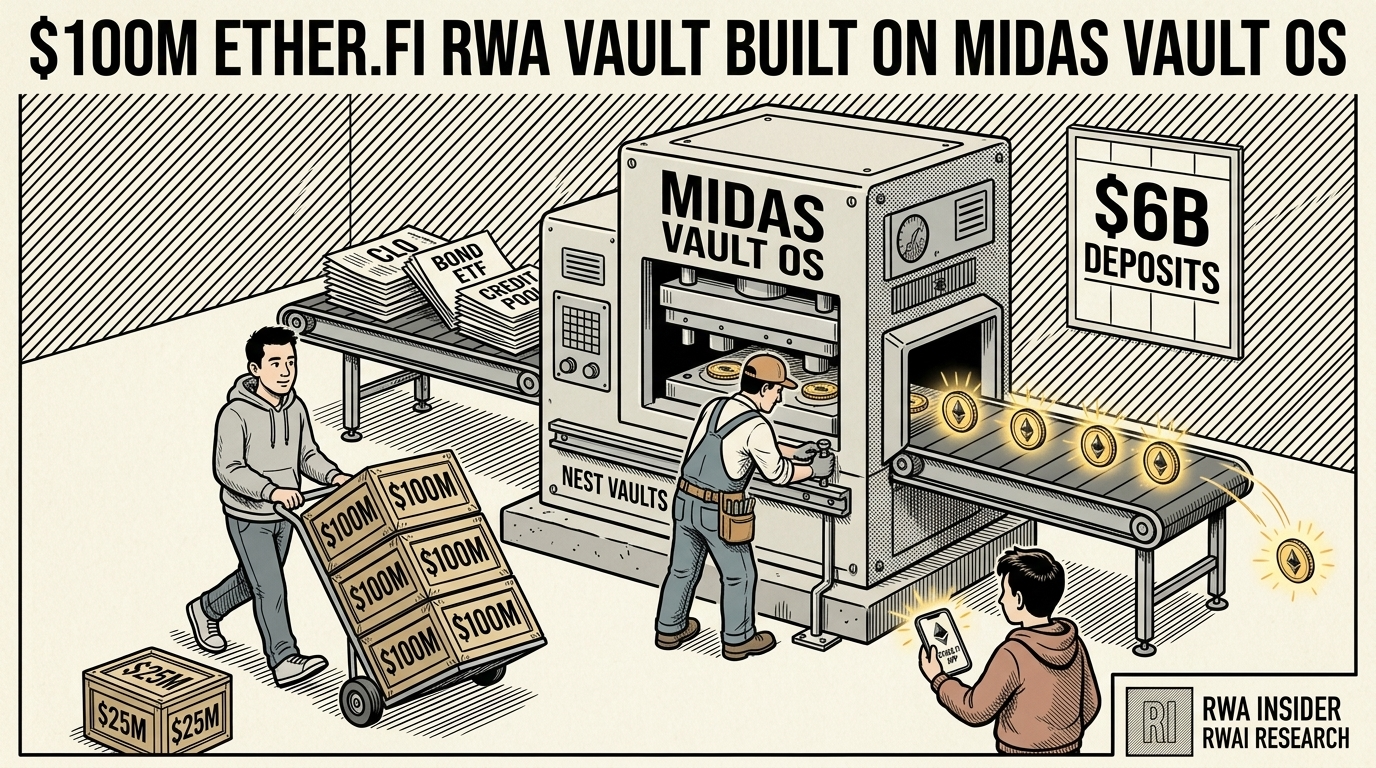
Ether.fi has committed $100 million to a new Liquid RWA vault built on Midas Vault OS, the tokenization infrastructure now powering a second Ether.fi product. Crypto Briefing reported the vault launched June 5 with Plume Network, giving users access to “tokenized yields from traditional financial instruments like overcollateralized credit pools, AAA-rated CLOs, and bond ETFs.” For a wallet holder, the real story is not the yield but the plumbing: one tokenization engine is quietly sitting under Ether.fi’s $6 billion deposit base, and that decides what RWA exposure you can actually reach from the app.
Midas Vault OS Now Runs Two Ether.fi Vaults
On June 5, Ether.fi opened a new Liquid RWA vault and committed $100 million to it.
The plumbing underneath comes from Midas, whose Vault OS now powers a second Ether.fi product. The first was the EURC Liquid vault, which launched around May 2026 with K3 Capital.
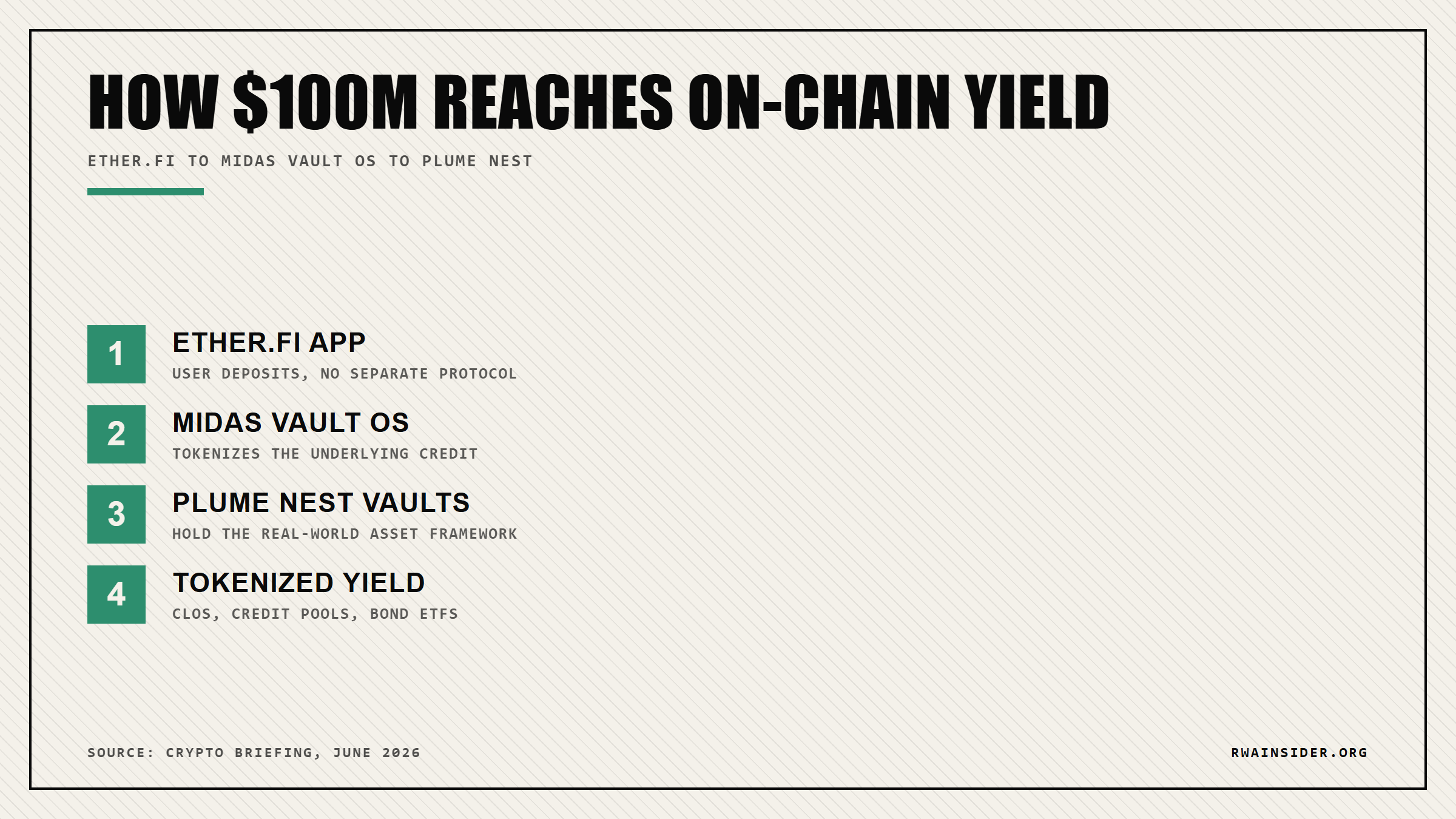
This newest vault was built with Plume Network. Plume’s Nest Vaults supply the underlying real-world asset framework, while Vault OS handles the tokenization layer that turns off-chain credit into an on-chain position.
Ether.fi is best known as a liquid restaking protocol, where users stake ETH and keep a tradable receipt token. This RWA push moves it well beyond that, into tokenized traditional credit.
The assets inside are tokenized versions of traditional credit: overcollateralized credit pools, AAA-rated CLOs, and bond ETFs.
For an on-chain user, the structure matters more than the announcement. Two of Ether.fi’s RWA vaults now route through the same engine, and that engine quietly decides which assets ever reach the app.
The $25M To $100M Jump On Plume Nest
The $100 million did not come from new fundraising. It came from Ether.fi’s existing managed capital and liquidity provider base, which now sits above $6 billion in total customer deposits.
It is also a sharp escalation. Ether.fi had already put $25 million into Plume’s Nest protocol through its nBASIS vaults, so the new allocation is a fourfold increase on that first bet.
Strip away the press release and this is really about who owns the tokenization layer, because whoever controls Vault OS controls what assets land in your vault.
The source does not disclose the vault’s yield rate, so no number is claimed here. As a permissionless benchmark, supplying USDC on Aave has tracked near 2.1% in prior RWA Insider coverage, and the pitch for tokenized credit is that it can pay more in exchange for more risk.
The products themselves are familiar names from traditional finance. Overcollateralized credit pools and AAA-rated CLOs are bundles of loans, and bond ETFs hold debt, all now wrapped to settle on-chain inside one vault.
If you want to compare how tokenized RWAs reach self-custody wallets, the access path is the real differentiator, not a headline APY.
The Credit Risk Behind Ether.fi’s RWA Yield
The reaction worth reading in the source is the warning, not the win.
Crypto Briefing’s analysis flagged that tokenized RWAs inherit the credit risk of whatever sits underneath them, and that AAA-rated CLOs, while historically strong, are not immune to broader market stress.
The blunt version: parking funds in this vault is not the same risk profile as staking ETH. You take on an entirely separate set of economic factors, packaged to look native.
For a wallet holder, the upside is convenience. You reach tokenized credit products from inside the Ether.fi app, with no separate protocol to navigate and no second wallet to fund.
RWA Insider covered Ether.fi’s first, smaller Plume push only days ago, so the real signal here is speed. A $25 million test became a $100 million commitment fast, and the pace of that scale-up is the part to watch.
The open question for a $1,000 wallet is whether access stays gated to the Ether.fi app or opens wider. For now the exposure lives where Ether.fi puts it, and you take the chain, the engine, and the front end as a single bundle.
Whether Midas Vault OS becomes Ether.fi’s default tokenization rail or stays one option among several depends on the third vault, and that decision quietly shapes what RWA exposure any wallet can reach.
See how the same deposit base chased on-chain yield in our look at Ether.fi’s earlier 7.25% Plume vault.
Frequently Asked Questions
What is Midas Vault OS and how does it work?
Midas Vault OS is tokenization infrastructure that turns off-chain assets like credit pools and CLOs into on-chain tokens. Ether.fi uses it to power its Liquid RWA vaults, so users get real-world asset exposure without leaving the Ether.fi app.
How much did Ether.fi put into the new Plume vault?
Ether.fi committed $100 million, drawn from its existing deposit base of more than $6 billion. That is a fourfold increase on the $25 million it first allocated to Plume’s Nest nBASIS vaults.
Can I buy into this Ether.fi RWA vault with a small wallet?
Access runs through the Ether.fi interface, so you interact with it like any other Ether.fi product rather than a separate protocol. The source does not confirm a minimum, so check the app for current terms before committing funds.
Is a tokenized CLO vault as safe as staking ETH?
No. Crypto Briefing notes tokenized RWAs carry the credit risk of their underlying assets, and AAA-rated CLOs can still suffer in market stress. The risk profile differs from staking ETH, even when the exposure sits in the same app.