
FDIC’s GENIUS Act Rule Bars Direct Yield Claims, Opens 60-Day Comment
Key Points
- The FDIC voted Tuesday to propose a 191-page regulatory framework for stablecoin issuers under the GENIUS Act, opening a 60-day comment period.
- The proposed rule restricts issuers from representing that stablecoins pay interest for holding or using the token, including arrangements with third-party exchanges.
- DeFi users earning rewards on stablecoin holdings should watch the 60-day comment window, since the FDIC rule directly affects how exchanges can market yield.
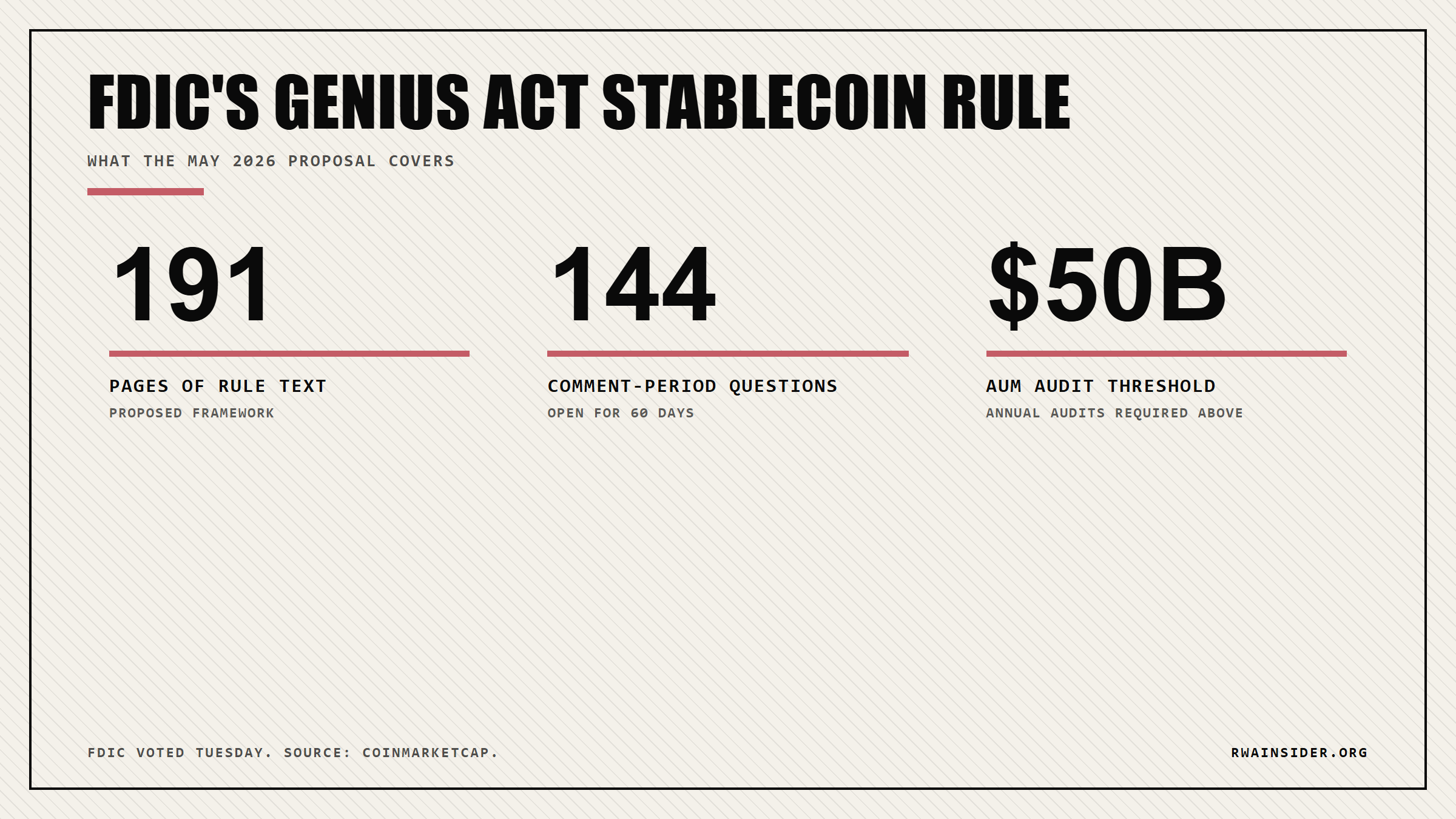
The US Federal Deposit Insurance Corporation voted Tuesday to propose a 191-page regulatory framework for stablecoin issuers under the GENIUS Act, opening a 60-day public comment period covering 144 specific questions. CoinMarketCap reported the vote on May 23, 2026, noting the rule targets capital, liquidity, and custody requirements for permitted payment stablecoin issuers, and includes restrictions on how yield-bearing arrangements can be marketed. For DeFi users earning rewards on stablecoin holdings through Coinbase Earn or wallet-side reward programs, the FDIC proposal directly addresses whether such yield can be represented to retail holders.
Inside The FDIC’s 191-Page Stablecoin Rulebook Proposal
FDIC Chair Travis Hill said growth in the stablecoin sector has accelerated as traditional finance firms explore crypto and crypto companies seek bank charters.
The 191-page proposal targets “permitted payment stablecoin issuers,” a category that under the GENIUS Act includes issuers that are subsidiaries of insured depository institutions or have received federal or state regulator authorization.
Those issuers would be subject to capital, liquidity, and custody requirements under the proposal.
FDIC counsel Chantal Hernandez said the rule seeks to clarify deposit insurance coverage for deposits that function as reserves backing stablecoins.
Under the GENIUS Act, payment stablecoins themselves are not covered by federal deposit insurance, a point the FDIC reaffirmed in Tuesday’s meeting.
The proposal is structured for industry response. The 60-day public comment window opens immediately, with 144 specific questions covering every section of the rulebook from capital ratios to marketing language.
How The Yield Restriction Could Reshape Exchange Reward Programs
One section of the proposal addresses yield-bearing arrangements directly. The FDIC said issuers would not be permitted to represent that their tokens pay interest or yield simply for holding or using a stablecoin.
That restriction applies to arrangements with third parties, including exchanges. Crypto insiders have said properly designed rewards programs should fall outside the scope of that prohibition.
Strip away the regulatory language and the practical question is whether a $1k wallet earning rewards through Coinbase Earn or a similar exchange program loses that yield once the FDIC rule finalizes.
Readers can track regulatory rulemaking across stablecoin frameworks as the FDIC, OCC, and Treasury all build implementation rules under the GENIUS Act.
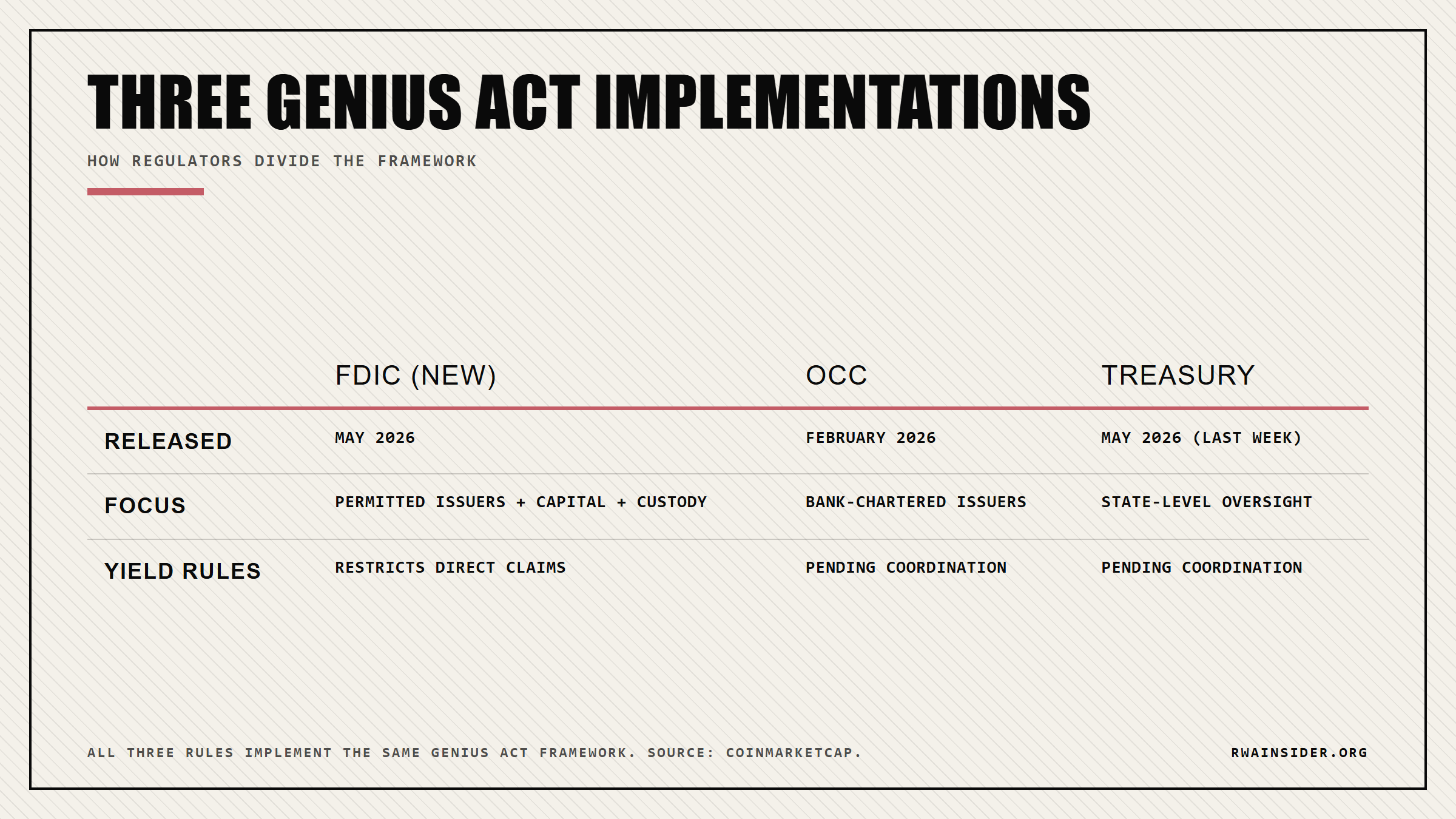
The FDIC joins other regulators building the GENIUS Act framework. The Office of the Comptroller of the Currency released proposed rules in February. The Treasury Department issued a separate notice last week focused on state-level oversight of smaller issuers.
Tuesday’s FDIC proposal is the agency’s second on GENIUS Act implementation, following a December proposal on the issuer application process.
What The $50B Audit Threshold And 144 Comment Questions Mean For Holders
The GENIUS Act established a federal framework requiring payment stablecoins to be fully backed by US dollars or equally liquid assets. It also mandates annual audits for issuers with a market capitalization above $50 billion.
The 144 questions in the FDIC’s comment period span capital requirements, liquidity thresholds, custody arrangements, deposit insurance interactions, and yield-bearing restrictions.
This builds on our earlier read on the CLARITY Act and the third White House yield meeting. The FDIC rule sits inside the GENIUS Act framework; the CLARITY Act is a separate bill that could revise the broader market structure.
A debate between the banking and crypto industries over yield-bearing stablecoin holdings has been unresolved for months, though lawmakers have said they are close to reaching an agreement on the broader market structure question.
For DeFi users actively allocating stablecoin capital, the practical move is to document each issuer’s regulatory status (FDIC-permitted, state-chartered, foreign) before the 60-day comment window closes and the rule finalizes.
Watch for the OCC and Treasury rules to converge with the FDIC framework, and for the Senate’s Digital Asset Market Clarity Act to either reinforce or revise the yield-bearing restrictions.
Whether the FDIC’s 60-day comment window produces meaningful revision to the yield-bearing restrictions depends on whether crypto industry submissions reshape the rule’s marketing language. The final rule will tell.
Track more Safety & Risk coverage from RWA Insider as the GENIUS Act framework finalizes.
Frequently Asked Questions
What did the FDIC actually propose?
The FDIC voted Tuesday to propose a 191-page regulatory framework for stablecoin issuers under the GENIUS Act. The rule covers capital, liquidity, custody requirements, and restrictions on yield-bearing representations. A 60-day public comment period is open, covering 144 specific questions.
Are stablecoins covered by FDIC deposit insurance?
No. Under the GENIUS Act, payment stablecoins themselves are not covered by federal deposit insurance. The FDIC’s proposed rule clarifies how deposit insurance applies to the underlying reserves backing stablecoins, but the tokens held by users are not insured.
Does the FDIC rule ban Coinbase Earn-style stablecoin rewards?
Not outright. The rule restricts issuers from representing that their stablecoins pay interest or yield for holding or using the token, including through third-party arrangements with exchanges. Crypto insiders have argued properly designed rewards programs should fall outside the prohibition. The 60-day comment window is the next decision point.
How does this connect to the CLARITY Act debate?
The FDIC’s proposal implements the already-passed GENIUS Act. The CLARITY Act is a separate Senate bill that could revise the broader market structure framework, including how yield-bearing arrangements are treated. Lawmakers have indicated they are close to a deal, but no Senate Banking Committee markup has been scheduled.