$4B Ondo TVL: Tokenized Stocks, ETFs Pass $1.3B
Key Points
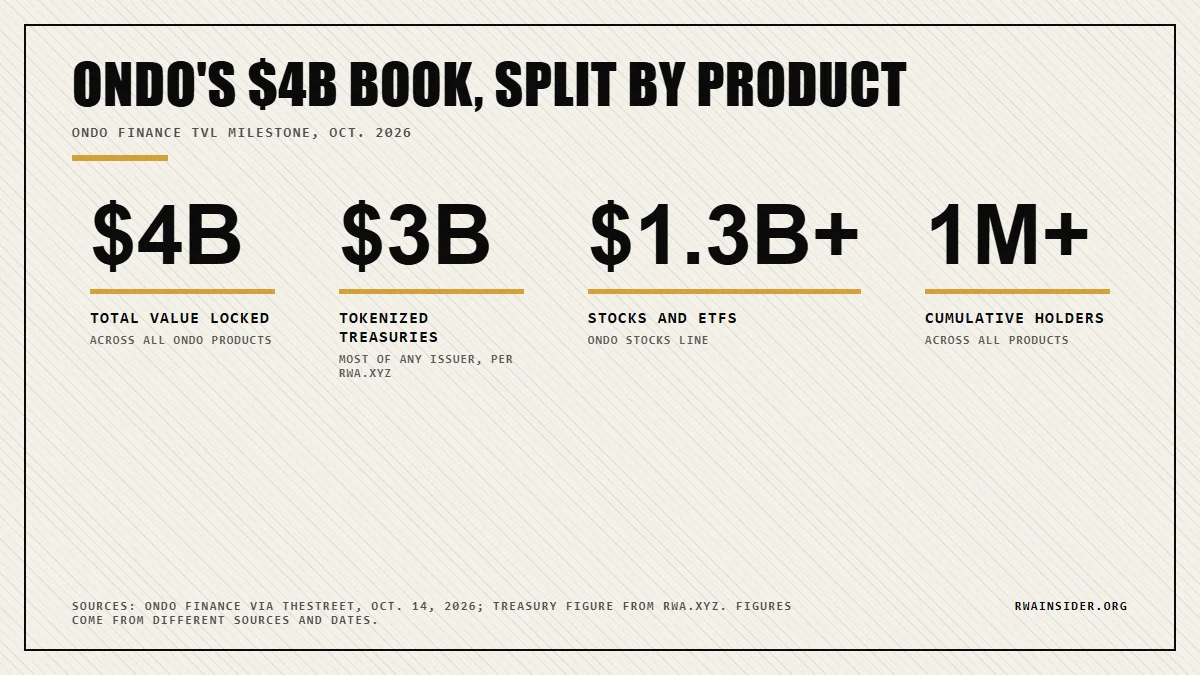
- Ondo Finance says total value locked across its tokenized products has crossed $4 billion, with more than 1 million cumulative holders.
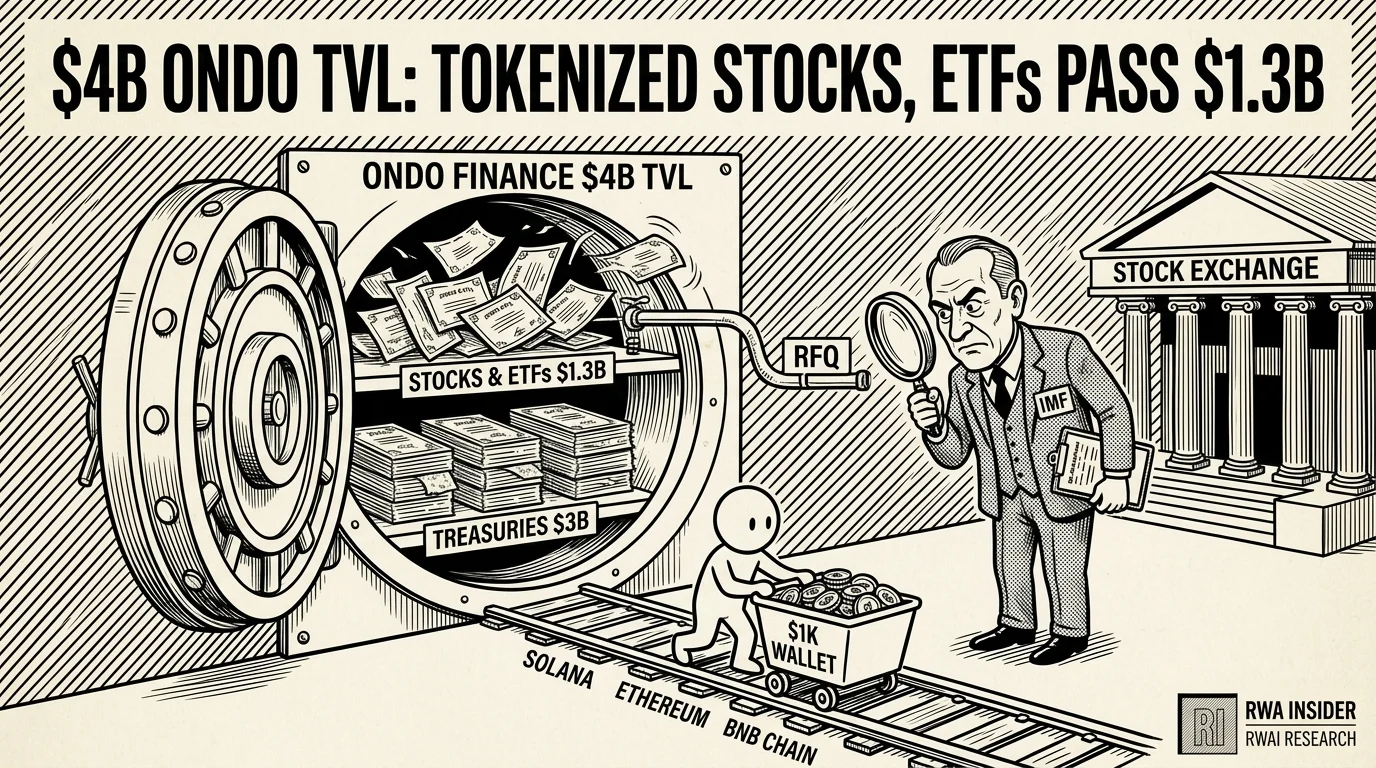
- RWA.xyz ranks Ondo’s tokenized Treasuries at $3 billion, the most of any issuer, while its stocks and ETFs now top $1.3 billion.
- A $1,000 wallet can move Ondo tokens without permission across Solana, Ethereum and BNB Chain, with Ondo Stocks pricing trades through exchange-linked RFQ quotes.
Ondo Finance has crossed $4 billion in total value locked, and more than $1.3 billion of it now sits in tokenized stocks and ETFs rather than Treasuries. The company announced the milestone on Oct. 14, TheStreet reported, a week after IMF economists warned that “tokenized markets today remain relatively illiquid and exhibit higher volatility than traditional counterparts.” For your wallet, the useful part is the plumbing: Ondo tokens move between users without permission across Solana, Ethereum and BNB Chain, and Ondo Stocks prices trades off traditional exchanges.
Ondo’s $4B TVL Now Leans On Stocks And ETFs
Ondo Finance started by tokenizing U.S. Treasuries, the yield-bearing debt the U.S. government issues.
TVL is the dollar value of assets held in a platform’s products. Ondo calls itself the largest platform for tokenized Treasuries.
RWA.xyz data ranks Ondo’s tokenized Treasury holdings at $3 billion, the most of any issuer.
The newer lines are catching up. Ondo says more than $1.3 billion of its $4 billion total now sits in tokenized stocks and ETFs.
The company also counts more than 1 million cumulative holders across its products.
It names portfolios and private markets as the next asset classes on its list.
For on-chain users, the key line is distribution. Ondo says its tokens move between users without permission on Solana, Ethereum and BNB Chain.
Dune: Stocks Are 8% Of RWAs But 93% Of Trading
A recent report from analytics firm Dune shows why Ondo is leaning into stocks.
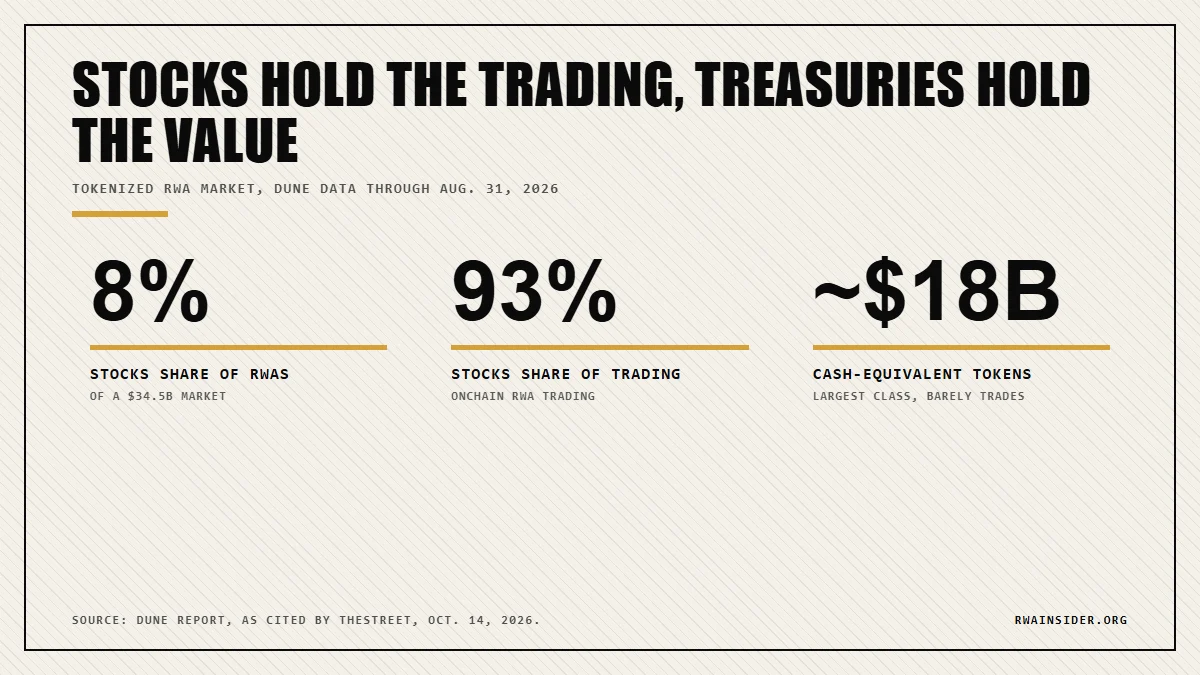
Tokenized stocks make up just 8% of the $34.5 billion RWA market, yet they account for 93% of onchain trading, per Dune data through Aug. 31.
Cash-equivalent tokens, such as tokenized Treasuries, form the largest class at nearly $18 billion. Dune says they barely trade.
That leaves a ,000 wallet with a split choice: hold the quiet Treasury token for yield, or trade the busy stock token where the volume is.
For a DeFi user, this matters less as a TVL trophy than as a liquidity map: Treasuries hold the yield, stocks hold the trading.
Ondo Stocks taps liquidity from traditional exchanges through a request-for-quote, or RFQ, system. A buyer asks for a price and a market maker quotes one.
That design targets the weak spot the IMF flagged: thin, fragmented liquidity that makes onchain prices harder to trust.
TheStreet’s report gives no current yield for Ondo’s Treasury tokens. Check the live rate before you weigh it against a stablecoin lending rate.
When rates post, you can compare yields across tokenized treasuries and DeFi lending in one place.
IMF Names Ondo As Tokenized Markets Face Scrutiny
The IMF’s October Global Financial Stability Report, its first with a chapter dedicated to tokenized markets, named Ondo among the top tokenization platforms.
Ondo appeared alongside Securitize, Circle, Tether and Bridgetower.
The scale is already large. Tokenized repurchase agreements, short-term loans backed by securities, average $300 billion to $350 billion in daily volume, per the IMF.
Other tokenized assets add about $65 billion a day, still small next to the roughly $13 trillion traded daily in the U.S. repo market.
In an Oct. 8 blog, IMF economists Gonzalo Fernandez Dionis, Caio Ferreira, Mindaugas Leika and Athanasios Vamvakidis wrote that fragmentation across networks and venues “weakens liquidity, prevents efficient price formation and contributes to price deviations.”
The fund also found that more than half of tokenized trading happens outside traditional market hours.
About 80% of the tokenized equity trades it analyzed were for less than one share. That echoes its finding that tokenized stocks swing hardest on decentralized exchanges.
The open question for wallets: how RFQ quotes hold up off-hours, when the exchanges Ondo draws liquidity from are closed.
Ondo says it expects tokenization to be measured in trillions one day. The IMF wants regulators to clarify the legal rights tied to tokenized assets before the market gets much bigger.
Ondo built the biggest Treasury book first. Whether its stock tokens keep tight prices while Wall Street sleeps is what a $1,000 wallet actually depends on.
Tracking where tokenized yield beats DeFi lending? The Yield Gap desk follows Ondo, BlackRock and every Treasury token worth a wallet slot.
Frequently Asked Questions
How big is Ondo Finance’s TVL now?
Ondo says total value locked across its products has passed $4 billion, with more than $1.3 billion in tokenized stocks and ETFs. Separately, RWA.xyz ranks Ondo’s tokenized Treasury holdings at $3 billion, the most of any issuer.
Can I send Ondo tokens to another wallet without permission?
Ondo says its tokens can move between users without permission across Solana, Ethereum and BNB Chain. That covers wallet-to-wallet transfers. The report does not cover buying or redeeming directly with Ondo, so check its terms for those steps.
Where does Ondo Stocks get its trading liquidity?
Ondo Stocks taps liquidity from traditional exchanges through a request-for-quote system. A buyer asks for a price and a market maker quotes one, which aims to avoid relying only on thin onchain order books.
Why does the IMF say tokenized markets are risky?
IMF economists wrote on Oct. 8 that tokenized markets remain relatively illiquid and more volatile than traditional ones, and that fragmentation across networks hurts price formation. The fund also found most tokenized trading happens outside market hours, and about 80% of equity trades were under one share.