1.5x Volatility: IMF Finds Tokenized Stocks Swing Most On DEXs
Key Points
- The IMF found tokenized stocks showed about 1.5 times the realized volatility of the same shares on traditional exchanges, in an Oct. 8 study.
- IMF data shows more than 50% of tokenized stock trading happened outside U.S. market hours, and 80% of trades were smaller than one share.
- Decentralized exchanges posted the highest volatility and the weakest liquidity, so a $1,000 Ondo or xStocks buy on a DEX needs a slippage check first.
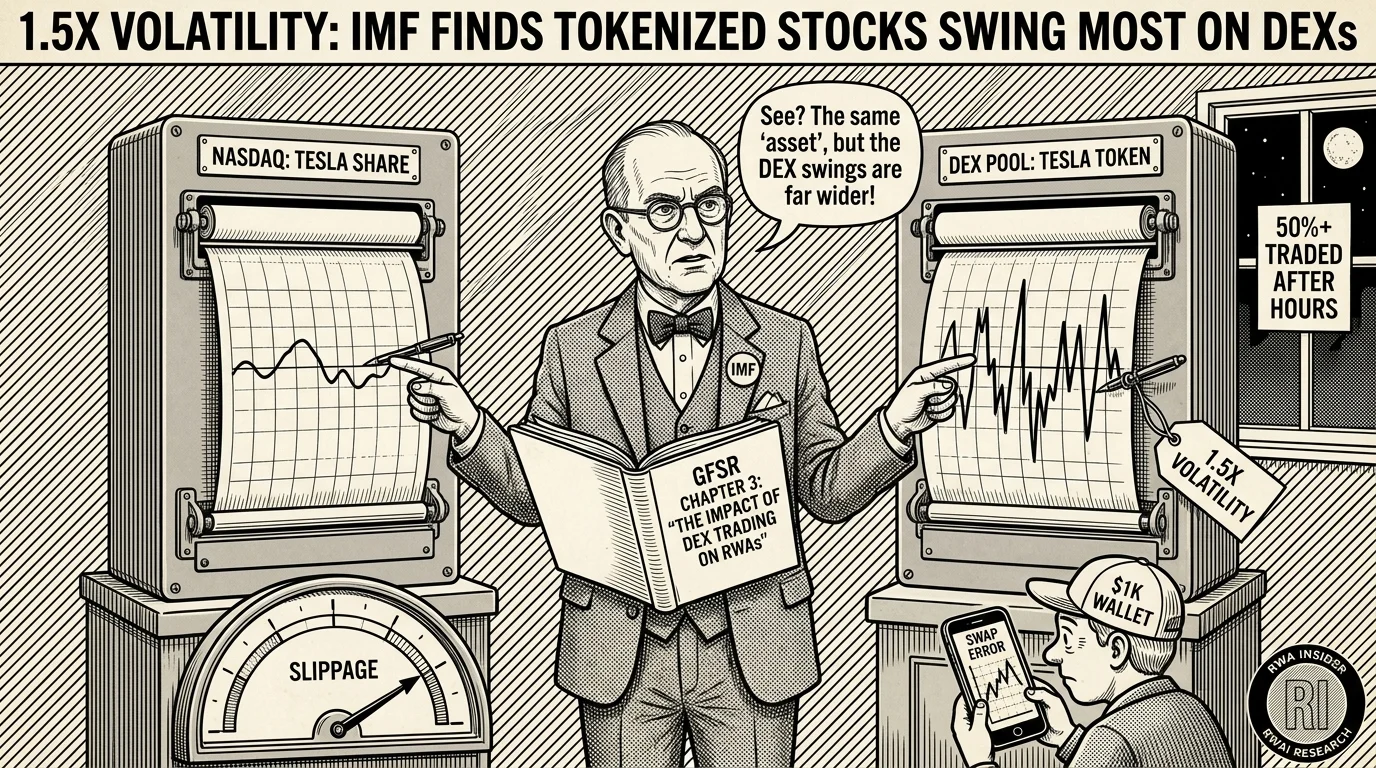
Tokenized stocks swing about 1.5 times harder than the shares they track, and decentralized exchanges swing hardest, the International Monetary Fund found in an Oct. 8 study. The research, Chapter 3 of the IMF’s October Global Financial Stability Report, sized the whole market plainly: “Tokenized assets have grown rapidly, reaching roughly $65b,” the IMF posted on X. For your wallet, the takeaway is practical. If you buy a Tesla or Nvidia token in a DEX pool on a weekend, you are trading in the thinnest, jumpiest corner of the market.
IMF Tracks $345M Of Ondo And xStocks Trading
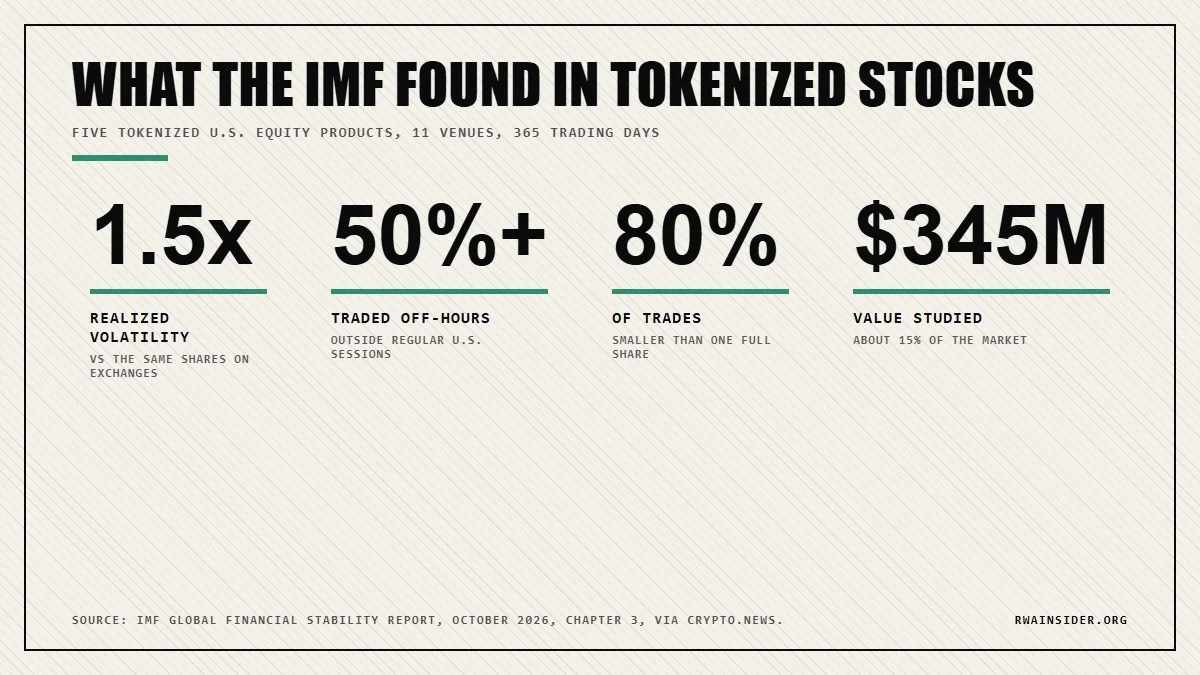
The IMF studied five actively traded tokenized U.S. equity products, covering Tesla, Nvidia, Alphabet, the S&P 500 and Nasdaq-linked exposure.
The sample included tokens from Ondo Finance and xStocks across 11 trading venues, both centralized and decentralized.
It covered about $345 million in tokenized equity value, roughly 15% of the stock token market the report measured.
Researchers logged 365 trading days and more than 2 million price and volume readings at five-minute intervals.
The headline result: realized volatility ran about 1.5 times that of the same stocks on traditional exchanges.
Price tracking held up during U.S. hours. Tokenized stock prices generally followed their underlying shares while conventional markets were open.
This is a research paper, not a rule. The IMF announced no binding regulation and set no deadline for anyone.
Why DEX Pools Swing Hardest For Tokenized Stocks
More than 50% of tokenized stock trading happened outside regular U.S. market hours, which run 9:30 a.m. to 4 p.m. Eastern.
About 80% of trades were smaller than one full share. That is retail buying slices, not funds moving blocks.
The catch is depth. The IMF measured how far prices moved for each dollar traded, and decentralized exchanges came out least liquid.
DEXs also logged the highest volatility, followed by centralized crypto exchanges and then traditional stock markets.
Fewer traders sit in a DEX pool overnight, so one order moves the price further. Higher-volume venues tracked the underlying share more closely.
Strip away the policy language and this is really about the gap between the price you see on Nasdaq and the fill you get in a pool.
There is an upside. Between 87% and 99% of overnight price information from the tokens showed up in the stock’s first five minutes of regular trading.
So the overnight token price carried real signal, even if it moved more getting there.
No yield comparison applies. These are stock tokens, and the study reports volatility and liquidity, not rates.
Before you pick a venue, track tokenized stock liquidity across DeFi venues.
Ondo And Backed Hold 70% As The IMF Asks For Clearer Rules
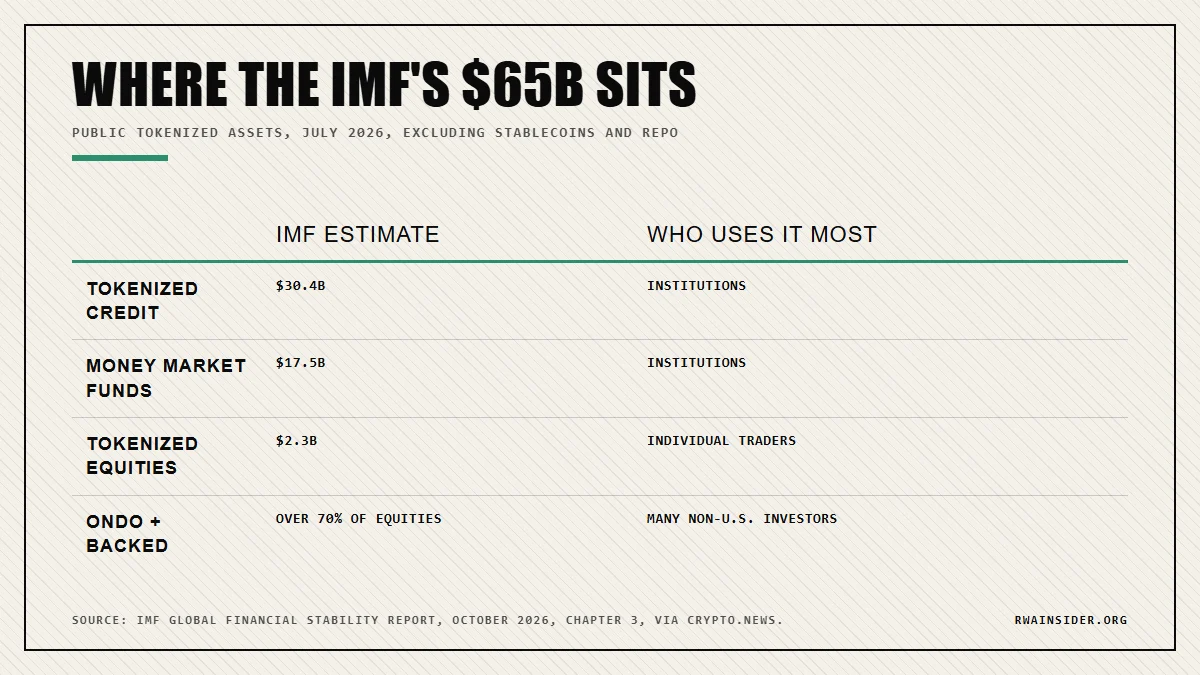
The IMF put the public tokenized asset market at about $65 billion as of July, excluding stablecoins and repo. Equities make up just $2.3 billion of it.
Ondo Finance and Backed Finance hold more than 70% of tokenized stock value, and many of their products target investors outside the United States.
The IMF’s main ask is legal clarity. A stock token can mean direct ownership, an entitlement held through an intermediary, or a product that only tracks the price.
Each carries different rights, so check what your token actually is before you size a position.
Bullish shows the other end. Its tokenized shares, trading since Aug. 12, are issuer-sponsored, carry direct shareholder rights and settle against a U.S. dollar stablecoin.
Securitize chairman and CEO Carlos Domingo has argued that equities should come on-chain without leaving ownership and investor protections behind, as our coverage of Securitize’s 12-stock Solana launch reported.
The IMF also flagged automated margin calls and liquidations. Fast collateral moves across connected platforms could speed up selling in a shock, so it wants circuit breakers evaluated.
For now, it judges systemic risk limited because the market is still small.
Watch for Nasdaq Equity Tokens, which Nasdaq and Kraken parent Payward expect in the second quarter of 2027.
If DEX pools for stock tokens deepen, that 1.5x gap should narrow. Until then, the price closest to the real share sits on the busiest venue, and the next few quarters will show whether liquidity follows the demand.
Trading stock tokens after hours? Follow the Secondary Markets desk for the next liquidity shift.
Frequently Asked Questions
Why does the IMF say tokenized stocks are more volatile?
The IMF found tokenized stocks showed about 1.5 times the realized volatility of the same shares on traditional exchanges. It tied part of the gap to limited liquidity and to continuous trading at hours when fewer buyers and sellers are active.
Is it risky to trade Ondo or xStocks tokens on a DEX?
In the IMF sample, decentralized exchanges had the highest volatility, the weakest liquidity and larger, more frequent price gaps against the underlying share. Check the slippage estimate before you confirm, and compare against the real stock price when U.S. markets are open.
Can I trade tokenized stocks when the U.S. market is closed?
Yes, depending on the platform, many stock tokens trade in the evenings, overnight and on weekends. The IMF found more than 50% of tokenized stock trading happened outside regular U.S. hours, and 87% to 99% of overnight price information showed up in the first five minutes of the next session.
Does holding a tokenized stock make me a shareholder?
It depends on the structure. The IMF says a stock token can be direct ownership, an entitlement held through an intermediary, or a product that only tracks the price, and each carries different rights. Securitize, for example, says its Solana token holders do not automatically appear as registered shareholders.