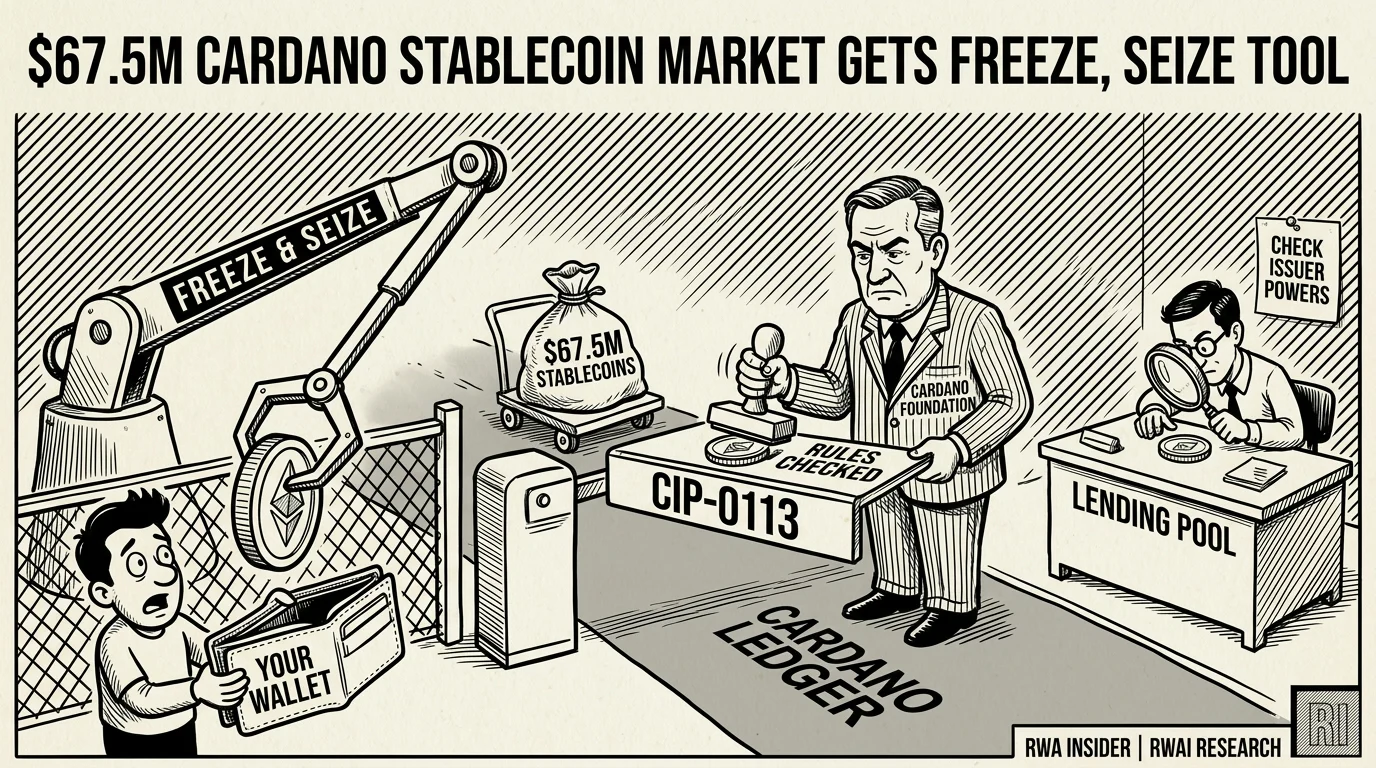
$67.5M Cardano Stablecoin Market Gets Freeze, Seize Tool
Key Points
- The Cardano Foundation switched on CIP-0113 on October 7, giving token issuers ledger-enforced freeze and seize rules on a chain holding $67.5 million in stablecoins.
- USDC makes up about $46.6 million of Cardano’s stablecoin supply and Moneta’s USDM about $13.6 million, according to DeFiLlama data.
- A CIP-0113 token can carry a seize rule that pulls it from your Cardano wallet without consent, so check issuer powers before borrowing against it.
The Cardano Foundation switched on CIP-0113 on October 7, a compliance toolkit that lets issuers freeze or seize stablecoins, funds and bonds on a chain holding just $67.5 million in stablecoins. Cryptopolitan reported the mainnet launch, quoting Cardano Foundation CEO Frederik Gregaard: “The rules have to travel with the asset and be enforced every time it moves.” For your wallet, that means a token issued under these rules can be blocked at every transfer, or pulled from your address without your consent, wherever you hold it.
Cardano’s CIP-0113 Puts Freeze And Seize Rules On-Chain
The Cardano Foundation, the Swiss nonprofit that stewards the network, took CIP-0113 live on mainnet without a hard fork.
It first announced the proposal at the TOKEN2049 conference.
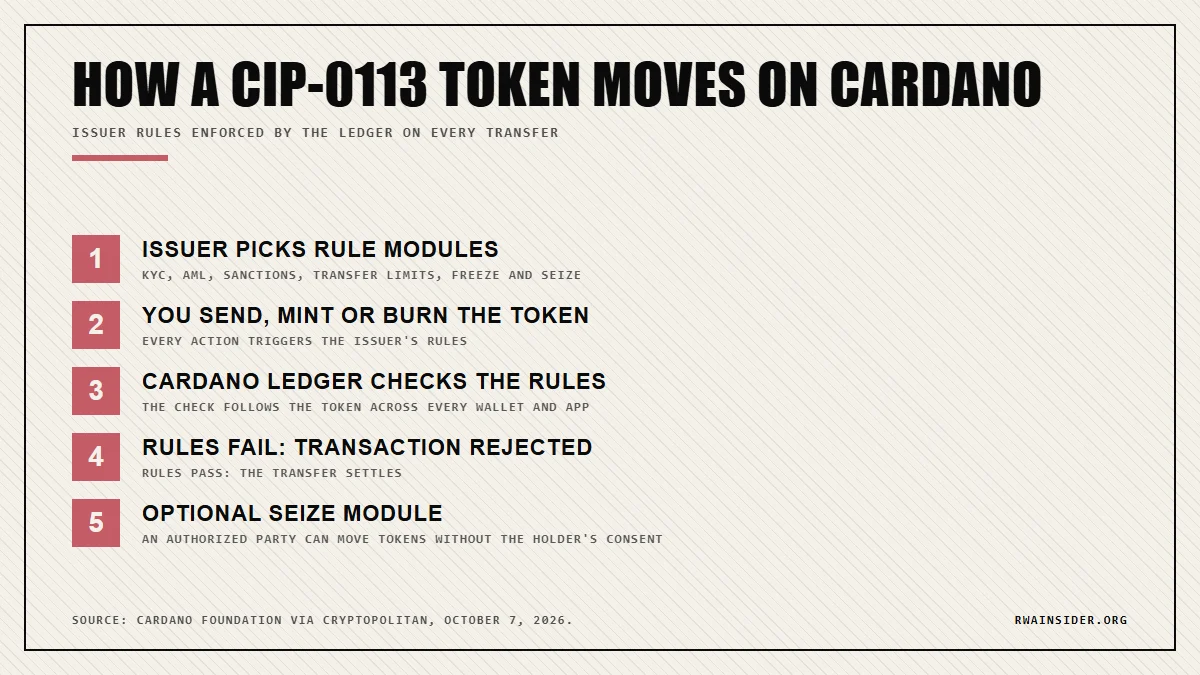
Issuers pick from pre-built rule sets called modules. These cover identity and AML checks, sanctions screening, transfer restrictions and freeze-and-seize controls.
Issuers can also screen recipients and block sanctioned wallets on the network.
They can write their own rules and swap them as regulations shift, without touching the underlying standard.
Every transfer, mint or burn now passes an issuer check at the ledger level. If a transaction breaks the issuer’s rules, Cardano rejects it.
The restriction does not stay inside one app. It follows the token across every wallet and service that touches it.
Freeze-and-seize is optional, per the GitHub repository for the Aiken implementation, so not every CIP-0113 token will carry clawback powers.
Cardano’s $67.5M Stablecoin Market Meets Clawback Risk
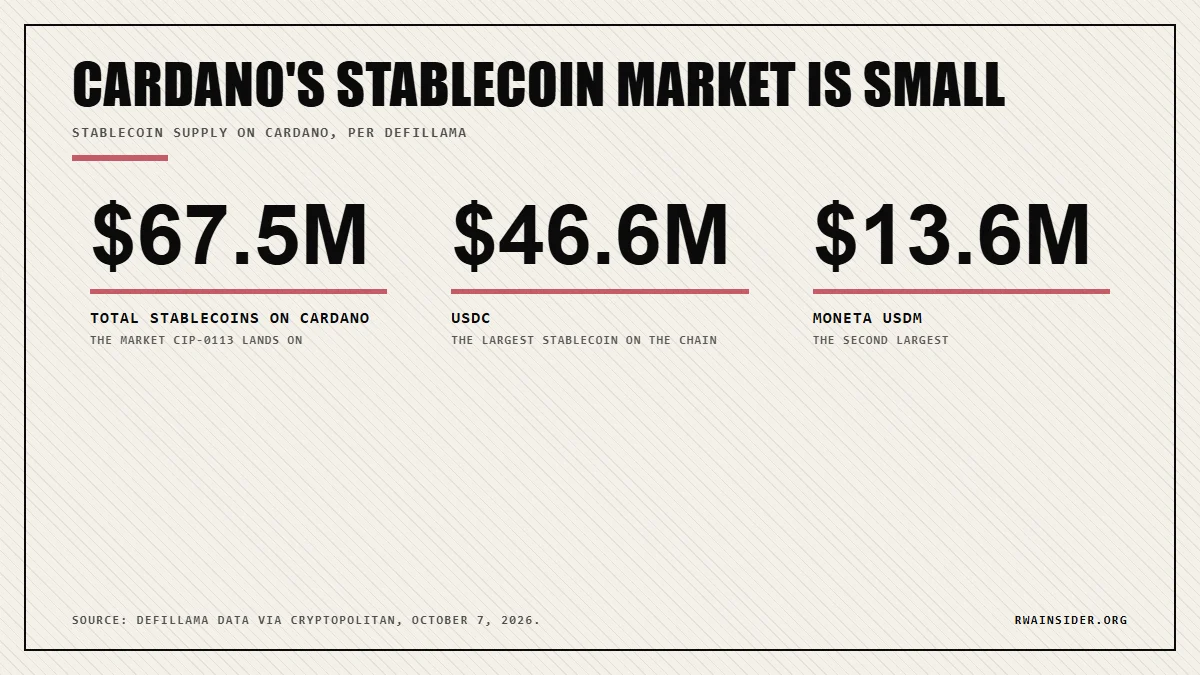
The toolkit lands on a small market. DeFiLlama puts Cardano’s stablecoin supply at roughly $67.5 million.
USDC leads with about $46.6 million, followed by Moneta’s USDM at about $13.6 million.
Next to Ethereum, Solana and XRP Ledger, which already run their own versions of transfer controls, Cardano’s stablecoin base is small.
For a DeFi user, this matters less as a compliance upgrade than as a new question to ask before you lend against or borrow with any Cardano RWA token.
If the issuer’s rules allow it, an authorized party can move tokens out of a holder’s wallet without consent.
That is why the technical specification warns lending services to check whether the issuers of tokens they accept as collateral hold those powers.
Collateral that an issuer can freeze or pull back carries a risk that no price feed shows.
There is no yield in this story to compare. CIP-0113 changes the rules attached to a token, not the rate it pays.
Before you move capital, compare how other chains handle RWA collateral risk in our DeFi-native coverage.
Gregaard, Hoskinson And The CIP-0113 Collateral Catch
Frederik Gregaard, CEO of the Cardano Foundation, pitches the toolkit as compliance that travels with the asset, not with any single app.
The Swiss Capital Markets and Technology Association backed it, recognizing CIP-113 Programmable Asset Tokens as a smart contract equivalent to its CMTAT framework.
That makes the standard usable for certifying compliance of ledger-based equity securities under Swiss standards.
The work predates this week. It builds on CIP-143, a reference design from Phil DiSarro and the IOG team, since migrated to the Aiken language.
In January 2025, Cardano founder Charles Hoskinson framed freeze-and-seize as a tool for non-adversarial uses too, such as asset recalls, identity updates and dividend payments.
That framing cuts both ways for holders. The same seize power that enables a recall also lets an issuer pull a token back.
CIP-0113 is also Cardano’s answer to calls from the BIS and IMF to make programmability a priority for tokenized finance.
The Foundation says a dedicated securities module for regulated instruments is still in development.
Lenders faced a similar test when Venus added tokenized stock collateral on BNB Chain before the borrowing risk was settled.
On Cardano, the check is now concrete: read a token’s issuer modules before you deposit it anywhere.
If large issuers launch on Cardano with seize modules switched on, every lending pool there inherits that risk. The securities module rollout will show how far they go.
Check whether a Cardano token carries freeze and seize powers before you post it as collateral.
Frequently Asked Questions
What is CIP-0113 on Cardano?
CIP-0113 is a Cardano improvement proposal, now live on mainnet, that lets issuers of stablecoins, tokenized funds and bonds build compliance rules into native tokens. Rules can cover KYC, AML, sanctions screening, transfer limits and freeze-and-seize. The ledger enforces them on every transfer, mint or burn.
Can a stablecoin issuer take tokens out of my Cardano wallet?
Yes, if the rules attached to that token allow it. An authorized party can move holdings without the holder’s consent. Freeze-and-seize is an optional module, so not every CIP-0113 token carries it.
How much USDC is on Cardano right now?
DeFiLlama puts USDC on Cardano at about $46.6 million, out of roughly $67.5 million in total stablecoins on the chain. Moneta’s USDM is next at about $13.6 million.
Is it safe to use CIP-0113 tokens as DeFi collateral?
It depends on the issuer’s powers. The CIP-0113 specification warns lending services to check whether the issuers of tokens they accept as collateral can freeze or seize them. Before you deposit, confirm which modules the token carries.