R3 Picks Solana Over EVM For Corda RWA Yield Vaults
Key Points
- R3 plans to launch Corda Protocol on Solana before Breakpoint in November 2026, opening with a yield vault built alongside an unnamed top-tier bank.
- Corda supports tens of billions of dollars in assets, yet Brown says many tokenized funds on-chain show only 3 to 7 holders.
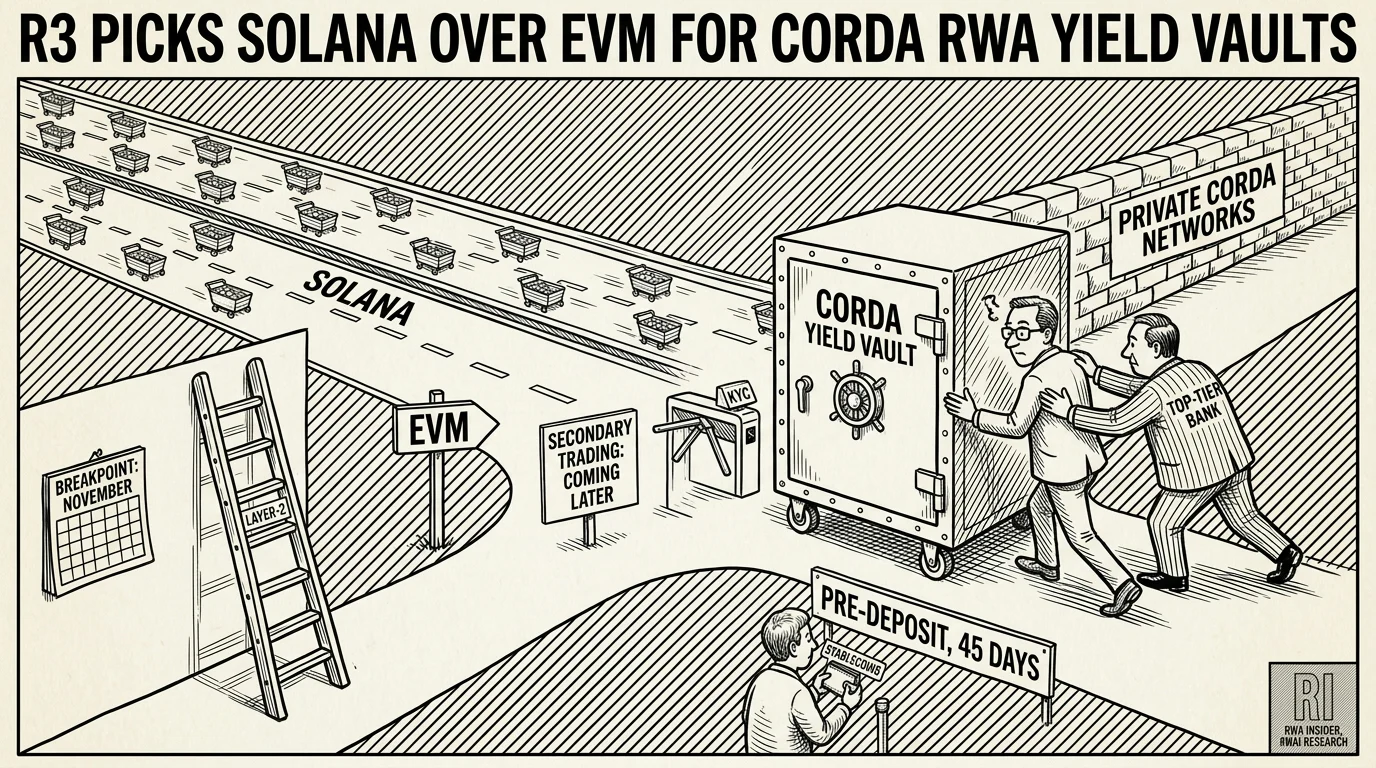
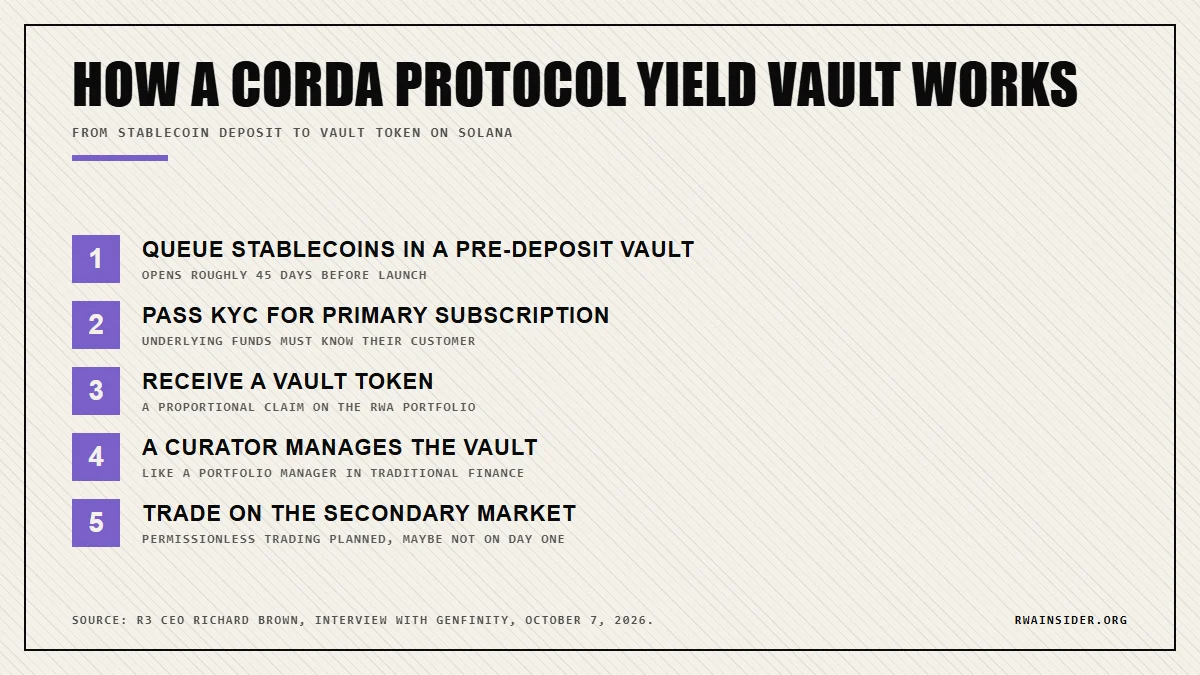
- Under R3’s design, Solana wallets queue stablecoins in a pre-deposit vault about 45 days early, but primary entry needs KYC and secondary trading may lag.
R3, the firm behind the Corda private blockchain used by banks and exchanges, is taking its RWA yield vaults to Solana instead of an EVM chain. Genfinity published an interview with CEO Richard Brown on October 7, reporting that R3 “is preparing to launch Corda Protocol on Solana, beginning with a yield vault alongside an unnamed top-tier bank.” For your wallet, that means tokenized private credit and other real-world assets could reach a Solana vault you fund with stablecoins, with a full launch targeted before Solana Breakpoint in November.
R3 Takes Corda Protocol Yield Vaults To Solana
R3 built Corda, the dominant private permissioned blockchain. Its networks support tens of billions of dollars in assets and process millions of transactions each month.
Those networks stayed walled off from each other. Now R3 wants the banks, exchanges and market operators on them to reach open networks directly.
Corda networks can now connect to Solana mainnet in production, per Genfinity.
Institutions can use Solana to notarize private transactions and bridge tokenized assets to on-chain investors.
The first product is a yield vault. R3 targets a full launch ahead of Solana Breakpoint in November, with instant liquidity planned as part of the rollout.
This is not open to every wallet on day one. Primary entry runs through KYC, but here is why it matters for what comes next.
Why Tokenized Funds Stall At 3 To 7 Holders
Brown’s pitch starts with a blunt diagnosis. Tokenizing an asset does not mean anyone wants it.
On block explorers, many tokenized funds show only three to seven holders, with a few whales and no long tail.
The reason is a product mismatch. On-chain holders can stake SOL for several percent, so the yield bar sits higher than off-chain.
They also expect to enter and exit instantly. A three-month redemption window does not work for that buyer.
Neither does a token that only approved holders can redeem. It makes poor collateral, because a lender who liquidates a defaulted position may not be able to redeem it.
For a DeFi user, this matters less as a bank partnership than as a test of whether RWA vault tokens can finally work as liquid collateral.
Brown also kept the access math simple. Someone can now spend $10 for exposure to a private credit fund that once required a $100,000 check.
There is nothing to move capital into yet. R3 has published no vault yield, so no rate exists to compare with staking SOL.
Until it does, track DeFi-native coverage of RWA yield vaults as launches land on Solana and other chains.
Brown’s Case For Solana And The KYC Catch
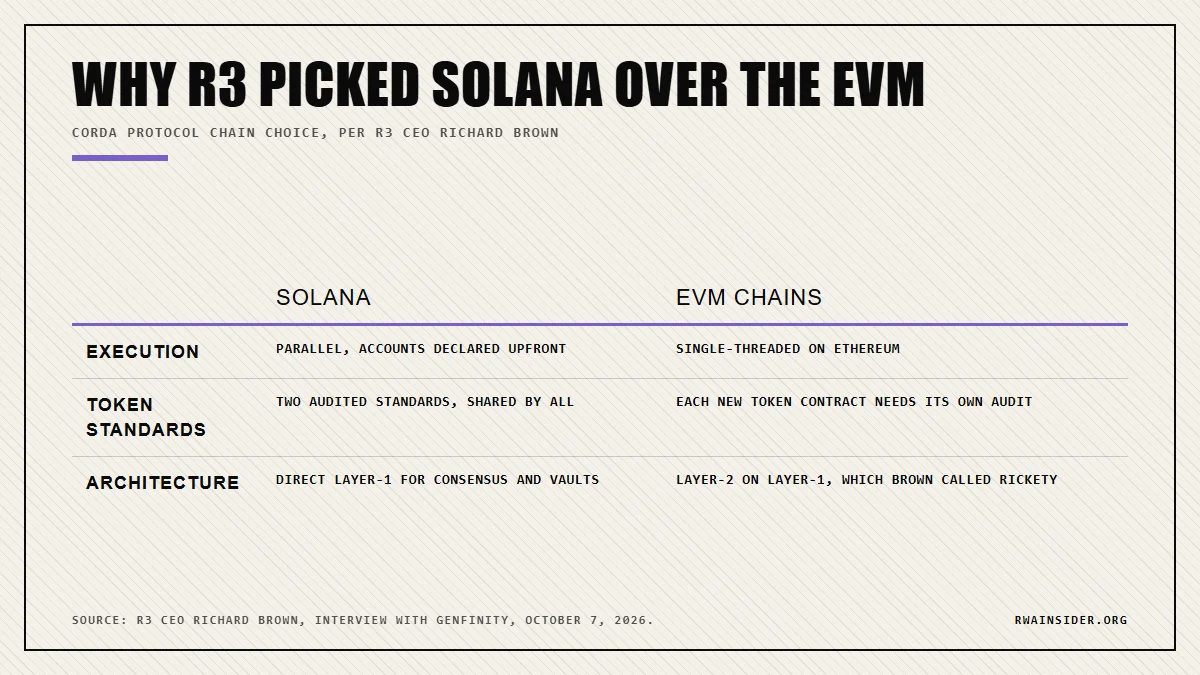
Brown admitted he did not expect Solana to win R3’s evaluation. He assumed R3 would build on the EVM, since nobody gets fired for picking the Solidity stack.
Two needs changed his mind. Corda networks had to plug straight into a layer-1 for consensus, and yield vaults needed a fast one.
A layer-2 sitting on a layer-1 would have made the setup, in Brown’s word, “rickety.”
He also credited Solana’s design. Developers declare upfront which accounts a transaction touches, so validators process thousands of non-conflicting transactions at once.
The catch for your wallet is access. Primary subscription and redemption require KYC, because the underlying funds must know their customer.
R3 is working to make secondary trading permissionless, though Brown said that may not arrive on day one.
That is the same wall that kept Securitize’s KYC-gated CLO fund on Solana out of reach for a $1,000 wallet.
Brown also flagged the trade-off. Putting everything on one shared layer-1 concentrates risk, and he said he does not want to sound utopian.
If R3 opens secondary trading to permissionless wallets, Solana gains a new kind of RWA collateral. Until then, it is a waiting game, and Breakpoint in November will tell.
Watch for the Corda Protocol pre-deposit vault before you plan a stablecoin allocation.
Frequently Asked Questions
What is Corda Protocol and how do its yield vaults work?
Corda Protocol is R3’s on-chain product on Solana. A smart contract holds tokens that represent real-world assets and issues a vault token against them, so holders own a proportional claim on the portfolio. A curator manages each vault, much like a portfolio manager.
Can I buy into an R3 yield vault without KYC?
Not at the primary level. Subscription and redemption require KYC because the underlying funds must know their customer. R3 is working to make secondary trading permissionless, but Brown said that may not arrive on day one.
When does Corda Protocol launch on Solana?
R3 is targeting a full launch ahead of Solana Breakpoint in November, according to Genfinity. The rollout begins with a yield vault built alongside an unnamed top-tier bank, and a pre-deposit vault opens roughly 45 days before launch so users can queue funds.
Why did R3 choose Solana over Ethereum?
Brown said R3 needed a fast layer-1 that existing Corda networks could connect to directly. He pointed to Solana’s parallel transaction processing and its two shared, audited token standards, while each new EVM token contract needs its own audit.