107K Hold ZBCN, But RLUSD Runs Zebec’s Payroll Rails
Key Points
- Zebec’s network counts roughly 107,000 ZBCN holders, yet the payroll moving across its rails settles in Ripple USD, not in the token itself.
- The SuperApp that bundles payroll, bill pay, and treasury tools entered final testing, with a planned release in the second quarter of 2026.
- A $1,000 wallet can buy ZBCN on the secondary market, but Zebec payroll runs on stablecoins, so token exposure stays optional rather than required.
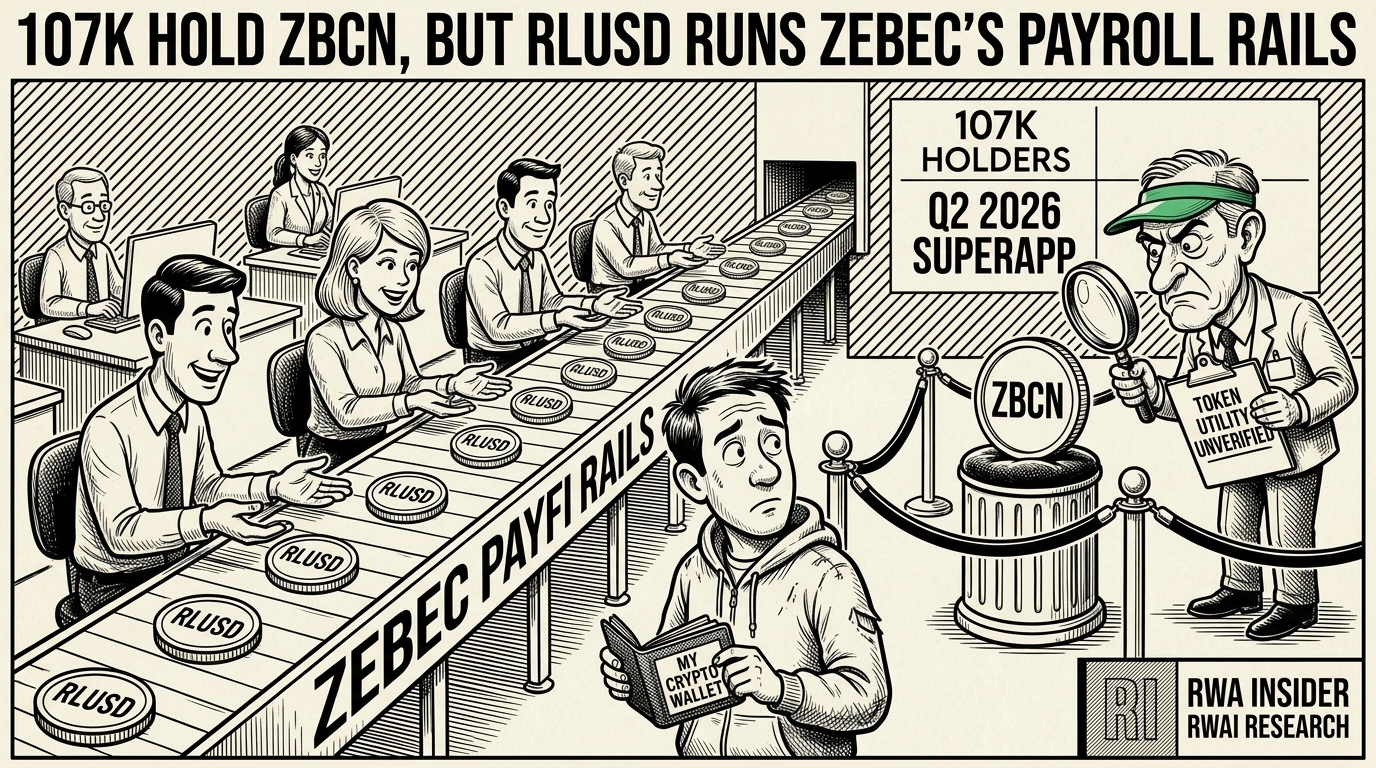
Zebec is marketed to investors as a real-world asset play, yet its own pitch runs on payments rather than tokenized receipts, with roughly 107,000 wallets now holding the ZBCN token. Crypto Daily contributor Sophia Bennett framed the distinction bluntly: “PayFi wins on operations first, token exposure second, and only when governance separates those decisions.” For a wallet holding $1,000, that means the real question is whether ZBCN does anything the stablecoin settling Zebec’s payroll does not.
Why Zebec Settles Payroll In RLUSD, Not ZBCN
Zebec runs what it calls PayFi: programmable, streaming payments that pay wages by the second and release vendor money the moment a contract condition is met.
The pitch is operational, not speculative. Continuous wages cut the lump-sum payroll cycle, and milestone-based releases shrink the reconciliation work that ties up vendor cash.
The headline integration is enterprise payroll settled in Ripple USD, the Ripple-issued stablecoin, moving across Zebec’s rails in near real time.
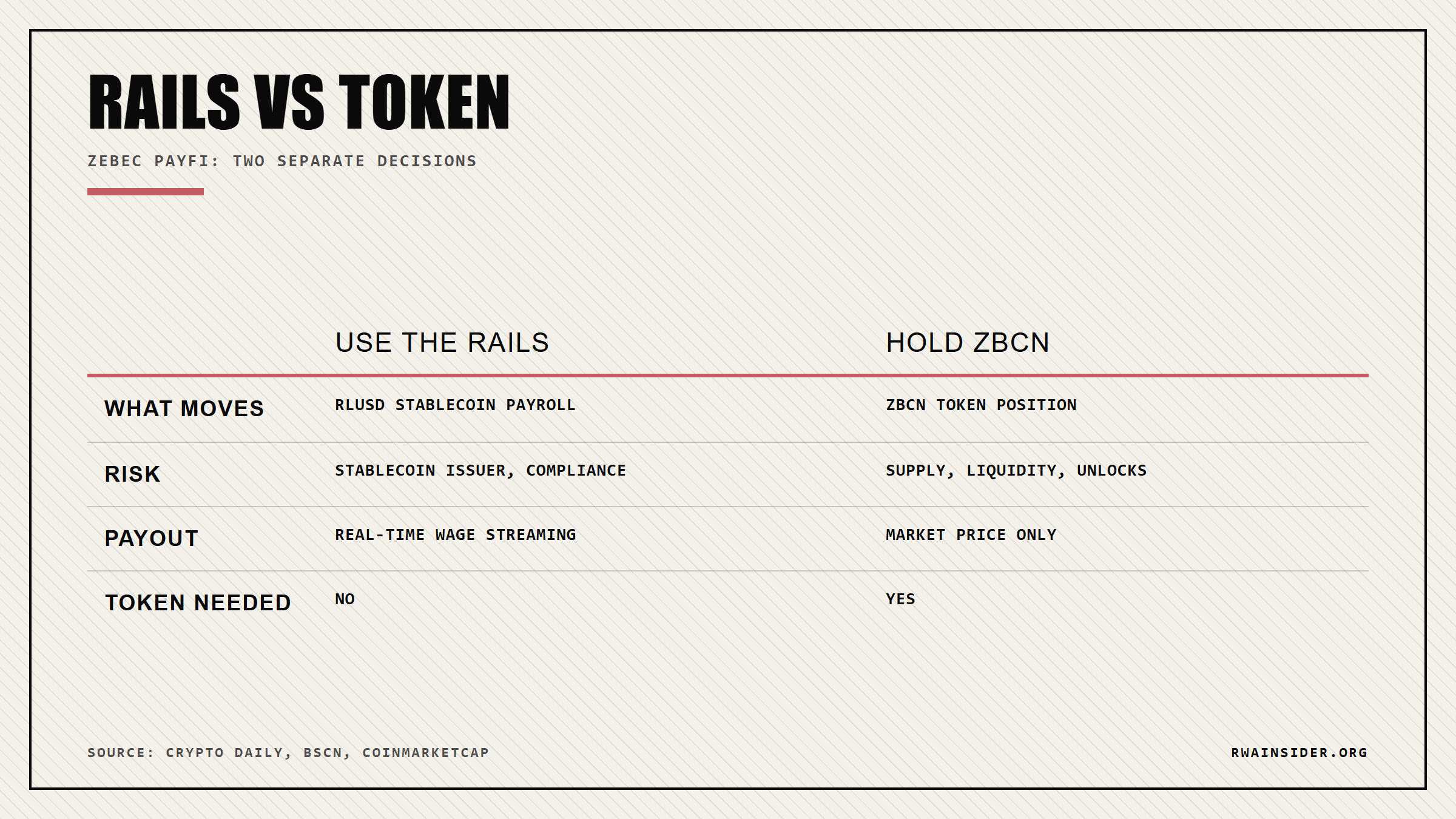
That stablecoin flow is the part a DeFi user can actually inspect on-chain. The token, ZBCN, is the network’s native asset, but the money in those payroll runs is the stablecoin, not ZBCN.
This splits one story into two: a working payments product that already settles real stablecoin volume, and a separate token whose value is harder to verify.
For now, holding ZBCN is a bet on network usage, not a claim on any payroll that crosses the rails.
Where ZBCN’s 107K Holders Fit The Risk Stack
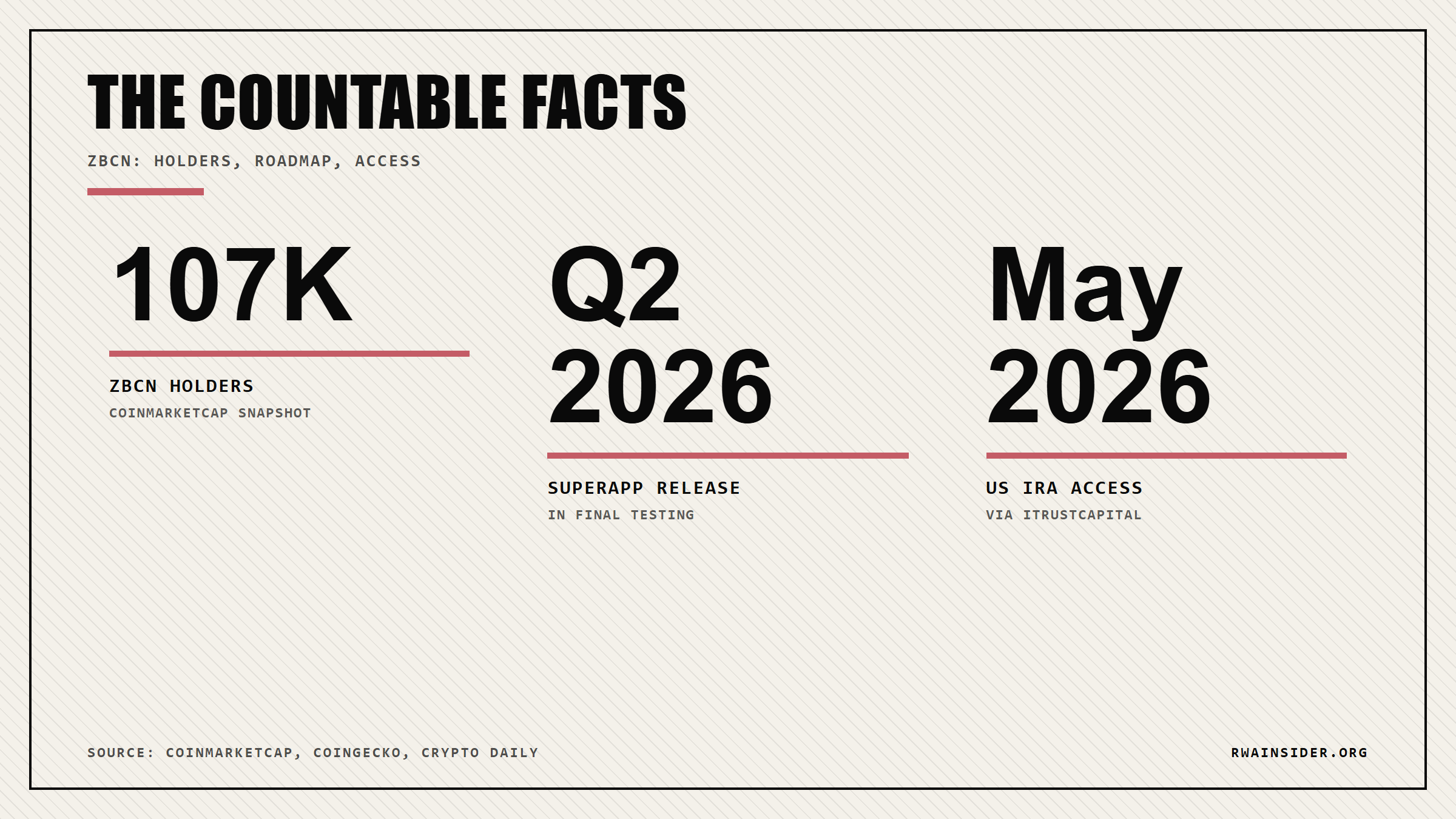
Start with what is countable. CoinMarketCap lists roughly 107,000 ZBCN holders at the time of access.
The SuperApp that bundles payroll, bill pay, and treasury tools is in final testing for a planned second-quarter 2026 release, and US investors got a compliant route through iTrustCapital’s crypto-IRA in May 2026.
None of those numbers is a yield. ZBCN does not pay a Treasury coupon the way a tokenized fund does, and the source is explicit that holders should not assume RWA-style cash flows.
Strip away the press release and this is really about whether network fees and usage, not an underlying asset, can carry the token’s price.
The stablecoin doing the payroll work carries its own issuer and reserve risk, and no holder count offsets that.
Adoption plus distribution, the source argues, can matter as much as the technology, which is why the iTrustCapital listing and the SuperApp rollout get equal billing with the holder count.
A retail buyer comparing ZBCN to a tokenized Treasury is weighing a usage bet against a yield instrument, and only one of them prints a rate.
That contrast is the test we apply when we map how other tokenized plays actually reach a $1,000 wallet.
ZBCN’s Supply Overhang And The RLUSD Dependence
Sophia Bennett, writing for Crypto Daily, argues the operational case has to be ring-fenced from the token case.
Enterprise buyers want certainty on support and controls before they route payroll through a new rail, and that adoption call should sit apart from whether anyone holds ZBCN.
For a token whose value tracks usage, two risks dominate.
The first is supply. Emissions and unlock schedules can pressure price no matter how many payrolls clear, so the vesting calendar matters more than the holder count.
The second is dependence. If Ripple USD is the asset doing the real work, ZBCN’s network thesis partly rides on someone else’s stablecoin staying solvent and liquid.
Access is uneven too. ZBCN trades on the open secondary market for any wallet, while the cleanest US route runs through iTrustCapital’s KYC-gated IRA.
The signal worth tracking is not the next holder milestone but whether real payroll volume keeps climbing once the SuperApp ships, because that, not the token chart, is the proof the thesis needs.
Zebec already moves stablecoin payroll. ZBCN still has to prove it captures any of that value, and that depends on real rail volume after the SuperApp ships, not on the next holder milestone.
Zebec is not the first project to wrap a payments rail in RWA language. Ripple runs the same play at far larger scale, and our look at Ripple’s move to brand its own on-chain trading venue shows how quickly the token-versus-rail line blurs.
Frequently Asked Questions
Is ZBCN actually a real-world asset token?
Not in the usual sense. RWA tokens represent a claim on an off-chain asset, while ZBCN is the native token of Zebec’s PayFi payment network. Its value tracks network usage and fees, not a Treasury, invoice, or other backing asset.
Can I use Zebec payroll without holding ZBCN?
Yes. Organisations can settle payroll in a supported stablecoin such as Ripple USD on Zebec’s rails without taking any ZBCN position. Holding the token is a separate market bet with its own supply and liquidity risk.
How many people hold ZBCN, and where can a US investor buy it?
CoinMarketCap listed roughly 107,000 ZBCN holders at the time of access. US investors were offered a compliant route through iTrustCapital’s crypto-IRA platform in May 2026, though terms and availability can change.
What is the biggest risk in buying ZBCN right now?
Two stand out. ZBCN’s price can be pressured by token emissions and unlock schedules regardless of payroll volume, and the rails lean on Ripple USD, so a stablecoin issuer or liquidity problem would hit the network thesis.